
Symbolator
Symbolator is a component diagramming tool for VHDL and Verilog. It will parse HDL source files, extract components or modules and render them as an image.
library ieee;
use ieee.std_logic_1164.all;

package demo is
  component demo_device is
    generic (
      SIZE : positive;
      RESET_ACTIVE_LEVEL : std_ulogic := '1'
    );
    port (
      --# {{clocks|}}
      Clock : in std_ulogic;
      Reset : in std_ulogic;

      --# {{control|Named section}}
      Enable : in std_ulogic;
      Data_in : in std_ulogic_vector(SIZE-1 downto 0);
      Data_out : out std_ulogic_vector(SIZE-1 downto 0)
    );
  end component;
end package;
> symbolator -i demo_device.vhdl
Scanning library: .
Creating symbol for demo_device.vhdl "demo_device"
-> demo_device-demo_device.svg
Produces the following:
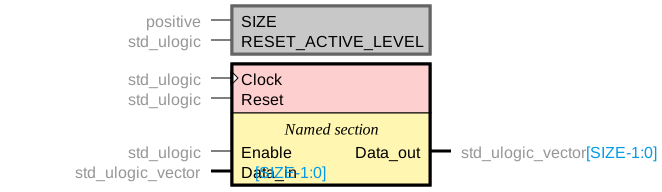
Symbolator can render to PNG bitmap images or SVG, PDF, PS, and EPS vector images. SVG is the default.
Requirements
Symbolator requires either Python 2.7 or Python 3.x, Pycairo, and Pango.
The installation script depends on setuptools. The source is written in Python 2.7 syntax but will convert cleanly to Python 3 when the installer passes it through 2to3.
The Pango library is used compute the dimensions of a text layout. There is no standard package to get the Pango Python bindings installed. It is a part of the Gtk+ library which is accessed either through the PyGtk or PyGObject APIs, both of which are supported by Symbolator. You should make sure that one of these libraries is available before installing Symbolator. A Windows installer is available. For Linux distributions you should install the relevant libraries with your package manager.
Licensing
Symbolator is licensed for free commercial and non-commercial use under the terms of the MIT license. The Symbolator Sphinx extension is derived from the Graphviz extension and is BSD licensed.
Download
You can access the Symbolator Git repository from Github. You can install direct from PyPI with the “pip” command if you have it available.
Documentation
The full documentation is available online at the main Symbolator site.
1 maintainer

Metadata
1 maintainer
Release files for symbolator 1.0.2
For a detailed explanation of source distributions (sdists) and built distributions (wheels), please see the package formats documentation.
Source distribution (sdist)
| File | Size | Uploaded | Provenance | Actions |
|---|---|---|---|---|
| symbolator-1.0.2.tar.gz | 30.7 kB | Without provenance | Details for symbolator-1.0.2.tar.gz |
Release files / symbolator-1.0.2.tar.gz
| Download URL | symbolator-1.0.2.tar.gz |
|---|---|
| Size | 30.7 kB |
| Tags | Source |
|
SHA-256 checksum How to use checksums |
cb25c11443536bdd9a998ed2245e143c406591b96ed236d2f2c43941f566752a
|
|
BLAKE2b-256 checksum How to use checksums |
8c8c4724beab5dff521e4d994a24776dfda7aedef202530b991b530c424f2f08
|
| Upload date | |
|
Uploaded using Trusted Publishing? What is trusted publishing? |
No |
Security for symbolator 1.0.2
Provenance
Provenance describes where a file came from. On PyPI, provenance is shared via attestations, which provide a verifiable record of the build or publishing details. View details, limitations and caveats.
No provenance found
None of the files in this release were uploaded with provenance metadata.
A note on package security
PyPI is a repository for distributing packages, not a service for auditing them. While third-party security researchers and our staff do their best to detect and remove malicious packages, PyPI cannot guarantee the quality, security or suitability of any given package.
To learn more about protecting yourself from malicious actors, visit our package security documentation.














