
docker2mqtt - Deliver docker status information over MQTT




This program uses docker events to watch for changes in your docker containers, and docker stats for metrics about those containers, and delivers current status to MQTT. It will also publish Home Assistant MQTT Discovery messages so that (binary) sensors automatically show up in Home Assistant.
This is part of a family of similar tools:
Installation and Deployment
It is available as python package on pypi/docker2mqtt or as a docker image on ghcr.io/docker2mqtt.
Pypi package

pip install docker2mqtt
docker2mqtt --name MyDockerName --events -vvvvv
Usage
from docker2mqtt import Docker2Mqtt, DEFAULT_CONFIG

cfg = Docker2MqttConfig({
  **DEFAULT_CONFIG,
  "host": "mosquitto",
  "enable_events": True
})

try:
  docker2mqtt = Docker2Mqtt(cfg)
  docker2mqtt.loop_busy()

except Exception as ex:
  # Do something
Docker image



Use docker to launch this. Please note that you must give it access to your docker socket, which is typically located at /var/run/docker.sock. A typical invocation is:
docker run --network mqtt -e MQTT_HOST=mosquitto -v /var/run/docker.sock:/var/run/docker.sock ghcr.io/miaucl/docker2mqtt
You can also use docker compose:
services:
  docker2mqtt:
    container_name: docker2mqtt
    image: ghcr.io/miaucl/docker2mqtt
    environment:
      - DOCKER2MQTT_HOSTNAME=my_docker_host
      - MQTT_HOST=mosquitto
      - MQTT_USER=username
      - MQTT_PASSWD=password
      - EVENTS=true
      - STATS=true
    restart: unless-stopped
    volumes:
      - /var/run/docker.sock:/var/run/docker.sock:ro
Default Configuration
You can use environment variables to control the behavior.
| Config | Env Variable | Default | Description |
|---|---|---|---|
log_level |
LOG_LEVEL |
4 |
Set to DEBUG=5,INFO=4,WARN=3,ERROR=2,CRITICAL=1 to enable different levels of verbosity. |
log_dir |
LOG_DIR |
`` | Set path to for additional logging to file. |
docker2mqtt_hostname |
DOCKER2MQTT_HOSTNAME |
docker2mqtt Container Hostname | The hostname of your docker host. This will be the container's hostname by default, you probably want to override it. |
discovery |
DISCOVERY |
homeassistant |
The discovery platforms supported (comma-separated list for ENV and multiple args for cli). Currently only home assistant is implemented. Set to empty string or empty argument for no discovery. |
homeassistant_prefix |
HOMEASSISTANT_PREFIX |
homeassistant |
The prefix for Home Assistant discovery. Must be the same as discovery_prefix in your Home Assistant configuration. |
homeassistant_single_device |
HOMEASSISTANT_SINGLE_DEVICE |
false |
Group all entities by a single device in Home Assistant instead of one device per entity. |
mqtt_client_id |
MQTT_CLIENT_ID |
mqtt2discord |
The client id to send to the MQTT broker. |
mqtt_host |
MQTT_HOST |
localhost |
The MQTT broker to connect to. |
mqtt_port |
MQTT_PORT |
1883 |
The port on the broker to connect to. |
mqtt_user |
MQTT_USER |
The user to send to the MQTT broker. Leave unset to disable authentication. | |
mqtt_password |
MQTT_PASSWD |
The password to send to the MQTT broker. Leave unset to disable authentication. | |
mqtt_timeout |
MQTT_TIMEOUT |
30 |
The timeout for the MQTT connection. |
mqtt_topic_prefix |
MQTT_TOPIC_PREFIX |
docker |
The MQTT topic prefix. With the default data will be published to docker/<hostname>. |
mqtt_qos |
MQTT_QOS |
1 |
The MQTT QOS level |
container_whitelist |
CONTAINER_WHITELIST |
Define a whitelist for containers to consider, if empty, everything is monitored. The entries are either match as literal strings or as regex. | |
container_blacklist |
CONTAINER_BLACKLIST |
Define a blacklist for containers to consider, takes priority over whitelist. The entries are either match as literal strings or as regex. | |
destroyed_container_ttl |
DESTROYED_CONTAINER_TTL |
86400 |
How long, in seconds, before destroyed containers are removed from Home Assistant. Containers won't be removed if the service is restarted before the TTL expires. |
stats_record_seconds |
STATS_RECORD_SECONDS |
30 |
The number of seconds to record state and make an average |
enable_events |
EVENTS |
<none> |
Set to enable and leave out to disable processing events |
enable_stats |
STATS |
<none> |
Set to enable and leave out to disable processing statistics |
Consuming The Data
Data is published to the topic docker/<DOCKER2MQTT_HOSTNAME>/<container>/events using JSON serialization. It will arrive whenever a change happens and its type can be inspected in type_definitions.py or the documentation.
Data is also published to the topic docker/<DOCKER2MQTT_HOSTNAME>/<container>/stats using JSON serialization. It will arrive every STATS_RECORD_SECONDS seconds or so and its type can be inspected in type_definitions.py or the documentation.
Home Assistant
Once docker2mqtt is collecting data and publishing it to MQTT, it's rather trivial to use the data in Home Assistant.
A few assumptions:
- Home Assistant is already configured to use a MQTT broker. Setting up MQTT and HA is beyond the scope of this documentation. However, there are a lot of great tutorials on YouTube. An external broker (or as add-on) like Mosquitto will need to be installed and the HA MQTT integration configured.
- The HA MQTT integration is configured to use
homeassistantas the MQTT autodiscovery prefix. This is the default for the integration and also the default fordocker2mqtt. If you have changed this from the default, use the--prefixparameter to specify the correct one. - You're not using TLS to connect to the MQTT broker. Currently
docker2mqttonly works with unencrypted connections. Username / password authentication can be specified with the--usernameand--passwordparameters, but TLS encryption is not yet supported.
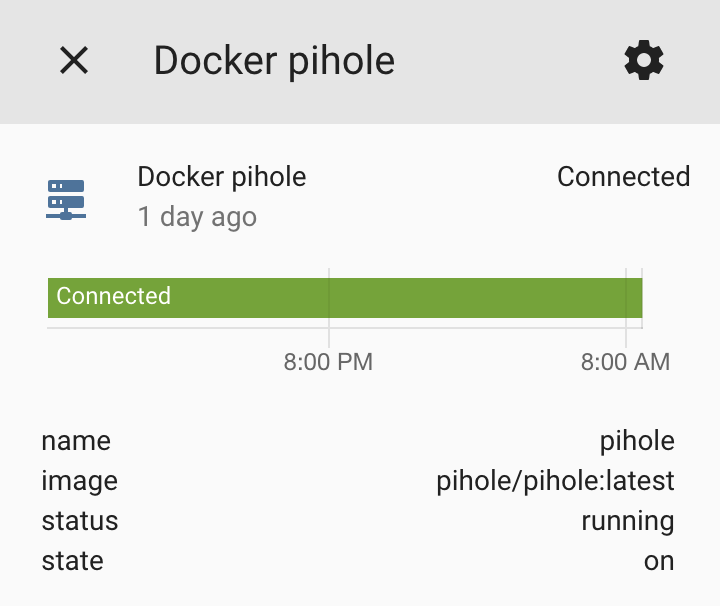
After you start the service (binary) sensors should show up in Home Assistant immediately. Look for sensors that start with (binary_)sensor.docker. Metadata about the container will be available as attributes for events, which you can then expose using template sensors if you wish.
Logging
docker2mqtt can log to a directory in addition to the console using the --logdir parameter. The specified directory can be absolute or relative and is created if it doesn't exist. The verbosity parameter applies to file logging and the log file size is limited to 1M bytes and 5 previous files are kept.
docker2mqtt --name Server1 -vvvvv --logdir /var/log/docker2mqtt/
Documentation
Using mkdocs, the documentation and reference is generated and available on github pages.
Dev
Setup the dev environment using VSCode, it is highly recommended.
python -m venv .venv
source .venv/bin/activate
pip install -r requirements_dev.txt
Install pre-commit
pre-commit install

# Run the commit hooks manually
pre-commit run --all-files
Following VSCode integrations may be helpful:
A final version can only be released from the master branch. To pass the gates of the publish workflow, the version must match in both the tag and docker2mqtt/__init__.py.
To release a prerelease version, it must be done from a feature branch (not master). Prerelease versions are explicitly marked as such on the GitHub release page.
Credits
This is a detached fork from the repo https://github.com/skullydazed/docker2mqtt, which does not seem to get evolved anymore.
CHANGELOG
DEPRECATED
This changelog is no longer maintained and will not be updated in future releases. Please refer to the release notes on GitHub for the latest changes.
2.2.0
- Add option to group all entities into a single device in home assistant
2.1.0
- Update version package identifier and bump setuptools
- Fix mypy setup
2.0.5
- Re-release due to bad deploy pipeline
2.0.4
- Update the discovery jsons for home assistant
2.0.3
- Transform the mqtt port cli arg to int as a str is not accepted by the paho.mqtt library
- Fix the container filter not only at startup but also at runtime
2.0.2
- Add version cli options to display package version
- Separate the entrypoints for cli (using cli arguments) and docker (using env vars)
2.0.1
- Fix white- and blacklist config via docker env where and empty string resulted in a pass-all regex overwriting the blacklist.
2.0.0
- Rework of the complete structure, but no functional changes.
1 maintainer

Metadata
1 maintainer
Release files for docker2mqtt 2.6.1
For a detailed explanation of source distributions (sdists) and built distributions (wheels), please see the package formats documentation.
Source distribution (sdist)
| File | Size | Uploaded | |
|---|---|---|---|
| docker2mqtt-2.6.1.tar.gz | 28.2 kB | Details |
Built distribution (wheel)
| File | Interpreter | ABI | Platform | Reset |
|---|---|---|---|---|
| docker2mqtt-2.6.1-py3-none-any.whl | Python 3 | none | any | Details |
Total release size: 53.0 kB
Release files / docker2mqtt-2.6.1.tar.gz
| Download URL | docker2mqtt-2.6.1.tar.gz |
|---|---|
| Size | 28.2 kB |
| Tags | Source |
|
SHA-256 checksum How to use checksums |
0a1919604eba471ec0a8d899f9d6053a3ef2b91cea281c9288e2db8d6352ec1b
|
|
BLAKE2b-256 checksum How to use checksums |
2524b1d5dfd01716115f122b9be49eb2030d83e373f0cbe905cbecd6f0b709b8
|
| Upload date | |
|
Uploaded using Trusted Publishing? What is trusted publishing? |
Yes |
| Uploaded via |
twine/6.1.0 CPython/3.13.12
|
Provenance
Provenance describes where a file came from. On PyPI, provenance is shared via attestations, which provide a verifiable record of the build or publishing details. View details, limitations and caveats.


PyPI Publish Attestation
PyPI verified that this artifact, at this checksum, originated from the publisher listed below.
Signed by GitHub Actions, verified by PyPI on May 3, 2026.
Transparency logRelease files / docker2mqtt-2.6.1-py3-none-any.whl
| Download URL | docker2mqtt-2.6.1-py3-none-any.whl |
|---|---|
| Size | 24.8 kB |
| Tags | Python 3 |
|
SHA-256 checksum How to use checksums |
94efb1c199211d40ef1659689bbb1cae02471d0a9ba385b4d1c62caa7ba0ec82
|
|
BLAKE2b-256 checksum How to use checksums |
9e8a348a554e2b87a119476323042e9442b31be5fe47fd42a01bfe826c4ab734
|
| Upload date | |
|
Uploaded using Trusted Publishing? What is trusted publishing? |
Yes |
| Uploaded via |
twine/6.1.0 CPython/3.13.12
|
Provenance
Provenance describes where a file came from. On PyPI, provenance is shared via attestations, which provide a verifiable record of the build or publishing details. View details, limitations and caveats.
PyPI Publish Attestation
PyPI verified that this artifact, at this checksum, originated from the publisher listed below.
Signed by GitHub Actions, verified by PyPI on May 3, 2026.
Transparency log













