
Finite difference time domain simulation (for slit diffraction)

Project description
AK FDTD
version=0.1
author Alexander V. Korovin [a.v.korovin73@gmail.com], Homepage
Overview
AK FDTD is a Python package designed for simple finite difference time domain (FDTD) simulation in open space. It allows you to test slit diffraction.
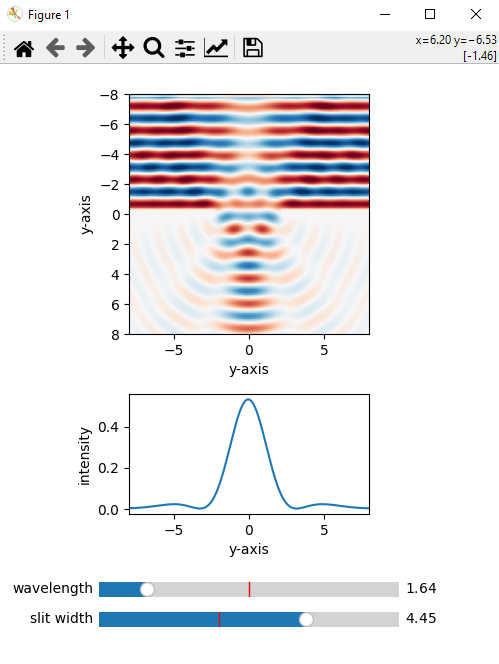
An example of light diffraction on a slit located in the center of the computational domain. Light falls on a screen with a slit from above (the speed of light is taken as unity). The intensity graph is a time-averaged square of the field.
Features
- PML: implementation of perfectly matched boundary layers.
Installation
You can install AKFDTD using pip. To install the latest version from PyPI, use:
pip install AKFDTD
Work with object
-
EM2D(Lx, Ly, Nx, Ny, wavelength): initialization of the simulator object, where Lx is the x dimension of the simulation domain, Ly is the y dimension of the simulation domain, Nx is the number of sampling points along the x axis, Ny is the number of sampling points along the y axis, wavelength is the wavelength of the incoming plane wave.
-
.add_slit(slit_width, slit_height, slit_position)(optional): method for adding single slit with a width, slit_width, where slit_height is the screen thickness, slit_position is the y-position of the screen (default is slit_height=0.5, slit_position=0).
-
.start(N_cycles)(optional): method for performing N_cycles simulation cycles necessary to avoid observing the wave start from above.
-
.update(): method of updating fields over time (one simulation cycle).
-
.get_x(show_PML): method to get x coordinates with or without PML region (default is show_PML=False).
-
.get_y(show_PML): method to get y coordinates with or without PML region (default is show_PML=False).
-
.get_Ez(show_PML): method for obtaining the z-component of the electric field with or without the PML region (default is show_PML=False).
Test
from FDTD.fdtd2D import EM2D
import matplotlib.pyplot as plt
from matplotlib.animation import FuncAnimation
from matplotlib.widgets import Slider


if __name__ == "__main__":
    # display PML region
    show_PML = False

    # display of the field distribution along the center of the calculation area
    show_xy = False
    # show_xy = True

    # incoming plane wave wavelength
    wavelength_init = 3
    # slit width
    slit_width_init = 3

    # create FDTD domain and initialize fields
    fields = EM2D(Lx=20., Ly=20., Nx=200, Ny=201, wavelength=wavelength_init)
    fields.add_slit(slit_width_init)

    # # Initial condition: sinusoidal wave
    # if True:
    if False:
        # Initial condition: sinusoidal wave
        N_cycles = 1
        x_init = -0.5
        fields.init_fields()
        fields.init_wave(x_init)
    else:
        N_cycles = 500
        fields.start(N_cycles)

    # create a matplotlib window to display the 2D field distribution, the output field intensity,
	# and two sliders (for wavelength and for slit width)
    fig, (ax1, ax2) = plt.subplots(2, 1, figsize=(5, 6))

    x = fields.get_x(show_PML)
    y = fields.get_y(show_PML)
    im1 = ax1.imshow(fields.get_Ez(show_PML), extent=(x.min(), x.max(), y.max(), y.min()),
                     cmap='RdBu', origin='upper', vmin=-2, vmax=2)
    # cax = fig.colorbar(im1, ax=ax1)
    # Add a title and labels
    ax1.set_xlabel('y-axis')
    ax1.set_ylabel('y-axis')

    if show_xy:
        im2, = ax2.plot(fields.x, abs(fields.Ez[:, fields.Ny // 2 + 0 * (fields.pml_width + 2)]))
    else:
        im2, = ax2.plot(y, fields.get_out_intensity(show_PML))
        ax2.set_xlim(y.min(), y.max())
    # ax2.set_ylim(0, 1.6)
    ax2.set_xlabel('y-axis')
    ax2.set_ylabel('intensity')

    ax1.set_position([0.1, 0.55, 0.8, 0.4])  # [left, bottom, width, height]
    out = ax1.get_position()
    ax2.set_position([out.x0, 0.25, out.x1 - out.x0, 0.2])

    # Create a slider axis and slider widget
    slider_ax1 = plt.axes([0.2, 0.1, 0.6, 0.05], facecolor='lightgoldenrodyellow')
    slider_ax2 = plt.axes([0.2, 0.05, 0.6, 0.05], facecolor='lightgoldenrodyellow')
    wavelength_slider = Slider(slider_ax1, 'wavelength', 1., 5.0, valinit=wavelength_init)
    slitwidth_slider = Slider(slider_ax2, 'slit width', 1., 6., valinit=slit_width_init)

    # Time-stepping loop
    def update(n):
        fields.update()

        if fields.n_step % 10 == 0:
            # Update the image data
            im1.set_data(fields.get_Ez(show_PML))
            if show_xy:
                im2.set_ydata(abs(fields.Ez[:, fields.Ny // 2 + 0 * (fields.pml_width + 2)]))
            else:
                im2.set_ydata(fields.get_out_intensity(show_PML))
            ax2.relim()  # Recalculate limits based on new data
            ax2.autoscale_view()  # Rescale the view

        # return [im1, im2]

    # Update functions for slider
    def slider_update_wavelength(val):
        fields.set_wavelength(wavelength=val)
        fields.start(N_cycles)

    def slider_update_slit_width(val):
        fields.add_slit(slit_width=val)
        fields.start(N_cycles)

    # Connect the slider to the update function
    wavelength_slider.on_changed(slider_update_wavelength)
    slitwidth_slider.on_changed(slider_update_slit_width)

    # Animation setup
    ani = FuncAnimation(fig, update, frames=100, interval=10)

    # display matplotlib plot
    plt.show()
Release history Release notifications | RSS feed


Download files
Download the file for your platform. If you're not sure which to choose, learn more about installing packages.
Source Distribution
Built Distribution
Filter files by name, interpreter, ABI, and platform.
If you're not sure about the file name format, learn more about wheel file names.
Copy a direct link to the current filters
File details
Details for the file AKFDTD-0.1.11.tar.gz.
File metadata
- Download URL: AKFDTD-0.1.11.tar.gz
- Upload date:
- Size: 92.7 kB
- Tags: Source
- Uploaded using Trusted Publishing? No
- Uploaded via: twine/5.1.1 CPython/3.8.10
File hashes
| Algorithm | Hash digest | |
|---|---|---|
| SHA256 |
c0eaacaf248d1db6d500d2c743d6ea2efc26c4e6897d59e04622fa09234d005d
|
|
| MD5 |
f22c643fb642090afcff62c93a8d2e66
|
|
| BLAKE2b-256 |
3f10b46236761d897abee6294a8080556983d17c95070c5357408482ba6580a3
|
File details
Details for the file AKFDTD-0.1.11-py3-none-any.whl.
File metadata
- Download URL: AKFDTD-0.1.11-py3-none-any.whl
- Upload date:
- Size: 8.0 kB
- Tags: Python 3
- Uploaded using Trusted Publishing? No
- Uploaded via: twine/5.1.1 CPython/3.8.10
File hashes
| Algorithm | Hash digest | |
|---|---|---|
| SHA256 |
5b86afafecf845fcca95e287beb8e03fc251be22a41636f3b4a54601372727de
|
|
| MD5 |
731d01e4d073c450d5b7662c17e50b7b
|
|
| BLAKE2b-256 |
9e2e2c2f8e9834e3bc607d7dcc1487517943fcfab52024b457a8daa433dd2ad3
|






