
AstroVista Lite



Website, tutorial and screenshots: https://ekourkchi.github.io/AstroVista-Lite/
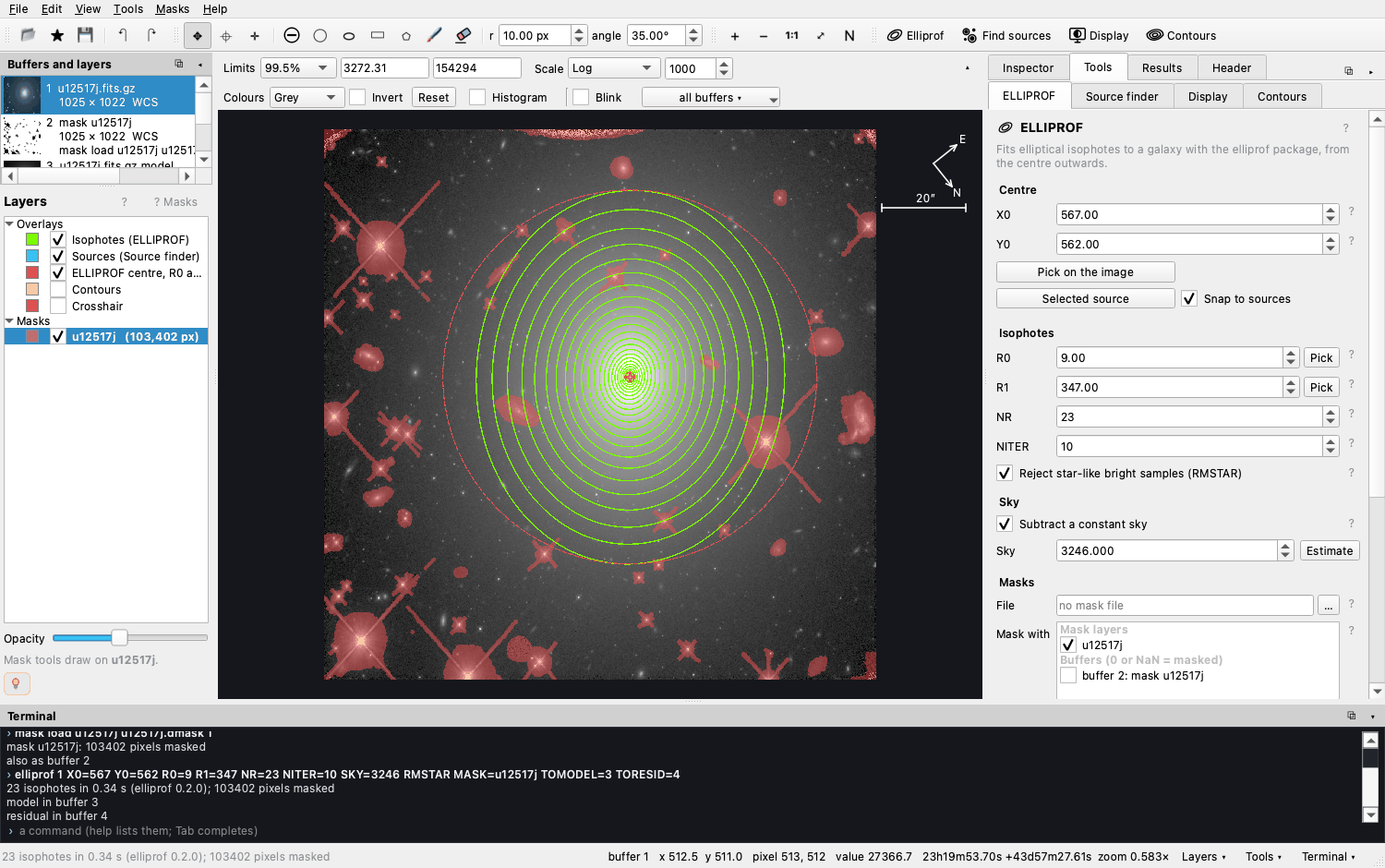
The lite edition of AstroVista, an astronomical image analysis studio in development: simple enough for students and classrooms, useful for everyday work. In one window:
- ELLIPROF isophote fitting of galaxies, through the
elliprofpackage: the profile table and plots, the isophotes drawn on the image, and the model and residual images. - The Source finder: the stars and galaxies in the image, measured (position, shape, flux, magnitude, size) and drawn on the image, with a sortable catalogue, plots, numbered runs and the segmentation image. The model, residual and segmentation images go into the buffers chosen (only free buffers are offered unless asked otherwise).
- For teaching: a welcome screen; built-in documentation, Help ▸ Documentation (F1), with a First lesson (about thirty minutes on the example galaxy), recipes, image arithmetic in detail, a FAQ, troubleshooting and every command; a ? next to each tool and each setting, all explained in Help ▸ Documentation ▸ Every setting explained; Help ▸ Tips and Help ▸ About.
- Panels are resized by dragging their edges, folded to a narrow strip with the button in their title bar (or a double-click on it, or the buttons in the status bar), and popped out as windows of their own (⧉) for another monitor, then put back (⤓); each panel docks only in its own place. View ▸ Reset the layout restores the standard layout.
- The galaxy's centre from the sources: pick it on the image (a click inside a source snaps to its centre), or double-click a source in the table.
- Layers: isophotes, sources, the ELLIPROF centre (a small cross) with R0 and R1, contours, a crosshair, and any number of mask layers: each shown or hidden and in its own colour (click its colour box); masks with their own opacity. The compass and scale bar are always shown (for images with a WCS).
- The crosshair follows the mouse while its tool (or its layer) is on, and stays where it is when another tool is chosen; Alt with the arrow keys nudges it. The Inspector shows the pixels around it.
- Masks: drawn with circle, ellipse, box, polygon and brush tools, and an eraser (Alt or Shift
unmasks; an ellipse, box or polygon can be moved, resized and rotated before it is applied; Ctrl-click, ⌘-click on macOS, removes the masked patch under the cursor);
made from the found sources (all, the selected one, or those matching a condition
such as
MAG_AUTO < 20), from their segmentation (grown), from non-finite pixels or a range of values, from a buffer, or loaded from FITS and legacy.dmaskfiles; grown, shrunk, inverted, combined (union, intersection), copied, renamed, saved and deleted, with undo and redo (right-click the Layers panel). The ticked layers, and any image buffer used as a mask (where it is 0 or NaN), are masked in the fit. - Arithmetic on images, as in the full AstroVista:
[3] = [1] - [2],[4] = median([1], [2], [3]),[5] = [1] - median([1]),[6] = div([1], [2], 0),[7] = [1] * mymask(a mask layer: NaN where it masks), comparisons,where,clipand the usual functions (help calc). - A terminal: every action that changes data is a command, echoed as it runs,
which can be typed, repeated, saved and run again from a file;
lslists in colour, with folders and FITS files one click away. Programs on the PATH run there too (ls -l,ll,grep ...;!forces the shell; Ctrl+C stops one). The Terminal button in the status bar folds or unfolds it. Tab completes commands, keywords, mask names, buffers and file names. - Files: FITS images are recognised by their contents, whatever they are called
(gzip-compressed too); one image of a multi-extension file opens as
name.fits[sci],[1]or[sci,2](fitsinfolists them); File ▸ Open recent; legacy BITPIX = 1.dmaskbitmaps open as mask layers. - Profiles: the ELLIPROF profile plotted against R or R¼, with the de Vaucouleurs law fitted and over-plotted (Re, Ie, and the scatter about the law).
- Contours, their own tool with DS9's settings: the number of levels, the scale and limits they are spread over (or the display's), the smoothing (Gaussian or block), the editable list of values, and the line colour, width and dashes.
- The Inspector (the first tab of the right-hand panel, beside Tools): the pixel under the cursor, its value and sky position, a magnified view in the display's colours, and the statistics around it.
- The display: limits from percentiles, ZScale, ZMax, min-max or typed, or dragged on the histogram; linear, log, power, square-root, squared, asinh, sinh and histogram-equalised stretches; twelve colour maps, inverted if wanted; contrast and bias (drag with the right mouse button); a colour bar; zoom, 1:1, North up, rotation and mirroring; Go to a pixel or RA/Dec; the histogram and blinking (← and → between the buffers chosen, with the same scale if wanted) switched on in the display bar above the image, which folds away for more room; the FITS header.
AstroVista Lite is published on PyPI as AstroVista (pip install AstroVista;
pip install astrovista is the same, since PyPI ignores capitals). The full AstroVista will
follow there when it is ready.
Installing
pip install AstroVista
astrovista --example        # the UGC 12517 example, shipped with the package
astrovista image.fits       # or your own images
astrovista -i galaxy.fits other.fits -m galaxy.dmask   # images into buffers 1, 2; a mask layer
-i loads images into the buffers in the order given (name.fits[sci] picks one image
of a file) and -m loads masks (FITS or .dmask, 0 = masked) as mask layers, ticked for
the fit; both can be repeated. astrovista --help lists every option.
AstroVista Lite is on PyPI for Linux and macOS (Python 3.10 or later; on Linux,
glibc on x86_64 or aarch64). Everything needed comes with pip install; there is nothing
else to install. The commands astrovista, astro-vista and astrovista-lite are the
same program, and so is python -m astro_vista.
A virtual environment keeps it apart from other Python programs:
python3 -m venv ~/astrovista-env
source ~/astrovista-env/bin/activate
pip install AstroVista
On Linux, the window is drawn by Qt, which needs a few libraries every desktop already has. On a minimal system (a fresh server, WSL or a container) where Qt reports that it could not load the Qt platform plugin "xcb", install them:
sudo apt install libxcb-cursor0 libxkbcommon-x11-0 libegl1 libgl1 libfontconfig1 libdbus-1-3   # Debian, Ubuntu
sudo dnf install xcb-util-cursor libxkbcommon-x11 mesa-libEGL mesa-libGL fontconfig dbus-libs  # Fedora, RHEL
The example
examples/u12517 holds the example image, its .dmask mask and
session.txt, the commands that reproduce elliprof's published fit:
cd examples/u12517
astrovista --run session.txt
The same image and mask ship inside the package, for astrovista --example.
Commands
rd 1 galaxy.fits[sci]              read an image (an HDU number or name) into buffer 1
sources 1 DETECT_THRESH=2.5        find the sources (stars and galaxies)
centre 1 SOURCE=12                 ELLIPROF's centre from a found source
mask new mymask 1                  a mask layer the size of buffer 1
mask sources mymask SCALE=1.5      mask the sources, except the galaxy at the centre
mask circle mymask 812 440 12      mask a circle (ERASE unmasks)
mask sources mymask WHERE='FWHM_IMAGE < 3'
mask grow mymask 2                 grow it by 2 pixels; undo takes it back
sky 1 MASK=mymask                  a clipped median of the pixels left
elliprof 1 X0=567 Y0=562 R0=9 R1=347 NR=23 MASK=mymask TOMODEL=3 TORESID=4
[4] = [1] - [2]                    arithmetic on buffers
wd 3 residual.fits                 write a buffer
run session.txt                    run a file of commands
Image commands in the style of VISTA and MONSTA, written for AstroVista Lite with NumPy and
SciPy: ac sc mc dc, ai si mi di, log ln sqrt inverse round, mn max min abx print,
shift rotate flip bin mash, smooth filt zap clip skysub, fft noise gauss, ch chead, and variables (set xc=567, then X0=xc in any command).
help lists them all, and help mask the mask commands. The website explains
how the terminal works (how a
line is written, buffers, coordinates, variables, programs, the keyboard, command files)
and gives the
full command reference: every
command with its keywords and an example. Both are also in Help ▸ Documentation.
Using it
- File ▸ Open example loads an HST image of UGC 12517 and its mask with the parameters of elliprof's published example. Press Fit isophotes. X0, Y0, R0 and R1 can be picked on the image.
- The Source finder tab finds the sources. Click a source on the image, or a row in the Sources table, to select it.
- In the ELLIPROF tab, pick the centre on the image (it snaps to a found source), and Mask the found sources makes a mask layer of every other source. The mask tools (circle, box) add to the mask chosen in the Layers list; Shift unmasks.
- File ▸ Export writes the profile (CSV), the isophotes (DS9 regions), the sources (CSV, comma separated with every column aligned; also Save CSV… in Results ▸ Sources) and the profile and source plots as PNG figures made with matplotlib (also Save PNG… beside each plot); File ▸ Save the commands writes the session as a command file.
Coordinates: X0, Y0 and the mask commands use ELLIPROF's coordinates, in which the first pixel spans 0 to 1 (its centre is at 0.5). The status bar shows these, the pixel's column and row (from 1), its value and its sky coordinates.
Tests
pip install -e '.[test]'
pytest -q
Licence
MIT (see LICENSE). The libraries it installs keep their own licences, listed
under Credits.
Citing
If AstroVista Lite helps your work or your teaching, please cite its GitHub repository:
Kourkchi, E., AstroVista Lite, https://github.com/ekourkchi/AstroVista-Lite
(GitHub's "Cite this repository" button gives the same from CITATION.cff.)
For the measurements, please also cite elliprof (isophotes), and SEP and SExtractor (the
Source finder), listed below.
Credits
AstroVista Lite is by Ehsan Kourkchi.
John Tonry. ELLIPROF, the isophote fitting at the heart of AstroVista Lite, was originally developed by John Tonry as part of MONSTA; it is used here through the elliprof package, which compiles his original code unchanged. The terminal follows the command language of MONSTA, John Tonry's image analysis and plotting system, which joined Vista (originally by Richard Stover and Tod Lauer, with image display by John Tonry) and Mongo (by John Tonry). The commands of AstroVista Lite are new code written in that style.
It is built on:
- elliprof: John Tonry's ELLIPROF as a Python package (github.com/ekourkchi/elliprof; the package is MIT, the original ELLIPROF sources keep their own terms).
- SEP (Source Extraction and Photometry), by Kyle Barbary and contributors (github.com/sep-developers/sep, LGPL-3.0): K. Barbary 2016, Journal of Open Source Software 1(6), 58. The Source finder uses it.
- SExtractor, whose algorithms SEP implements: E. Bertin & S. Arnouts 1996, Astronomy & Astrophysics Supplement Series 117, 393. Please cite SEP and SExtractor when you publish measurements from the Source finder.
- Qt for Python (PySide6, LGPL), pyqtgraph (MIT), matplotlib (the PNG figures; matplotlib licence, BSD-style), NumPy, SciPy and Astropy (BSD).
- The example image of UGC 12517 (Hubble Space Telescope, WFC3/IR, F110W) and its mask come from the elliprof package's example.
- The command language follows MONSTA (Vista and Mongo): the names and style are those of John Tonry, Richard Stover and Tod Lauer; the commands are new code, written for AstroVista Lite.
The same list is in Help ▸ Documentation ▸ Credits.
1 maintainer

Metadata
1 maintainer
Release files for AstroVista 1.0.1
For a detailed explanation of source distributions (sdists) and built distributions (wheels), please see the package formats documentation.
Source distribution (sdist)
| File | Size | Uploaded | |
|---|---|---|---|
| astrovista-1.0.1.tar.gz | 2.0 MB | Details |
Built distribution (wheel)
| File | Interpreter | ABI | Platform | Reset |
|---|---|---|---|---|
| astrovista-1.0.1-py3-none-any.whl | Python 3 | none | any | Details |
Total release size: 4.0 MB
Release files / astrovista-1.0.1.tar.gz
| Download URL | astrovista-1.0.1.tar.gz |
|---|---|
| Size | 2.0 MB |
| Tags | Source |
|
SHA-256 checksum How to use checksums |
abc02c23d5c93b72aa5e0e2ba614a3fd9f130a807a1bba43f9d71c15da8f9004
|
|
BLAKE2b-256 checksum How to use checksums |
14bfd8e512ee2a1f8f88647833af1be63bd8423ecb3077cb854cd1ab8da08f33
|
| Upload date | |
|
Uploaded using Trusted Publishing? What is trusted publishing? |
Yes |
| Uploaded via |
twine/7.0.0 CPython/3.13.14
|
Provenance
Provenance describes where a file came from. On PyPI, provenance is shared via attestations, which provide a verifiable record of the build or publishing details. View details, limitations and caveats.


PyPI Publish Attestation
PyPI verified that this artifact, at this checksum, originated from the publisher listed below.
Signed by GitHub Actions, verified by PyPI on Oct 13, 2026.
Transparency logRelease files / astrovista-1.0.1-py3-none-any.whl
| Download URL | astrovista-1.0.1-py3-none-any.whl |
|---|---|
| Size | 2.0 MB |
| Tags | Python 3 |
|
SHA-256 checksum How to use checksums |
285a5699d0aed134aa2336b15b95d39cdd57f0779ff4eeb55013caa05c787d46
|
|
BLAKE2b-256 checksum How to use checksums |
f80ccaf66b009c6799ffb41cdaf8938d9b1ad4f0590ef424ee2a9b96d28a0d29
|
| Upload date | |
|
Uploaded using Trusted Publishing? What is trusted publishing? |
Yes |
| Uploaded via |
twine/7.0.0 CPython/3.13.14
|
Provenance
Provenance describes where a file came from. On PyPI, provenance is shared via attestations, which provide a verifiable record of the build or publishing details. View details, limitations and caveats.
PyPI Publish Attestation
PyPI verified that this artifact, at this checksum, originated from the publisher listed below.
Signed by GitHub Actions, verified by PyPI on Oct 13, 2026.
Transparency log













