
Chen-Fliess series computation

Project description





CFSpy
CFSpy is a package to simulate the output of a control system by means of the Chen-Fliess series.
It provides:
- The list of iterated integrals indexed by words of a certain length or less.
- The list of Lie derivatives indexed by words of a certain length or less.
- A single iterated integral indexed by a given word.
- A single Lie derivative indexed by a given word.
Overview
CFSpy is a Python library that contains the following functions:
| Function | Description |
|---|---|
| iter_int | A function for the numerical computation of a list of iterated integrals |
| iter_lie | A function for the analytical computation of a list of Lie derivatives |
| single_iter_int | A function for the numerical computation of a single iterated integral |
| single_iter_lie | A function for the analytical computation of a single Lie derivative |
CFSpy is used for:
- Simulation of the output of a control systems.
- Reachability analysis of a control system.
Installation
Currently, CFSpy supports releases of Python 3.12.4 onwards.
To install the current release:
$ pip install --upgrade CFSpy
Getting Started
Minimal Example
from CFS import iter_int, iter_lie, single_iter_int, single_iter_lie

import numpy as np
from scipy.integrate import solve_ivp
import matplotlib.pyplot as plt
import sympy as sp

# Define the Lotka-Volterra system
def system(t, x, u1_func, u2_func):
    x1, x2 = x
    u1 = u1_func(t)
    u2 = u2_func(t)
    dx1 = -x1*x2 +  x1 * u1
    dx2 = x1*x2 - x2* u2
    return [dx1, dx2]

# Input 1
def u1_func(t):
    return np.sin(t)

# Input 2
def u2_func(t):
    return np.cos(t)

# Initial condition
x0 = [1/3,2/3]

# Time range
t0 = 0
tf = 3
dt = 0.001
t_span = (t0, tf)

# Simulation of the system
solution = solve_ivp(system, t_span, x0, args=(u1_func, u2_func), dense_output=True)

# Partition of the time interval
t = np.linspace(t_span[0], t_span[1], int((tf-t0)//dt+1))
y = solution.sol(t)

# Define the symbolic variables
x1, x2 = sp.symbols('x1 x2')
x = sp.Matrix([x1, x2])


# Define the system symbolically
g = sp.transpose(sp.Matrix([[-x1*x2, x1*x2], [x1, 0], [0, - x2]]))

# Define the output symbolically
h = x1

# The truncation of the length of the words that index the Chen-Fliess series
Ntrunc = 4

# Coefficients of the Chen-Fliess series evaluated at the initial state
Ceta = np.array(iter_lie(h,g,x,Ntrunc).subs([(x[0], 1/3),(x[1], 2/3)]))

# inputs as arrays
u1 = np.sin(t)
u2 = np.cos(t)

# input array
u = np.vstack([u1, u2])

# List of iterated integral
Eu = iter_int(u,t0, tf, dt, Ntrunc)

# Chen-Fliess series
F_cu = x0[0]+np.sum(Ceta*Eu, axis = 0)

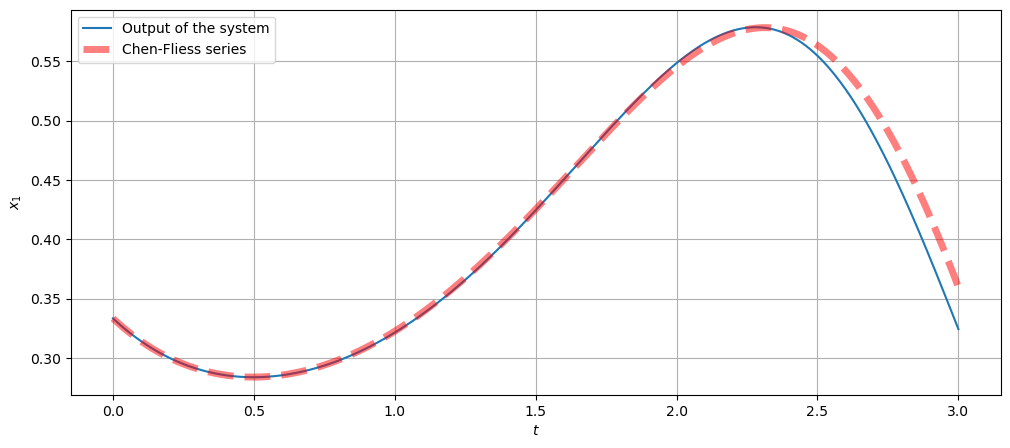
# Graph of the output and the Chen-Fliess series
plt.figure(figsize = (12,5))
plt.plot(t, y[0].T)
plt.plot(t, F_cu, color='red', linewidth=5, linestyle = '--', alpha = 0.5)
plt.xlabel('$t$')
plt.ylabel('$x_1$')
plt.legend(['Output of the system','Chen-Fliess series'])
plt.grid()
plt.show()
For more examples, see the CFSpy demos
Resources
Contributing
All feedback is welcome.
Asking for help
Please reach out if you have any questions:
License
CFSpy is open-source and released under the MIT License.
BibTeX
Feel free to cite my work:
@article{iperezave,
  title={CFSpy},
  author={Perez Avellaneda, Ivan},
  journal={GitHub. Note: https://github.com/iperezav/CFSpy},
  volume={1},
  year={2024}
}
Release history Release notifications | RSS feed


Download files
Download the file for your platform. If you're not sure which to choose, learn more about installing packages.
Source Distribution
Built Distribution
Filter files by name, interpreter, ABI, and platform.
If you're not sure about the file name format, learn more about wheel file names.
Copy a direct link to the current filters
File details
Details for the file cfspy-1.2.0.tar.gz.
File metadata
- Download URL: cfspy-1.2.0.tar.gz
- Upload date:
- Size: 9.8 kB
- Tags: Source
- Uploaded using Trusted Publishing? No
- Uploaded via: twine/6.1.0 CPython/3.13.3
File hashes
| Algorithm | Hash digest | |
|---|---|---|
| SHA256 |
932f4bf457b0330cd4ceff42e720b8bf74bc535e95338277022a50cee75b1409
|
|
| MD5 |
89fc8aa3c886481c796171d52e2d998b
|
|
| BLAKE2b-256 |
ef64f77e8fef6f78d2a9928b6b359d47ed7e945a5778269f07a4b3ccff8d8382
|
File details
Details for the file cfspy-1.2.0-py3-none-any.whl.
File metadata
- Download URL: cfspy-1.2.0-py3-none-any.whl
- Upload date:
- Size: 12.6 kB
- Tags: Python 3
- Uploaded using Trusted Publishing? No
- Uploaded via: twine/6.1.0 CPython/3.13.3
File hashes
| Algorithm | Hash digest | |
|---|---|---|
| SHA256 |
e0be31f23798f5788580a7914ce55dd85c59966ed3b91e0f62aff3bdb79fdf8a
|
|
| MD5 |
47a96dd9c38e9eb8b17931c54c60eb01
|
|
| BLAKE2b-256 |
8d39889f177fd96a8cd27926283a96e7d265e675223b3c7c83be576d171b277d
|






