
LLM-powered test coverage improver

Project description

by Juan Altmayer Pizzorno and Emery Berger at UMass Amherst's PLASMA lab.






About CoverUp
CoverUp automatically generates tests that ensure that more of your code is tested (that is, it increases its code coverage). CoverUp can also create a test suite from scratch if you don't yet have one. The new tests are based on your code, making them useful for regression testing.
CoverUp is designed to work closely with the pytest test framework. To generate tests, it first measures your suite's coverage using SlipCover. It then selects portions of the code that need more testing (that is, code that is uncovered). CoverUp then engages in a conversation with an LLM, prompting for tests, checking the results to verify that they run and increase coverage (again using SlipCover), and re-prompting for adjustments as necessary. Finally, CoverUp optionally checks that the new tests integrate well, attempting to resolve any issues it finds.
For technical details and a complete evaluation, see our arXiv paper, CoverUp: Coverage-Guided LLM-Based Test Generation (PDF), to appear at FSE 2025.
Installing CoverUp
CoverUp is available from PyPI, so you can install simply with
$ python3 -m pip install coverup
LLM model access
CoverUp can be used with OpenAI, Anthropic or AWS Bedrock models; it requires that the
access details be defined as shell environment variables: OPENAI_API_KEY,
ANTHROPIC_API_KEY or AWS_ACCESS_KEY_ID/AWS_SECRET_ACCESS_KEY/AWS_REGION_NAME, respectively.
For example, for OpenAI you would create an account, ensure
it has a positive balance and then create an
an API key, storing its "secret key" (usually a
string starting with sk-) in an environment variable named OPENAI_API_KEY:
$ export OPENAI_API_KEY=<...your-api-key...>
Using CoverUp
If your module is named mymod, its sources are under src and the tests under tests, you can run CoverUp as
$ coverup --package src/mymod --tests tests
CoverUp then creates tests named test_coverup_N.py, where N is a number, under the tests directory.
Example
Here we have CoverUp create additional tests for the popular package Flask:
$ coverup --package src/flask --tests tests
Measuring coverage...  90.9%
Prompting gpt-4o-2024-05-13 for tests to increase coverage...
(in the following, G=good, F=failed, U=useless and R=retry)
100%|███████████████████████████████████████| 92/92 [01:01<00:00,  1.50it/s, G=55, F=122, U=20, R=0, cost=~$4.19]
Measuring coverage...  94.4%

$
In just over a minute, CoverUp increases Flask's test coverage from 90.9% to 94.4%.
Avoiding flaky tests
While evaluating each newly generated test, CoverUp executes it a number of times in an
attempt to detect any flaky tests; that can be adjusted with the --repeat-tests and
--no-repeat-tests options.
If CoverUp detects that a newly generated test is flaky, it prompts the LLM for a correction.
Test pollution and isolation
CoverUp only adds tests to the suite that, when run by themselves, pass and increase coverage.
However, it is possible tests to "pollute" the state, changing it in a way that causes other tests to fail.
By default, CoverUp uses the pytest-cleanslate
plugin to isolate tests, working around any (in-memory) test pollution; that can be disabled by
passing in the --no-isolate-tests option.
CoverUp can also be asked to find and disable the polluting test module or function (--disable-polluting)
or simply disable any failing tests (--disable-failing).
Running CoverUp with Docker
To evaluate the tests generated by the LLM, CoverUp must execute them. For best security and to minimize the risk of damage to your system, we recommend running CoverUp with Docker.
Evaluation
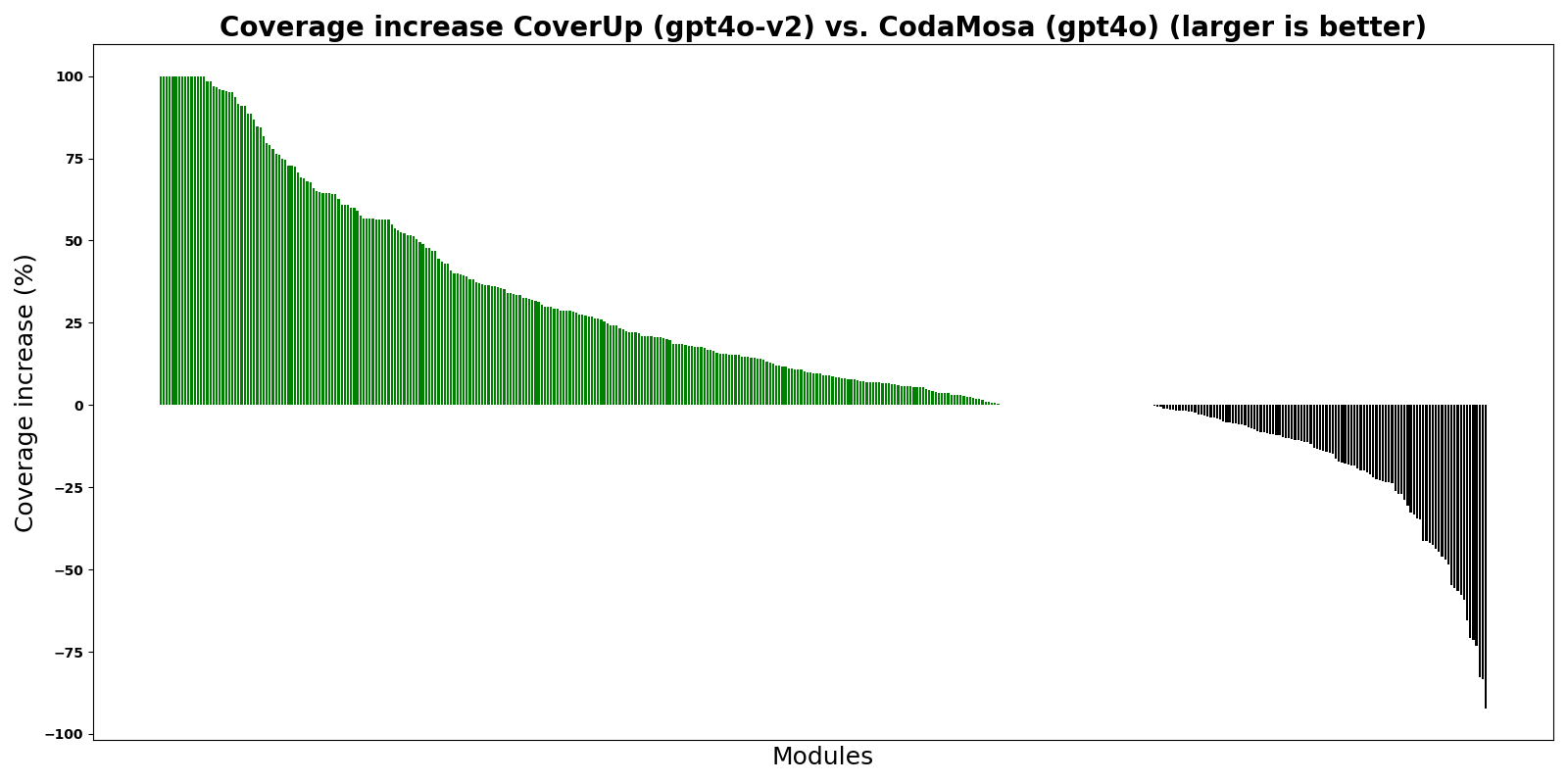
The graph shows CoverUp in comparison to CodaMosa, a state-of-the-art search-based test generator based on Pynguin test generator. For this experiment, both CoverUp and CodaMosa created tests "from scratch", that is, ignoring any existing test suite. The bars show the difference in coverage percentage between CoverUp and CodaMosa for various Python modules; green bars, above 0, indicate that CoverUp achieved a higher coverage.
As the graph shows, CoverUp achieves higher coverage than CodaMosa for most modules.
Work In Progress
This is an early release of CoverUp. Please enjoy it, and pardon any disruptions as we work to improve it. We welcome bug reports, experience reports, and feature requests (please open an issue).
Release history Release notifications | RSS feed


Download files
Download the file for your platform. If you're not sure which to choose, learn more about installing packages.
Source Distribution
Built Distribution
Filter files by name, interpreter, ABI, and platform.
If you're not sure about the file name format, learn more about wheel file names.
Copy a direct link to the current filters
File details
Details for the file coverup-0.6.3.tar.gz.
File metadata
- Download URL: coverup-0.6.3.tar.gz
- Upload date:
- Size: 52.0 kB
- Tags: Source
- Uploaded using Trusted Publishing? No
- Uploaded via: twine/6.1.0 CPython/3.11.13
File hashes
| Algorithm | Hash digest | |
|---|---|---|
| SHA256 |
4c2435353bcd9716c75aec2c84549b6e225d34dfd295022556cc041a8ec27996
|
|
| MD5 |
55f526dc2b469e87c3396112469cec19
|
|
| BLAKE2b-256 |
0ea37886e3fd95941a739560eb79aaf68affa0a0c51aa061c4b3083a4a932514
|
File details
Details for the file coverup-0.6.3-py3-none-any.whl.
File metadata
- Download URL: coverup-0.6.3-py3-none-any.whl
- Upload date:
- Size: 41.6 kB
- Tags: Python 3
- Uploaded using Trusted Publishing? No
- Uploaded via: twine/6.1.0 CPython/3.11.13
File hashes
| Algorithm | Hash digest | |
|---|---|---|
| SHA256 |
b06177e78900ef5c9d95b798c96f293d29d79e6559a378f188134750c536c8ab
|
|
| MD5 |
f099d9db156a619e794edf6c005f7b3a
|
|
| BLAKE2b-256 |
d2beea687cf6b72278b85a453fc9133e4a8958ebd83cb5504efbf13c243bd093
|






