



DMDO
DMDO (Distributed Multidisciplinary Design Optimization) solves coupled, multidisciplinary engineering design problems by decomposing them into subproblems, one per discipline, and coordinating them with nonhierarchical analytical target cascading (NHATC).
Documentation, theory, tutorials and benchmarks: ahmed-bayoumy.github.io/DMDO
Author: Dr. Ahmed H. Bayoumy
Version 2612.0
Why DMDO
Design the whole system, let every discipline keep its own tools. Aircraft, vehicles, turbines and energy systems are designed by teams that each own an analysis: aerodynamics, structures, propulsion, controls, cost. Optimizing them as one monolithic problem needs a multidisciplinary analysis that converges at every design point, one optimizer that suits every discipline, and every code in one process. DMDO needs none of that.
- No converged multidisciplinary analysis. Each subproblem keeps its own copies of the variables it shares with the others, and an augmented Lagrangian coordinator drives the copies to agreement. Coupled analyses never have to be iterated to convergence inside the optimizer.
- Measured on the classic MDO benchmarks. On the Sellar problem with derivative-free MADS subproblems, DMDO reaches f = 3.2042, 0.65 % from the best known solution 3.18339 [3], with the disciplines consistent to 1.3 × 10⁻⁶. In all six recorded benchmark runs (Sellar, Golinski's speed reducer, a geometric program and a basic two-discipline problem), the inconsistency between disciplines falls below 10⁻³ within 6 to 16 outer iterations.
- The right optimizer for each discipline. A subproblem built on a noisy or failing simulation uses derivative-free Mesh Adaptive Direct Search (OMADS); a smooth analytical one uses SciPy's SLSQP, in the same run. Any other optimizer plugs in as a small strategy class.
- Serial, parallel or distributed, with the same answer. Solve the subproblems one after the other (Gauss–Seidel) or all at once (Jacobi), in-process, in a pool of worker processes, or on remote machines. Jacobi results do not depend on which worker finishes first: the test suite checks that in-process, out-of-order, process-pool and remote runs give bit-identical designs.
- An API, not just a script. Build a problem from YAML, a dictionary or Python objects, then
run()it, drive it one outer iteration at a time withstep(), or solve the subproblems yourself withask()/tell(). Observers stream progress, registries and entry points add solvers, executors and analyses, and an optional HTTP service exposes runs to any language. - Results you can reproduce. Runs are seeded; every benchmark run is checked against a recorded history that the code must reproduce bit for bit; interrupted runs resume from their checkpoint to exactly the same result; the test suite runs on Linux, Windows and macOS in continuous integration.
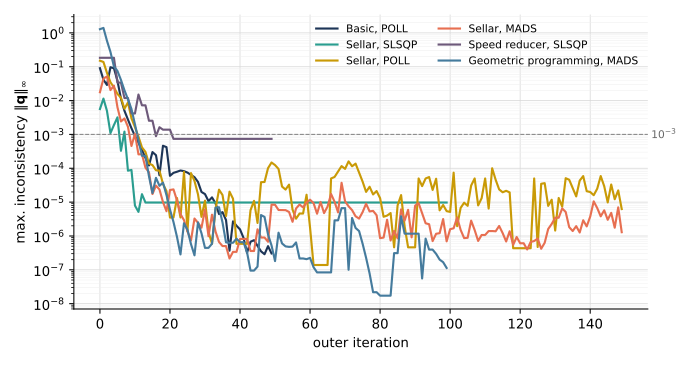
Maximum inconsistency between the copies held by different subproblems, at each outer iteration of the six recorded benchmark runs. Details in the benchmarking documentation.
Benchmark results
| Problem | Subproblems | Inner solver | Outer iterations | Final objective (gap) | Best known solution | Final max. inconsistency |
|---|---|---|---|---|---|---|
| Sellar | 2 | OMADS MADS | 150 | 3.2042 (+0.65 %) | 3.18339 [3] | 1.3 × 10⁻⁶ |
| Sellar | 2 | OMADS poll | 150 | 3.5216 (+10.6 %) | 3.18339 [3] | 6.2 × 10⁻⁶ |
| Sellar | 2 | SciPy SLSQP | 100 | 3.6037 (+13.2 %) | 3.18339 [3] | 9.7 × 10⁻⁶ |
| Speed reducer | 4 | SciPy SLSQP | 50 | 2741.41 (−8.45 %)† | 2994.355 [3] | 7.4 × 10⁻⁴ |
| Geometric program | 3 | OMADS MADS | 100 | 20.2632 (+15.2 %) | 17.59 [4] | 1.1 × 10⁻⁷ |
| Basic problem | 2 | OMADS poll | 50 | 5.58977 (+0.18 %) | 5.58 | 3.1 × 10⁻⁷ |
| Supersonic business jet (SBJ)* | 4 | SciPy SLSQP | 100 | Wt = 35,374 lb (+5.3 %) | 33,600 lb [5] | 4.4 × 10⁻⁵ |
| Supersonic business jet (SBJ)* | 4 | OMADS MADS | 33–64 | Wt = 33,536 lb (−0.2 %; median of 86 runs) | 33,600 lb [5] | 8.8 × 10⁻⁹ (median of 100 runs) |
The numbers come from the recorded regression traces in tests/golden/traces, which the current code reproduces
bit for bit; the best known solutions are taken from the references [3]–[5] (the basic problem's, 5.58, has no
published reference), and the gap is relative to them. The Sellar rows show why DMDO lets every subproblem choose its optimizer: with the same coordination,
the full MADS algorithm ends within 0.65 % of the optimum, while the poll step alone and SLSQP settle on consistent
but less optimal designs.
† The speed-reducer run ends below the best known solution because it is not exactly consistent and feasible: its final inconsistency is 7.4 × 10⁻⁴, and the regression suite accepts subproblem constraint violations up to 0.06 for it.
* The SBJ rows come from the SBJ benchmarking campaigns rather than from recorded regression traces. The aircraft,
propulsion, aerodynamics and structures subproblems (tests/SBJ) start from randomly perturbed designs; all
constraints are handled by the progressive barrier; the objective is the total weight Wt.
- OMADS MADS (100 starts, coordinator β = 1.8, γ = 0.9; 150 evaluations per solve in the aircraft, propulsion and aerodynamics subproblems and 500 in the structures subproblem, which holds most of the constraints; run in March 2026 with DMDO 2601 and OMADS 2401): every run brings the inconsistency between disciplines below 10⁻³ (median outer iteration 13) and below 10⁻⁴ (median iteration 18), and the final inconsistency has a median of 8.8 × 10⁻⁹. 86 runs end consistent and meeting the 2000 nm range requirement, at a median weight of 33,536 lb (middle half 26,600–38,800 lb); the histories of this campaign do not record the other disciplines' constraints, so a median slightly below the best known solution is compatible with small violations of those constraints.
- SLSQP (one run, β = 1.8, γ = 0.9, at most 50 iterations per solve, 100 outer iterations): the inconsistency falls below 10⁻³ at outer iteration 14 and below 10⁻⁴ at iteration 32; the largest remaining constraint violation is 3.8 × 10⁻⁴.
- With only 50 evaluations per solve (10 runs, β = 2.4, γ = 0.4, 100 outer iterations), MADS does not reach an inconsistency of 10⁻³ (final values 5.0 × 10⁻² to 1.0 × 10⁻¹).
On SBJ the subproblem budget decides whether the derivative-free solvers converge: the structures subproblem, with 72 constraints, needs a large budget for MADS to reach consistency.
Features
- NHATC coordination with an augmented Lagrangian penalty and method-of-multipliers updates; penalty weights grow
only on the couplings that stall (
normal,median,maxorrankupdate schemes) - Subproblem solvers: OMADS
mads,pollandsearch, SciPy (SLSQP,COBYLA,trust-constr, ...), or your own - Gauss–Seidel and Jacobi coordination sweeps; in-process, process-pool, remote or custom executors
SessionAPI:run,step,ask/tell, early stopping, JSON-ready results, checkpoints and exact resume- Observers for every phase of the coordination loop; registries and entry points for solvers, executors, analyses and coordination policies
- Analyses as plain callables or as
Disciplineobjects (compute(inputs) -> outputs), the natural form of an adapter around a simulation code or another framework's model - Optional HTTP service (
dmdo serve) with remote workers (dmdo worker --tags ...), standard library only - Post-processing dashboard: interactive plots of any column of a run's history files
Installation
pip install DMDO
DMDO needs Python 3.10 or newer.
Quick start
The basic two-discipline problem: minimize u + v + a + b where a = log10(u) + log10(v) + log10(b) and
b = 1/u + 1/w + 1/a are computed by two coupled analyses, subject to w + b <= 10. The problem file
examples/basic_problem.yaml declares the variables, analyses and subproblems; the
analyses and objectives are ordinary Python callables, referenced by name.
import numpy as np
from DMDO import Session

def A1(x):                       # discipline 1: x = [u, v, b] -> [a]
    x = np.maximum(x, 1e-12)
    return [np.log10(x[0]) + np.log10(x[1]) + np.log10(x[2])]

def A2(x):                       # discipline 2: x = [u, w, a] -> [b]
    x = np.maximum(x, 1e-12)
    return [1 / x[0] + 1 / x[1] + 1 / x[2]]

def opt1(x, y, c=None):          # subproblem 1: objective u + v + b + a, no constraint
    return [sum(x) + y[0], [0.0]]

def opt2(x, y, c=None):          # subproblem 2: no objective, constraint w + b - 10 <= 0
    return [0.0, [x[1] + y[0] - 10.0]]

if __name__ == "__main__":
    session = Session.from_yaml("examples/basic_problem.yaml", working_dir="runs",
                                blackboxes={"A1": A1, "A2": A2, "opt1": opt1, "opt2": opt2})
    result = session.run()
    print(result.objective, result.max_inconsistency)   # 5.589770658112853 3.051476282101007e-07
    print(result.variables)                              # u_1 = u_2 = 1.54957, a_1 = a_2 = 0.56132, ...
step() runs one outer iteration at a time; ask()/tell() hands the subproblem solves to you:
from DMDO import solve_task

while not session.done:
    tasks = session.ask()                          # independent tasks: solve them anywhere, in any order
    session.tell([solve_task(t) for t in tasks])
The problem definition at a glance
| Section | Purpose | Main keys |
|---|---|---|
variables |
One row per variable copy | [name, subproblem, link, coupling, lb, baseline, ub, dim, type] |
DA |
Disciplinary analyses | inputs, outputs, blackbox |
MDA |
Analyses evaluated in each subproblem | analyses, variables, responses |
coord |
The coordinator | beta, gamma, M_update_scheme, scaling, budget, index_of_master_SP |
subproblem |
The subproblems | vars, resps, opt, solver, budget, is_main |
MDO |
The run | subproblems, inc_stop, noprogress_stop, display |
Every key, with its default, is listed in the problem-definition reference.
Serial, parallel and remote execution
session = Session.from_yaml("problem.yaml", mode="parallel", blackboxes={...})    # Jacobi in worker processes
session = Session.from_yaml("problem.yaml", sweep="jacobi", executor=my_cluster)  # any map(fn, tasks) back end
dmdo serve  --host 0.0.0.0 --port 8400 --token <secret>                   # sessions over HTTP
dmdo worker --connect http://dmdo-host:8400 --tags aero --token <secret>  # where the aero code lives
See the tutorials on parallel execution and the HTTP service.
Post-processing dashboard
DMDO includes a web dashboard for exploring the files a run writes. Start it and open http://127.0.0.1:8050:
from DMDO import dmdo_dash

dmdo_dash()                  # or, from a terminal:  python -m DMDO.dashboard
Drop a run's Coordination_history.out (or the evaluation history SP_<j>_<t>.out of a subproblem solve) on the
page, then choose the columns for the X axis, the Y axis (logarithmic) and, optionally, the marker size and color.
Hover to read values, drag to zoom, and toggle the line joining the points.
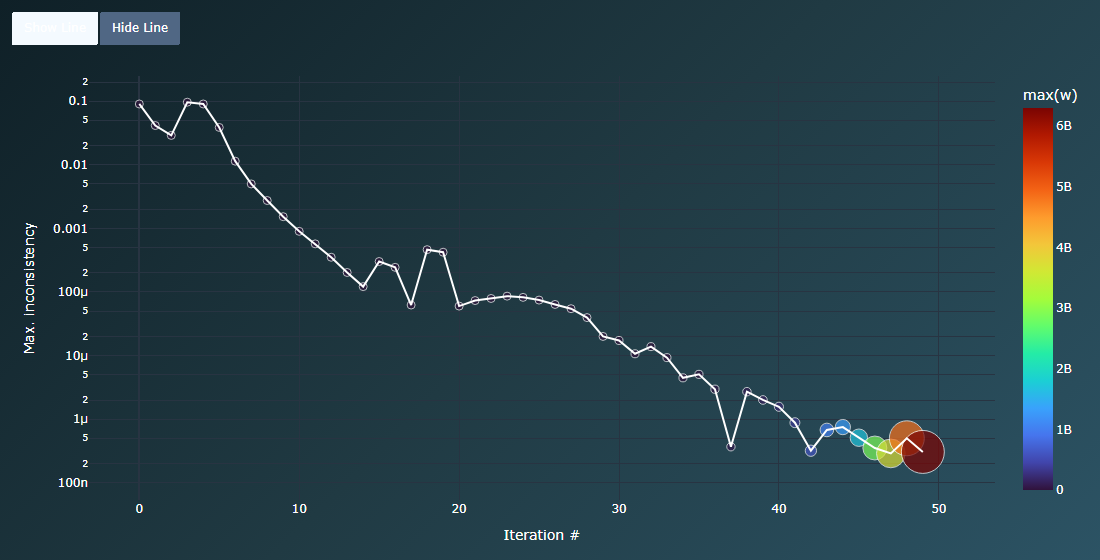
The basic problem in the dashboard: maximum inconsistency at each outer iteration, with markers sized and colored
by the largest penalty weight max(w). See the
dashboard tutorial.
Extending DMDO and connecting other packages
DMDO talks to analyses, optimizers and execution back ends through small, framework-neutral interfaces
(DMDO.ports). Nothing in DMDO depends on a specific external package; an adapter written in user code only has to
satisfy the interface. OpenMDAO [1] and GEMSEO [2] are examples of frameworks whose models could be wrapped as
DMDO analyses, or which could drive DMDO through the Session API; neither is required by or bundled with DMDO.
from DMDO import BaseSolver, SolverOutcome, register_blackbox, solvers

register_blackbox("aero", my_aero_discipline)       # usable as `blackbox: aero` in a problem file

@solvers.register("my_solver")                      # usable as `solver: my_solver`
class MySolver(BaseSolver):
    def solve(self, request):
        ...  # minimize request.objective(x) within request.lb / request.ub
        return SolverOutcome(x=x_best, fmin=f_best, hmin=h_best)
Plugin packages register solvers, executors, analyses and coordination policies through the dmdo.solvers,
dmdo.executors, dmdo.blackboxes and dmdo.policies entry-point groups. See the
extension tutorial.
Documentation
- Getting started
- Background: ATC, NHATC and the augmented Lagrangian coordinator
- Implementation: architecture, interfaces, the coordination loop
- Benchmarking
- Tutorials and API reference
The documentation is built from docs_src with pip install -r docs_src/requirements.txt and
sphinx-build -b html docs_src docs.
Citation
If DMDO contributes to published work, please cite it as follows.
@software{DMDO_AB,
  author    = {Bayoumy, Ahmed H.},
  title     = {DMDO: Distributed Multidisciplinary Design Optimization},
  year      = {2022},
  publisher = {GitHub},
  version   = {2612.0},
  url       = {https://github.com/Ahmed-Bayoumy/DMDO},
  doi       = {https://doi.org/10.5281/zenodo.24281878}
}
License & copyright
© Ahmed H. Bayoumy
This project is licensed under the GNU General Public License v3.0 or later (GPL-3.0-or-later). See the LICENSE file for details.
Benchmark references
- N. P. Tedford and J. R. R. A. Martins, "Benchmarking multidisciplinary design optimization algorithms", Optimization and Engineering, 11(1), 159–183, 2010. https://doi.org/10.1007/s11081-009-9082-6 (Sellar: Sect. 5.1; speed reducer: Sect. 5.2)
- B. Talgorn, M. Kokkolaras, A. DeBlois and P. Piperni, "Numerical investigation of non-hierarchical coordination for distributed multidisciplinary design optimization with fixed computational budget", Structural and Multidisciplinary Optimization, 55(1), 205–220, 2017. https://doi.org/10.1007/s00158-016-1489-z (geometric programming: Table 1)
- S. Tosserams, M. Kokkolaras, L. F. P. Etman and J. E. Rooda, "A nonhierarchical formulation of analytical target cascading", Journal of Mechanical Design, 132(5), 051002, 2010. https://doi.org/10.1115/1.4001346 (supersonic business jet: Table 2, lowest all-in-one optimal weight over 100 starting points)
References to related frameworks
DMDO is independent of the frameworks below; they are cited only as examples of tools that can be connected to it through its generic interfaces.
- J. S. Gray, J. T. Hwang, J. R. R. A. Martins, K. T. Moore and B. A. Naylor, "OpenMDAO: an open-source framework for multidisciplinary design, analysis, and optimization", Structural and Multidisciplinary Optimization, 59(4), 1075–1104, 2019. https://doi.org/10.1007/s00158-019-02211-z — https://openmdao.org
- F. Gallard, C. Vanaret, D. Guénot, V. Gachelin, R. Lafage, B. Pauwels, P.-J. Barjhoux and A. Gazaix, "GEMS: a Python library for automation of multidisciplinary design optimization process generation", AIAA SciTech Forum, 2018 AIAA/ASCE/AHS/ASC Structures, Structural Dynamics, and Materials Conference, AIAA 2018-0657. https://doi.org/10.2514/6.2018-0657 — https://gemseo.org
1 maintainer

Metadata
1 maintainer
Release files for DMDO 2612.0
For a detailed explanation of source distributions (sdists) and built distributions (wheels), please see the package formats documentation.
Source distribution (sdist)
| File | Size | Uploaded | Provenance | Actions |
|---|---|---|---|---|
| dmdo-2612.0.tar.gz | 140.7 kB | Without provenance | Details for dmdo-2612.0.tar.gz |
Built distribution (wheel)
| File | Interpreter | ABI | Platform | Actions Reset |
|---|---|---|---|---|
| dmdo-2612.0-py3-none-any.whl | Python 3 | none | any | Details for dmdo-2612.0-py3-none-any.whl |
Total release size: 284.3 kB
Release files / dmdo-2612.0.tar.gz
| Download URL | dmdo-2612.0.tar.gz |
|---|---|
| Size | 140.7 kB |
| Tags | Source |
|
SHA-256 checksum How to use checksums |
c8a648a6e558a61ba5ceb64507f22d60c8bd2b241da7a2d7d248f6cc2e221911
|
|
BLAKE2b-256 checksum How to use checksums |
333733a9b008917e1aa9e6a62f755306a5e1766bd47f9fd3c6df97c655025ce6
|
| Upload date | |
|
Uploaded using Trusted Publishing? What is trusted publishing? |
No |
| Uploaded via |
uv/0.11.23 {"installer":{"name":"uv","version":"0.11.23","subcommand":["publish"]},"python":null,"implementation":{"name":null,"version":null},"distro":null,"system":{"name":null,"release":null},"cpu":null,"openssl_version":null,"setuptools_version":null,"rustc_version":null,"ci":null}
|
Release files / dmdo-2612.0-py3-none-any.whl
| Download URL | dmdo-2612.0-py3-none-any.whl |
|---|---|
| Size | 143.6 kB |
| Tags | Python 3 |
|
SHA-256 checksum How to use checksums |
dc7769be3cdfc186f9a9ccd7a49fa18bc71f95f304d9bb1d2200158ade1c9994
|
|
BLAKE2b-256 checksum How to use checksums |
2efaafd720158ab1d20a8ca1d62bc24d8d77a3037cca3d1d0cbce7553eaab44b
|
| Upload date | |
|
Uploaded using Trusted Publishing? What is trusted publishing? |
No |
| Uploaded via |
uv/0.11.23 {"installer":{"name":"uv","version":"0.11.23","subcommand":["publish"]},"python":null,"implementation":{"name":null,"version":null},"distro":null,"system":{"name":null,"release":null},"cpu":null,"openssl_version":null,"setuptools_version":null,"rustc_version":null,"ci":null}
|
Security for DMDO 2612.0
Provenance
Provenance describes where a file came from. On PyPI, provenance is shared via attestations, which provide a verifiable record of the build or publishing details. View details, limitations and caveats.
No provenance found
None of the files in this release were uploaded with provenance metadata.
A note on package security
PyPI is a repository for distributing packages, not a service for auditing them. While third-party security researchers and our staff do their best to detect and remove malicious packages, PyPI cannot guarantee the quality, security or suitability of any given package.
To learn more about protecting yourself from malicious actors, visit our package security documentation.














