
Visualize and analyze your data with DaSPi. This package is designed for users who want to find relevant influencing factors in processes and validate improvements.

Project description





Data analysis, Statistics and Process improvements (DaSPi)
Visualize and analyze your data with DaSPi. This package is designed for users who want to find relevant influencing factors in processes and validate improvements. This package offers many Six Sigma tools based on the following packages:
The goal of this package is to be easy to use and flexible so that it can be adapted to a wide array of data analysis tasks.
Why DaSPi?
There are great packages for data analysis and visualization in Python, such as Pandas, Seaborn, Altair, Statsmodels, Scipy, Pinguins. But most of the time they work not directly with each other. Wouldn't it be great if you could use all of these packages together in one place? That's where DaSPi comes in. DaSPi is a Python package that provides a unified interface for data analysis, statistics and visualization. It allows you to use all of the great packages mentioned above together in one place, making it easier to explore and understand your data.
Features
- Ease of Use: DaSPi is designed to be easy to use, even for beginners. It provides a simple and intuitive interface that makes it easy to get started with data analysis.
- Visualization: DaSPi provides a wide range of visualization options, including multivariate charts, joint charts, and useful templates. This makes it easy to explore and understand your data in a visual way.
- Statistics: DaSPi provides a wide range of statistical functions and tests, including hypothesis testing, confidence intervals, and regression analysis. This makes it easy to explore and understand your data in a statistical way.
- Open Source: DaSPi is open source, which means that it is free to use and modify. This makes it a great option for users who want to customize the package to their specific needs.
This Package contains following submodules:
- plotlib: Visualizations with Matplotlib, where the division by color, marker size or shape as well as rows and columns subplots are automated depending on the given categorical data. Any plots can also be combined, such as scatter with contour plot, violin with error bars or other creative combinations.
- anova: analysis of variance (ANOVA), which is used to compare the variance within and between of two or more groups, or the effects of different treatments on a response variable. It also includes a function for calculating the variance inflation factor (VIF) for linear regression models. The main class is LinearModel, which provides methods for fitting linear regression with interactions and automatically elimiinating insignificant variables.
- statistics: applied statistics, hypothesis test, confidence calculations and monte-carlo simulation. It also includes estimation for process capability and capability index.
- datasets: data for exersices. It includes different datasets that can be used for testing and experimentation.
Usage
Visualization
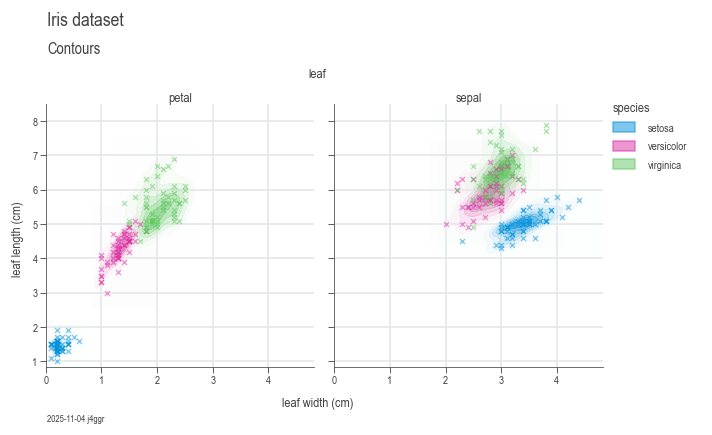
To use DaSPi, you can import the package and start exploring your data. Here is an example of how to use DaSPi to visualize a dataset:
import daspi as dsp
df = dsp.load_dataset('iris')

chart = dsp.MultivariateChart(
        source=df,
        target='length',
        feature='width',
        hue='species',
        col='leaf',
        markers=('x',)
    ).plot(
        dsp.GaussianKDEContour
    ).plot(
        dsp.Scatter
    ).label(
        feature_label='leaf width (cm)',
        target_label='leaf length (cm)',
    )
ANOVA
Do some ANOVA and statistics on a dataset. Run the example below in a Jupyther Notebook to see the results.
df = dsp.load_dataset('aspirin-dissolution')
model = dsp.LinearModel(
    source=df,
    target='dissolution',
    features=['employee', 'stirrer', 'brand', 'catalyst', 'water'],
    disturbances=['temperature', 'preparation'],
    order=2)
df_gof = pd.DataFrame()
for data_gof in model.recursive_elimination():
    df_gof = pd.concat([df_gof, data_gof])

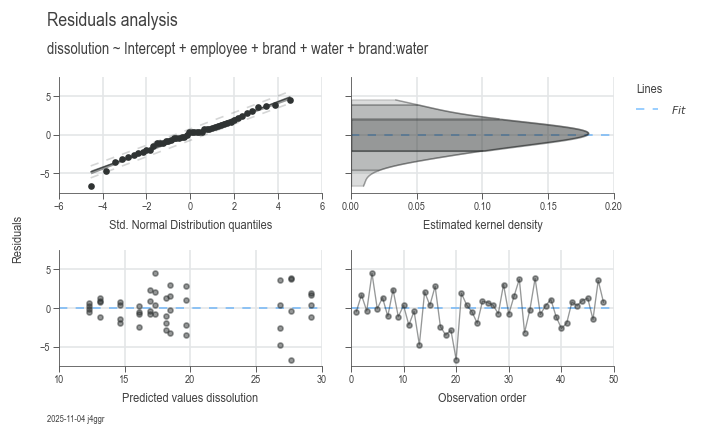
dsp.ResidualsCharts(model).plot().stripes().label(info=True)
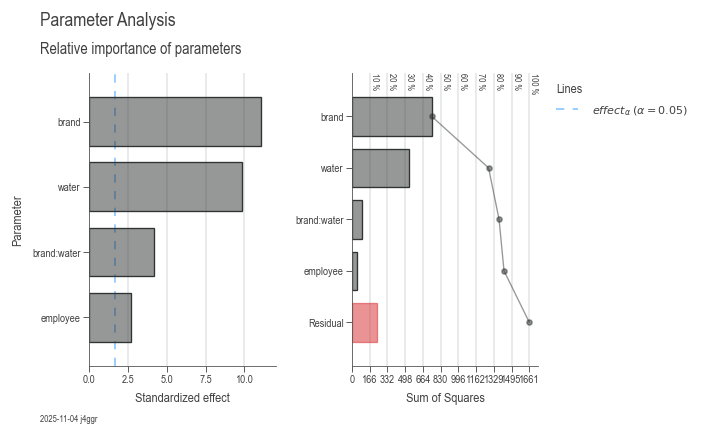
dsp.ParameterRelevanceCharts(model).plot().label(info=True)
model
Formula:
dissolution ~ 16.0792 + 2.3750 employee[T.B] + 0.8375 employee[T.C] + 10.7500 brand[T.Godamed] - 3.8000 water[T.tap] - 5.7167 brand[T.Godamed]:water[T.tap]
Model Summary
| Hierarchical | Least Parameter | P Least | S | AIC | R² | R² Adj | R² Pred |
|---|---|---|---|---|---|---|---|
| True | employee | 0.023298 | 2.374693 | 224.835935 | 0.857379 | 0.840400 | 0.813719 |
Parameter Statistics
| Coef | Std Err | T | P | CI Low | CI Upp | |
|---|---|---|---|---|---|---|
| Intercept | 16.079167 | 0.839581 | 19.151424 | 0.000000 | 14.384824 | 17.773509 |
| employee[T.B] | 2.375000 | 0.839581 | 2.828793 | 0.007133 | 0.680657 | 4.069343 |
| employee[T.C] | 0.837500 | 0.839581 | 0.997522 | 0.324224 | -0.856843 | 2.531843 |
| brand[T.Godamed] | 10.750000 | 0.969464 | 11.088598 | 0.000000 | 8.793542 | 12.706458 |
| water[T.tap] | -3.800000 | 0.969464 | -3.919690 | 0.000321 | -5.756458 | -1.843542 |
| brand[T.Godamed]:water[T.tap] | -5.716667 | 1.371030 | -4.169616 | 0.000149 | -8.483516 | -2.949817 |
Analysis of Variance
| Source | DF | SS | MS | F | P | n² |
|---|---|---|---|---|---|---|
| employee | 2 | 46.431667 | 23.215833 | 4.116891 | 0.023298 | 0.027960 |
| brand | 1 | 747.340833 | 747.340833 | 132.526821 | 0.000000 | 0.450027 |
| water | 1 | 532.000833 | 532.000833 | 94.340328 | 0.000000 | 0.320355 |
| brand:water | 1 | 98.040833 | 98.040833 | 17.385695 | 0.000149 | 0.059037 |
| Residual | 42 | 236.845000 | 5.639167 | nan | nan | 0.142621 |
Variance Inflation Factor
| DF | VIF | GVIF | Threshold | Collinear | Method | |
|---|---|---|---|---|---|---|
| Intercept | 1 | 5.000000 | 2.236068 | 2.236068 | True | R_squared |
| employee | 2 | 1.000000 | 1.000000 | 1.495349 | False | generalized |
| brand | 1 | 1.000000 | 1.000000 | 2.236068 | False | R_squared |
| water | 1 | 1.000000 | 1.000000 | 2.236068 | False | R_squared |
| brand:water | 1 | 1.000000 | 1.000000 | 2.236068 | False | single_order-2_term |
Process capability
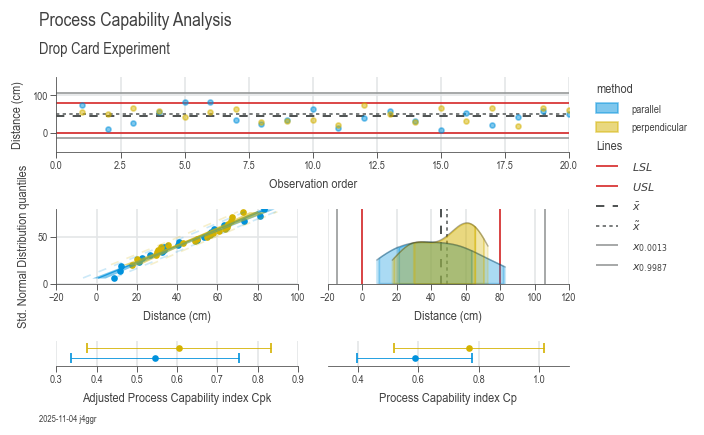
Analyze process variation and other key performance indicators for process capacity.
df = dsp.load_dataset('drop_card')
spec_limits = dsp.SpecLimits(0, float(df.loc[0, 'usl']))
target = 'distance'

chart = dsp.ProcessCapabilityAnalysisCharts(
        source=df,
        target=target,
        spec_limits=spec_limits,
        hue='method'
    ).plot(
    ).stripes(
    ).label(
        fig_title='Process Capability Analysis',
        sub_title='Drop Card Experiment',
        target_label='Distance (cm)',
        info=True
    )

samples_parallel = df[df['method']=='parallel'][target]
samples_series = df[df['method']=='perpendicular'][target]
pd.concat([
    dsp.ProcessEstimator(samples_parallel, spec_limits).describe(),
    dsp.ProcessEstimator(samples_series, spec_limits).describe()],
    axis=1,
    ignore_index=True,
).rename(
    columns={0: 'parallel', 1: 'perpendicular'}
)
| parallel | perpendicular | |
|---|---|---|
| n_samples | 20 | 20 |
| n_missing | 0 | 0 |
| n_ok | 18 | 20 |
| n_nok | 2 | 0 |
| n_errors | 0 | 0 |
| ok | 90.00 % | 100.00 % |
| nok | 10.00 % | 0.00 % |
| nok_norm | 8.01 % | 3.73 % |
| nok_fit | 7.24 % | 5.77 % |
| min | 8.5 | 17.5 |
| max | 83.0 | 73.0 |
| mean | 42.935 | 48.485 |
| median | 40.75 | 52.5 |
| std | 22.666583 | 17.359489 |
| sem | 5.068402 | 3.8817 |
| excess | -0.900801 | -1.236078 |
| p_excess | 0.288757 | 0.072573 |
| skew | 0.19252 | -0.377538 |
| p_skew | 0.690373 | 0.438723 |
| p_ad | 0.754044 | 0.098371 |
| dist | lognorm | logistic |
| p_dist | 0.964797 | 0.744326 |
| strategy | norm | norm |
| lcl | -25.064748 | -3.593468 |
| ucl | 110.934748 | 100.563468 |
| lsl | 0 | 0 |
| usl | 80.0 | 80.0 |
| cp | 0.588237 | 0.768072 |
| cpk | 0.545076 | 0.605145 |
| Z | 1.635227 | 1.815434 |
| Z_lt | 0.135227 | 0.315434 |
Release history Release notifications | RSS feed


Download files
Download the file for your platform. If you're not sure which to choose, learn more about installing packages.
Source Distribution
Built Distribution
Filter files by name, interpreter, ABI, and platform.
If you're not sure about the file name format, learn more about wheel file names.
Copy a direct link to the current filters
File details
Details for the file daspi-1.5.0.tar.gz.
File metadata
- Download URL: daspi-1.5.0.tar.gz
- Upload date:
- Size: 10.4 MB
- Tags: Source
- Uploaded using Trusted Publishing? No
- Uploaded via: pdm/2.23.0 CPython/3.12.3 Windows/11
File hashes
| Algorithm | Hash digest | |
|---|---|---|
| SHA256 |
66548e16114cb6d8c31dd8afa7ba718b8ad7068ebac0990bbee5baf317cd66c2
|
|
| MD5 |
3e2f4f99d16ba0910a9c11769a1b33fb
|
|
| BLAKE2b-256 |
a0b33565f9a4d88397093334313b8705552fa9e0ad55a911062de4387b9f68d5
|
File details
Details for the file daspi-1.5.0-py3-none-any.whl.
File metadata
- Download URL: daspi-1.5.0-py3-none-any.whl
- Upload date:
- Size: 271.6 kB
- Tags: Python 3
- Uploaded using Trusted Publishing? No
- Uploaded via: pdm/2.23.0 CPython/3.12.3 Windows/11
File hashes
| Algorithm | Hash digest | |
|---|---|---|
| SHA256 |
ec5a0c8d5e9546666b44e09995b674ca77eb91f54202fc1d981554143910bbf1
|
|
| MD5 |
da4060b9cf05d7a7a036901585f1bddc
|
|
| BLAKE2b-256 |
87e372f14be57bc1670eb74d77ee64061dc23526355e1250fca2320453931520
|






