






Introduction:
A tensorflow implementation of the Equation Learner Neural Network based model:
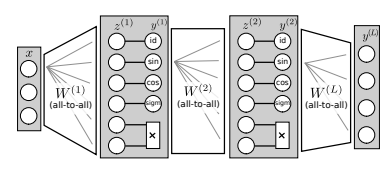
Functionality:
Installation:
pip:
pip install EQL-NN
or from github:
git clone https://github.com/KristofPusztai/EQL.git
Navigate to cloned directory and run setup.py
sudo python setup.py install
Creating and training a model:
from EQL.model import EQL
EQLmodel = EQL(num_layers = 2, dim=5, v = [1,1]) # num_layers -> hidden_layers, dim -> dimension of input, v -> number of binary inputs
x = tf.random_normal_initializer()(shape=(100, 5))
y = tf.random_normal_initializer()(shape=(100, 1))

EQLmodel.build_and_compile(self, metrics=None, loss_weights=None, weighted_metrics=None,
                           run_eagerly=None, kernel_regularizer=None,
                           w_init='random_normal', b_init='random_normal, exclude=None) # exclude specifies activation function exclusions in layers

EQLmodel.fit(x, y, lmbda, t0=100, t1=0, t2=0, initial_epoch=0, verbose=0, batch_size=None, callbacks=None,
        validation_split=0.0, validation_data=None, shuffle=True, class_weight=None,
        sample_weight=None, steps_per_epoch=None,
        validation_steps=None, validation_batch_size=None, validation_freq=1,
        max_queue_size=10, workers=1, use_multiprocessing=False, atol=0.01)
Prediction:
EQLmodel.predict(x, batch_size=None, verbose=0, steps=None,
                 callbacks=None, max_queue_size=10,
                 workers=1, use_multiprocessing=False)
Note: use tensor input for maximum computational efficiency
Model Information:
There are a variety of methods for understanding what is going on in your model.
EQLmodel.summary() # Provides tensorflow summary
EQLmodel.count_params() # Provides # trainable params
EQLmodel.get_weights(layer) #returns array of layer values
EQLmodel.set_weights(layer, weights) #sets weights of specified layer
EQLmodel.formula(raw_latex=False, reduce=True) # Returns interpretable equations via sympy

EQLmodel.evaluate(x=None, y=None, batch_size=None, verbose=1,
                  sample_weight=None, steps=None,
                  callbacks=None, max_queue_size=10,
                  workers=1, use_multiprocessing=False,
                  return_dict=False)
# Returns the loss value & metrics values for the model
Can also access the tensorflow model directly to use other TensorFlow functions such as saving:
EQLmodel.model.save('path/to/save')
Implementation Notes:
Training regiment is interpretted as debiased LASSO:
- T0 epochs are normal training, no regularization
- T1 epochs are L1 regularized training, continuing where T0 ended
- T2 epochs are L0 (weights with values close to 0, |w| < atol, are rounded to 0 and left untrained) regularized training, continuing from T1
Check out the jupyter notebook for examples on learning sinusoidal functions: https://github.com/KristofPusztai/EQL/blob/master/Jupyter%20Notebooks/EQLtest.ipynb
1 maintainer

Metadata
1 maintainer
Release files for EQL-NN 2.1.0
For a detailed explanation of source distributions (sdists) and built distributions (wheels), please see the package formats documentation.
Source distribution (sdist)
| File | Size | Uploaded | |
|---|---|---|---|
| eql_nn-2.1.0.tar.gz | 10.9 kB | Details |
Built distribution (wheel)
| File | Interpreter | ABI | Platform | Reset |
|---|---|---|---|---|
| EQL_NN-2.1.0-py3-none-any.whl | Python 3 | none | any | Details |
Total release size: 22.5 kB
Release files / eql_nn-2.1.0.tar.gz
| Download URL | eql_nn-2.1.0.tar.gz |
|---|---|
| Size | 10.9 kB |
| Tags | Source |
|
SHA-256 checksum How to use checksums |
35b006a11acb1f3d1241461e0eaab7aa62dee39a18727f28097d83e1b5672dc9
|
|
BLAKE2b-256 checksum How to use checksums |
eb4715ecf2f29da75e9da388573af36d752da8b29c11ba0a310d4f27a3ea64da
|
| Upload date | |
|
Uploaded using Trusted Publishing? What is trusted publishing? |
No |
| Uploaded via |
twine/5.1.0 CPython/3.9.19
|
Release files / EQL_NN-2.1.0-py3-none-any.whl
| Download URL | EQL_NN-2.1.0-py3-none-any.whl |
|---|---|
| Size | 11.6 kB |
| Tags | Python 3 |
|
SHA-256 checksum How to use checksums |
47a03ab778271f2ed29872bab71cdccf3a51c255ddcd905c931407155f4eb4d1
|
|
BLAKE2b-256 checksum How to use checksums |
e7e534f9441a00f77b374e37b96e66946bfb5c35f4b193f9c39cace4caaae403
|
| Upload date | |
|
Uploaded using Trusted Publishing? What is trusted publishing? |
No |
| Uploaded via |
twine/5.1.0 CPython/3.9.19
|














