
Library to calculate Planet Similarity Indexes


Project description
ExoPSI
ExoPSI is an open source Python package which offers similarity indexing of exoplanets in order to assess their habitability. It provides the capability to calculate similarity indices of different planetary candidates with respect to any reference values and any numerical parameter, yielding a more accurate evaluation of the survivability of different species.
ExoPSI offers the ability to use any planet as a reference point and visualization functions that allow for easy comparison of the similarity between the interior and surface parameters of different planets. ExoPSI aims to help planetary sceince researches by offering a comprehensive solution for evaluating planetary similarities.
Installation
To Install ExoPSI simply use pip and type in the following command pip install ExoPSI.
Getting Started
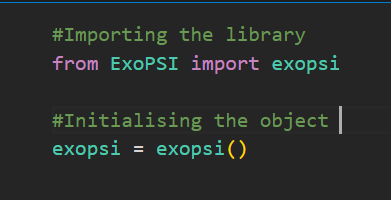
To utilize the functions available in ExoPSI, import the library and instantiate an object of the exopsi class.
Importing Datasets
ExoPSI can only handle datasets of the type pandas.core.frame.DataFrame. As a result, any dataset to be used has to be imported as a pandas data frame.
For example, the PHL’s Exoplanet Catalog (PHL-EC) of the Planetary Habitability Laboratory can be imported as:

Calculating weights for Similarity Indices
All similarity indices rely on parameters,to calculate the similarity of planets. The weights of individual parameters can be computed by providing the reference value, the lower and upper limits for the parameter (where, lower limit ≤ referance value ≤ upper limit). Optionally, a threshold value of the similarity index (default = 0.8) can also be provided.
The calc_weight function calculates the weight parameters and takes in ref val, upper lim, lower lim and threshold (optional) for the reference values, upper limits, lower limits and threshold value, respectively.
The below example uses planetary radius, density, escape velocity (in Earth Units) and temperature(K) as the parameters.
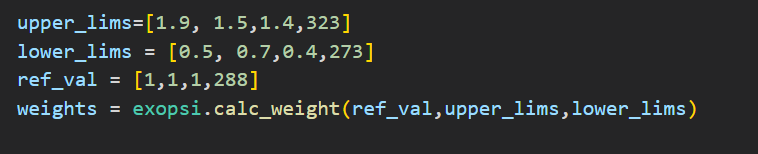
and the following output is received:

Calculating Planet Similarity Index (PSI)
The Planet Similarity Index (PSI) is the modified equivalent of the traditional Earth Similarity Index (ESI) and can be calculated for single or multiple planetary properties. As the name suggests it is used to find the simlarity between planets. ExoPSI offers the capability to use any planet as the reference planet.
To utilise this functionality kindly use the calc_psi function. The calc_psi function takes in the following inputs:
-
params - The dataset containing the values of the different parameters for which PSI is to be calculated.
-
upper lim - The list of upper limits for the given parameters.
-
lower lim - The list of lower limits for the given parameters.
-
ref val - The list of reference values for the given parameters.
-
threshold (optional) - The threshold value to be considered for very high similarity (default = 0.8).
-
int param (optional) - List of column names that contribute to interior PSI.
-
surf param (optional) - List of column names that contribute to surface PSI.
-
p index (optional) - A column (passed as a pandas data frame) that is to be used as the index for the table.
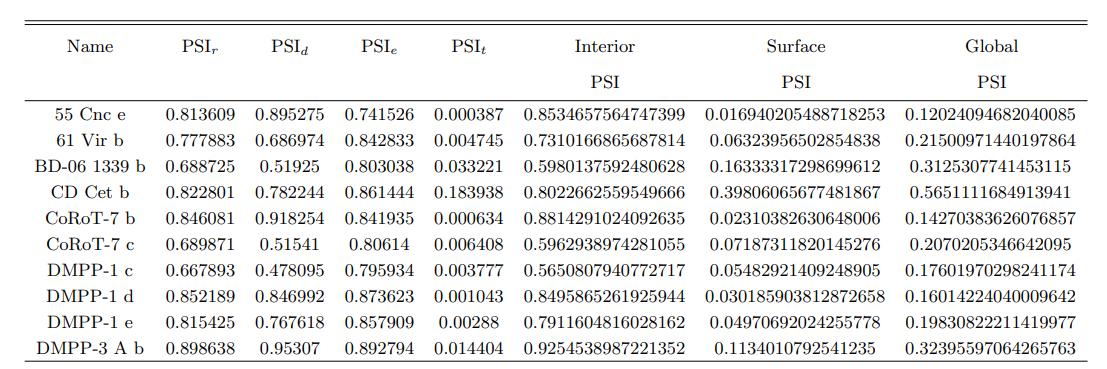
An example using the the PHL’s Exoplanet Catalog is given:

and the output is:
Unit Conversion
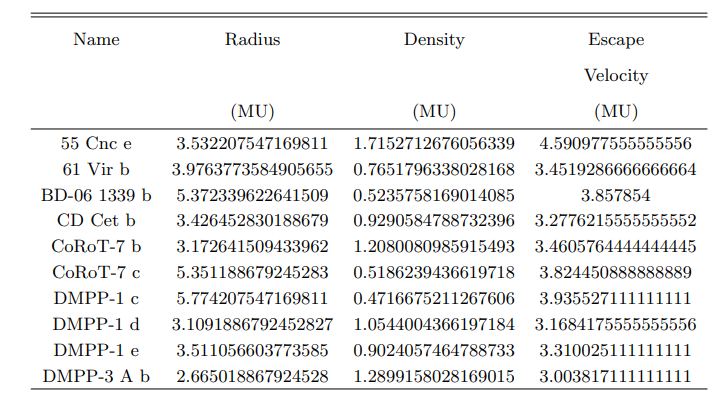
The similarity index calculations are simplified by converting the property values into a single unit scale. Unit conversion provides the ability to find the value of planetary properties relative to a single planet. This has the added advantage of providing a method for comparing planetary features. ExoPSI offers unit conversion through the function unit conv requiring the data to be converted, the transformation reference value (the values of the given parameters in the same units as the data for the planet taken as the reference), and the name that should be assigned to the unit. These are taken as function arguments data, ref index and unit name. The p index argument serves the same purpose as in the calc psi function.It returns a pandas data frame containing the data values in the desired unit scale.
An example using the the PHL’s Exoplanet Catalog is given:

and the output is:


Download files
Download the file for your platform. If you're not sure which to choose, learn more about installing packages.
Source Distribution
Built Distribution
Filter files by name, interpreter, ABI, and platform.
If you're not sure about the file name format, learn more about wheel file names.
Copy a direct link to the current filters
File details
Details for the file ExoPSI-1.0.4.tar.gz.
File metadata
- Download URL: ExoPSI-1.0.4.tar.gz
- Upload date:
- Size: 21.5 kB
- Tags: Source
- Uploaded using Trusted Publishing? No
- Uploaded via: twine/4.0.2 CPython/3.9.7
File hashes
| Algorithm | Hash digest | |
|---|---|---|
| SHA256 |
3fb02a135c8503e528e79a09b0671fc93433e9cbef864f6bcc7e8e69957f7f1a
|
|
| MD5 |
c5c79ae1e1658622d34472467afbe219
|
|
| BLAKE2b-256 |
55245e7d39744790494f87d82487a0f48e076ab373331028379b1a8e86460b98
|
File details
Details for the file ExoPSI-1.0.4-py3-none-any.whl.
File metadata
- Download URL: ExoPSI-1.0.4-py3-none-any.whl
- Upload date:
- Size: 19.5 kB
- Tags: Python 3
- Uploaded using Trusted Publishing? No
- Uploaded via: twine/4.0.2 CPython/3.9.7
File hashes
| Algorithm | Hash digest | |
|---|---|---|
| SHA256 |
8ed398d14ef29c41c044e853325e0044f343d4362b44f06c9c6e69d98fe3008b
|
|
| MD5 |
644a17ccef80aaea9912d1a50270c9e0
|
|
| BLAKE2b-256 |
ec80c2b7ebb922f8cf8214d7f4746f6cbdaac79995dd4b17b7efdd5f37e67521
|






