
This release is a pre-release and may not be stable for production use.
FermiSimplex
Adaptive, occupation-certified spectral calculations on simplex meshes.
FermiSimplex finds Fermi surfaces and computes zero-temperature charge and density matrices without paying for a dense momentum grid. Its central object is the local occupation
$$ N(k; \mu) = \mathrm{Tr}\left[\Theta\left(\mu I - H(k)\right)\right], $$
and its central question is simple: can the occupation be proved constant on this simplex, or should we look more closely?
The upstream development repository is GitLab; the GitHub repository is a public mirror.
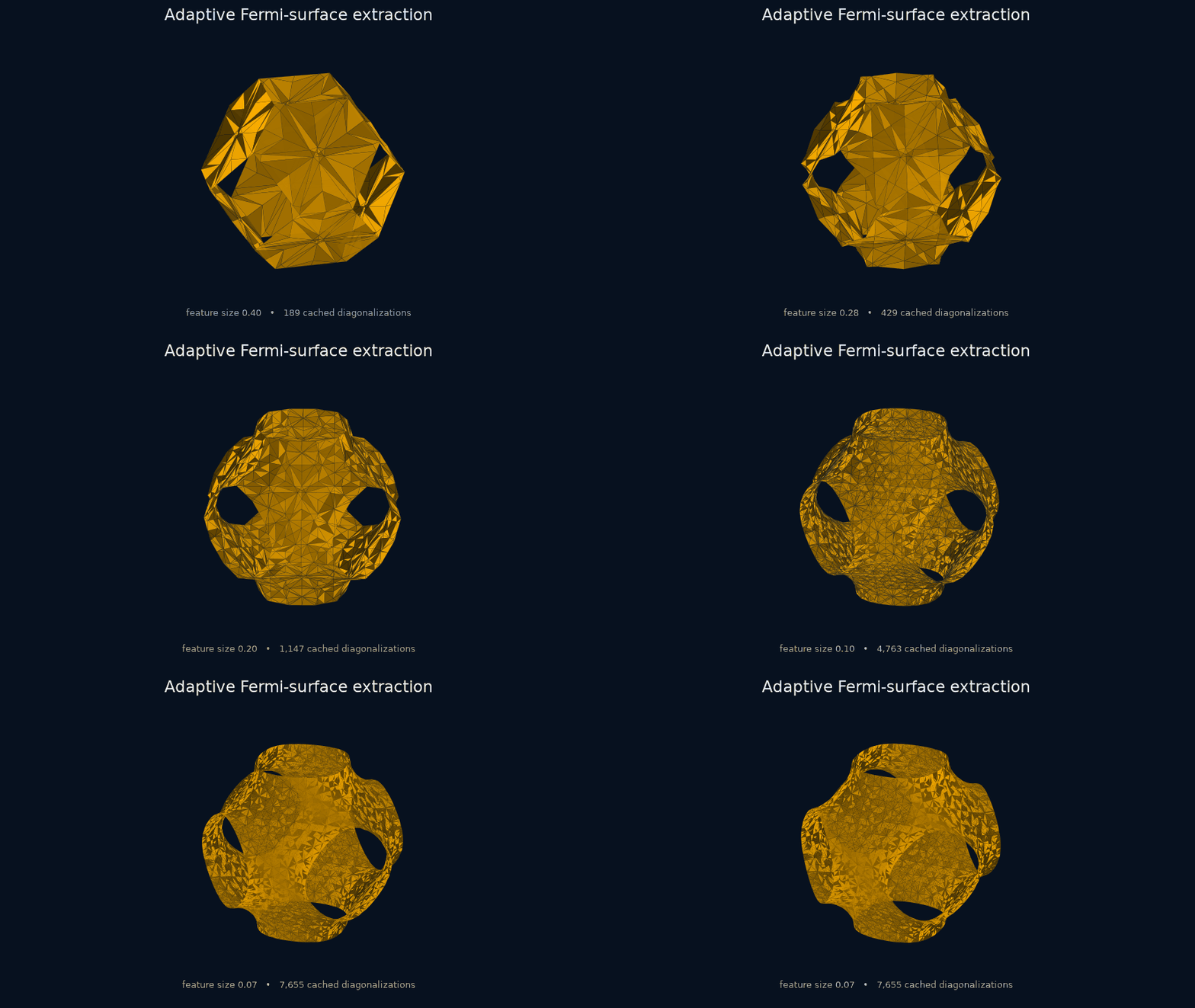
See the visual Python tour for a presentation-ready introduction with real adaptive sampling traces, multiband examples, and a rotating noble-metal-inspired three-dimensional surface.
- 🛡️ Gapped-region proofs combine cached eigensystems with rigorous spectral bounds to exclude a Fermi-level crossing throughout a simplex.
- ⚡ Adaptive sampling, built on AdaptiveSimplex, concentrates diagonalizations near unresolved Fermi surfaces instead of refining the entire Brillouin zone uniformly.
- 🚀 Numerical efficiency by design: adaptive refinement, shared spectral caching, and the compiled numerical core avoid repeated work as the Fermi surface becomes progressively sharper.
- 🎯 Shared occupation bounds use a quadratic reduced matrix model for charge errors and gap classification. Temporary subdivision of the model requires no further Hamiltonian evaluations.
- 🧩 Python and C++ share one numerical core; models can be dense callables or translation-invariant tight-binding Hamiltonians.
Quick start
From a source checkout with a C++20 compiler and BLAS/LAPACK available:
pip install .
The model below produces the three-dimensional surface shown above:
import numpy as np

from fermisimplex import SpectralMesh


def hamiltonian(kx, ky, kz):
    phase = 2 * np.pi * np.array([kx, ky, kz])
    return np.array([[np.cos(phase).sum()]], dtype=complex)


mesh = SpectralMesh(hamiltonian)
surface = mesh.fermi_surface(
    mu=0.17,
    min_feature_size=0.07,
    curvature_bound=(2 * np.pi) ** 2,
)

surface.points      # (npoints, 3)
surface.cells       # (ntriangles, 3)
surface.cell_bands  # band index for every triangle
The coordinates are reduced coordinates in $[0,1]^d$. Here
$M=(2\pi)^2$ bounds every directional second derivative of the scalar
Hamiltonian. SpectralMesh infers the momentum-space dimension from the
callable arguments and the matrix dimension by evaluating it at the origin.
Callables receive separate coordinates: hamiltonian(kx, ky, ...). They are
trusted to keep returning finite Hermitian matrices of the inferred shape.
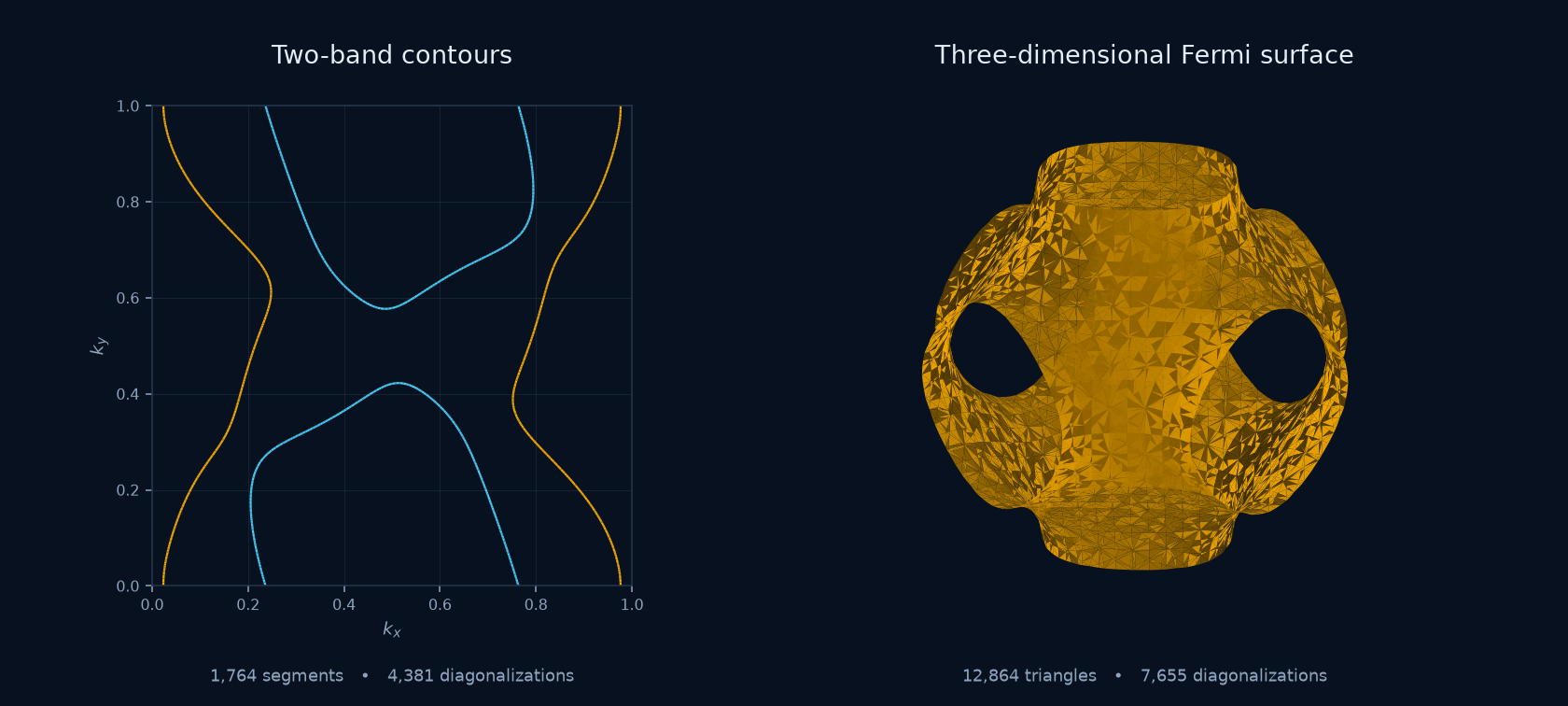
The same SpectralMesh can drive the other observables and reuse every
eigensystem it has already computed:
charge = mesh.integrate_charge(
    mu=0.17,
    target_error=1e-2,
    max_refinements=10_000,
    error_depth=2,
)
density = mesh.integrate_density_matrix(
    mu=0.17,
    lattice_vectors=[(0, 0, 0), (1, 0, 0)],
    target_error=1e-2,
    max_refinements=10_000,
)
selected_density = mesh.integrate_density_components(
    mu=0.17,
    lattice_vectors=[(0, 0, 0), (1, 0, 0)],
    components=[(0, 0, 0), (1, 0, 1)],
    target_error=1e-2,
)

charge.value
charge.stopping_error
charge.error_stats
density.matrices  # (number of lattice vectors, ndof, ndof)
selected_density.values  # follows the component request order

weights = mesh.occupied_weights(0.17)
mesh.points        # (active_vertices, ndim), read-only
mesh.simplices     # (active_simplices, ndim + 1), read-only
mesh.eigenvalues   # (active_vertices, ndof), read-only
mesh.eigenvectors  # (active_vertices, ndof, ndof), read-only
particle_number = weights.sum()
band_energy = np.sum(weights * mesh.eigenvalues)
projectors = np.einsum("vib,vjb->vbij", mesh.eigenvectors, mesh.eigenvectors.conj())
onsite_density = np.einsum("vb,vbij->ij", weights, projectors)
occupied_weights only uses cached eigensystems on the current active mesh;
it performs no Hamiltonian evaluations or refinement. If an active vertex
has not been cached yet, it raises instead of filling the cache implicitly.
For a tight-binding model,
$$ H(k)=\sum_R H_R e^{-2\pi i k\cdot R}, $$
pass {R: H_R, ...} directly to SpectralMesh. Opposite hoppings are checked
for $H_{-R}=H_R^\dagger$.
What is certified?
The direct certificate and Fermi-surface calculation ask whether occupation can
change inside a simplex. They combine vertex eigensystems with
curvature_bound, which limits the Hamiltonian between samples. With a valid
bound, separated occupied and empty trial subspaces prove fixed occupation.
- Certified: no Fermi surface crosses the simplex.
- Partially certified: rigorous lower and upper occupation bounds remain.
- Inconclusive: this is not a gapless verdict; FermiSimplex refines and tries again.
surface.coverage_certified concerns classification down to
min_feature_size, not topology or geometric accuracy. Charge and surface
classification share a quadratic occupation enclosure. A positive surface
curvature_bound supplies a uniform interpolation allowance. Omitting it,
None, or 0.0 uses a sampled remainder. Charge also samples its remainder.
For general Hamiltonians, features between probes can still be missed.
See the occupation design for the degree-four
polynomial guarantee, the Schur bound and the sampling limitations.
API at a glance
SpectralMesh: accept a callable or tight-binding dictionary and own the adaptive geometry and cached eigensystems.certify_simplex: certify supplied vertex eigenpairs directly; eigenvalues must be finite and ascending, and eigenvector columns must be finite and orthonormal. These performance-sensitive numerical preconditions are not rechecked.mesh.integrate_charge: adaptive filling and $dQ/d\mu$.mesh.estimate_charge_on_current_mesh: direct linear-simplex filling and $dQ/d\mu$ with no error estimation or refinement.mesh.points,mesh.simplices,mesh.eigenvalues, andmesh.eigenvectors: read-only snapshots of the current active mesh and its cached eigensystems.mesh.occupied_weights: current-mesh occupied barycentric weights.mesh.integrate_density_components: selected real-space density entries, requested as(lattice_vector_index, row, column).mesh.integrate_density_matrix: real-space density-matrix components.mesh.fermi_surface: band-labelled points and cells in reduced coordinates.
Adaptive controls are ordinary keyword arguments on the calculation that uses
them—there is no separate options object. Charge defaults to error_depth=2.
Each level permits one complete temporary subdivision into $2^d$
microsimplices on each unresolved branch; certified branches stop early.
Increasing the maximum depth subdivides the fixed quadratic model without
additional Hamiltonian samples or persistent mesh refinement.
charge.error_stats reports the resulting reductions, solves, eigensystems,
and temporary simplices.
Density integration follows charge integration on the same mesh. Full matrices
and selected entries use adaptive polynomial cubature:
start with Q3-Q1, raise the degree through seven by default, then bisect unresolved
density cells. The density tree preserves the charge cuts and does not change
the retained charge mesh. max_degree, max_refinements (promotions), and
max_h_refinements (bisections) bound the work; both refinement budgets are
unlimited by default. The reported quadrature error excludes remaining cut error.
estimate_density_on_current_mesh evaluates selected affine density moments
without refinement or an error estimate. Use it for an explicitly prescribed
mesh; it is not an adaptive integration method.
See the visual Python tour, runnable quick start, and two-band plotting example, the visual-generation notes, and the build and architecture guide.
Development
AdaptiveSimplex provides the mesh geometry, refinement, vertex caching, and cut-simplex integration; FermiSimplex adds the spectral models, certificates, and observable-specific algorithms.
pixi run test
This builds the standalone C++ library, verifies an installed downstream CMake consumer, rebuilds the Python extension, and runs the Python tests. The dense 60-band stress case lives in benchmarks/fermi_surface_60.py.
FermiSimplex is licensed under the BSD 3-Clause license. If you use it in research, please cite the metadata in CITATION.cff.
Reusing retained density-preview spectra
The points, simplices, eigenvalues and eigenvectors properties describe
only the active mesh. After density integration, use:
snapshot = mesh.evaluated_snapshot(include_eigenvectors=True)
cell_points = snapshot.points[snapshot.simplices]
cell_energies = snapshot.eigenvalues[snapshot.simplices]
print(snapshot.cached_vertices, snapshot.preview_vertices)
This independent read-only snapshot exports all cached full spectra, including preview points, and the finest complete already-evaluated partition. Export never evaluates the Hamiltonian, diagonalizes, or refines. Incomplete previews fall back to complete evaluated ancestors while their cached points remain available. A mesh without an evaluated covering raises an error. Exact dyadic coordinate keys support downstream midpoint/centroid deduplication. Temporary charge-error data is excluded. See the snapshot design for fields and guarantees. This API works with the existing AdaptiveSimplex dependency; no changes to AdaptiveSimplex are required.
Experimental quadratic occupation enclosure
mesh.integrate_charge(...) uses one quadratic matrix
model for occupation tests and charge error intervals. Inspect its per-simplex
results with mesh.occupation_enclosures(mu=...). Surface classification uses
the same enclosure. The remainder is sampled unless the inspection
API receives a valid uniform interpolation bound. See the
design and measured comparisons for assumptions,
limitations, numerical tests and runtime tradeoffs.
1 maintainer

Metadata
1 maintainer
Release files for FermiSimplex 0.2.0b2
For a detailed explanation of source distributions (sdists) and built distributions (wheels), please see the package formats documentation.
Source distribution (sdist)
| File | Size | Uploaded | Provenance | Actions |
|---|---|---|---|---|
| fermisimplex-0.2.0b2.tar.gz | 82.2 kB | With provenance | Details for fermisimplex-0.2.0b2.tar.gz |
Built distributions (wheels)
Total release size: 49.9 MB
Release files / fermisimplex-0.2.0b2.tar.gz
| Download URL | fermisimplex-0.2.0b2.tar.gz |
|---|---|
| Size | 82.2 kB |
| Tags | Source |
|
SHA-256 checksum How to use checksums |
245c7dd407544b4cfc6d38ceb71479264831db1bc4b7a9473b4ad3135f607ae1
|
|
BLAKE2b-256 checksum How to use checksums |
f0f47b4915a5cc6ad50dc618ad76c86121429f6e3dc10c228fe0e57f9d479635
|
| Upload date | |
|
Uploaded using Trusted Publishing? What is trusted publishing? |
Yes |
| Uploaded via |
twine/6.1.0 CPython/3.13.14
|
Provenance
Provenance describes where a file came from. On PyPI, provenance is shared via attestations, which provide a verifiable record of the build or publishing details. View details, limitations and caveats.


PyPI Publish Attestation
PyPI verified that this artifact, at this checksum, originated from the publisher listed below.
Signed by GitHub Actions, verified by PyPI on Oct 15, 2026.
Transparency logRelease files / fermisimplex-0.2.0b2-cp313-cp313-win_amd64.whl
| Download URL | fermisimplex-0.2.0b2-cp313-cp313-win_amd64.whl |
|---|---|
| Size | 6.9 MB |
| Tags | CPython 3.13 Windows x86-64 |
|
SHA-256 checksum How to use checksums |
a17ae2b04ca4edbcf58f06a5ec774eda82c850af0aaa27de19e7db17f1864e6b
|
|
BLAKE2b-256 checksum How to use checksums |
f38fcda9932a39cd9eb9d6606793377c404b762a7ecad02937dc8c04cee2d36a
|
| Upload date | |
|
Uploaded using Trusted Publishing? What is trusted publishing? |
Yes |
| Uploaded via |
twine/6.1.0 CPython/3.13.14
|
Provenance
Provenance describes where a file came from. On PyPI, provenance is shared via attestations, which provide a verifiable record of the build or publishing details. View details, limitations and caveats.
PyPI Publish Attestation
PyPI verified that this artifact, at this checksum, originated from the publisher listed below.
Signed by GitHub Actions, verified by PyPI on Oct 15, 2026.
Transparency logRelease files / fermisimplex-0.2.0b2-cp313-cp313-manylinux_2_27_x86_64.manylinux_2_28_x86_64.whl
| Download URL | fermisimplex-0.2.0b2-cp313-cp313-manylinux_2_27_x86_64.manylinux_2_28_x86_64.whl |
|---|---|
| Size | 9.2 MB |
| Tags | CPython 3.13 Linux glibc 2.27+ x86-64 Linux glibc 2.28+ x86-64 |
|
SHA-256 checksum How to use checksums |
57294182d593ea45e8a4aa0829850031b01edfac801140efed0af35c75ba3a71
|
|
BLAKE2b-256 checksum How to use checksums |
a7b904fd6ff62b10dc2711a80918577113b3b1a718bbbd494ab07ffcb980b5f2
|
| Upload date | |
|
Uploaded using Trusted Publishing? What is trusted publishing? |
Yes |
| Uploaded via |
twine/6.1.0 CPython/3.13.14
|
Provenance
Provenance describes where a file came from. On PyPI, provenance is shared via attestations, which provide a verifiable record of the build or publishing details. View details, limitations and caveats.
PyPI Publish Attestation
PyPI verified that this artifact, at this checksum, originated from the publisher listed below.
Signed by GitHub Actions, verified by PyPI on Oct 15, 2026.
Transparency logRelease files / fermisimplex-0.2.0b2-cp313-cp313-macosx_11_0_x86_64.whl
| Download URL | fermisimplex-0.2.0b2-cp313-cp313-macosx_11_0_x86_64.whl |
|---|---|
| Size | 267.0 kB |
| Tags | CPython 3.13 macOS 11.0+ x86-64 |
|
SHA-256 checksum How to use checksums |
b22ebed04425558ece20f032e8aa9c213c4f30188f4603133c2451c9708ec224
|
|
BLAKE2b-256 checksum How to use checksums |
13cea071c9f449d6717665a91ae474a7c51efe20df313e4cfa093719cca51f90
|
| Upload date | |
|
Uploaded using Trusted Publishing? What is trusted publishing? |
Yes |
| Uploaded via |
twine/6.1.0 CPython/3.13.14
|
Provenance
Provenance describes where a file came from. On PyPI, provenance is shared via attestations, which provide a verifiable record of the build or publishing details. View details, limitations and caveats.
PyPI Publish Attestation
PyPI verified that this artifact, at this checksum, originated from the publisher listed below.
Signed by GitHub Actions, verified by PyPI on Oct 15, 2026.
Transparency logRelease files / fermisimplex-0.2.0b2-cp313-cp313-macosx_11_0_arm64.whl
| Download URL | fermisimplex-0.2.0b2-cp313-cp313-macosx_11_0_arm64.whl |
|---|---|
| Size | 246.5 kB |
| Tags | CPython 3.13 macOS 11.0+ ARM64 |
|
SHA-256 checksum How to use checksums |
4707e6d688142533616e8b965d0e8b64c53c81479fc6504d5d83b6d38df16ae7
|
|
BLAKE2b-256 checksum How to use checksums |
5d4add4c525f19ddc3078e1b8508ee4dc555968a459da987fcd240144a10f585
|
| Upload date | |
|
Uploaded using Trusted Publishing? What is trusted publishing? |
Yes |
| Uploaded via |
twine/6.1.0 CPython/3.13.14
|
Provenance
Provenance describes where a file came from. On PyPI, provenance is shared via attestations, which provide a verifiable record of the build or publishing details. View details, limitations and caveats.
PyPI Publish Attestation
PyPI verified that this artifact, at this checksum, originated from the publisher listed below.
Signed by GitHub Actions, verified by PyPI on Oct 15, 2026.
Transparency logRelease files / fermisimplex-0.2.0b2-cp312-cp312-win_amd64.whl
| Download URL | fermisimplex-0.2.0b2-cp312-cp312-win_amd64.whl |
|---|---|
| Size | 6.9 MB |
| Tags | CPython 3.12 Windows x86-64 |
|
SHA-256 checksum How to use checksums |
72f7bef20e33263c0fb48ea11d4a13ce09f237ed97190846dff3db2c91a9783b
|
|
BLAKE2b-256 checksum How to use checksums |
6e553844fd8ca10197f26826072f3cbd38dcebf1446c2cbc3b796a16b951b327
|
| Upload date | |
|
Uploaded using Trusted Publishing? What is trusted publishing? |
Yes |
| Uploaded via |
twine/6.1.0 CPython/3.13.14
|
Provenance
Provenance describes where a file came from. On PyPI, provenance is shared via attestations, which provide a verifiable record of the build or publishing details. View details, limitations and caveats.
PyPI Publish Attestation
PyPI verified that this artifact, at this checksum, originated from the publisher listed below.
Signed by GitHub Actions, verified by PyPI on Oct 15, 2026.
Transparency logRelease files / fermisimplex-0.2.0b2-cp312-cp312-manylinux_2_27_x86_64.manylinux_2_28_x86_64.whl
| Download URL | fermisimplex-0.2.0b2-cp312-cp312-manylinux_2_27_x86_64.manylinux_2_28_x86_64.whl |
|---|---|
| Size | 9.2 MB |
| Tags | CPython 3.12 Linux glibc 2.27+ x86-64 Linux glibc 2.28+ x86-64 |
|
SHA-256 checksum How to use checksums |
f3401576bf50139c34d3211e0c0b6bcb09b23851907c2bac66be048949d60d0f
|
|
BLAKE2b-256 checksum How to use checksums |
e39b0c6dd8f2894ad603a8e4b6dbb515ec9a19cacfb26464d9ef5ad2f5d5efe5
|
| Upload date | |
|
Uploaded using Trusted Publishing? What is trusted publishing? |
Yes |
| Uploaded via |
twine/6.1.0 CPython/3.13.14
|
Provenance
Provenance describes where a file came from. On PyPI, provenance is shared via attestations, which provide a verifiable record of the build or publishing details. View details, limitations and caveats.
PyPI Publish Attestation
PyPI verified that this artifact, at this checksum, originated from the publisher listed below.
Signed by GitHub Actions, verified by PyPI on Oct 15, 2026.
Transparency logRelease files / fermisimplex-0.2.0b2-cp312-cp312-macosx_11_0_x86_64.whl
| Download URL | fermisimplex-0.2.0b2-cp312-cp312-macosx_11_0_x86_64.whl |
|---|---|
| Size | 267.0 kB |
| Tags | CPython 3.12 macOS 11.0+ x86-64 |
|
SHA-256 checksum How to use checksums |
e02001b64f6f3cb7f3d6512e04b7632f0a26071ac4a87a959239a3db6f418054
|
|
BLAKE2b-256 checksum How to use checksums |
83167dbef4e187c04624e9d432d9800b962d3a81a6805cb52ded202547860d25
|
| Upload date | |
|
Uploaded using Trusted Publishing? What is trusted publishing? |
Yes |
| Uploaded via |
twine/6.1.0 CPython/3.13.14
|
Provenance
Provenance describes where a file came from. On PyPI, provenance is shared via attestations, which provide a verifiable record of the build or publishing details. View details, limitations and caveats.
PyPI Publish Attestation
PyPI verified that this artifact, at this checksum, originated from the publisher listed below.
Signed by GitHub Actions, verified by PyPI on Oct 15, 2026.
Transparency logRelease files / fermisimplex-0.2.0b2-cp312-cp312-macosx_11_0_arm64.whl
| Download URL | fermisimplex-0.2.0b2-cp312-cp312-macosx_11_0_arm64.whl |
|---|---|
| Size | 246.5 kB |
| Tags | CPython 3.12 macOS 11.0+ ARM64 |
|
SHA-256 checksum How to use checksums |
9bb93c04b1b2817a9e2006c92c7fd546941cf7a08d6197d3f809f36eb7973ad7
|
|
BLAKE2b-256 checksum How to use checksums |
40cf3d860a5bce9ef4a1e62fcbef81ea2a02165deacee1874df737433d94394f
|
| Upload date | |
|
Uploaded using Trusted Publishing? What is trusted publishing? |
Yes |
| Uploaded via |
twine/6.1.0 CPython/3.13.14
|
Provenance
Provenance describes where a file came from. On PyPI, provenance is shared via attestations, which provide a verifiable record of the build or publishing details. View details, limitations and caveats.
PyPI Publish Attestation
PyPI verified that this artifact, at this checksum, originated from the publisher listed below.
Signed by GitHub Actions, verified by PyPI on Oct 15, 2026.
Transparency logRelease files / fermisimplex-0.2.0b2-cp311-cp311-win_amd64.whl
| Download URL | fermisimplex-0.2.0b2-cp311-cp311-win_amd64.whl |
|---|---|
| Size | 6.9 MB |
| Tags | CPython 3.11 Windows x86-64 |
|
SHA-256 checksum How to use checksums |
d85d4ce574803e6f58a1a2af2e031fffd9a9475c4db4f70c055234c3d6793024
|
|
BLAKE2b-256 checksum How to use checksums |
07fa9869daac633438d3e4de9c98f097e78c82894096e18fa3d0e4b1cd507e6c
|
| Upload date | |
|
Uploaded using Trusted Publishing? What is trusted publishing? |
Yes |
| Uploaded via |
twine/6.1.0 CPython/3.13.14
|
Provenance
Provenance describes where a file came from. On PyPI, provenance is shared via attestations, which provide a verifiable record of the build or publishing details. View details, limitations and caveats.
PyPI Publish Attestation
PyPI verified that this artifact, at this checksum, originated from the publisher listed below.
Signed by GitHub Actions, verified by PyPI on Oct 15, 2026.
Transparency logRelease files / fermisimplex-0.2.0b2-cp311-cp311-manylinux_2_27_x86_64.manylinux_2_28_x86_64.whl
| Download URL | fermisimplex-0.2.0b2-cp311-cp311-manylinux_2_27_x86_64.manylinux_2_28_x86_64.whl |
|---|---|
| Size | 9.2 MB |
| Tags | CPython 3.11 Linux glibc 2.27+ x86-64 Linux glibc 2.28+ x86-64 |
|
SHA-256 checksum How to use checksums |
d85bff898d6d7a72c196744d24c8e7fbbddf5804e1ca2b8ed9ca49601d16614e
|
|
BLAKE2b-256 checksum How to use checksums |
6a9c95bf6135a1ee16c255869e0566bcb67032853974c51090bda7b240066234
|
| Upload date | |
|
Uploaded using Trusted Publishing? What is trusted publishing? |
Yes |
| Uploaded via |
twine/6.1.0 CPython/3.13.14
|
Provenance
Provenance describes where a file came from. On PyPI, provenance is shared via attestations, which provide a verifiable record of the build or publishing details. View details, limitations and caveats.
PyPI Publish Attestation
PyPI verified that this artifact, at this checksum, originated from the publisher listed below.
Signed by GitHub Actions, verified by PyPI on Oct 15, 2026.
Transparency logRelease files / fermisimplex-0.2.0b2-cp311-cp311-macosx_11_0_x86_64.whl
| Download URL | fermisimplex-0.2.0b2-cp311-cp311-macosx_11_0_x86_64.whl |
|---|---|
| Size | 267.4 kB |
| Tags | CPython 3.11 macOS 11.0+ x86-64 |
|
SHA-256 checksum How to use checksums |
b9b0387efb8b9e3fe3bea3846ef8f7804ee5d3fdffdd0260784c750ed1916d38
|
|
BLAKE2b-256 checksum How to use checksums |
284f4508fb1cbfad7646bd335c896021ba3a6fa11804e437edfb5a75eee8735b
|
| Upload date | |
|
Uploaded using Trusted Publishing? What is trusted publishing? |
Yes |
| Uploaded via |
twine/6.1.0 CPython/3.13.14
|
Provenance
Provenance describes where a file came from. On PyPI, provenance is shared via attestations, which provide a verifiable record of the build or publishing details. View details, limitations and caveats.
PyPI Publish Attestation
PyPI verified that this artifact, at this checksum, originated from the publisher listed below.
Signed by GitHub Actions, verified by PyPI on Oct 15, 2026.
Transparency logRelease files / fermisimplex-0.2.0b2-cp311-cp311-macosx_11_0_arm64.whl
| Download URL | fermisimplex-0.2.0b2-cp311-cp311-macosx_11_0_arm64.whl |
|---|---|
| Size | 247.4 kB |
| Tags | CPython 3.11 macOS 11.0+ ARM64 |
|
SHA-256 checksum How to use checksums |
3f284bfc53149c8afdba331ffbf0c8660c8d8a17d5adde89425ab8db3a952338
|
|
BLAKE2b-256 checksum How to use checksums |
d8d89c8152d586f5f73f173b059925f6eb07761d30e3ec98792c6a81c7a2370d
|
| Upload date | |
|
Uploaded using Trusted Publishing? What is trusted publishing? |
Yes |
| Uploaded via |
twine/6.1.0 CPython/3.13.14
|
Provenance
Provenance describes where a file came from. On PyPI, provenance is shared via attestations, which provide a verifiable record of the build or publishing details. View details, limitations and caveats.
PyPI Publish Attestation
PyPI verified that this artifact, at this checksum, originated from the publisher listed below.
Signed by GitHub Actions, verified by PyPI on Oct 15, 2026.
Transparency logSecurity for FermiSimplex 0.2.0b2
Provenance
Provenance describes where a file came from. On PyPI, provenance is shared via attestations, which provide a verifiable record of the build or publishing details. View details, limitations and caveats.
Full provenance
All 13 files in this release have been uploaded with provenance metadata.
Attestation for fermisimplex-0.2.0b2.tar.gz
PyPI Publish Attestation
PyPI verified that this artifact, at this checksum, originated from the publisher listed below.
Signed by GitHub Actions, verified by PyPI on Oct 15, 2026.
Transparency logA note on package security
PyPI is a repository for distributing packages, not a service for auditing them. While third-party security researchers and our staff do their best to detect and remove malicious packages, PyPI cannot guarantee the quality, security or suitability of any given package.
To learn more about protecting yourself from malicious actors, visit our package security documentation.














