

HEACalculator







HEACalculator is a Python tool for calculating phenomenological parameters based on thermodynamics and physics to predict the formation of solid solutions in High Entropy Alloys (HEAs). It provides a CLI (Typer), a GUI (PyQt6), and a Python API.
Installation
Choose the workflow that matches how you want to use HEACalculator.
Add to a Project with uv
Use this when HEACalculator should be installed inside a project's environment.
uv add HEACalculator
uv add "HEACalculator[gui]"
Use as a Standalone Tool with uv
Use this when you want uv to manage HEACalculator as a CLI tool rather than a project dependency.
Persistent install:
uv tool install HEACalculator
HEACalculator --help
One-off run without installing permanently:
uvx HEACalculator search single FeCoCrNi
With GUI support:
uv tool install "HEACalculator[gui]"
HEACalculator gui
or
uvx --from "HEACalculator[gui]" HEACalculator gui
Install with pip
Use this if you are not using uv.
pip install HEACalculator          # CLI only
pip install "HEACalculator[gui]"   # with GUI support
Usage
Command Line Interface
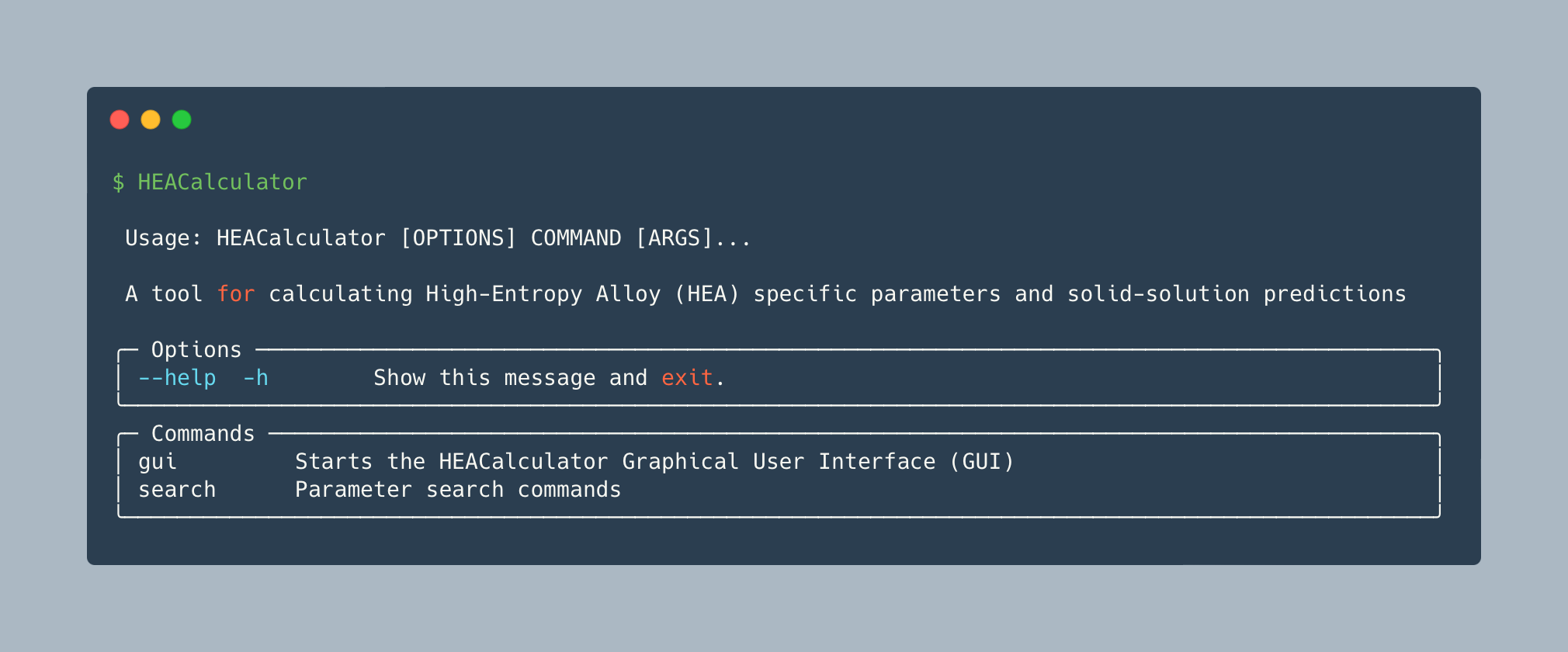
Run HEACalculator without arguments to display the help text.
Single Alloy Calculations
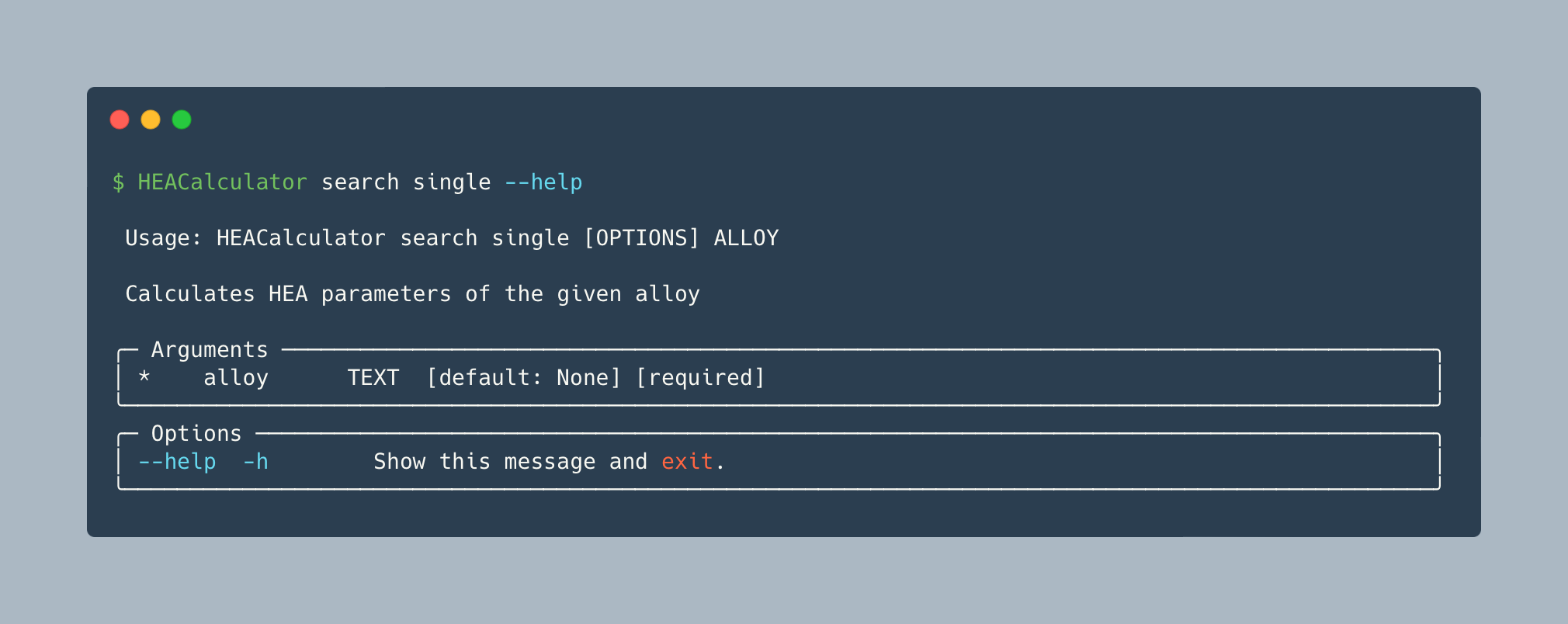
HEACalculator search single <ALLOY> calculates all parameters and predictions for the given alloy and prints results to stdout.
HEACalculator search single FeCoCrNi
Append --json to get a machine-readable JSON output with raw numeric values instead of formatted text:
HEACalculator search single FeCoCrNi --json
Range Screening
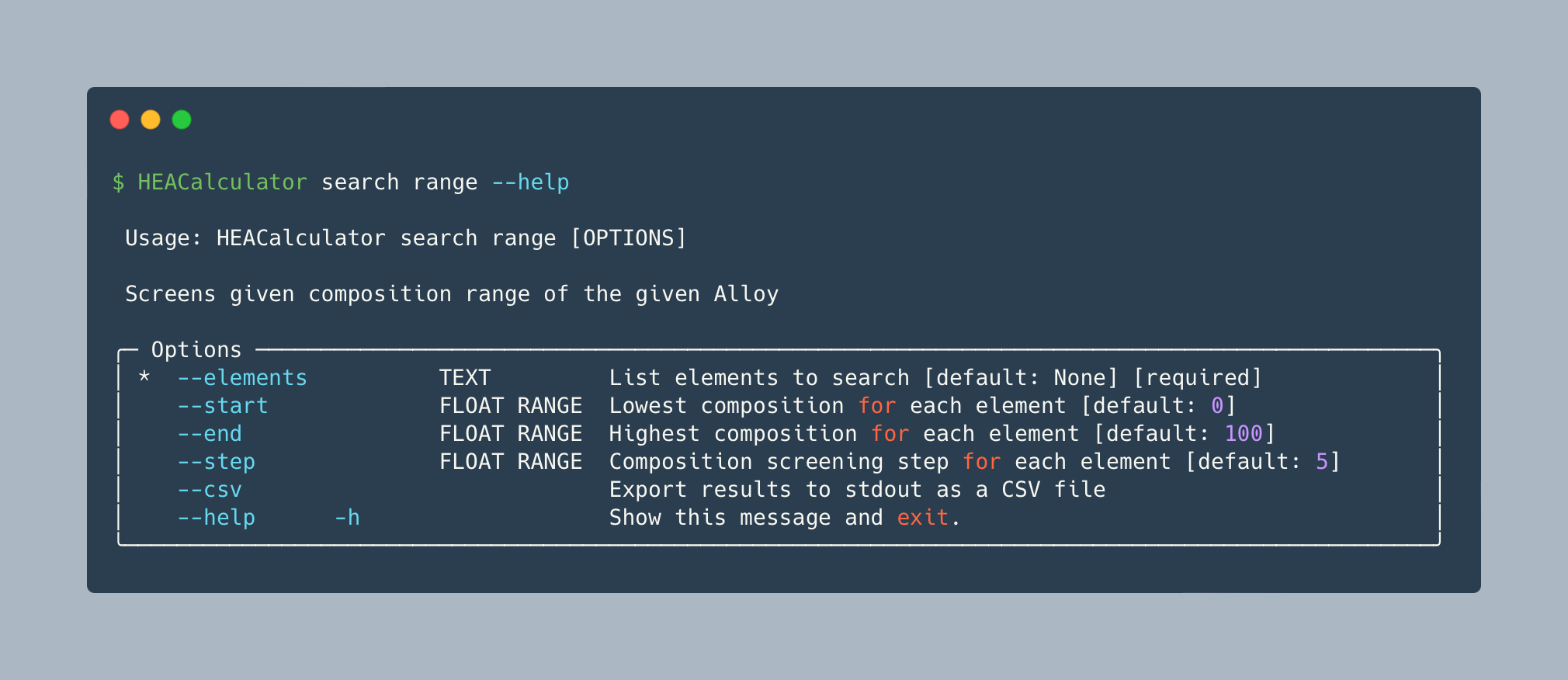
HEACalculator search range calculates all parameters and predictions for a composition range over a set of elements. Compositions are evaluated in parallel across all available CPU cores, so large screens complete significantly faster.
HEACalculator search range --elements "Al Ti V" --start 0 --end 100 --step 5
Append --csv or --json to get CSV or newline-delimited JSON instead of formatted text, and redirect it to a file with >:
HEACalculator search range --elements "Al Ti V" --start 0 --end 100 --step 5 --csv > results.csv
HEACalculator search range --elements "Al Ti V" --start 0 --end 100 --step 5 --json > results.ndjson
CSV Batch Calculations
HEACalculator search csv <FILE> calculates all parameters and predictions for every alloy listed in a CSV file.
HEACalculator search csv alloys.csv
If your CSV uses a different column name, override it with --column/-c:
HEACalculator search csv alloys.csv --column Alloy
Append --json to get newline-delimited JSON (one object per alloy) instead of CSV rows:
HEACalculator search csv alloys.csv --json
Graphical User Interface
HEACalculator gui
The GUI has two pages, switched via the navigation buttons on the left:
Parameters page (single alloy)
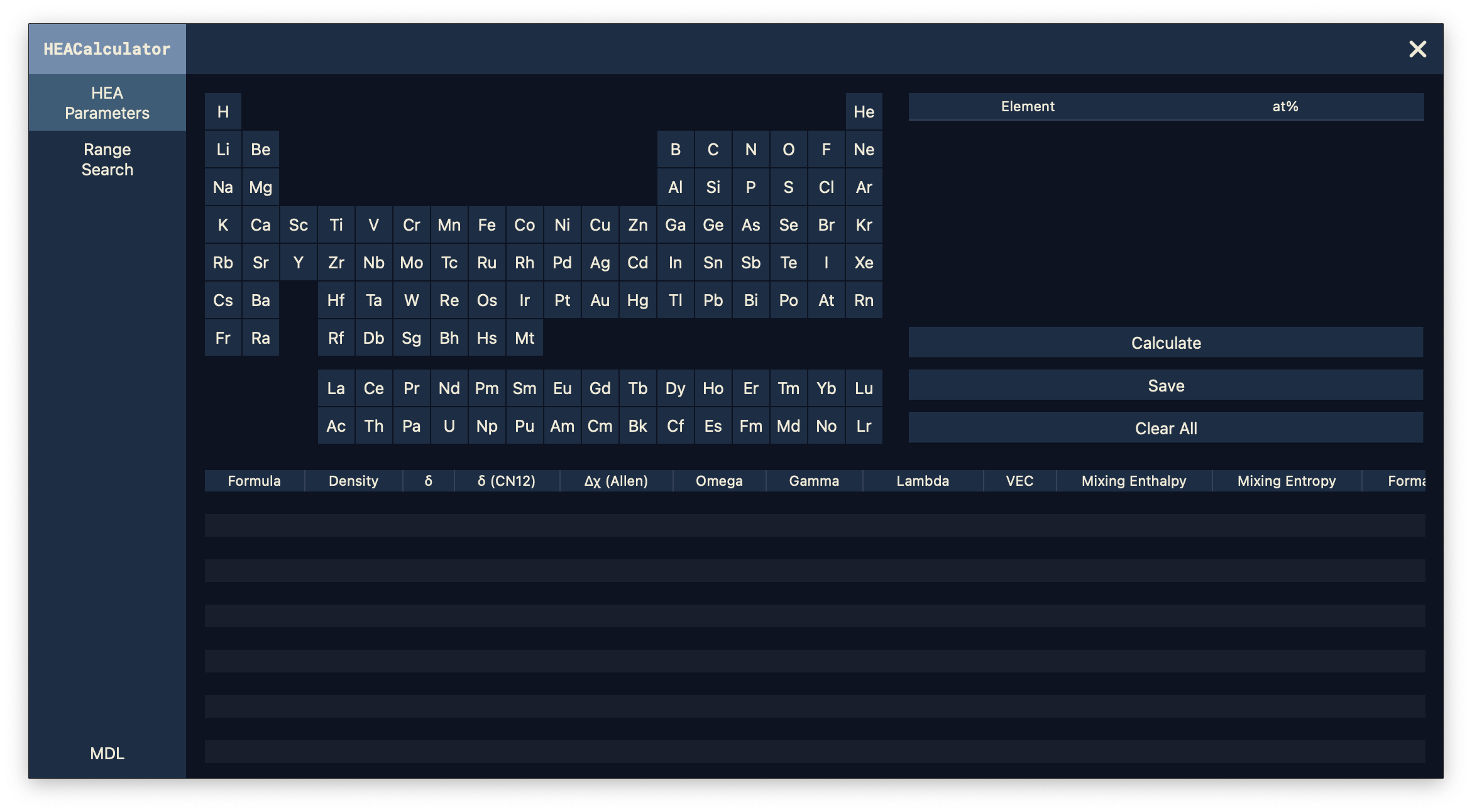
- Select elements from the periodic table (percentages are distributed equally by default)
- Adjust the at% values in the composition table as needed
- Click Calculate
- Click Save to export results as CSV
Batch Calculations page (range screening)
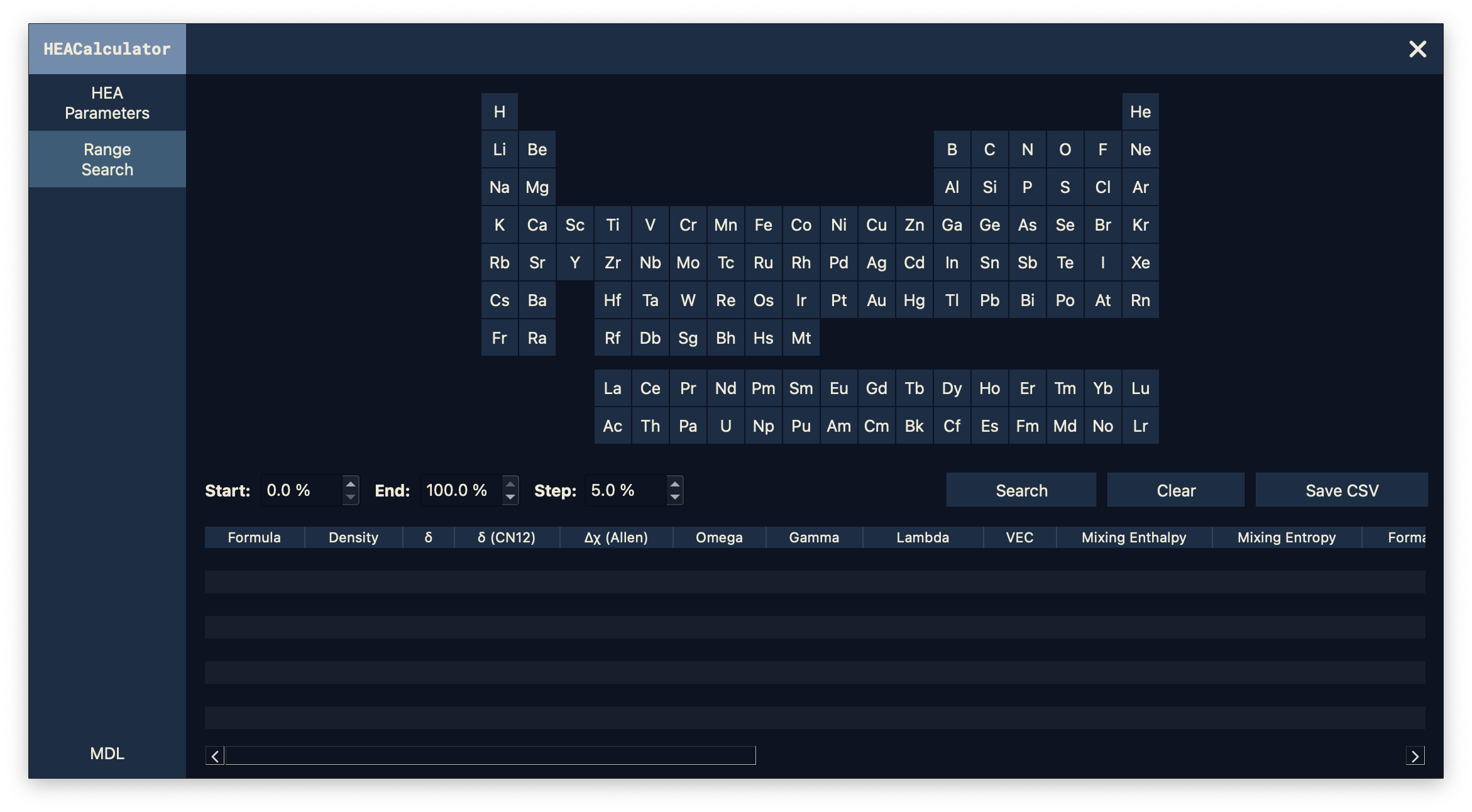
Equivalent to search range.
- Select elements from the periodic table
- Set the composition range and step size
- Click Search
- Click Save to export results as CSV
Python API
HEACalculator can also be imported as a library. The CLI and GUI both use the same HEACalculator class.
Single Alloy Calculations
HEACalculator(<ALLOY>) calculates all parameters and predictions for the given alloy. Printing it gives the same report as search single.
from HEACalculator import HEACalculator

hea = HEACalculator("FeCoCrNi")
print(hea)
Individual properties are available through hea.thermo, and solid solution predictions through hea.predictor:
hea.thermo.mixing_enthalpy                 # -3.75 kJ/mol
hea.thermo.mixing_entropy                  # 11.53 J/K.mol
hea.thermo.valence_electron_concentration  # 8.25
hea.thermo.omega                           # 5.75
hea.thermo.omega_at(800)                   # Omega at 800 K

hea.predictor.microstructure               # "FCC"
hea.predictor.model_1                      # "Solid Solution"
hea.predictor.model_7()                    # method, accepts optional parameters
Use get_dict() to get raw numeric values, the same data as --json. NaN values are returned as None:
import json

json.dumps(hea.get_dict())
Range Screening
HEACalculator.screen calculates many alloys in parallel. It takes a list of formulas or the output of find_all_comps, which generates the same compositions as search range. By default it uses all CPU cores; set n_workers to limit this. It yields fully calculated HEACalculator objects in input order.
import pandas as pd

from HEACalculator import HEACalculator
from HEACalculator.utils import find_all_comps

if __name__ == "__main__":  # required by multiprocessing on macOS and Windows
    compositions = find_all_comps("Al Ti V", start=0, end=100, step=5)
    results = pd.DataFrame(calc.get_dict() for calc in HEACalculator.screen(compositions, n_workers=4))
Features
-
Property calculations
-
Parameters and predictions
- Expected Microstructure 6
- Delta Parameter (Atomic Size Difference) 7 8
- Delta Parameter (CN12 Atomic Size Difference) 7 9
- Electronegativity Difference (Allen CE scale) 10 11
- Electronegativity Difference (Pauling scale) 12
- Omega Parameter 13
- Gamma Parameter 14
- Lambda Parameter 15
- Phi Parameter 16 17 18
- Solid Solution Prediction Models
License
This project is licensed under the GNU GPLv3 License. See the LICENSE file for details.
Citation
If you use HEACalculator in your research, please cite the following:
Sarıtürk, D., Kalay, Y. E., & Arróyave, R. (2026). HEACalculator: An Open-Source Python Tool for Thermodynamic Property Calculation and Solid Solution Prediction in High-Entropy Alloys. arXiv. https://doi.org/10.48550/arXiv.2606.19661
Sarıtürk, D. (2019). HEACalculator. Zenodo. https://doi.org/10.5281/zenodo.3590318
BibTeX:
@misc{sariturk_2026_arxiv,
  author    = {Sarıtürk, Doğuhan and Kalay, Yunus Eren and Arróyave, Raymundo},
  title     = {{HEACalculator}: An Open-Source {Python} Tool for Thermodynamic Property Calculation and Solid Solution Prediction in High-Entropy Alloys},
  year      = 2026,
  publisher = {arXiv},
  doi       = {10.48550/arXiv.2606.19661},
  url       = {https://doi.org/10.48550/arXiv.2606.19661},
}

@software{sariturk_2019_3590318,
  author    = {Sarıtürk, Doğuhan},
  title     = {HEACalculator},
  year      = 2019,
  publisher = {Zenodo},
  doi       = {10.5281/zenodo.3590318},
  url       = {https://doi.org/10.5281/zenodo.3590318},
}
-
Zhang, Y.; Zuo, T.T.; Tang, Z.; Gao, M.C.; Dahmen, K.A.; Liaw, P.K.; Lu, Z.P. Prog. Mater. Sci. 2014, 61, 1–93. ↩
-
Takeuchi, A.; Inoue, A. Mater. Trans. 2005, 46(12), 2817–2829. ↩
-
King, D.J.M.; Middleburgh, S.C.; McGregor, A.G.; Cortie, M.B. Acta Mater. 2016, 104, 172–179. ↩ ↩2
-
Troparevsky, M.C.; Morris, J.R.; Kent, P.R.C.; Lupini, A.R.; Stocks, G.M. Phys. Rev. X 2015, 5(1), 011041. ↩ ↩2
-
Hume-Rothery, W.; Smallman, R.E.; Haworth, C.W. The Structure of Metals and Alloys, 5th ed.; Institute of Metals: London, 1969. ↩
-
Guo, S.; Ng, C.; Lu, J.; Liu, C.T. J. Appl. Phys. 2011, 109, 103505. ↩
-
Fang, S.S.; Xiao, X.S.; Xia, L.; Li, W.H.; Dong, Y.D. J. Non-Cryst. Solids 2003, 321, 120–125. ↩ ↩2
-
Guo, S.; Liu, C.T. Prog. Nat. Sci.: Mater. Int. 2011, 21, 433–446, Table 1. ↩
-
Kittel, C. Introduction to Solid State Physics, 8th ed.; Wiley, 2005; Chapter 3, Table 9. ↩
-
Mann, J.B.; Meek, T.L.; Allen, L.C. J. Am. Chem. Soc. 2000, 122, 2780–2783. ↩
-
Mann, J.B.; Meek, T.L.; Knight, E.T.; Capitani, J.F.; Allen, L.C. J. Am. Chem. Soc. 2000, 122, 5132–5137. ↩
-
Haynes, W.M. CRC Handbook of Chemistry and Physics, 95th ed.; CRC Press: Boca Raton, FL, 2014. ISBN 9781482208689. ↩
-
Yang, X.; Zhang, Y. Mater. Chem. Phys. 2012, 132, 233–238. ↩ ↩2
-
Wang, Z.; Huang, Y.; Yang, Y.; Wang, J.; Liu, C.T. Scr. Mater. 2015, 94, 28–31. ↩ ↩2
-
Singh, A.K.; Kumar, N.; Dwivedi, A.; Subramaniam, A. Intermetallics 2014, 53, 112–119. ↩ ↩2
-
Ye, Y.F.; Wang, Q.; Lu, J.; Liu, C.T.; Yang, Y. Scr. Mater. 2015, 104, 53–55. ↩ ↩2
-
Ye, Y.F.; Wang, Q.; Lu, J.; Liu, C.T.; Yang, Y. Intermetallics 2015, 59, 75–80. ↩
-
Mansoori, G.A.; Carnahan, N.F.; Starling, K.E.; Leland, T.W., Jr. J. Chem. Phys. 1971, 54, 1523–1525. ↩
-
Guo, S.; Hu, Q.; Ng, C.; Liu, C.T. Intermetallics 2013, 41, 96–103. ↩
-
Senkov, O.N.; Miracle, D.B. J. Alloys Compd. 2016, 658, 603–607. ↩
1 maintainer

Metadata
1 maintainer
Release files for HEACalculator 2.2.0
For a detailed explanation of source distributions (sdists) and built distributions (wheels), please see the package formats documentation.
Source distribution (sdist)
| File | Size | Uploaded | |
|---|---|---|---|
| heacalculator-2.2.0.tar.gz | 662.5 kB | Details |
Built distribution (wheel)
| File | Interpreter | ABI | Platform | Reset |
|---|---|---|---|---|
| heacalculator-2.2.0-py3-none-any.whl | Python 3 | none | any | Details |
Total release size: 1.0 MB
Release files / heacalculator-2.2.0.tar.gz
| Download URL | heacalculator-2.2.0.tar.gz |
|---|---|
| Size | 662.5 kB |
| Tags | Source |
|
SHA-256 checksum How to use checksums |
e1facddfe399338c1cf9c3ecdfad679665d41f9d7c3eb94b2d32f12364dd8dd7
|
|
BLAKE2b-256 checksum How to use checksums |
d459dbd5e9ac02c5762c90d376b7aab72e47e392851092a5d8bf958641917593
|
| Upload date | |
|
Uploaded using Trusted Publishing? What is trusted publishing? |
Yes |
| Uploaded via |
uv/0.12.19 {"installer":{"name":"uv","version":"0.12.19","subcommand":["publish"]},"python":null,"implementation":{"name":null,"version":null},"distro":{"name":"Ubuntu","version":"24.04","id":"noble","libc":null},"system":{"name":null,"release":null},"cpu":null,"openssl_version":null,"setuptools_version":null,"rustc_version":null,"ci":true}
|
Release files / heacalculator-2.2.0-py3-none-any.whl
| Download URL | heacalculator-2.2.0-py3-none-any.whl |
|---|---|
| Size | 344.3 kB |
| Tags | Python 3 |
|
SHA-256 checksum How to use checksums |
1912ccfb31c850bed76e80ed5ffdd50db7b7d41b76aa7f6ec939b9888ab66dda
|
|
BLAKE2b-256 checksum How to use checksums |
3149762163f42622a8f76090633b1aa1a6b3c2c5c0fe52dd25eba917e3360720
|
| Upload date | |
|
Uploaded using Trusted Publishing? What is trusted publishing? |
Yes |
| Uploaded via |
uv/0.12.19 {"installer":{"name":"uv","version":"0.12.19","subcommand":["publish"]},"python":null,"implementation":{"name":null,"version":null},"distro":{"name":"Ubuntu","version":"24.04","id":"noble","libc":null},"system":{"name":null,"release":null},"cpu":null,"openssl_version":null,"setuptools_version":null,"rustc_version":null,"ci":true}
|














