
Hackadash
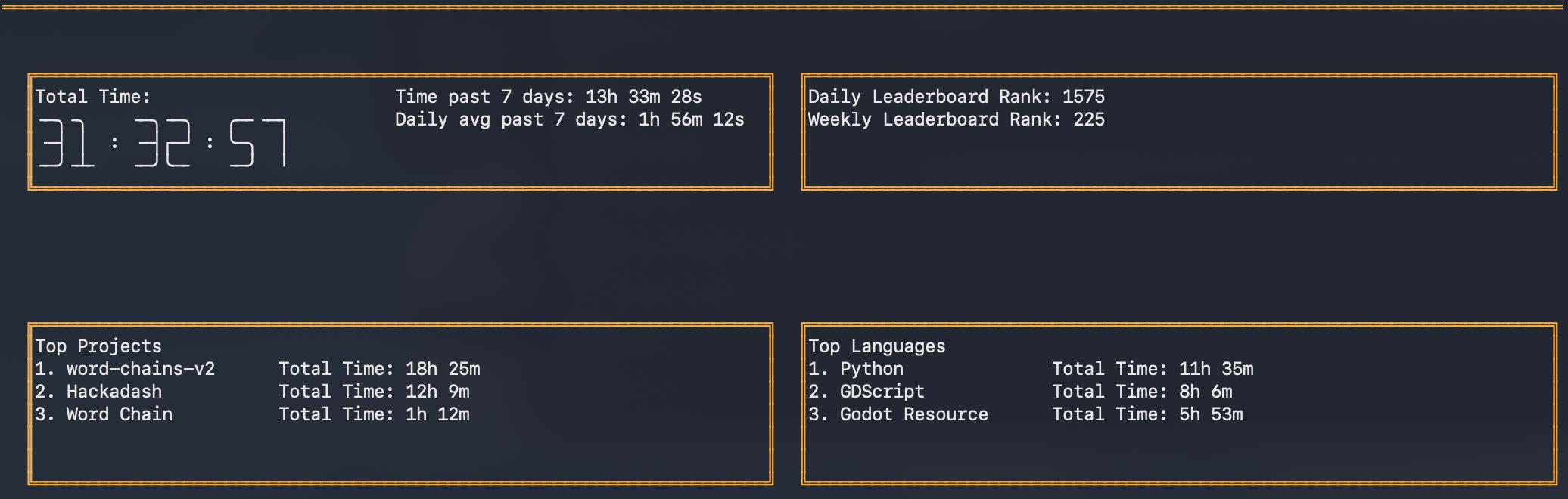
A customizable dash board for hackatime in your terminal! Built with Textual, an amazing TUI framework!
Installation & Running
Follow these steps to install hackadash:
Installing from PyPI
pip install Hackadash
Installing repo for editing
Follow these steps if you want to edit hackadash:
1. Clone the repository
git clone https://github.com/Chiken502/Hackadash
cd hackadash
2. Set up a virtual environment
python -m venv .venv

# On macOS/Linux:
source .venv/bin/activate

# On Windows:
.venv\Scripts\activate
3. Install the package
Install the repository locally in editable mode so your CLI shortcut is registered:
pip install -e .
Running the app
Now you can start the application from anywhere in your terminal by running:
hackadash
Enter Hackatime API Key
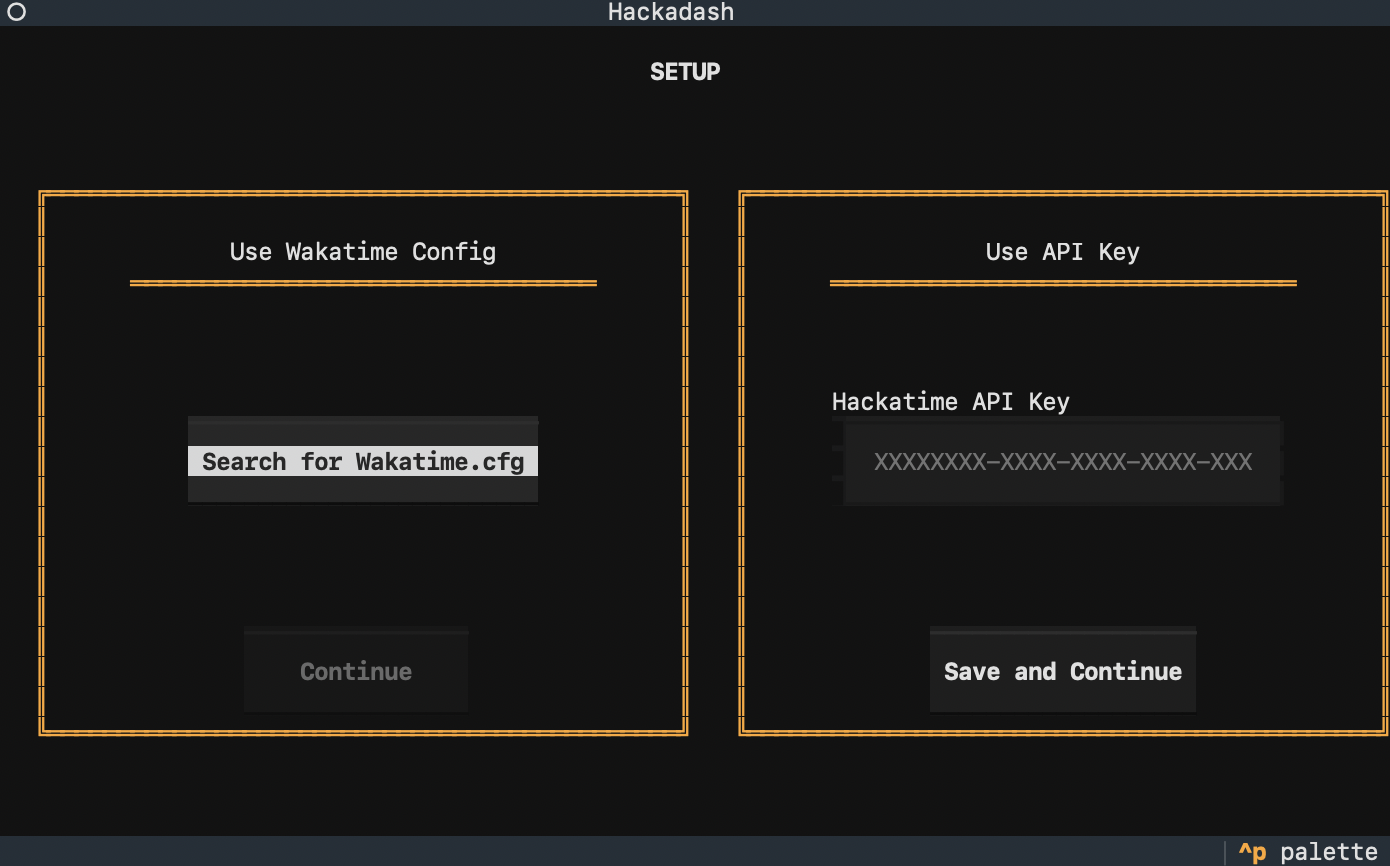
Select one of the two given options to continue. This step gets your hackatime API Key so that Hackadash can send API requests for the data it displays. On this screen you are presented with two options.
- Option 1: Use Wakatime Config (recomended)
- Hackadash will then look for the
.wakatime.cfg, that all hackatime applications use, in your home directory. If it finds the file, then it will read the API Key from it and your good to go. If it can't find the.wakatime.cfgfile then you will have to use option 2.
- Hackadash will then look for the
- Option 2: Manualy Input API Key
- Find your API Key in Hackatime settings. Then copy paste the key into the text box, and hit save and continue.
Features
- Manual api_key input or automatic search for
.wakatime.cfg - Total Coding Time
- Weekly and Daily Leaderbaord placements
- Average coding time in the last 7 days
- Top 3 projects and the respective times
- Top 3 languages and the respective times
- Data Refreshing
- Time range switching to veiw times, projects, and languages for time ranges of total, weekly or today.
- Hackatime username and ID
- Customizable Themes! (Just comes with Textual! use
^porcmd + pto open the menu)
Hackadash Bindings

- r: Refresh the API data
- s: Switch the time frame. Cycles through total, weekly, today
- c: Close Hackadash
1 maintainer

Metadata
1 maintainer
Release files for Hackadash 1.0.3
For a detailed explanation of source distributions (sdists) and built distributions (wheels), please see the package formats documentation.
Source distribution (sdist)
| File | Size | Uploaded | |
|---|---|---|---|
| hackadash-1.0.3.tar.gz | 7.3 kB | Details |
Built distribution (wheel)
| File | Interpreter | ABI | Platform | Reset |
|---|---|---|---|---|
| hackadash-1.0.3-py3-none-any.whl | Python 3 | none | any | Details |
Total release size: 16.0 kB
Release files / hackadash-1.0.3.tar.gz
| Download URL | hackadash-1.0.3.tar.gz |
|---|---|
| Size | 7.3 kB |
| Tags | Source |
|
SHA-256 checksum How to use checksums |
3c33edf8643948b023d6abd041622760131f0f6a3da992d8881095fef7b97221
|
|
BLAKE2b-256 checksum How to use checksums |
7b6877ef9d542919d64ab790ea2b1f8258ea63a3ff288004b9802370eefb3a8c
|
| Upload date | |
|
Uploaded using Trusted Publishing? What is trusted publishing? |
Yes |
| Uploaded via |
twine/7.0.0 CPython/3.13.14
|
Provenance
Provenance describes where a file came from. On PyPI, provenance is shared via attestations, which provide a verifiable record of the build or publishing details. View details, limitations and caveats.


PyPI Publish Attestation
PyPI verified that this artifact, at this checksum, originated from the publisher listed below.
Signed by GitHub Actions, verified by PyPI on Sep 20, 2026.
Transparency logRelease files / hackadash-1.0.3-py3-none-any.whl
| Download URL | hackadash-1.0.3-py3-none-any.whl |
|---|---|
| Size | 8.7 kB |
| Tags | Python 3 |
|
SHA-256 checksum How to use checksums |
026e878316135e12fa7705093b10a79eccd91230b0a915e6dfc7daf71f758fea
|
|
BLAKE2b-256 checksum How to use checksums |
a1752b8872e046572bc274c08aa50ecfef6bb3d3429af1dd04fa15e3839a762f
|
| Upload date | |
|
Uploaded using Trusted Publishing? What is trusted publishing? |
Yes |
| Uploaded via |
twine/7.0.0 CPython/3.13.14
|
Provenance
Provenance describes where a file came from. On PyPI, provenance is shared via attestations, which provide a verifiable record of the build or publishing details. View details, limitations and caveats.
PyPI Publish Attestation
PyPI verified that this artifact, at this checksum, originated from the publisher listed below.
Signed by GitHub Actions, verified by PyPI on Sep 20, 2026.
Transparency log













