
HyperFlow: Next-Generation Computational Framework for Machine Learning & Deep Learning

Project description
HyperFlow: Next-Generation Computational Framework for Machine Learning & Deep Learning
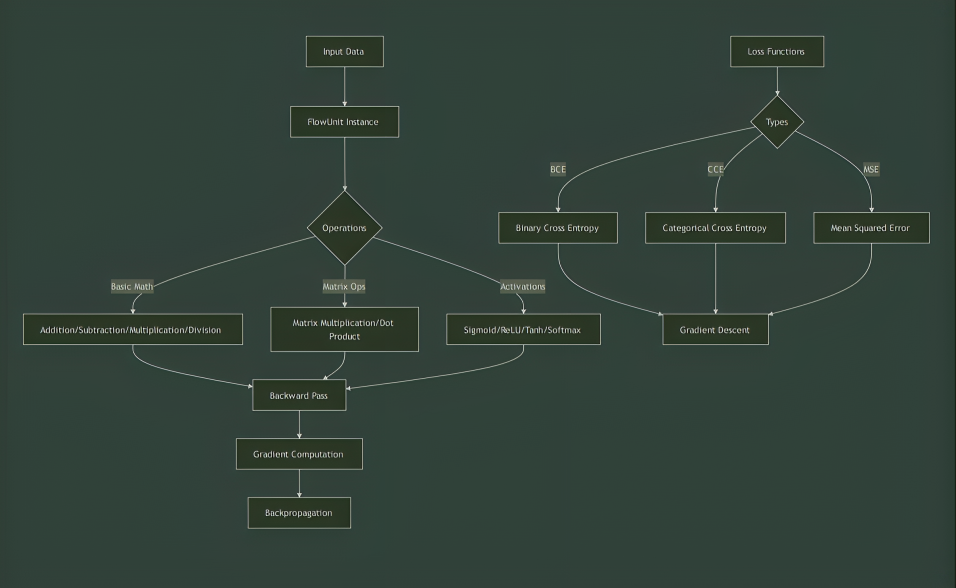
🚀 Introduction
HyperFlow is an advanced computational framework designed to enhance machine learning and deep learning research. At its core is the FlowUnit class, an optimized and modular implementation supporting:
- 🔢 Mathematical operations
- ⚙️ Activation functions
- 📉 Optimization techniques
- 🔄 Backpropagation
HyperFlow provides simplicity and power, making it ideal for understanding neural networks, automatic differentiation, and optimization techniques.
🎯 Inspiration
Inspired by Micrograd by Andrej Karpathy, HyperFlow extends its capabilities by offering:
- 🚀 Advanced mathematical operations
- 🎯 Broader activation function support
- ⚡ Optimized backpropagation
- 🔍 Enhanced modularity
It serves as a lightweight yet powerful alternative to complex deep learning frameworks like PyTorch.
💡 Why HyperFlow?
✅ Lightweight & Transparent – Focuses on raw Python implementations to help understand ML/DL concepts.
⚡ Efficient & Optimized – Uses map functions for better performance.
🔧 Flexible & Powerful – Supports neural networks, including backpropagation.
📉 Minimal NumPy Dependency – Encourages learning without excessive reliance on pre-built libraries.
🔑 Core Functionalities
🔢 Mathematical Operations
create2darray,convert2darray,add,sub,mul,matmul,dot,pow
⚙️ Activation Functions
sigmoid,tanh,ReLU,Leaky ReLU,softmax
📉 Loss Functions
categorical_cross_entropy,binary_cross_entropy,mse_loss
🔄 Optimization & Backpropagation
backpropagate,gradient_descent
🧠 Neural Network Implementation
The Neuron.py module simplifies the creation of:
- 🏗 Neurons
- 🔗 Layers
- 🏛 Complete Neural Networks
This module offers full control over weights, biases, and architecture for in-depth experimentation.
📌 Examples & Outputs
✅ Dot Product Calculation
from hyperflow import FlowUnit

a = FlowUnit([1, 2, 3])
b = FlowUnit([4, 5, 6])

result = a.__dot__(b)
print(f"Dot product result: {result.data}")
Output:
Dot product result: 32
🔄 Backpropagation Test
def test_backpropagation():
    x = FlowUnit(2.0)
    y = FlowUnit(-3.0)
    z = FlowUnit(1.5)

    a = x.sigmoid()
    b = y.tanh()
    c = z.relu()
    d = x.leaky_relu()

    loss = a + b + c + d
    loss.backpropagate()

    print(f"x.grad: {x.grad}")
    print(f"y.grad: {y.grad}")
    print(f"z.grad: {z.grad}")

test_backpropagation()
Output:
x.grad: 1.1049935854035067
y.grad: 0.00986603716543999
z.grad: 1.0
🔢 Activation Function Tests
def test_flow_unit_functions():
    data = np.array([1.0, 2.0, 3.0])
    flow_unit = FlowUnit(data)

    sigmoid_out = flow_unit.sigmoid()
    print("Sigmoid Output:", sigmoid_out.data)

    tanh_out = flow_unit.tanh()
    print("Tanh Output:", tanh_out.data)

    relu_out = flow_unit.relu()
    print("ReLU Output:", relu_out.data)

    leaky_relu_out = flow_unit.leaky_relu(alpha=0.01)
    print("Leaky ReLU Output:", leaky_relu_out.data)

    softmax_out = flow_unit.softmax()
    print("Softmax Output:", softmax_out.data)

test_flow_unit_functions()
Output:
Sigmoid Output: [0.731 0.880 0.952]
Tanh Output: [0.761 0.964 0.995]
ReLU Output: [1.0 2.0 3.0]
Leaky ReLU Output: [1.0 2.0 3.0]
Softmax Output: [0.090 0.244 0.665]
📉 Loss Function Tests
def test_loss_functions():
    logits = FlowUnit(np.array([2.0, 1.0, 0.1]))
    target = [1, 0, 0]

    cce_loss = LossFunctions.categorical_cross_entropy(logits, target)
    print("Categorical Cross-Entropy Loss:", cce_loss.data)

    inputs = FlowUnit(np.array([[1.0, 2.0], [3.0, 4.0]]))
    target = FlowUnit(np.array([1, 0]))
    parameters = (FlowUnit(np.array([0.5, -0.5])), FlowUnit(0.1))

    bce_loss = LossFunctions.binary_cross_entropy_loss(inputs, target, parameters)
    print("Binary Cross-Entropy Loss:", bce_loss.data)

test_loss_functions()
Output:
Categorical Cross-Entropy Loss: 0.417
Binary Cross-Entropy Loss: [0.715]
📚 Explore More Use Cases
Find more examples and use cases in the GitHub repository.
Release history Release notifications | RSS feed

Download files
Download the file for your platform. If you're not sure which to choose, learn more about installing packages.
Source Distribution
Built Distribution
Filter files by name, interpreter, ABI, and platform.
If you're not sure about the file name format, learn more about wheel file names.
Copy a direct link to the current filters
File details
Details for the file hyperflow_package-1.0.0.tar.gz.
File metadata
- Download URL: hyperflow_package-1.0.0.tar.gz
- Upload date:
- Size: 11.5 kB
- Tags: Source
- Uploaded using Trusted Publishing? No
- Uploaded via: twine/6.1.0 CPython/3.12.6
File hashes
| Algorithm | Hash digest | |
|---|---|---|
| SHA256 |
3d489de391adcca4f1f348655a6fdd970894c0b7caf3abe9b2bb39c22b81fd57
|
|
| MD5 |
116f578f00875dc99cdab6bfab183a74
|
|
| BLAKE2b-256 |
6998343e627712184e7216707476407ca03422127c044bbd31822bc16c045e6f
|
File details
Details for the file HyperFlow_Package-1.0.0-py3-none-any.whl.
File metadata
- Download URL: HyperFlow_Package-1.0.0-py3-none-any.whl
- Upload date:
- Size: 12.1 kB
- Tags: Python 3
- Uploaded using Trusted Publishing? No
- Uploaded via: twine/6.1.0 CPython/3.12.6
File hashes
| Algorithm | Hash digest | |
|---|---|---|
| SHA256 |
8dfb40fa0e8904cc7ffa11e6acd71418603a3f7c43b33a21709953c1a8f5b583
|
|
| MD5 |
21f0f2b233ff67c8e34fe47d99fe06bf
|
|
| BLAKE2b-256 |
b2c5aeda8ea46f1f110279139c560b9836d86d0ae02b8e3b499c61f6288ea0cd
|






