
Label Augmented Modality Agnostic Registration: A Python-based workflow combining deep learning-based segmentation and numerical solutions to generate precise warpfields between different MRI modalities.

Project description
LAMAReg: Label Augmented Modality Agnostic Registration





We introduced a novel approach for more accurate registration between modalities. This python based workflow combines deep learning-based segmentation and numerical solutions (ANTs) to generate precise warpfields, even for modalities with low signal-to-noise ratio, signal dropout and strong geometric distortions, such as diffusion MRI and fMRI acquisitions.
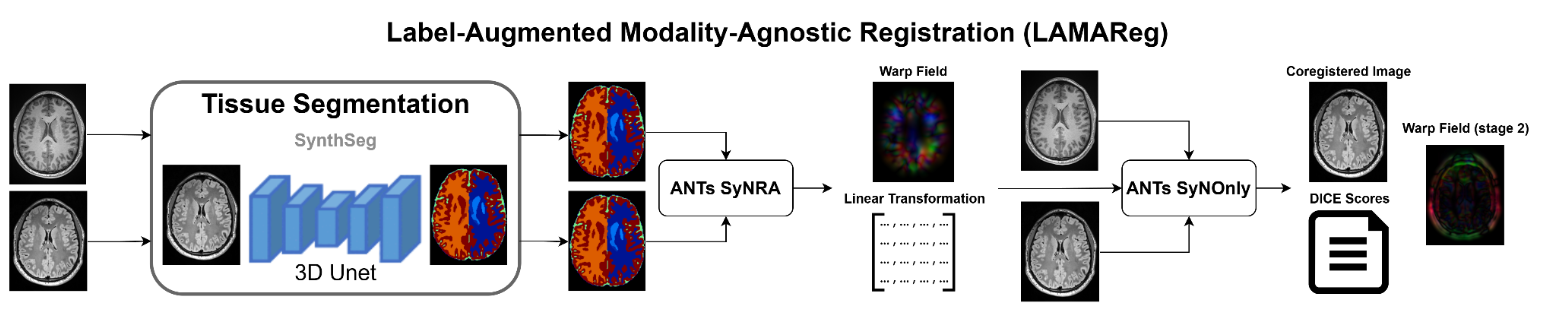
Overview
LAMAReg provides contrast-agnostic registration between different MRI modalities by using SynthSeg's brain parcellation to enable robust alignment between images with different contrasts (e.g., T1w to T2w, FLAIR to T1w, DWI to T1w).
This Python-based workflow combines deep learning-based segmentation (SynthSeg) and numerical optimization (ANTs) to generate precise warpfields, even for modalities with low signal-to-noise ratio, signal dropout, and strong geometric distortions, such as diffusion MRI and fMRI acquisitions.
!lamar_workflow
Installation
pip install -e .
Workflows
LAMAReg offers three main workflows and direct access to individual tools:
1. Full Registration Pipeline
Parcellate both input images, register them, and apply the transformation:
lamar register [options]
2. Generate Warpfield Only
Create warpfields without applying them to the input image:
lamar generate-warpfield [options]
3. Apply Existing Warpfield
Apply previously created warpfields to an input image:
lamar apply-warpfield [options]
4. Direct Tool Access
Run individual components directly:
lamar synthseg [options]      # Run SynthSeg brain parcellation
lamar coregister [options]    # Run ANTs coregistration
lamar apply-warp [options]    # Apply transformations
lamar dice-compare [options]  # Calculate Dice similarity coefficient
Command-Line Arguments
Full Registration
Required Arguments:
--moving PATH: Input image to be registered--fixed PATH: Reference image (target space)--output PATH: Output registered image--moving-parc PATH: Path for moving image parcellation--fixed-parc PATH: Path for fixed image parcellation--registered-parc PATH: Path for registered parcellation--affine PATH: Path for affine transformation--warpfield PATH: Path for warp field
Optional Arguments:
--registration-method STR: Registration method (default: SyNRA)--synthseg-threads N: SynthSeg threads (default: 1)--ants-threads N: ANTs threads (default: 1)--qc-csv PATH: Path for QC Dice score CSV file--inverse-warpfield PATH: Path for inverse warp field--inverse-affine PATH: Path for inverse affine transformation--skip-fixed-parc: Skip fixed image parcellation if it already exists--skip-moving-parc: Skip moving image parcellation if it already exists--skip-qc: Skip quality control metrics calculation--disable-robust: Disable two-stage robust registration
ANTs Registration Parameters
When using coregister directly, additional ANTs parameters are available:
--verbose: Enable verbose output--grad-step FLOAT: Gradient step size (default: 0.2)--flow-sigma FLOAT: Smoothing for update field (default: 3)--total-sigma FLOAT: Smoothing for total field (default: 0)--aff-metric STR: Metric for affine stage (default: "mattes")--aff-sampling INT: Sampling parameter for affine metric (default: 32)--syn-metric STR: Metric for SyN stage (default: "mattes")--syn-sampling INT: Sampling parameter for SyN metric (default: 32)--reg-iterations STR: SyN iterations, comma-separated (e.g., "40,20,0")--aff-iterations STR: Affine iterations, comma-separated (e.g., "2100,1200,1200,10")--aff-shrink-factors STR: Affine shrink factors, comma-separated (e.g., "6,4,2,1")--aff-smoothing-sigmas STR: Affine smoothing sigmas, comma-separated (e.g., "3,2,1,0")--random-seed INT: Random seed for reproducibility--initial-affine-file PATH: Path to initial affine transform to use--initial-warp-file PATH: Path to initial warp field to use--interpolator STR: Interpolation method (default: "genericLabel")
Generate Warpfield
Same arguments as full registration, but without --output
Apply Warpfield
Required Arguments:
--moving PATH: Input image to transform--fixed PATH: Reference space image--output PATH: Output registered image--warpfield PATH: Path to warp field--affine PATH: Path to affine transformation
Optional Arguments:
--ants-threads N: ANTs threads (default: 1)
SynthSeg
Required Arguments:
--i PATH: Input image--o PATH: Output segmentation
Optional Arguments:
--parc: Output parcellation--cpu: Use CPU--threads N: Number of threads
Dice Compare
Required Arguments:
--ref PATH: Path to reference parcellation image--reg PATH: Path to registered parcellation image--out PATH: Output CSV file path
Argument Parsing Logic
LAMAReg uses a subcommand-based CLI structure using the Python argparse library. Here's how it works:
- Main Parser: Defines the global command structure with subparsers for each workflow.
- Subparsers: Each workflow (
register,generate-warpfield, etc.) has its own subparser with specific arguments. - Command Routing: The
main()function routes commands to the appropriate functions in the lamar module. - Default Help: If no command is provided, the comprehensive help message is shown.
- Unknown Arguments: For commands like
synthseg, additional arguments are parsed fromunknown_argsto handle SynthSeg-specific options. - Direct Tool Access: Commands like
coregisterandapply-warpforward arguments to their respective modules.
All output files require explicit paths to ensure deterministic behavior and prevent accidental file overwrites.
Example Usage
Register DWI to T1w using example data:
lamar register --moving example_data/sub-HC001_ses-02_space-dwi_desc-b0.nii.gz --fixed example_data/sub-HC001_ses-01_T1w.nii.gz \
  --output output/sub-001_dwi_in_T1w.nii.gz --moving-parc output/sub-001_dwi_parc.nii.gz \
  --fixed-parc output/sub-001_T1w_parc.nii.gz --registered-parc output/sub-001_dwi_reg_parc.nii.gz \
  --affine output/dwi_to_T1w_affine.mat --warpfield output/dwi_to_T1w_warp.nii.gz \
  --inverse-warpfield output/T1w_to_dwi_warp.nii.gz --inverse-affine output/T1w_to_dwi_affine.mat \
  --synthseg-threads 4 --ants-threads 8
Register without robust two-stage approach:
lamar register --moving subject_flair.nii.gz --fixed subject_t1w.nii.gz \
  --output registered_flair.nii.gz --moving-parc flair_parcellation.nii.gz \
  --fixed-parc t1w_parcellation.nii.gz --affine flair_to_t1w_affine.mat \
  --warpfield flair_to_t1w_warp.nii.gz --disable-robust
Generate parcellations separately:
lamar synthseg --i subject_t1w.nii.gz --o t1w_parcellation.nii.gz --parc
lamar synthseg --i subject_flair.nii.gz --o flair_parcellation.nii.gz --parc
Register using existing parcellations:
lamar register --moving subject_flair.nii.gz --fixed subject_t1w.nii.gz \
  --output registered_flair.nii.gz --moving-parc flair_parcellation.nii.gz \
  --fixed-parc t1w_parcellation.nii.gz --skip-fixed-parc --skip-moving-parc \
  --registered-parc registered_parcellation.nii.gz --affine flair_to_t1w_affine.mat \
  --warpfield flair_to_t1w_warp.nii.gz --inverse-warpfield t1w_to_flair_warp.nii.gz \
  --inverse-affine t1w_to_flair_affine.mat
Apply existing warpfield:
lamar apply-warpfield --moving subject_flair.nii.gz --fixed subject_t1w.nii.gz \
  --output registered_flair.nii.gz --warpfield flair_to_t1w_warp.nii.gz \
  --affine flair_to_t1w_affine.mat
Evaluate registration quality:
lamar dice-compare --ref reference_parcellation.nii.gz \
  --reg registered_parcellation.nii.gz --out dice_scores.csv
Working with Existing Parcellations
LAMAReg is designed to work with both new and existing parcellations:
-
Generate New Parcellations: If you provide paths to non-existing parcellation files, LAMAReg will generate them using SynthSeg.
-
Use Existing Parcellations: If the parcellation files already exist, LAMAReg will use them directly without regenerating them.
This flexibility allows you to:
- Process data end-to-end in a single command
- Pre-compute parcellations for reuse across multiple registrations
- Mix existing and new parcellations in your workflow
Technical Implementation
LAMAReg's registration approach consists of three main steps:
- Brain Parcellation: SynthSeg generates contrast-agnostic parcellations of both the moving and fixed images.
- Registration: ANTs registers the parcellations using the SyNRA method (rigid + affine + SyN).
- Transformation Application: The resulting transformation is applied to the original moving image.
This approach enables accurate registration between images with different contrast properties where direct intensity-based registration might fail.
Robust Registration Mode
When not using the --disable-robust flag, LAMAReg performs a two-stage registration process:
- First Stage: Register parcellations (contrast-agnostic approach)
- Second Stage: Fine-tune with a second direct nonlinear registration using the first result as initialization
This two-stage approach can improve registration accuracy for cases where initial alignment is difficult, such as images with large geometric distortions or very different contrast mechanisms. The only reason to disable this is if you wanted to run your own second stage, or to speed up the runtime.
Directory Structure
LAMAR/
├── setup.py
├── requirements.txt
├── README.md
├── lamar/
│   ├── __init__.py
│   ├── cli.py
│   ├── scripts/
│   │   ├── lamar.py
│   │   ├── apply_warp.py
│   │   ├── coregister.py
│   │   ├── synthseg.py
│   │   └── dice_compare.py
│   ├── SynthSeg/
│   │   └── ... (SynthSeg code files)
│   └── ext/
│       ├── lab2im/
│       └── neuron/
Notes
- LAMAReg works with any MRI modality combination
- If parcellation files already exist, they will be used directly
- All output files need explicit paths to ensure deterministic behavior
- The transforms can be reused with the apply-warpfield command
- Use dice-compare to evaluate registration quality
- The robust mode performs a two-stage registration for improved accuracy:
- Register parcellations (contrast-agnostic)
- Fine-tune with a second direct registration using the first result as initialization
- For reproducible results, you can set a random seed when using the coregister command directly
References
- Billot, Benjamin, et al. "Robust machine learning segmentation for large-scale analysis of heterogeneous clinical brain MRI datasets." Proceedings of the National Academy of Sciences 120.9 (2023): e2216399120.
- Avants, Brian B., Nick Tustison, and Gang Song. "Advanced normalization tools (ANTS)." Insight j 2.365 (2009): 1-35.
License
This project is licensed under the MIT License.
Contributors
- Ian Goodall-Halliwell
- Paul Bautin
- Nya Yazdi
- Kevin Du
- Raul R. Cruces
Release history Release notifications | RSS feed


Download files
Download the file for your platform. If you're not sure which to choose, learn more about installing packages.
Source Distribution
Built Distributions
Filter files by name, interpreter, ABI, and platform.
If you're not sure about the file name format, learn more about wheel file names.
Copy a direct link to the current filters
File details
Details for the file lamareg-1.2.3.tar.gz.
File metadata
- Download URL: lamareg-1.2.3.tar.gz
- Upload date:
- Size: 197.6 kB
- Tags: Source
- Uploaded using Trusted Publishing? No
- Uploaded via: twine/6.2.0 CPython/3.10.18
File hashes
| Algorithm | Hash digest | |
|---|---|---|
| SHA256 |
2654c067656cbb8814d7029e44310ea5164b68c38b8bbcd07d4ec98e02631380
|
|
| MD5 |
85f4c8f99589fd9ef309ff3c5c1881c5
|
|
| BLAKE2b-256 |
ce13da739a76ec827518a0eed0bd6a44bfbf0d05298df3c0e10073aaf1850ca8
|
File details
Details for the file lamareg-1.2.3-cp310-cp312-win_amd64.whl.
File metadata
- Download URL: lamareg-1.2.3-cp310-cp312-win_amd64.whl
- Upload date:
- Size: 245.6 kB
- Tags: CPython 3.12, Windows x86-64
- Uploaded using Trusted Publishing? No
- Uploaded via: twine/6.2.0 CPython/3.10.18
File hashes
| Algorithm | Hash digest | |
|---|---|---|
| SHA256 |
64404b4fa306fe6ecd7fa6a154d1b50d4e4317105b3d352d9f05305042354432
|
|
| MD5 |
258962131b37bb761c90154f0deadfa2
|
|
| BLAKE2b-256 |
175d2833468d248562f0fb0843aa349df425f00dae620fe6e999847f6387edd3
|
File details
Details for the file lamareg-1.2.3-cp310-cp312-manylinux_2_17_x86_64.whl.
File metadata
- Download URL: lamareg-1.2.3-cp310-cp312-manylinux_2_17_x86_64.whl
- Upload date:
- Size: 244.0 kB
- Tags: CPython 3.12, manylinux: glibc 2.17+ x86-64
- Uploaded using Trusted Publishing? No
- Uploaded via: twine/6.2.0 CPython/3.10.18
File hashes
| Algorithm | Hash digest | |
|---|---|---|
| SHA256 |
639185316773a9b47a97d38fa35e83c1f161079053c8ad821d6c45388a838995
|
|
| MD5 |
adb7ca8bf16f64e384325c308129c277
|
|
| BLAKE2b-256 |
e3728afd26b5b57468de4602194bbfb8d5ba167a145d375db46247eb87652438
|
File details
Details for the file lamareg-1.2.3-cp310-cp312-macosx_10_9_x86_64.whl.
File metadata
- Download URL: lamareg-1.2.3-cp310-cp312-macosx_10_9_x86_64.whl
- Upload date:
- Size: 244.0 kB
- Tags: CPython 3.12, macOS 10.9+ x86-64
- Uploaded using Trusted Publishing? No
- Uploaded via: twine/6.2.0 CPython/3.10.18
File hashes
| Algorithm | Hash digest | |
|---|---|---|
| SHA256 |
d8928ff356aff33ed18bc06f32c587aae40ea26883932d8983085488c73e0023
|
|
| MD5 |
f59aa8cf883ca5f38ced29cc283a907f
|
|
| BLAKE2b-256 |
519348f2e4444404f23131d8b08119e6e247d9a0755a84b344ac014e250233fa
|






