

LightPFN
A 4.6M-parameter tabular foundation model for classification.
Pretrained only on synthetic data. A scikit-learn classifier that runs on CPU, CUDA, ROCm and any Vulkan GPU.



User guide Results Vulkan backend Training Issues




English Italiano
What it is
LightPFN is a prior-data fitted network: a transformer pretrained once on millions of synthetic
classification tasks. At fit it stores your training set as context; at predict_proba it reads that
context and the test rows in one forward pass. It does not train on your data and requires no tuning.
from lightpfn import LightPFNClassifier

clf = LightPFNClassifier().fit(X_train, y_train)
proba = clf.predict_proba(X_test)
- Small. 4,603,088 parameters, 18 MB of weights, designed for a commodity CPU. TabICLv2 has six times as many.
- Accurate without tuning. On the 38 TabArena classification tasks, lower error than default CatBoost on 76% of the tasks; the mean AUC gap, +0.28 points [-0.26, 0.80], is not significant. On the 55 OpenML datasets of the development set, used for design decisions, 0.86 points above default CatBoost.
- Any GPU. CUDA and ROCm through PyTorch, and a Vulkan backend with its own WGSL compute kernels for AMD, Intel and NVIDIA GPUs on Linux and Windows, with no CUDA or ROCm install. On an RX 7900 XT it is 6 to 10 times faster than a 16-thread CPU.
- scikit-learn API.
Pipeline,GridSearchCV,clone,cross_val_score, and pandas DataFrames with categorical, string, boolean and missing values. - Open. Code, weights and the full training pipeline under Apache 2.0. Trained from scratch: no distillation, no weights or outputs of other tabular foundation models.
Benchmarks
TabArena-Lite, official pipeline, 38 classification datasets, 99 methods (8 October 2026). LightPFN uses its default configuration with four estimators, eight-fold bagging and the official validation protocol. All 38 tasks succeeded, none imputed. 25th of 99, Elo 1420 (+67 / -66).
| Rank | Method | Elo | 95% CI |
|---|---|---|---|
| 1-17 | 17 methods, from Kumo-Tabular (default) to TabPFN-2.6 (default) | 1995-1559 | |
| 18 | TabICLv2 (default) | 1558 | +77 / -68 |
| 19 | RealTabPFN-2.5 (tuned + ensembled) | 1551 | +79 / -74 |
| 20 | RealTabPFN-2.5 (default) | 1517 | +61 / -54 |
| 21 | RealTabPFN-2.5 (tuned) | 1512 | +68 / -62 |
| 22 | AutoGluon 1.4 (best, 4h) | 1503 | +77 / -56 |
| 23 | TabDPT-1.3 (default) | 1467 | +78 / -54 |
| 24 | RealMLP (tuned + ensembled) | 1459 | +50 / -47 |
| 25 | LightPFN (default) | 1420 | +67 / -66 |
| 29 | CatBoost (tuned) | 1378 | +58 / -55 |
| 32 | CatBoost (tuned + ensembled) | 1370 | +58 / -48 |
| 33 | LightGBM (tuned + ensembled) | 1365 | +52 / -42 |
| 38 | XGBoost (tuned + ensembled) | 1346 | +58 / -62 |
| 41 | CatBoost (default) | 1339 | +49 / -52 |
| 70 | XGBoost (default) | 1191 | +57 / -69 |
| 76 | LightGBM (default) | 1144 | +59 / -63 |
| 89 | RandomForest (default) | 1000 | +71 / -84 |
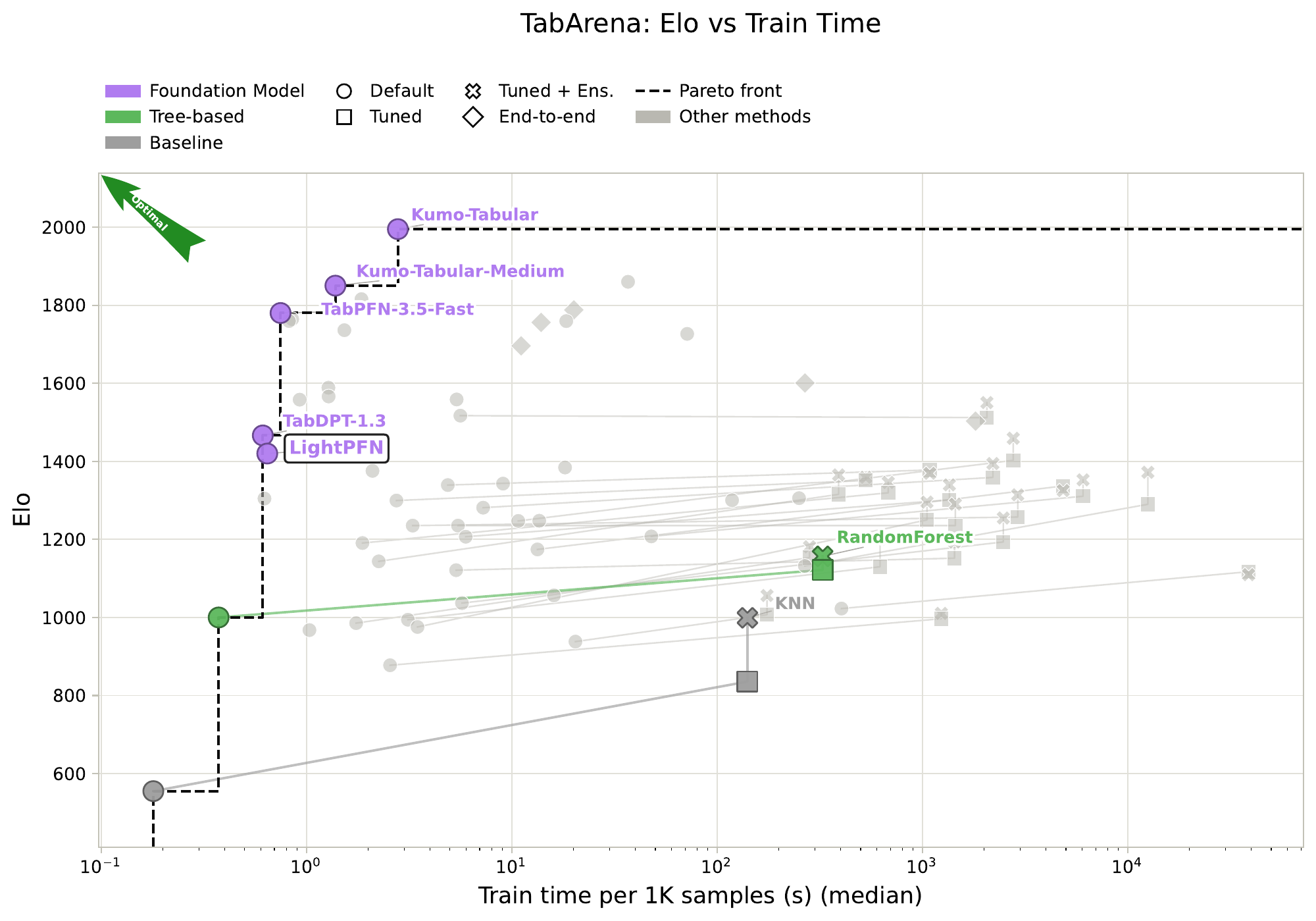
The point estimate is above every GBDT in this leaderboard, including tuned and ensembled entries; the intervals with tuned CatBoost overlap, so this does not establish a clear win. TabICLv2 and larger foundation models lead. Median fit time is 0.65 s per 1,000 rows on an RX 7900 XT; the other timings in the plot are TabArena's published measurements on different hardware, so it is not a controlled speed comparison. This is an author-run Lite evaluation; TabArena maintainers re-run the full benchmark before leaderboard inclusion. Protocol, results and artifacts.
Install
pip install LightPFN             # CPU, CUDA or ROCm, through your PyTorch install
pip install "LightPFN[vulkan]"   # adds the Vulkan GPU backend (wgpu)
Python 3.10 or newer. The first fit downloads the weights (18 MB) from
Hugging Face at a pinned commit and caches them. On a CPU-only
machine, install PyTorch from its CPU index first to skip the CUDA libraries:
pip install torch --index-url https://download.pytorch.org/whl/cpu.
Quick start
from sklearn.datasets import load_breast_cancer
from sklearn.metrics import roc_auc_score
from sklearn.model_selection import train_test_split

from lightpfn import LightPFNClassifier

X, y = load_breast_cancer(return_X_y=True)
X_train, X_test, y_train, y_test = train_test_split(X, y, stratify=y, random_state=0)

clf = LightPFNClassifier(random_state=0)
clf.fit(X_train, y_train)
print(roc_auc_score(y_test, clf.predict_proba(X_test)[:, 1]))
A pandas DataFrame with categorical and missing values goes in as it is:
import pandas as pd

df = pd.DataFrame({
    "age": [34, 51, None, 28, 45, 39],
    "plan": ["basic", "pro", "pro", None, "basic", "enterprise"],
    "region": pd.Categorical(["north", "south", "south", "east", "north", "east"]),
    "active": [True, False, True, True, False, True],
})
y = [0, 1, 1, 0, 1, 0]
clf = LightPFNClassifier().fit(df, y)
clf.predict_proba(df.head(2))
Columns of category, string, object or bool dtype become ordinal codes of the categories seen in fit.
A category dtype keeps its declared levels, including unused ones. Missing values and values outside
that vocabulary become NaN, which the model handles natively. More in
examples/ and in the user guide.
Devices
device= |
Runs on |
|---|---|
"auto" (default) |
a CUDA or ROCm GPU through PyTorch, else a Vulkan GPU, else the CPU |
"cpu" |
the CPU, through PyTorch |
"cuda", "cuda:1" |
an NVIDIA (CUDA) or AMD (ROCm) GPU through PyTorch |
"vulkan", "vulkan:1" |
any GPU with a Vulkan driver, through lightpfn.vulkan (needs lightpfn[vulkan]) |
The environment variable LIGHTPFN_DEVICE replaces "auto". Every device returns the same probabilities
up to floating-point rounding (within 3e-5). See the Vulkan backend.
When to use it
LightPFN is a good default for classification tables with 2 to 10 classes and up to tens of thousands of rows, when you want a strong model without tuning. Know its limits:
- Classification only, 2 to 10 classes. Regression comes with version 2.
- Large tables. Above
max_contextrows (default 20,000) each estimator reads a stratified subsample. In the report, with the whole training set as context, its mean AUC is level with default CatBoost up to 100,000 rows. Larger contexts cost more; sizes beyond 100,000 were not evaluated. - Categorical columns are read as ordinal codes. On tables dominated by high-cardinality categorical columns, CatBoost is ahead (by up to 4.5 AUC points on two TabArena tasks).
- CPU time grows with the context. On TabArena, four estimators take a median of 1 s per split on small
tables, 15 s on medium and 54 s on large ones, against 3, 4 and 7 s for CatBoost. When time matters, use a
GPU or
n_estimators=1(about four times faster, slightly less accurate).
Results
Baselines at default settings. Differences in AUC points (100 times the AUC difference) with 95% paired bootstrap intervals. Full tables, per-task results and timings: docs/en/RESULTS.md.
TabArena, 38 classification tasks (official splits, first repeat, run with our own harness, which is not the official leaderboard protocol):
| Model | Mean AUC | Mean rank of 7 | Lower error than CatBoost |
|---|---|---|---|
| TabICLv2 (28M parameters, GPU) | 0.864 | 1.58 | 87% |
| LightPFN, 4 estimators | 0.858 | 2.50 | 76% |
| LightPFN, 1 estimator | 0.857 | 3.37 | 68% |
| CatBoost | 0.855 | 3.50 | |
| LightGBM | 0.844 | 5.34 | 5% |
| Random forest | 0.838 | 5.89 | 3% |
| XGBoost | 0.833 | 5.82 | 11% |
Development set: 55 OpenML-CC18 datasets outside TabArena (used for design decisions, so the estimate is optimistic; at most 1,000 rows and 100 features, five-fold cross-validation, one estimator):
| Model | Mean AUC | LightPFN minus model |
|---|---|---|
| LightPFN | 0.911 | |
| CatBoost | 0.902 | +0.86 [0.42, 1.40] |
| Random forest | 0.893 | +1.76 |
| LightGBM | 0.891 | +2.02 |
| XGBoost (54 datasets: its wrapper fails on one) | 0.889 | +2.06 [1.32, 2.94] |
How it works
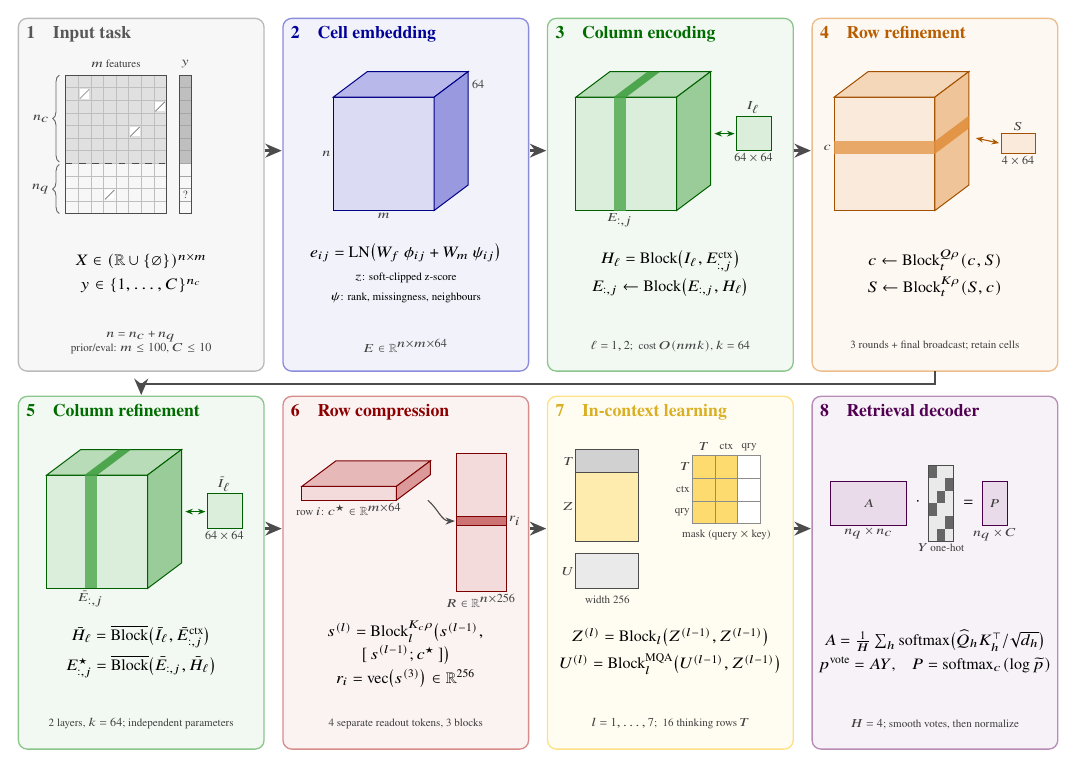
Each cell is embedded from its value, its rank in the column and a missing-value flag. Two column stages with induced attention read the labelled context of each column. A row stage with four summary tokens mixes the features of each row and compresses it into one vector. Seven in-context blocks let every test row attend to the training rows, and a retrieval decoder turns the attention into a vote over the training labels.
Pretraining used 7.68 million task draws from 4.03 million distinct synthetic tasks: 90% from a structural causal graph prior and 10% from a rule prior (XOR, parity, lookup tables, trees) that teaches feature interactions. A second stage trained on tables of up to 60,000 rows. The technical report describes the model, the priors and the selection protocol; docs/en/TRAINING.md explains how to reproduce the training.
Roadmap
Version 2 will add:
- Native categorical features. The model will see the categorical mask from the start of pretraining, and the prior will contain high-cardinality categorical columns whose many rare levels each carry a small effect. An adapter trained on top of the frozen v1 weights did not help, because the v1 prior has no such columns to learn from (report, Section 12).
- Regression.
Repository layout
| Path | Content |
|---|---|
lightpfn/ |
the package: model, scikit-learn wrapper, devices, Vulkan backend (vulkan/), and the training code: priors (prior/), trainer (train.py), evaluation harness (eval/) |
tests/ |
unit and equivalence tests (CPU; the Vulkan tests also run on a CPU driver) |
examples/ |
runnable examples |
docs/ |
user guide, results, Vulkan backend and training in English (en/) and Italian (it/), changelog, third-party licenses |
paper/ |
technical report: PDF, LaTeX source, figures and plot data |
The published wheel contains only the inference code; training needs a source checkout
(pip install -e ".[train,eval]").
Contributing and support
Bug reports and focused pull requests are welcome: see CONTRIBUTING. Security issues go through SECURITY. Changes between versions are in CHANGELOG.
Citation
@techreport{ottoboni2026lightpfn,
  title  = {A Sling Against Giants: {LightPFN}, a 4.6M-parameter tabular in-context classifier designed to stay small},
  author = {Ottoboni, Giorgio},
  year   = {2026},
  url    = {https://github.com/GioOtto/LightPFN}
}
GitHub's "Cite this repository" button reads CITATION.cff.
License
Code and weights: Apache License 2.0, with the attribution notice in NOTICE. Dependencies keep their own licenses, listed in THIRD_PARTY_LICENSES.
1 maintainer

Metadata
1 maintainer
Release files for LightPFN 1.1.0
For a detailed explanation of source distributions (sdists) and built distributions (wheels), please see the package formats documentation.
Source distribution (sdist)
| File | Size | Uploaded | |
|---|---|---|---|
| lightpfn-1.1.0.tar.gz | 56.3 kB | Details |
Built distribution (wheel)
| File | Interpreter | ABI | Platform | Reset |
|---|---|---|---|---|
| lightpfn-1.1.0-py3-none-any.whl | Python 3 | none | any | Details |
Total release size: 112.7 kB
Release files / lightpfn-1.1.0.tar.gz
| Download URL | lightpfn-1.1.0.tar.gz |
|---|---|
| Size | 56.3 kB |
| Tags | Source |
|
SHA-256 checksum How to use checksums |
21a3ec6ada92386b341bdac62803b84fc7d216c1d7dfa53d932accf128cfd498
|
|
BLAKE2b-256 checksum How to use checksums |
2970d05a8ea82593e74907fcb5c9cccdb0e60d9a6aa58c269099813f0f96ce28
|
| Upload date | |
|
Uploaded using Trusted Publishing? What is trusted publishing? |
No |
| Uploaded via |
twine/7.0.0 CPython/3.13.9
|
Release files / lightpfn-1.1.0-py3-none-any.whl
| Download URL | lightpfn-1.1.0-py3-none-any.whl |
|---|---|
| Size | 56.4 kB |
| Tags | Python 3 |
|
SHA-256 checksum How to use checksums |
704d70822ab55cdb5d29cfd2179080383650242e46b40b924e0c9faf294e67e5
|
|
BLAKE2b-256 checksum How to use checksums |
ab1853c5b8e5ff5e15a1485324d057f6e18bbe682b808b2e53728dd7034d7823
|
| Upload date | |
|
Uploaded using Trusted Publishing? What is trusted publishing? |
No |
| Uploaded via |
twine/7.0.0 CPython/3.13.9
|














