



MyoSuite is a collection of musculoskeletal environments and tasks simulated with the MuJoCo physics engine and wrapped in the OpenAI gym API to enable the application of Machine Learning to bio-mechanic control problems.
Full task details | Baselines | Documentation | Tutorials
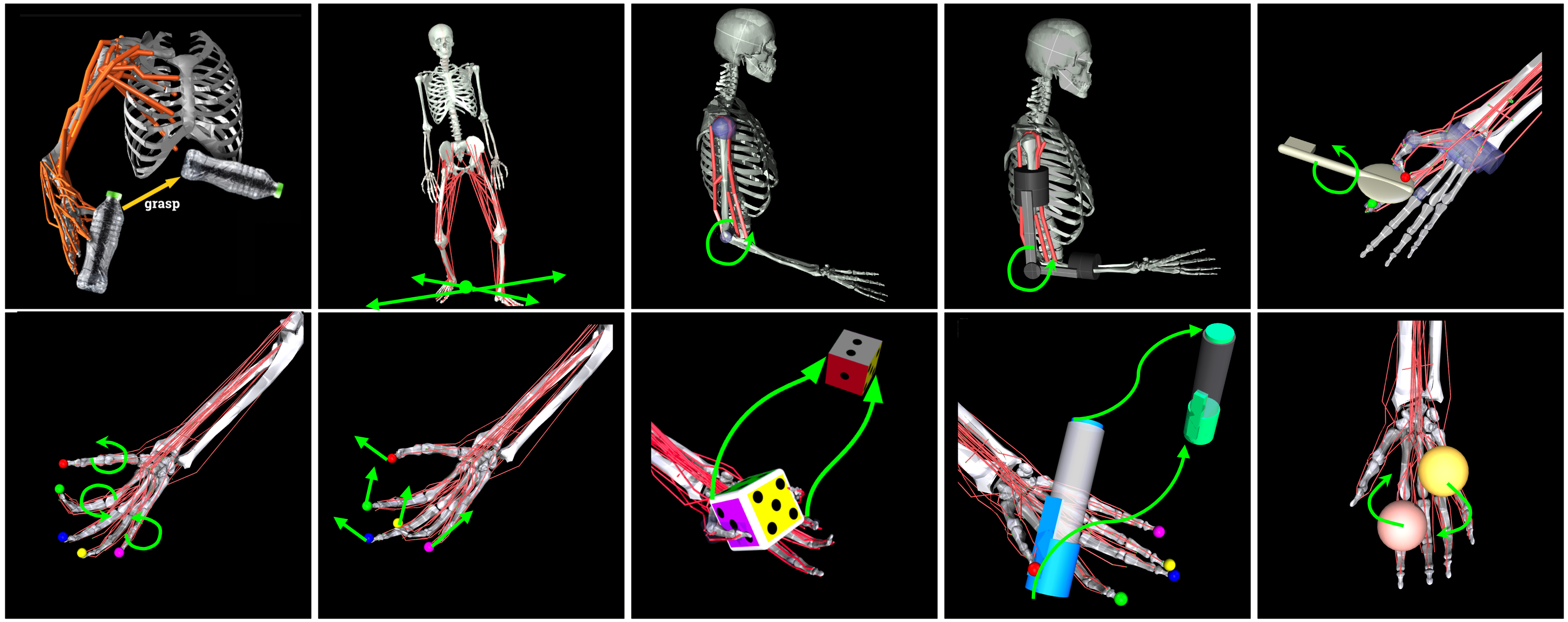
Below is an overview of the tasks in the MyoSuite.
Getting Started
You will need Python 3.8 or later versions.
It is recommended to use Miniconda and to create a separate environment with:
conda create --name myosuite python=3.8
conda activate myosuite
It is possible to install MyoSuite with:
pip install -U myosuite
for advanced installation, see here.
Test your installation using the following command (this will return also a list of all the current environments):
python -m myosuite.tests.test_myo
You can also visualize the environments with random controls using the command below:
python -m myosuite.utils.examine_env --env_name myoElbowPose1D6MRandom-v0
NOTE: On MacOS, we moved to mujoco native launch_passive which requires that the Python script be run under mjpython:
mjpython -m myosuite.utils.examine_env --env_name myoElbowPose1D6MRandom-v0
Examples
It is possible to create and interface with MyoSuite environments just like any other OpenAI gym environments. For example, to use the myoElbowPose1D6MRandom-v0 environment, it is possible simply to run:
import myosuite
import gym
env = gym.make('myoElbowPose1D6MRandom-v0')
env.reset()
for _ in range(1000):
  env.mj_render()
  env.step(env.action_space.sample()) # take a random action
env.close()
You can find tutorials on how to load MyoSuite models/tasks, train them, and visualize their outcome. Also, you can find baselines to test some pre-trained policies.
License
MyoSuite is licensed under the Apache License.
Citation
If you find this repository useful in your research, please consider giving a star ⭐ and cite our arXiv paper by using the following BibTeX entrys.
@Misc{MyoSuite2022,
  author =       {Vittorio, Caggiano AND Huawei, Wang AND Guillaume, Durandau AND Massimo, Sartori AND Vikash, Kumar},
  title =        {MyoSuite -- A contact-rich simulation suite for musculoskeletal motor control},
  publisher = {arXiv},
  year = {2022},
  howpublished = {\url{https://github.com/myohub/myosuite}},
  year =         {2022}
  doi = {10.48550/ARXIV.2205.13600},
  url = {https://arxiv.org/abs/2205.13600},
}
1 maintainer

Metadata
1 maintainer
Release files for MyoSuite 2.1.5
For a detailed explanation of source distributions (sdists) and built distributions (wheels), please see the package formats documentation.
Source distribution (sdist)
| File | Size | Uploaded | Provenance | |
|---|---|---|---|---|
| MyoSuite-2.1.5.tar.gz | 83.2 MB | Without provenance | Details |
Built distribution (wheel)
| File | Interpreter | ABI | Platform | Reset |
|---|---|---|---|---|
| MyoSuite-2.1.5-py3-none-any.whl | Python 3 | none | any | Details |
Total release size: 167.0 MB
Release files / MyoSuite-2.1.5.tar.gz
| Download URL | MyoSuite-2.1.5.tar.gz |
|---|---|
| Size | 83.2 MB |
| Tags | Source |
|
SHA-256 checksum How to use checksums |
5e0081e0be29ec818d5d3336b1717fc34397cc169c0d9bcfce12c38bd8b79c24
|
|
BLAKE2b-256 checksum How to use checksums |
14eb5d85783cc7593bf45e3ca050c60cf328373c36b38a226a5197299e88d4b8
|
| Upload date | |
|
Uploaded using Trusted Publishing? What is trusted publishing? |
No |
| Uploaded via |
twine/4.0.2 CPython/3.9.18
|
Release files / MyoSuite-2.1.5-py3-none-any.whl
| Download URL | MyoSuite-2.1.5-py3-none-any.whl |
|---|---|
| Size | 83.9 MB |
| Tags | Python 3 |
|
SHA-256 checksum How to use checksums |
23e614d34402d1306439e32e280f79ad799e8baacc802d71a5a910c932917c7f
|
|
BLAKE2b-256 checksum How to use checksums |
e08b9e99d00c1356cde46346822b9f18d5bef8467062e63878ad393b7a8e1a0e
|
| Upload date | |
|
Uploaded using Trusted Publishing? What is trusted publishing? |
No |
| Uploaded via |
twine/4.0.2 CPython/3.9.18
|
Security for MyoSuite 2.1.5
Provenance
Provenance describes where a file came from. On PyPI, provenance is shared via attestations, which provide a verifiable record of the build or publishing details. View details, limitations and caveats.
No provenance found
None of the files in this release were uploaded with provenance metadata.
A note on package security
PyPI is a repository for distributing packages, not a service for auditing them. While third-party security researchers and our staff do their best to detect and remove malicious packages, PyPI cannot guarantee the quality, security or suitability of any given package.
To learn more about protecting yourself from malicious actors, visit our package security documentation.














