
Omnidirectional Volume Slicer - OmniSlicer
Implementation of the omnidirectional volume slicer package in Python and PyTorch for 3D medical image analysis, from our Medical Image Analysis publication "TomoGraphView: 3D Medical Image Classification with Omnidirectional Slice Representations and Graph Neural Networks".
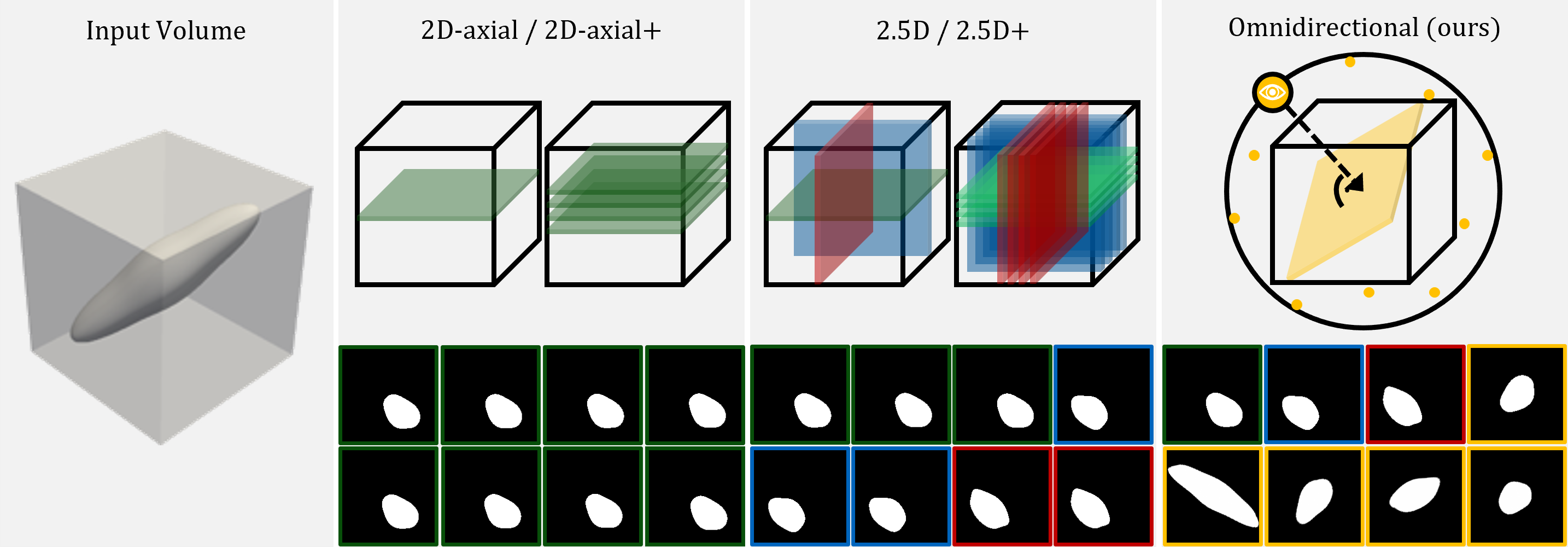
Example Usage
from OmniSlicer import OmniSlicer

volume_path = "path/to/volume.nii.gz"
mask_path = "path/to/mask.nii.gz"
output_dir = "path/to/output_dir"
n_views = N

OmniSlicer.encode_volumes(
  volume_list=[volume_path],   # you can pass a list of several image paths here
  mask_list=[mask_path],       # you can pass a list of several segmentation mask paths here
  output_dir=output_dir,
  n_views=n_views,
  model_name="facebook/dinov3-vits16-pretrain-lvd1689m"
)
Tested Dependencies
The functionality of OmniSlicer has been successfully validated using the following dependency versions. These represent the environment in which the package has been developed and tested:
| Dependency | Version Tested |
|---|---|
python |
3.11.14 |
torch |
2.6.0+cu124 |
torchvision |
0.21.0+cu124 |
trimesh |
4.6.8 |
numpy |
2.2.6 |
pyvista |
0.45.0 |
torchio |
0.20.7 |
tqdm |
4.67.1 |
transformers |
5.21.0 |
These versions are defined in the project’s installation requirements and are automatically resolved when installing OmniSlicer via pip. While other combinations may work, the dependency set above is the configuration against which all core features have been verified. Please make sure that you install torch with CUDA.
Citation
@article{kiechle2026tomographview,
  title={TomoGraphView: 3D medical image classification with omnidirectional slice representations and graph neural networks},
  author={Kiechle, Johannes and Fischer, Stefan M and Lang, Daniel M and Bercea, Cosmin I and Nyflot, Matthew J and Felsner, Lina and Schnabel, Julia A and Peeken, Jan C},
  journal={Medical Image Analysis},
  pages={104174},
  year={2026},
  publisher={Elsevier}
}
1 maintainer

Metadata
1 maintainer
Release files for OmniSlicer 0.0.12
For a detailed explanation of source distributions (sdists) and built distributions (wheels), please see the package formats documentation.
Source distribution (sdist)
| File | Size | Uploaded | Provenance | Actions |
|---|---|---|---|---|
| omnislicer-0.0.12.tar.gz | 12.9 kB | Without provenance | Details for omnislicer-0.0.12.tar.gz |
Built distribution (wheel)
| File | Interpreter | ABI | Platform | Actions Reset |
|---|---|---|---|---|
| omnislicer-0.0.12-py3-none-any.whl | Python 3 | none | any | Details for omnislicer-0.0.12-py3-none-any.whl |
Total release size: 24.9 kB
Release files / omnislicer-0.0.12.tar.gz
| Download URL | omnislicer-0.0.12.tar.gz |
|---|---|
| Size | 12.9 kB |
| Tags | Source |
|
SHA-256 checksum How to use checksums |
b0b551d151406a05dfb2e53f1c17663297d1abaf35cf5b064fbb0a7d51300a1e
|
|
BLAKE2b-256 checksum How to use checksums |
4006fd439ae4ea0f39c89abf55126a1863b22a188ed9051592649faea0c0024d
|
| Upload date | |
|
Uploaded using Trusted Publishing? What is trusted publishing? |
No |
| Uploaded via |
twine/6.2.0 CPython/3.11.14
|
Release files / omnislicer-0.0.12-py3-none-any.whl
| Download URL | omnislicer-0.0.12-py3-none-any.whl |
|---|---|
| Size | 12.0 kB |
| Tags | Python 3 |
|
SHA-256 checksum How to use checksums |
f36ec1c4b439d8475a6aeec406b30bf4f3e124600c8de03ab4a7e5ed51a8ccd7
|
|
BLAKE2b-256 checksum How to use checksums |
57eea7c264f955bf296c1548b00cf6142734750dfe9457b344bf5ccfabb3c7c9
|
| Upload date | |
|
Uploaded using Trusted Publishing? What is trusted publishing? |
No |
| Uploaded via |
twine/6.2.0 CPython/3.11.14
|
Security for OmniSlicer 0.0.12
Provenance
Provenance describes where a file came from. On PyPI, provenance is shared via attestations, which provide a verifiable record of the build or publishing details. View details, limitations and caveats.
No provenance found
None of the files in this release were uploaded with provenance metadata.
A note on package security
PyPI is a repository for distributing packages, not a service for auditing them. While third-party security researchers and our staff do their best to detect and remove malicious packages, PyPI cannot guarantee the quality, security or suitability of any given package.
To learn more about protecting yourself from malicious actors, visit our package security documentation.














