
A Python library for Pulp and Paper manufacturing processes, based on BREF (Best Available Techniques) standards.

Project description
PapAiEra
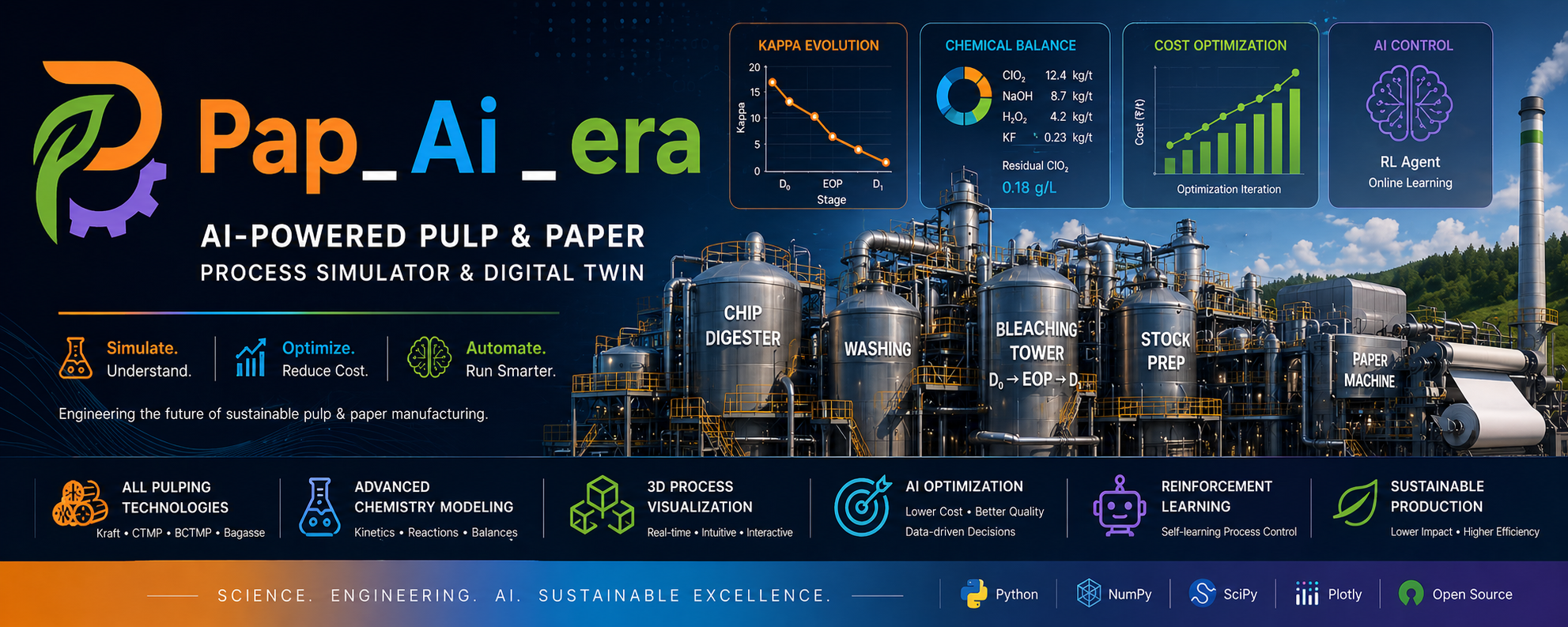
PapAiEra is a specialized Python library engineered for the Pulp and Paper industry. It mathematically models and solves optimization problems based on the Best Available Techniques (BAT) reference documents (EU BREF 2015).
Included Processes & Modules
The library covers a massive array of metrics across the entire pulp and paper production cycle.
1. Pulping Modules (pap_ai_era.pulping)
- Kraft (
kraft.py): H-factor calculation, Digester Mass Balance, Kappa numbers, recovery efficiency, black liquor solids, yield, BAT compliance. - Sulphite (
sulphite.py): Yields for paper/dissolving grades, SO2 and Mg/Ca base recovery. - Mechanical (
mechanical.py): Energy intensity of SGW, PGW, TMP, and CTMP, heat recovery. - Recycled Fibre (
recycled.py): Deinking yield, fiber loss, rejects rates. - Non-Wood (
non_wood.py): Depithing efficiency, silica load checks (crucial for bagasse). - Bleaching (
bleaching.py): O2 delignification drops, wash press carry-over, AOX generation. - Recovery Cycle (
recovery_cycle.py): Causticizing efficiency, evaporator steam economy, lime kiln energy.
2. Papermaking Modules (pap_ai_era.papermaking)
- Machine Operations (
machine.py): Paper machine fiber mass balance, OEE, broke tracking, wire retention, dryer section economy. - Wet End Chemistry (
wet_end_chemistry.py): Furnish-based dosing heuristics, physical GPL to LPH pump conversion algorithms, ash retention. - Coating/Finishing (
coating.py): Colour recovery, ultrafiltration efficiency, specific water usage.
3. Sustainability (pap_ai_era.sustainability)
- Emissions (
emissions.py,air_emissions.py): BOD/COD/TSS load to water. TRS, SO2, NOx, Dust to air. - Wastewater & Water (
wastewater.py,water_energy.py): Loop closure, explicit cooling-water vs contaminated-water accounting. - Management (EMS): ISO 14001 grading, solid waste footprint (Ash + Sludge + Rejects).
- Power Plant & Cogen (
power_plant.py): Boiler thermal efficiency and TG steam tracking.
4. Mathematical AI Solvers (pap_ai_era.optimization_models)
Allows for non-linear optimization using SciPy constraints to determine optimal dosing/setpoints.
optimize_batch_kraft_digester()optimize_continuous_kamyr_digester()optimize_bleaching_sequence_cost()optimize_sulphite_base_recovery()optimize_machine_steam_consumption()optimize_wet_end_dosing()optimize_cogeneration_tg_fuel()
Basic Usage
The library is organized into discrete processes. You can import individual functions to check Key Performance Indicators (KPIs):
from pap_ai_era.pulping.kraft import pulping_yield
from pap_ai_era.papermaking.machine import machine_oee

oee = machine_oee(availability=0.95, performance=0.98, quality=0.99)
print(f"Machine OEE is: {oee:.2f}%")
Advanced Usage Examples
Here is exactly how you can use the newly integrated mill modules to track production physics, dosages, and mass balances natively.
1. Digester Vroom H-Factor Tracking
Calculates the integrated cooking reaction rate required to hit your Kappa target based on Digester temperatures (Arrhenius logic).
from pap_ai_era.pulping.kraft import calculate_h_factor

# 165 °C cooking zone for 45 minutes
h_factor_generated = calculate_h_factor(temperature_celsius=165.0, time_minutes=45.0)
print(f"H-Factor Generated: {h_factor_generated:.2f}")
2. Pulping Mass Balance (Fiber & Liquor)
Splits bone dry wood into accepted pulp, screened rejects, and the organic mass that correctly dissolved into Black Liquor going to the recovery boiler.
from pap_ai_era.pulping.kraft import calculate_pulpmill_mass_balance

mass_flow = calculate_pulpmill_mass_balance(
    wood_charged_bdmt=100.0,  # 100 Bone Dry Metric Tonnes of wood
    target_yield_pct=50.0,    # 50% target pulp yield
    rejects_pct=1.5           # 1.5% knot/screen rejects
)
print(f"Accepted Pulp Out: {mass_flow['accepted_pulp_bdmt']} BDMT")
print(f"Black Liquor Organics to Recovery: {mass_flow['dissolved_organics_to_recovery_bdmt']} BDMT")
3. Machine Fiber Delivery Balance
Calculates the net saleable paper and tracks exactly what was physically lost to the effluent (Wire loss) vs economically lost to recycling (Broke generation).
from pap_ai_era.papermaking.machine import calculate_machine_fiber_balance

machine_flow = calculate_machine_fiber_balance(
    fiber_in_headbox_kg=5000.0,
    wire_retention_pct=92.0,
    broke_generated_pct=8.0
)
print(f"Saleable Paper Reel: {machine_flow['saleable_paper_out_kg']} kg")
print(f"Fiber strictly lost to wire water stream: {machine_flow['effluent_loss_kg']} kg")
4. Furnish-Based Machine Dosing Suggestions
Uses mill heuristics to track Anionic Trash spikes (Broke) vs Surface Area demands (Hardwood) to dynamically formulate sizing and coagulant demands.
from pap_ai_era.papermaking.wet_end_chemistry import suggest_furnish_dosing

chemical_targets = suggest_furnish_dosing(
    hardwood_pct=60.0,  # Fines drive up AKD sizing limit
    softwood_pct=10.0,
    broke_pct=30.0,     # Heavily drives up PAC/Alum coagulant demand
    target_akd_sizing=True
)
print(f"Suggested Alum Dose: {chemical_targets['suggested_PAC_Alum_kg_t']:.2f} kg/t")
print(f"Warning Triggers: {chemical_targets['furnish_warnings']}")
5. Multi-Layer Machine Stage-Wise Moisture Prediction
Simulates the entire water loss journey through the Wire formers, Press Nips, and condensing Steam Dryers.
from pap_ai_era.papermaking.moisture_prediction import predict_wire_drainage_and_couch_moisture, predict_press_section_moisture, predict_dryer_group_moisture

# Wire Drain
couch = predict_wire_drainage_and_couch_moisture(
    target_gsm=80, machine_speed_mpm=1200, wire_width_m=6.5,
    layer_data=[{'gsm': 40}, {'gsm': 40}], # Multi-layer boosting drain efficiency
    vacuum_boxes=[{'vacuum_kpa': 15}, {'vacuum_kpa': 35}, {'vacuum_kpa': 60}]
)
print(f"Moisture exiting Couch Roll: {couch['moisture_after_couch_pct']:.2f}%")

# Press Dewatering
presses = predict_press_section_moisture(
    presses=[{'linear_load_kn_m': 60}, {'linear_load_kn_m': 90, 'shoe_press': True}],
    inlet_moisture_pct=couch['moisture_after_couch_pct'],
    machine_speed_mpm=1200
)
print(f"Moisture after 3rd Press: {presses['final_press_moisture_pct']:.2f}%")

# Dryer Cylinder Extraction
evap = predict_dryer_group_moisture(
    dryer_groups=[{'cylinders': 12, 'steam_pressure_bar': 2.5}, {'cylinders': 16, 'steam_pressure_bar': 4.0}],
    inlet_moisture_pct=presses['final_press_moisture_pct'],
    target_gsm=80,
    machine_speed_mpm=1200,
    width_m=6.5
)
print(f"Final Reel Moisture: {evap['final_reel_moisture_pct']:.2f}%")
5. Bleaching Cost Sequencing (ECF)
Minimises total chemical cost subject to physical constraints (Target brightness and minimum viscosity drops) traversing dynamically through the D0, Eop, D1, and P stages.
from pap_ai_era.core_simulations.lib_optimisation import bleach_objective_function

params_dict = {
    'price_ClO2': 1.20, 'price_NaOH': 0.40, 'price_H2O2': 0.80, # Costs
    'D': {'k_D': 0.20, 'n_D': 0.90, 'B_max_D': 88, 'k_B_D': 0.05, 'k_v_D': 0.1},
    'Eop': {'a_E': 10, 'b_E': 2.5, 'c_E': 1.5, 'd_E': 3.0},
    'P': {'k_d': 0.01, 'B_max_P': 92, 'k_P': 0.08, 'k_v_P': 0.05, 'k_B_H2O2': 0.8}
}

result = bleach_objective_function(
    chemical_doses=[12.0, 10.0, 3.0, 8.0, 4.0],
    kappa_0=30.0,
    B_target=88.0,
    visc_min=700.0,
    params_dict=params_dict
)
if result['success']:
    print(f"Minimized Sequence Cost: ${result['cost_minimized']:.2f}")
    print(f"Optimal Dosing Vectors [D0, Eop, pEop, D1, P]: {result['optimal_doses_kg_t']}")
6. Full Digester Kinetics Integration
Numerically integrates Lignin dissolution, Carbohydrate peeling, and Effective Alkali consumption across specific chip time-temperature vectors using SciPy ODEs to predict exact blow Kappa.
from pap_ai_era.core_simulations.lib_cook_module import cook_module

inputs = {
    'L0': 0.25, 'C0': 0.70, 'EA_conc': 45.0, 'LWR': 4.0, 'sulphidity': 30.0,
    'T_profile': ([0, 30, 90, 150], [90, 150, 165, 165]) # Minutes vs Celsius T_vec
}
params = {
    'kappa_factor': 6.57, 'kappa_bulk_thresh': 50, 'kappa_res_thresh': 20,
    'alpha_L': 0.4, 'alpha_C': 0.15, 'k_C': 0.002, 'Ea_C': 130000,
    'initial': {'A': 1e7, 'Ea': 100000, 'a': 0.5, 'b': 0.3},
    'bulk': {'A': 3.2e10, 'Ea': 134000, 'a': 1.0, 'b': 0.4},
    'residual': {'A': 1.8e8, 'Ea': 125000, 'a': 0.5, 'b': 0.3}
}

simulation = cook_module(inputs, params)
print(f"Final Kappa Predict: {simulation['kappa_f']:.2f}")
print(f"Final Estimated Yield: {simulation['Y']:.2f}%")
print(f"Generated H-Factor: {simulation['H_f']:.1f}")
Example Optimization: The Continuous Digester Bottleneck
Find the lowest Effective Alkali (%) and optimal cook temperature to hit the Target Kappa while mathematically penalizing the Kamyr Liquor-to-Wood ratio to save steam costs.
from pap_ai_era.optimization_models import optimize_continuous_kamyr_digester

result = optimize_continuous_kamyr_digester(target_kappa=16.0, liquor_to_wood_ratio_cost_penalty=5.0)

if result["success"]:
    print(f"Optimal Effective Alkali: {result['optimal_EA']:.2f}%")
Troubleshooting Guide
1. Optimization returns success: False: Target constraints are mathematically impossible (e.g., high Brightness with no chemicals). Adjust boundaries in the bounds variables.
2. Import Errors: Ensure you run pip install PapAiEra in an active environment.
Release history Release notifications | RSS feed


Download files
Download the file for your platform. If you're not sure which to choose, learn more about installing packages.
Source Distribution
Built Distribution
Filter files by name, interpreter, ABI, and platform.
If you're not sure about the file name format, learn more about wheel file names.
Copy a direct link to the current filters
File details
Details for the file papaiera-0.2.0.tar.gz.
File metadata
- Download URL: papaiera-0.2.0.tar.gz
- Upload date:
- Size: 42.1 kB
- Tags: Source
- Uploaded using Trusted Publishing? No
- Uploaded via: twine/6.2.0 CPython/3.11.9
File hashes
| Algorithm | Hash digest | |
|---|---|---|
| SHA256 |
d7a6b12e5227055cf6f40d53d8b1b433193388be0cb9ff43c7c5bd0bb49838bb
|
|
| MD5 |
36a7c094f46db2cedb420bb8afa4f226
|
|
| BLAKE2b-256 |
c43956917899305e6f186eff8667f2cb52a18bfeed2cccab24c7dfa860ab3a90
|
File details
Details for the file papaiera-0.2.0-py3-none-any.whl.
File metadata
- Download URL: papaiera-0.2.0-py3-none-any.whl
- Upload date:
- Size: 52.6 kB
- Tags: Python 3
- Uploaded using Trusted Publishing? No
- Uploaded via: twine/6.2.0 CPython/3.11.9
File hashes
| Algorithm | Hash digest | |
|---|---|---|
| SHA256 |
5677f689c8110d280fd9295d80d0c0c3df41058b200b4abbb75e0862e4143595
|
|
| MD5 |
63a2584767fb49c726c081b50d6ccf08
|
|
| BLAKE2b-256 |
b5bad0a257e05499e832bf583f99a5ac7a6ca2f342e64af2fd806ae3e97a0c6a
|






