






ProbabilisticDiffusion
This is a PyTorch implementation of the training algorithm found in Denoising Diffusion Probabilistic Models.
Specifically, we implement the following training procedure:
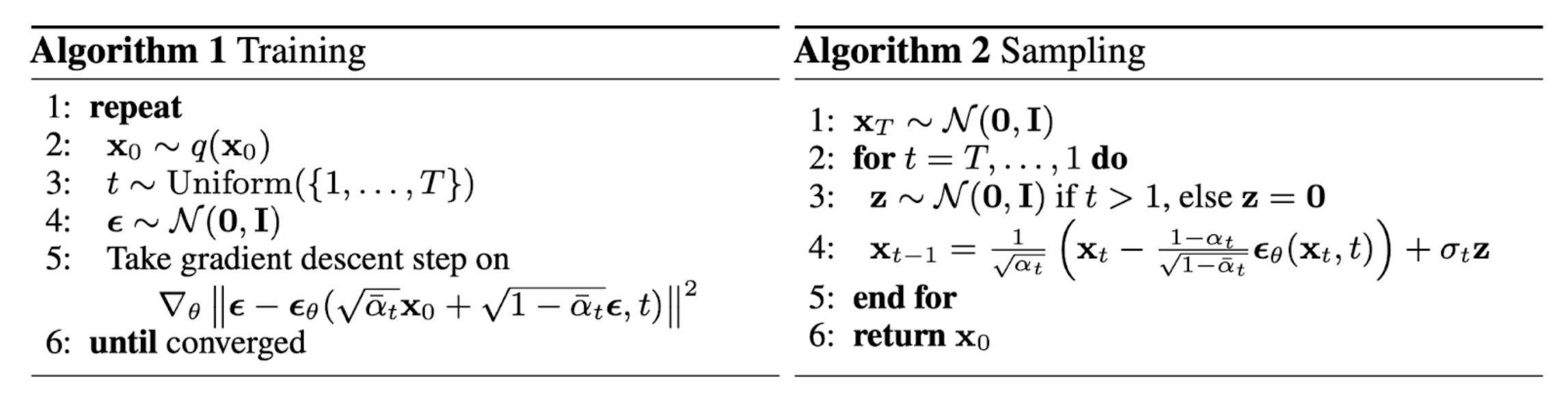
Where $\epsilon_\theta$ represents the user defined model with learnable parameters $\theta$.
Installation
pip install:
pip install ProbabilisticDiffusion
For any additional needs, sdist and bdist can be found in the GitHub repo.
Usage
The data we use for the below examples is a set of randomly generated points points lying on a circle of radius 2 and added i.i.d gaussian noise with SD of 0.3 to x and y axes:
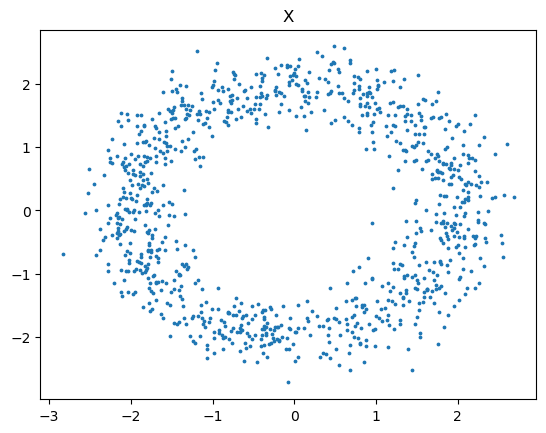
The Jupyter Notebook with this example can be found on GitHub here.
Defining Model
Defining $\epsilon_\theta$
Below we define our model with the parameters we would like to learn. In this case we use a simple architecture with a combination of PyTorch Linear layers with Softplus activations, as well as an embedding to take into account the timestep, $t$, which we also include in the input (the y value).
import torch.nn as nn
import torch.nn.functional as F


class ConditionalLinear(nn.Module):
    def __init__(self, num_in, num_out, n_steps):
        super(ConditionalLinear, self).__init__()
        self.num_out = num_out
        self.lin = nn.Linear(num_in, num_out)
        self.embed = nn.Embedding(n_steps, num_out)
        self.embed.weight.data.uniform_()

    def forward(self, x, y):
        out = self.lin(x)
        gamma = self.embed(y)
        out = gamma.view(-1, self.num_out) * out
        return out


class ConditionalModel(nn.Module):
    def __init__(self, n_steps):
        super(ConditionalModel, self).__init__()
        self.lin1 = ConditionalLinear(2, 128, n_steps)
        self.lin2 = ConditionalLinear(128, 128, n_steps)
        self.lin3 = nn.Linear(128, 2)

    def forward(self, x, y):
        x = F.softplus(self.lin1(x, y))
        x = F.softplus(self.lin2(x, y))
        return self.lin3(x)
In version 2.1.0 we can also specify models which are conditioned on additional variables that are not present in the
final output generation, i.e. generating $x_t$ from $p(x_t|c)$ instead of just $p(x_t)$. This change manifests itself in
the model by taking an extra input value in the forward method of the ConditionalModel:
class ConditionalModel(nn.Module):
    def __init__(self, n_steps):
        super(ConditionalModel, self).__init__()
        self.lin1 = ConditionalLinear(2 + shape_of_c, 128, n_steps)  # Make sure to add dimension of c to input dim
        ...

    def forward(self, x, c, y):
        x = torch.cat([x, c], 1)  # Here, we just concatenate the conditional variable
        x = F.softplus(self.lin1(x, y))
        ...
Defining Diffusion Based Learning Model
We define our diffusion based model with 200 timesteps, MSE loss (although the original algorithm specifies just SSE but we found that MSE works as well), beta start and end values of 1e-5, 1e-2 respectively with a linear schedule, and use the ADAM optimizer with a learning rate of 1e-3.
from ProbabilisticDiffusion import Diffusion
import torch

n_steps = 200
model = ConditionalModel(n_steps)
loss = torch.nn.MSELoss(
    reduction='mean')  # We use MSE for the loss which adheres to the gradient step procedure defined
optimizer = torch.optim.Adam(model.parameters(), lr=1e-3)  # ADAM Optimizer Parameters for learning
diffusion = Diffusion(data, n_steps, 1e-5, 1e-2, 'linear', model, loss,
                      optimizer)  # Note the (1e-5, 1e-2) are Beta start and end values
In version 2.1.0 we can now also include conditional data in the construction of Diffusion:
diffusion = Diffusion(data, n_steps, 1e-5, 1e-2, 'linear', model, loss,
                      optimizer, conditional_data)  # Note the additional conditional_data argument after optimizer
Forward Sampling
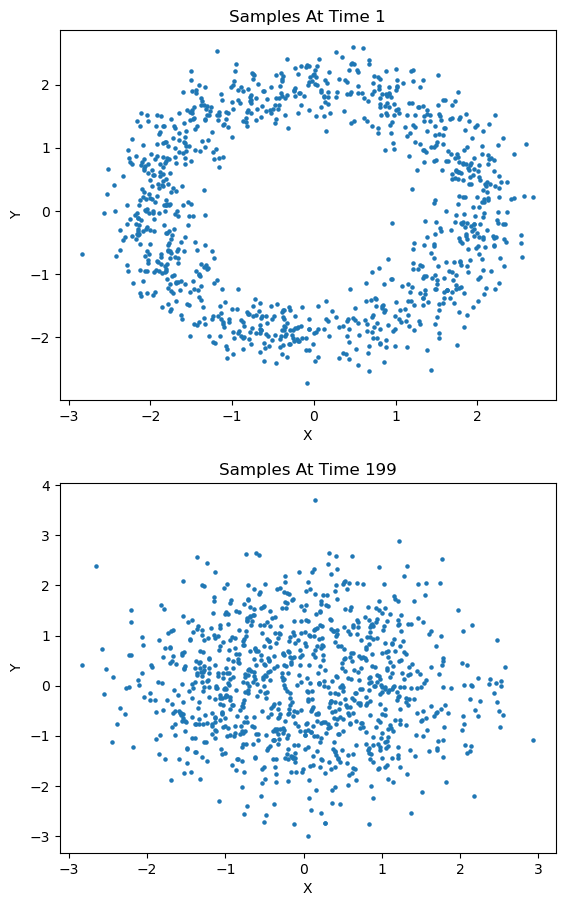
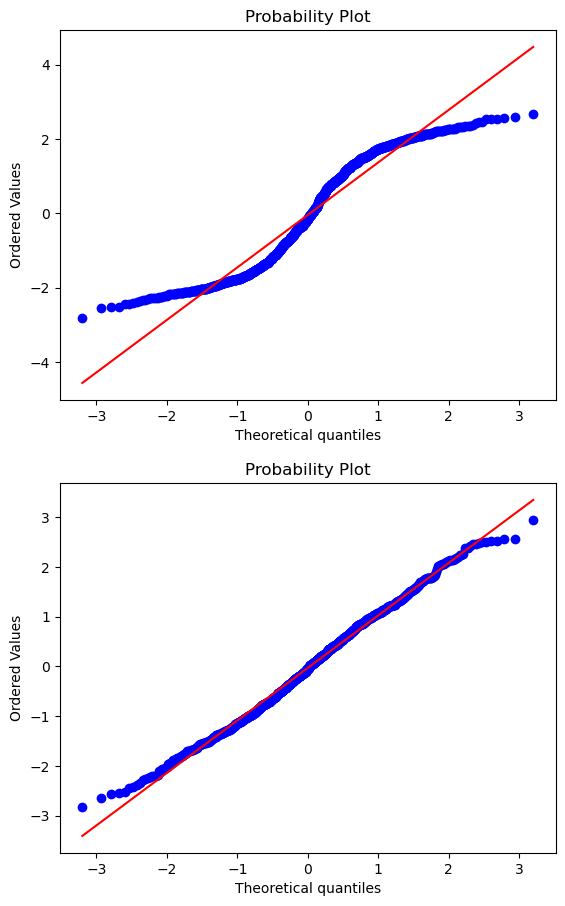
This allows us to see the forward diffusion process and ensure that our n_steps parameter is large enough. We want to see the data morph into standard gaussian distributed points by the last time step.
import scipy.stats as stats

noised = diffusion.forward(199, s=5)
stats.probplot(noised[:, 0], dist="norm", plot=plt)
plt.show()
Training
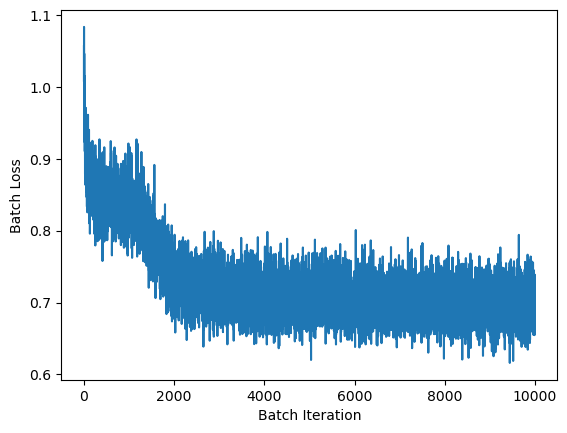
We train with batch size of 1,000 for 10,000 epochs.
diffusion.train(1000, 10000)
Sampling New Data
We can sample new data based on the learned model via the following method:
new_x = diffusion.sample(1000, 50, keep="last", s=3)
If using the conditional model capabilities added in version 2.1.0, make sure to pass in the conditional data you
would like to sample upon. This data needs to have a length of the number of samples you wish to generate, n, and have
the same dimensionality as the conditional data you passed in when constructing the initial Diffusion model:
# the input to conditional_data in this example should have a length of 1000 since we set the new sample size to 1000
new_x = diffusion.sample(1000, 50, keep="last", conditional_data=c, s=3)
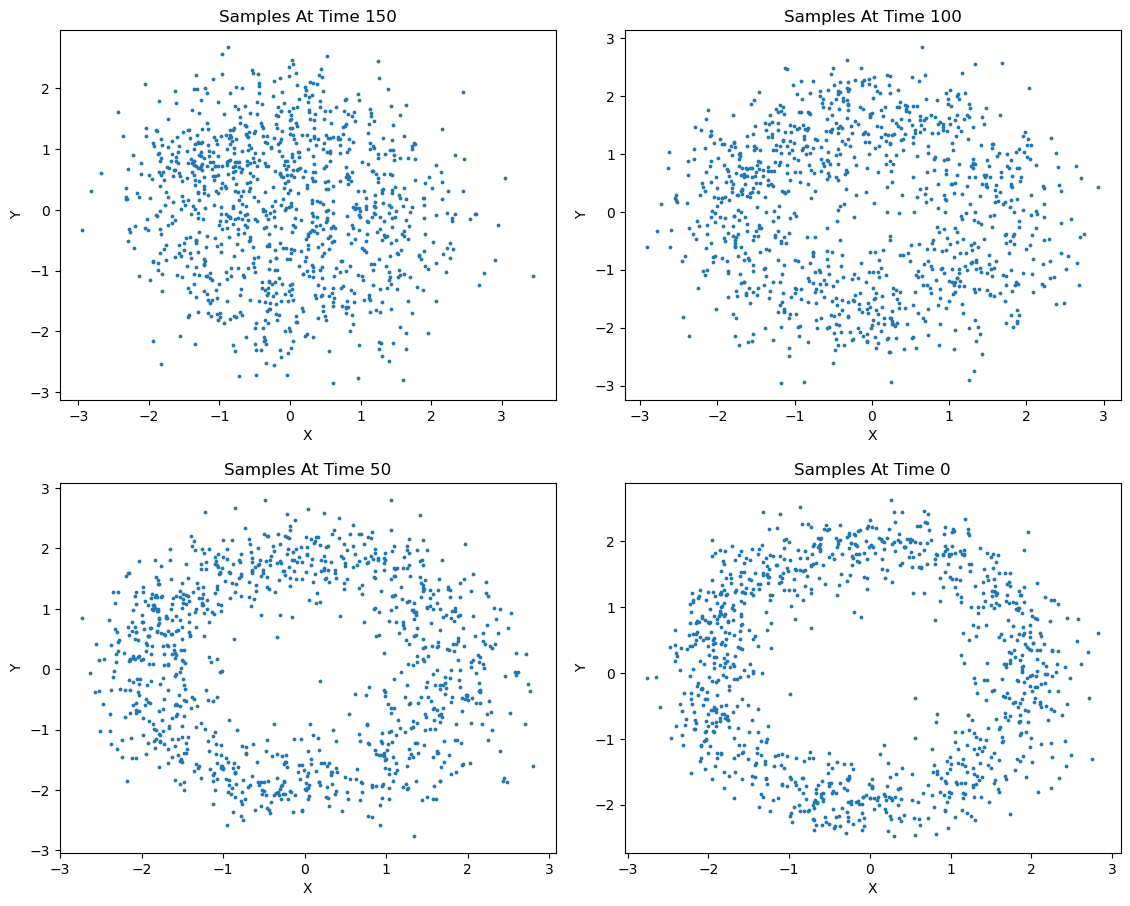
This method generated 1000 new samples and plotted at an interval of 50. In addition, we can specify which points to keep from these new samples, 'last' will only keep the last timestep of samples, 'all', will keep all timesteps, and for more granularity, one can specify a tuple of integer values corresponding to the desired timesteps to keep.
1 maintainer

Download files
Download the file for your platform. If you're not sure which to choose, learn more about installing packages.
Source Distribution
Built Distribution
Filter files by name, interpreter, ABI, and platform.
If you're not sure about the file name format, learn more about wheel file names.
Copy a direct link to the current filters
File details
Details for the file probabilisticdiffusion-2.1.0.tar.gz.
File metadata
- Download URL: probabilisticdiffusion-2.1.0.tar.gz
- Upload date:
- Size: 7.2 kB
- Tags: Source
- Uploaded using Trusted Publishing? No
- Uploaded via:
twine/6.2.0 CPython/3.9.25
File hashes
| Algorithm | Hash digest | |
|---|---|---|
| SHA256 |
437a8dfc582288a085d45a126e50d45144dda2a9b94c13b3d178eaaaca24a5ac
|
|
| MD5 |
74b9b9318d29347b75d96c6473d0370e
|
|
| BLAKE2b-256 |
8ed679965a08e7b460cd150d1b344baf51d7cc5c17b7c9bb070b9c4a49ab3d01
|
File details
Details for the file probabilisticdiffusion-2.1.0-py3-none-any.whl.
File metadata
- Download URL: probabilisticdiffusion-2.1.0-py3-none-any.whl
- Upload date:
- Size: 7.8 kB
- Tags: Python 3
- Uploaded using Trusted Publishing? No
- Uploaded via:
twine/6.2.0 CPython/3.9.25
File hashes
| Algorithm | Hash digest | |
|---|---|---|
| SHA256 |
0a4fc0087e9a1ab39a4a09926957ccc7070ae1e4afac0f50664e776b27ff2d21
|
|
| MD5 |
783130534c8301ec67c9b56151257d35
|
|
| BLAKE2b-256 |
79ef8bb08c5ddafd97860146c3f3b76f99e206ca0fddf2958438bb9de0648c67
|














