
🛠️ Tools Kit 🛠



📖 Description
The Tools Kit package allows chemistry students to find basic information on molecules and provides easy access to some graphs and calculations required in experimental laboratories.
🌙 Note: For an aesthetically pleasing experience, it is recommended to use the dark mode interface if you are on a Mac or any other platform that supports it.
📚 Table of Contents
🛠️ Installation
1. 🍴 Fork the Repository
To start, fork the repository to your own GitHub account.
To do so, navigate to the repository page and click the "Fork" button. The repository will then be copied to your account, and you will be able to access it.
2. 📥 Clone the Repository

Next, clone the repository using the following command:
a) Using HTTPS (default):
git clone https://github.com/sgrunber/Project-ppchem-tools-kit.git
b) Using SSH (recommended for users who have set up SSH):
To clone with SSH, use the following command:
git clone git@github.com:sgrunber/Project-ppchem-tools-kit.git
3. ⬇️ Install with pip
After cloning, navigate into the cloned directory and install the package locally using pip:
cd path/to/Project-ppchem-tools-kit
pip install .
This will install the package and its dependencies from the cloned repository, automatically fetching the latest version:

Alternatively, you can install Tools Kit using pip, which will fetch and install the latest updated version from PyPI:
pip install Project_ppchem-tools-kit
🚀 Usage
To use Tools Kit and access its features, follow these steps after cloning the repository:
Using Jupyter Notebook:

-
Launch Jupyter Notebook by navigating to the cloned repository directory in your terminal and running the command:
jupyter notebook -
In the Jupyter Notebook interface, navigate to the
notebooksdirectory. -
Open the notebook named
project_report.ipynb. -
Follow the instructions inside the notebook to interact with the Tools Kit interface and utilize its features for molecule analysis, graph plotting, error calculation, and more. This notebook provides an interactive environment for convenient usage of Tools Kit directly within Visual Studio Code.
Usage with Visual Studio Code:

-
Open Visual Studio Code and navigate to the cloned directory.
-
Install the Jupyter extension if not already installed. You can do this by searching for "Jupyter" in the Extensions view (Ctrl+Shift+X) and installing the "Python" extension pack.
-
Open the
notebooksdirectory in Visual Studio Code. -
Open the notebook named
project_report.ipynb. -
Follow the instructions inside the notebook to interact with the Tools Kit interface and utilize its features for molecule analysis, graph plotting, error calculation, and more. This notebook provides an interactive environment for convenient usage of Tools Kit with Jupyter Notebook.
🧪 Features
-
🧬 Molecule Name
- Input: Raw formula of the molecule
- Output: SMILES of the molecule
-
⚖️ Molecular Weight
- Input: SMILES of the molecule
- Output: Corresponding molar mass in g/mol
-
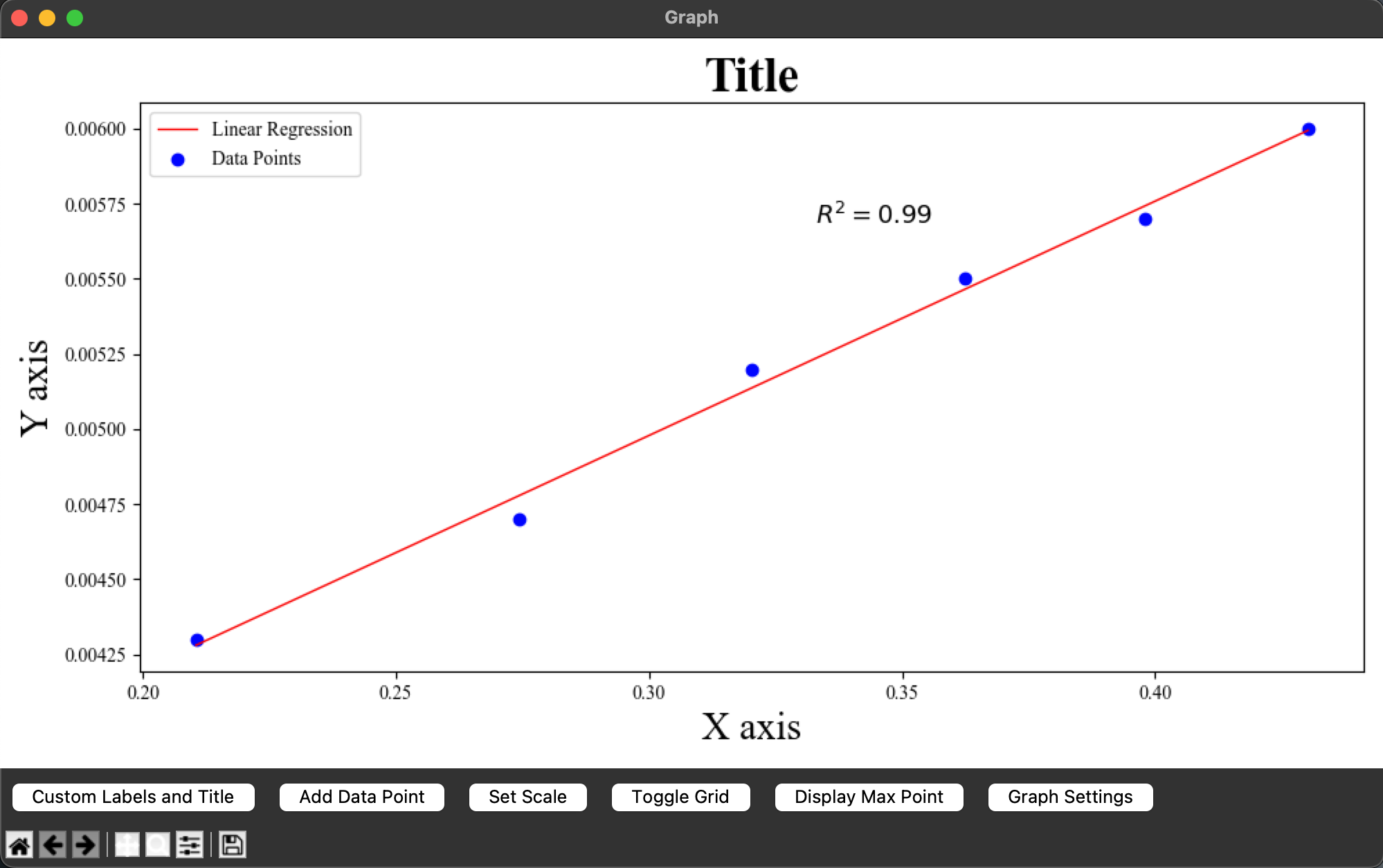
📈 Linear Regression
- Input: Excel document (imported by pressing the Browse button)
- Output: Linear regression graph with the R2 value
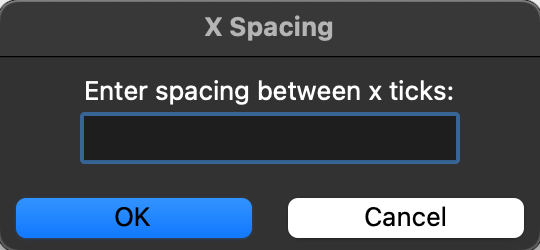
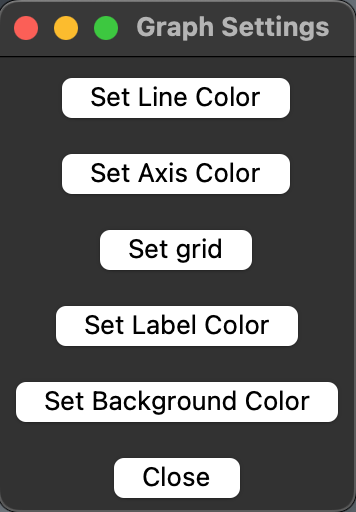
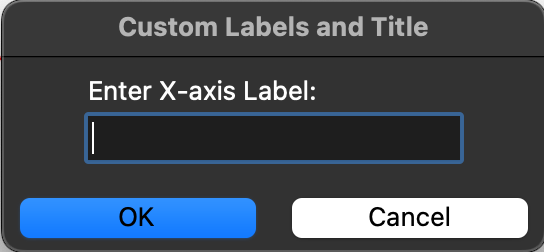
- Options: The graph allows customization of various parameters such as changing scales, axis labels, title, displaying maximum values, enabling gridlines, adjusting line types and colors, modifying grid and label axes, and background color.
-
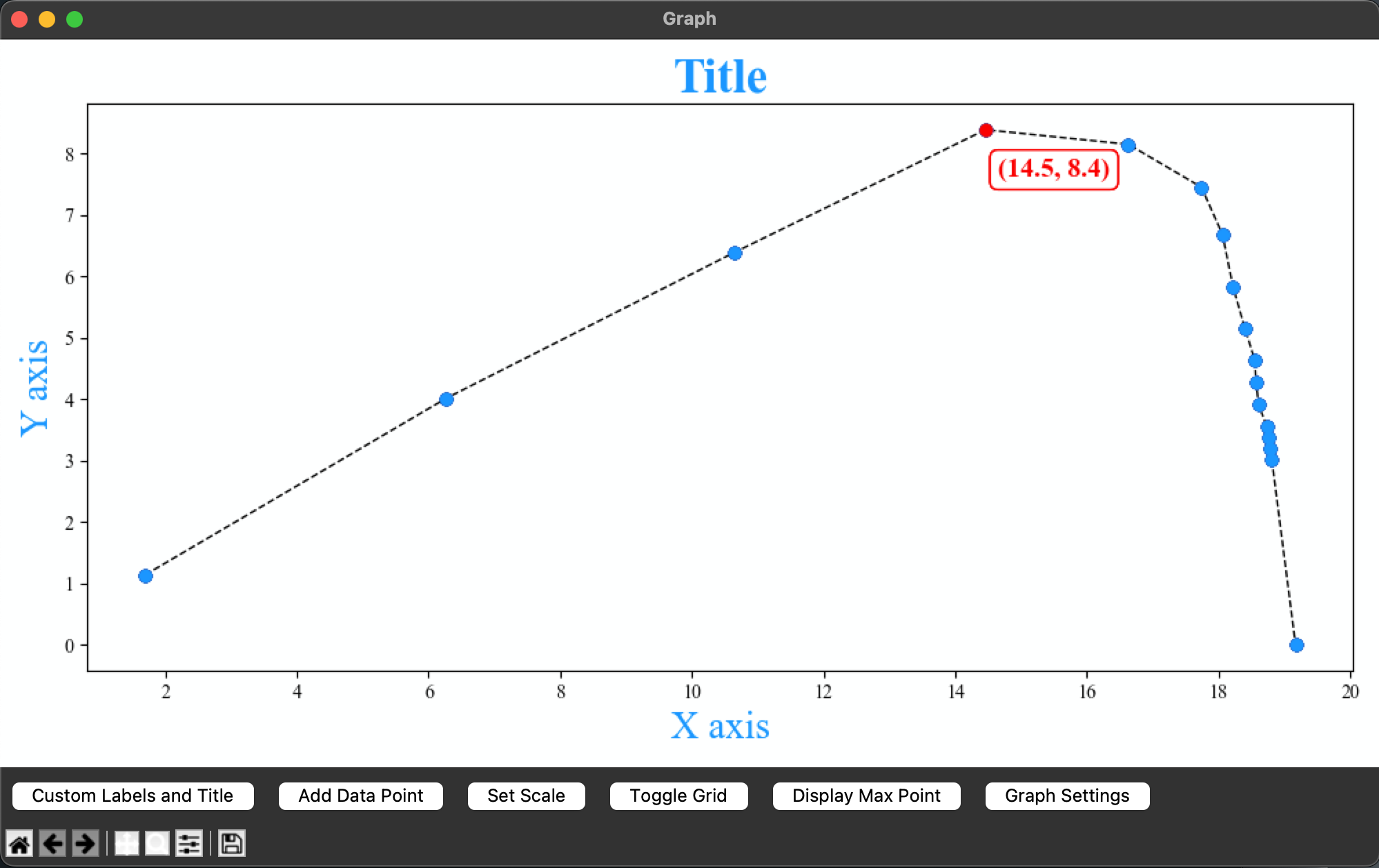
📊 Graph Maker
- Input: Excel document with x and y values arranged in two columns
- Output: Graph plotting all values
- Options: The graph allows customization of various parameters such as changing scales, axis labels, title, displaying maximum values, enabling gridlines, adjusting line types and colors, modifying grid and label axes, and background color.
-
🧮 Error Propagation
- Input: Variables, their values, and their uncertainties.
- Output: Mean value, its uncertainty, and the result can be copied as LaTeX code for easy inclusion in documents.
-
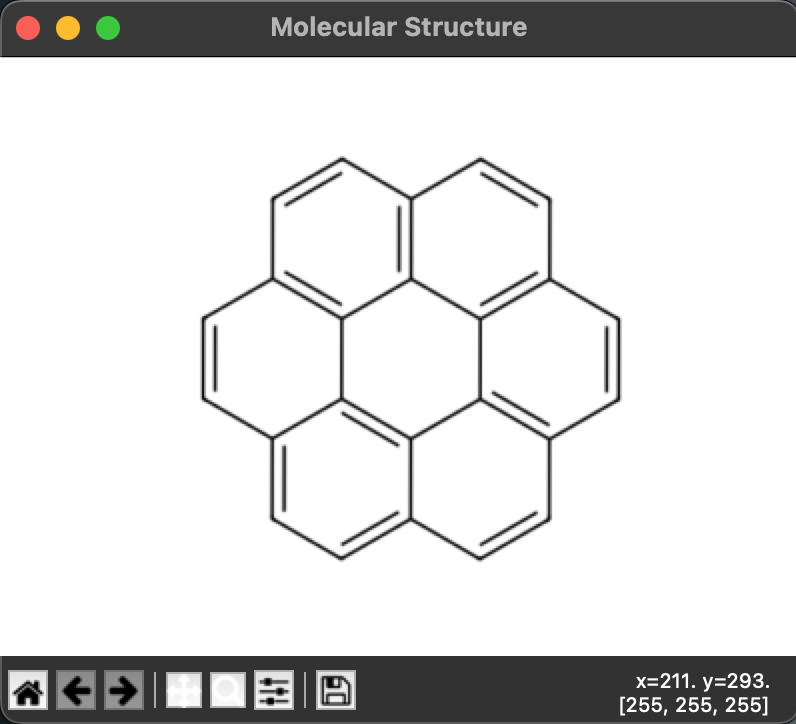
🔬 Show Molecule
- Input: SMILES
- Output: Molecular structure
🤝 Contributing
Contributions are welcome! To contribute to Tools Kit, please follow these steps:
-
Fork the project to your GitHub account.
-
Create a new branch for your feature or bug fix:
git checkout -b feature/your-feature-name
-
Create a new branch for your feature or bug fix:
git checkout -b feature/your-feature-name
-
Make your changes and ensure they adhere to the project's coding conventions and style guidelines.
-
Commit your changes with descriptive messages explaining the purpose of your changes:
git commit -am 'Add some feature'
-
Push your changes to your branch on your forked repository:
git push origin feature/your-feature-name
-
Once you've pushed your changes, you can open a Pull Request (PR) in the original repository. Provide a clear description of the changes you've made in the PR.
-
After reviewing your PR, if everything looks good, it will be merged into the main repository. Congratulations, you've successfully contributed to Tools Kit!
Thank you for your contribution! Your efforts help improve the project for everyone.
📚 Cite Us
If you use Tools Kit in your research work or academic projects, we would appreciate it if you could cite us. You can use the following BibTeX entry:

@misc{project-ppchem-tools-kit,
  title = {Project-ppchem-tools-kit},
  author = {{Méloé Enzinger & Sébastien Grunberg}},
  year = {2024},
  publisher = {GitHub},
  journal = {GitHub Repository},
  howpublished = {\url{https://github.com/username/Project-ppchem-tools-kit}}
}
Chicago Style

Méloé Enzinger and Sébastien Grunberg. 2024. Project-ppchem-tools-kit. Computer software. GitHub. https://github.com/username/Project-ppchem-tools-kit.`
📜 License

This project is licensed under the MIT License. See the LICENSE file for details.
📸 Screenshots
Note: Graphs have much better quality when saved to your computer.
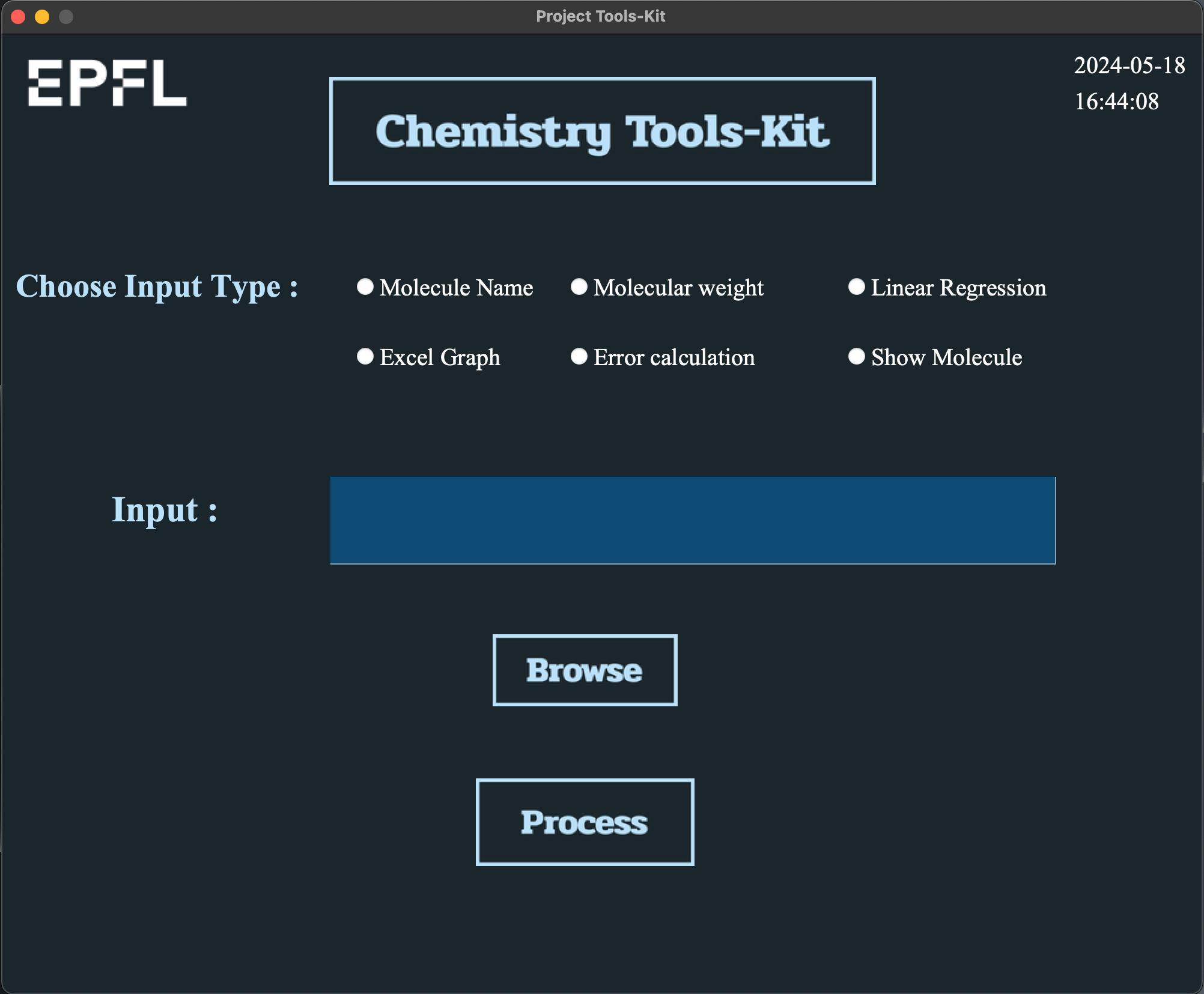
Interface
Graph
Linear Regression
Graph & Linear Regression Settings
Show Molecule
1 maintainer

Metadata
1 maintainer
Release files for Project-ppchem-tools-kit 1.1.0
For a detailed explanation of source distributions (sdists) and built distributions (wheels), please see the package formats documentation.
Source distribution (sdist)
| File | Size | Uploaded | Provenance | Actions |
|---|---|---|---|---|
| project_ppchem_tools_kit-1.1.0.tar.gz | 21.0 kB | Without provenance | Details for project_ppchem_tools_kit-1.1.0.tar.gz |
Built distribution (wheel)
| File | Interpreter | ABI | Platform | Actions Reset |
|---|---|---|---|---|
| project_ppchem_tools_kit-1.1.0-py3-none-any.whl | Python 3 | none | any | Details for project_ppchem_tools_kit-1.1.0-py3-none-any.whl |
Total release size: 50.6 kB
Release files / project_ppchem_tools_kit-1.1.0.tar.gz
| Download URL | project_ppchem_tools_kit-1.1.0.tar.gz |
|---|---|
| Size | 21.0 kB |
| Tags | Source |
|
SHA-256 checksum How to use checksums |
c0e6e116e518af0be8fe865bb6d2331768c6f485c552a820239a2133e4c768e0
|
|
BLAKE2b-256 checksum How to use checksums |
b086013484c6d33342ed9f6104b1079e0775fc2bf958ea1f77d9f2c6dbfab5c3
|
| Upload date | |
|
Uploaded using Trusted Publishing? What is trusted publishing? |
No |
| Uploaded via |
twine/5.1.0 CPython/3.10.14
|
Release files / project_ppchem_tools_kit-1.1.0-py3-none-any.whl
| Download URL | project_ppchem_tools_kit-1.1.0-py3-none-any.whl |
|---|---|
| Size | 29.5 kB |
| Tags | Python 3 |
|
SHA-256 checksum How to use checksums |
c84e5b10b213414f524ff2c138fe7328b456aafced14a2e0b3b4452e5d169fef
|
|
BLAKE2b-256 checksum How to use checksums |
a97c7cc4a710c5715edf20ecb5c6772a4597200ee3d942aae8b5c0235354235a
|
| Upload date | |
|
Uploaded using Trusted Publishing? What is trusted publishing? |
No |
| Uploaded via |
twine/5.1.0 CPython/3.10.14
|
Security for Project-ppchem-tools-kit 1.1.0
Provenance
Provenance describes where a file came from. On PyPI, provenance is shared via attestations, which provide a verifiable record of the build or publishing details. View details, limitations and caveats.
No provenance found
None of the files in this release were uploaded with provenance metadata.
A note on package security
PyPI is a repository for distributing packages, not a service for auditing them. While third-party security researchers and our staff do their best to detect and remove malicious packages, PyPI cannot guarantee the quality, security or suitability of any given package.
To learn more about protecting yourself from malicious actors, visit our package security documentation.














