









This is Ptera Software: a fast, easy-to-use, and open-source package for analyzing flapping-wing flight.
Quick Start
Install the package with pip (requires Python 3.11, 3.12, or 3.13):
pip install pterasoftware
Then run a simulation. The following snippet defines a simple rectangular wing, solves for its aerodynamics using the steady horseshoe vortex lattice method (VLM), and visualizes the results:
import pterasoftware as ps

airplane = ps.geometry.airplane.Airplane(
    wings=[
        ps.geometry.wing.Wing(
            wing_cross_sections=[
                ps.geometry.wing_cross_section.WingCrossSection(
                    airfoil=ps.geometry.airfoil.Airfoil(
                        name="naca2412",
                    ),
                    num_spanwise_panels=8,
                    control_surface_symmetry_type="asymmetric",
                    spanwise_spacing="cosine",
                ),
                ps.geometry.wing_cross_section.WingCrossSection(
                    airfoil=ps.geometry.airfoil.Airfoil(
                        name="naca2412",
                    ),
                    num_spanwise_panels=None,
                    Lp_Wcsp_Lpp=(0, 5, 0),
                    control_surface_symmetry_type="asymmetric",
                ),
            ],
            symmetric=True,
            symmetryNormal_G=(0, 1, 0),
            symmetryPoint_G_Cg=(0, 0, 0),
        ),
    ],
)

operating_point = ps.operating_point.OperatingPoint()

problem = ps.problems.SteadyProblem(
    airplanes=[airplane], operating_point=operating_point
)

solver = (
    ps.steady_horseshoe_vortex_lattice_method.SteadyHorseshoeVortexLatticeMethodSolver(
        steady_problem=problem
    )
)

solver.run()

ps.output.draw(solver=solver, scalar_type="lift", show_streamlines=True)
Features
- Various Aerodynamic Simulation Methods
- Steady simulations can be run with a standard horseshoe vortex-lattice method (VLM) or a ring VLM.
- Unsteady simulations use a ring unsteady VLM (UVLM) solver.
- Unsteady simulations support both fixed and free wakes.
- Unsteady simulations implement vortex aging to reduce numerical instabilities.
- All three solvers support surface effects (e.g., ground effect) via the method of images.
- Customizable Aircraft Geometry
- Aircraft can be defined as a collection of one or more wings of any dimensions and positions.
- Wings can be defined as a collection of two or more wing cross sections of any dimensions and positions.
- Wing cross sections can be specified to match the mean camber line of an airfoil.
- The package comes with a massive database of airfoils to choose from, courtesy of the UIUC Airfoil Coordinates Database.
- Wings are automatically discretized into panels with customizable sizes and spacings.
- Customizable Aircraft Motion
- The relative motion of wings and wing cross sections can be defined using any time-dependent functions of sweep, pitch, and heave angles.
- Customizable Operating Points
- Parameters such as the free-stream velocity, density, angle of attack, angle of sideslip, etc. can be changed by the user.
- High-Speed Simulations
- Using Just-In-Time compilation, Ptera Software can solve many unsteady flapping-wing simulations in less than a minute!
- Steady simulations take only seconds!
- Simulations of Formation Flight
- Since v2.0.0, Ptera Software has supported simulations with more than one airplane.
- This feature can be used to analyze the aerodynamics of flapping-wing formation flight!
- Save and Load Simulation Results
- Save solved simulations to JSON files and load them back without re-running.
- Uses JSON serialization instead of pickle, avoiding arbitrary code execution vulnerabilities.
- Supports gzip compression for reduced file sizes.
- Loaded objects are fully compatible with all output and visualization functions.
- Features for Flapping-Wing Vehicle Design
- Ptera Software is focused on developing features to facilitate designing flapping-wing vehicles.
- For example, use the functions in the trim module to automatically search for a trim operating point for steady and unsteady simulations of aircraft.
- Aeroelastic Module for Flapping Flight (Beta)
- This feature enables co-simulation of structural wing deformation and standard Ptera Software UVLM calculations.
- Currently the feature offers a simple torsional spring model for each WingCrossSection.
- Experimental validation and improved deformation models coming soon.
- Free Flight Module (Beta)
- This feature couples Ptera Software's UVLM with six-degree-of-freedom rigid body dynamics, using the MuJoCo physics engine, so an aircraft flies a free trajectory under its own aerodynamic loads, weight, and inertia.
- The body's motion updates the aerodynamics at every time step, capturing the two-way coupling between flight dynamics and unsteady aerodynamics.
- Currently this feature supports single-airplane free flight.
Installation
As a Package
If you haven't already, install Ptera Software from PyPI (see Quick Start above):
pip install pterasoftware
Your IDE should automatically provide docstring hints for the available classes and functions. For more detailed documentation, visit the Ptera Software documentation site.
From Source
If you want to browse the example scripts or dig into the source code, you will need a local copy of the repository. Follow the environment setup instructions in the Contributing Guidelines to clone the repository, create a virtual environment, and install dependencies.
Once set up, the examples/ directory contains scripts that demonstrate the full range of Ptera Software's features and solvers. These scripts are also available on the documentation site.
Example Output

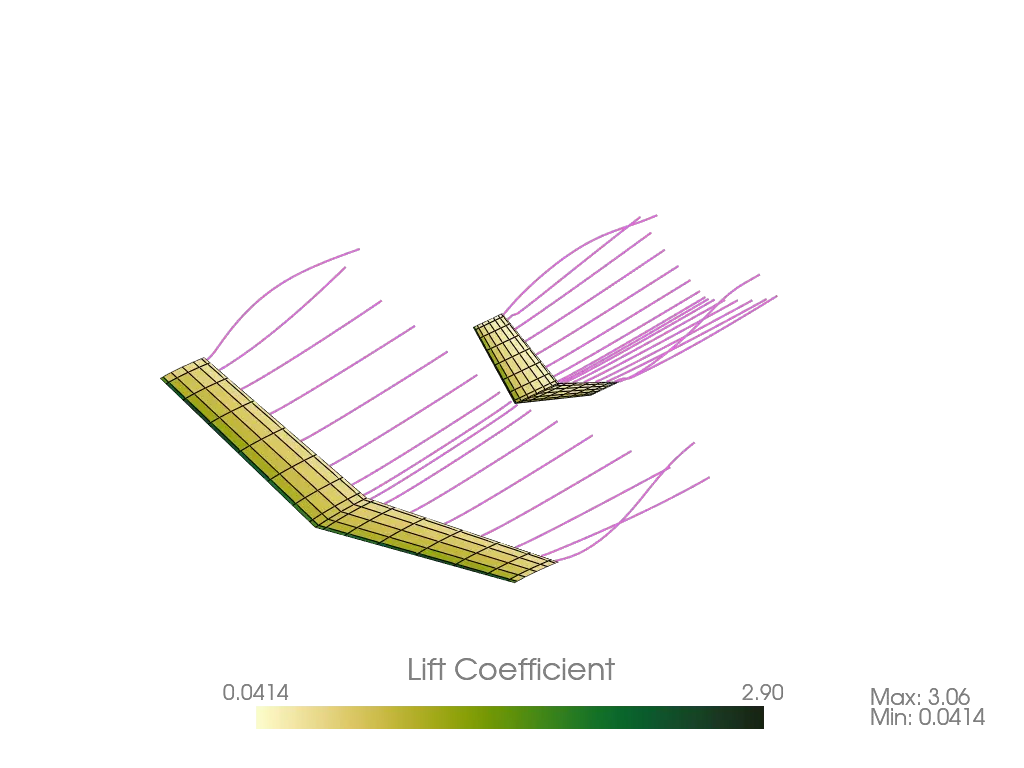
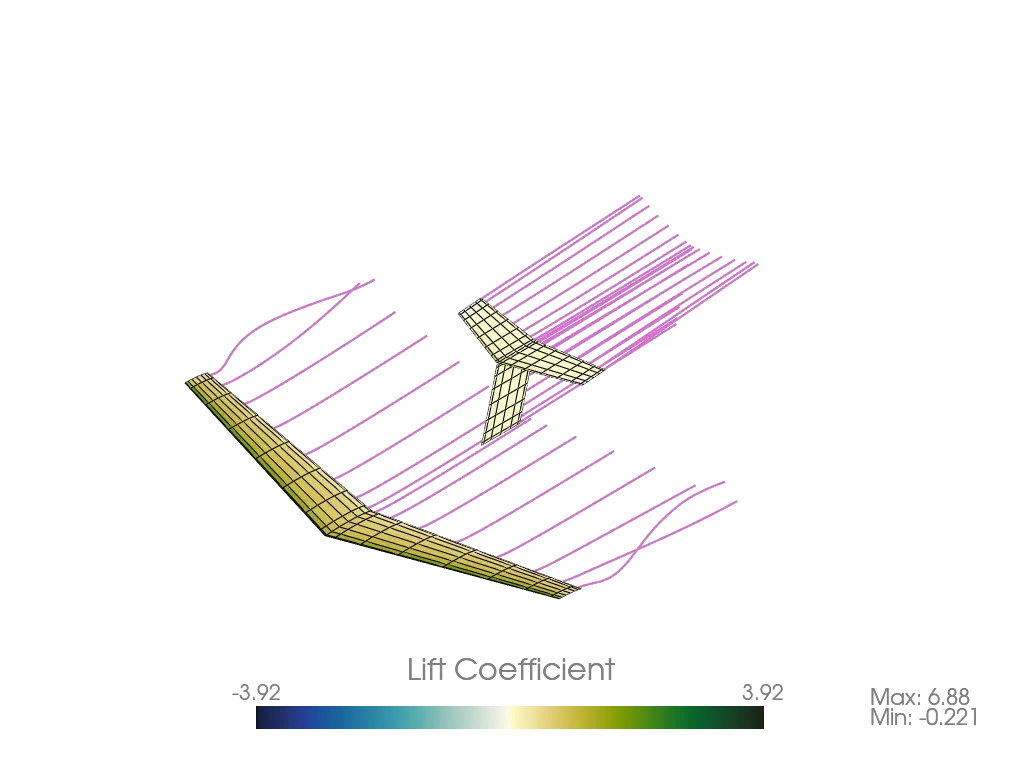

This package currently supports five different solvers, a steady horseshoe VLM, a steady ring VLM, an unsteady ring VLM (UVLM), an aeroelastic unsteady ring VLM, and a free flight unsteady ring VLM. Here are examples of the output you can expect to receive from each of them.
Steady Horseshoe VLM
Steady Ring VLM
Unsteady Ring VLM
Aeroelastic Unsteady Ring VLM

Free Flight Unsteady Ring VLM
Validation
Since the release of version 1.0.0, Ptera Software is now validated against experimental flapping-wing data! See the validation/ directory to run the test case and read a report on the software's accuracy.
Documentation
For detailed API documentation and guides, visit the Ptera Software documentation site.
How to Contribute
The primary goal of this project is to increase the open-source community's understanding and appreciation for unsteady aerodynamics in general and flapping-wing flight in particular. This will only happen through your participation. Feel free to request features, report bugs or security issues, and provide suggestions.
Before contributing, make sure to read through the Contributing Guidelines for how to best help out.
Contributors
- Cameron Urban (camUrban)
- Zach Tait (Zach10a)
- Jonah Jaffe (JonahJ27)
- Venkata Akhil Mettu (AKHIL-149)
- Savitha N (Savitha-Akhilu)
- Pedro Bornia (BorniaPedro)
- Mohamed Abdulghany (MohamedMG7)
- Hang Haotian (haotianh9)
- Monisha Sikka (20086080)
- Cameron Hendrikse (MonoChromatical)
- Abdullah Imran (codexabdullah)
Supporters
- Peter Sharpe
- Suhas Kodali
- Ramesh Agarwal
- E. Farrell Helbling
- Raphael Zufferey
- Joseph Katz
- Allen Plotkin
- Austin Stover
Background
Ptera Software grew out of a desire to make flapping-wing aerodynamics accessible without expensive commercial CFD tools or hard-to-use open-source alternatives. Initially built on AeroSandbox with the support of Peter Sharpe and Suhas Kodali, it has developed into an actively-maintained UVLM package that is well documented, tested, and validated. We hope that with your help, we will increase the open-source community's interest and understanding of biological flight.
1 maintainer

Release files for PteraSoftware 5.1.0
For a detailed explanation of source distributions (sdists) and built distributions (wheels), please see the package formats documentation.
Source distribution (sdist)
| File | Size | Uploaded | |
|---|---|---|---|
| pterasoftware-5.1.0.tar.gz | 1.0 MB | Details |
Built distribution (wheel)
| File | Interpreter | ABI | Platform | Reset |
|---|---|---|---|---|
| pterasoftware-5.1.0-py3-none-any.whl | Python 3 | none | any | Details |
Total release size: 2.4 MB
Release files / pterasoftware-5.1.0.tar.gz
| Download URL | pterasoftware-5.1.0.tar.gz |
|---|---|
| Size | 1.0 MB |
| Tags | Source |
|
SHA-256 checksum How to use checksums |
f288837586e93416b918c10a852fdcdad625d5ec8e5dc81dea84a141011a2967
|
|
BLAKE2b-256 checksum How to use checksums |
a5e06c0629bcdb6a880800c8b346c6e686711cad613c8a64c783ca93b979a90a
|
| Upload date | |
|
Uploaded using Trusted Publishing? What is trusted publishing? |
Yes |
| Uploaded via |
twine/6.1.0 CPython/3.13.13
|
Provenance
Provenance describes where a file came from. On PyPI, provenance is shared via attestations, which provide a verifiable record of the build or publishing details. View details, limitations and caveats.


PyPI Publish Attestation
PyPI verified that this artifact, at this checksum, originated from the publisher listed below.
Signed by GitHub Actions, verified by PyPI on Jul 15, 2026.
Transparency logRelease files / pterasoftware-5.1.0-py3-none-any.whl
| Download URL | pterasoftware-5.1.0-py3-none-any.whl |
|---|---|
| Size | 1.4 MB |
| Tags | Python 3 |
|
SHA-256 checksum How to use checksums |
1775e7e6ee8e4ef21740c48b0fa8dddb3861144eb9e4f5f96244f4f6536bb1bb
|
|
BLAKE2b-256 checksum How to use checksums |
a32319bf92609c0de63bec24ec85cde9caf4ef93ef61a3ca456b6c8de1bcee89
|
| Upload date | |
|
Uploaded using Trusted Publishing? What is trusted publishing? |
Yes |
| Uploaded via |
twine/6.1.0 CPython/3.13.13
|
Provenance
Provenance describes where a file came from. On PyPI, provenance is shared via attestations, which provide a verifiable record of the build or publishing details. View details, limitations and caveats.
PyPI Publish Attestation
PyPI verified that this artifact, at this checksum, originated from the publisher listed below.
Signed by GitHub Actions, verified by PyPI on Jul 15, 2026.
Transparency log













