

Python3 implementation of an improved ADRecon for Pentesters and Blue Teams.
ADRecon is a tool which gathers information about MS Active Directory and generates an XSLX report to provide a holistic picture of the current state of the target AD environment.
Table of Contents
Installation
# stable release from pypi
pipx install pyadrecon

# latest commit from github
pipx install git+https://github.com/l4rm4nd/PyADRecon
Then verify installation:
pyadrecon --version
Usage
usage: pyadrecon.py [-h] [--version] [--generate-excel-from CSV_DIR] [-dc DOMAIN_CONTROLLER] [-u USERNAME] [-p [PASSWORD]] [-d DOMAIN] [--auth {ntlm,kerberos}] [--tgt-file TGT_FILE] [--tgt-base64 TGT_BASE64]
                    [--ssl] [--port PORT] [-o OUTPUT] [--page-size PAGE_SIZE] [--threads THREADS] [--dormant-days DORMANT_DAYS] [--password-age PASSWORD_AGE] [--only-enabled] [--collect COLLECT]
                    [--no-excel] [-v]

PyADRecon - Python Active Directory Reconnaissance Tool

options:
  -h, --help            show this help message and exit
  --version             show program's version number and exit
  --generate-excel-from CSV_DIR
                        Generate Excel report from CSV directory (standalone mode, no AD connection needed)
  --generate-dashboard-from CSV_DIR
                        Generate HTML dashboard from existing CSV files (standalone mode)
  -dc, --domain-controller DOMAIN_CONTROLLER
                        Domain Controller IP or hostname
  -u, --username USERNAME
                        Username for authentication
  -p, --password [PASSWORD]
                        Password for authentication (optional if using TGT)
  -d, --domain DOMAIN   Domain name (e.g., DOMAIN.LOCAL) - Required for Kerberos auth
  --auth {ntlm,kerberos}
                        Authentication method (default: ntlm)
  --tgt-file TGT_FILE   Path to Kerberos TGT ccache file (for Kerberos auth)
  --tgt-base64 TGT_BASE64
                        Base64-encoded Kerberos TGT ccache (for Kerberos auth)
  --ssl                 Force SSL/TLS (LDAPS). No LDAP fallback allowed.
  --port PORT           LDAP port (default: 389, use 636 for LDAPS)
  -o, --output OUTPUT   Output directory (default: PyADRecon-Report-<timestamp>)
  --page-size PAGE_SIZE
                        LDAP page size (default: 500)
  --dormant-days DORMANT_DAYS
                        Days for dormant account threshold (default: 90)
  --password-age PASSWORD_AGE
                        Days for password age threshold (default: 180)
  --only-enabled        Only collect enabled objects
  --collect COLLECT     Comma-separated modules to collect (default: all)
  --workstation WORKSTATION
                        Explicitly spoof workstation name for NTLM authentication (default: empty string, bypasses userWorkstations restrictions)
  --no-excel            Skip Excel report generation
  --no-dashboard        Skip interactive HTML dashboard generation
  -v, --verbose         Verbose output

Examples:
  # Basic usage with NTLM authentication
  pyadrecon.py -dc 192.168.1.1 -u admin -p password123 -d DOMAIN.LOCAL

  # With Kerberos authentication (bypasses channel binding)
  pyadrecon.py -dc dc01.domain.local -u admin -p password123 -d DOMAIN.LOCAL --auth kerberos

  # With Kerberos using TGT from file (bypasses channel binding)
  pyadrecon.py -dc dc01.domain.local -u admin -d DOMAIN.LOCAL --auth kerberos --tgt-file /tmp/admin.ccache

  # With Kerberos using TGT from base64 string (bypasses channel binding)
  pyadrecon.py -dc dc01.domain.local -u admin -d DOMAIN.LOCAL --auth kerberos --tgt-base64 BQQAAAw...

  # Only collect specific modules
  pyadrecon.py -dc 192.168.1.1 -u admin -p pass -d DOMAIN.LOCAL --collect users,groups,computers

  # Output to specific directory
  pyadrecon.py -dc 192.168.1.1 -u admin -p pass -d DOMAIN.LOCAL -o /tmp/adrecon_output

  # Generate Excel report from existing CSV files (standalone mode)
  pyadrecon.py --generate-excel-from /path/to/CSV-Files -o report.xlsx
[!TIP] PyADRecon always tries LDAPS on TCP/636 first.
If flag
--sslis not used, LDAP on TCP/389 may be tried as fallback.
[!WARNING] If LDAP channel binding is enabled, this script will fail with
automatic bind not successful - strongerAuthRequired, as ldap3 does not support it (see here). You must use Kerberos authentication instead.If you use Kerberos auth under Linux, please create a valid
/etc/krb5.confand DC hostname entry in/etc/hosts. May read this. If you are on Windows, please make sure you have valid Kerberos tickets. May read this. Note that you can provide an already existing TGT ticket to the script via--tgt-fileor--tgt-base64. For example, obtained by Netexec vianetexec smb <TARGET> <ARGS> --generate-tgt <FILEMAME>.
Docker
There is also a Docker image available on GHCR.IO.
docker run --rm -v /etc/krb5.conf:/etc/krb5.conf:ro -v /etc/hosts:/etc/hosts:ro -v ./:/tmp/pyadrecon_output ghcr.io/l4rm4nd/pyadrecon:latest -dc dc01.domain.local -u admin -p password123 -d DOMAIN.LOCAL -o /tmp/pyadrecon_output
Collection Modules
As default, PyADRecon runs all collection modules. They are referenced to as default or all.
Though, you can freely select your own collection of modules to run:
| Icon | Meaning |
|---|---|
| 🛑 | Requires administrative domain privileges (e.g. Domain Admins) |
| ✅ | Requires regular domain privileges (e.g. Authenticated Users) |
| 💥 | New collection modul in beta state. Results may be incorrect. |
Forest & Domain
forest✅domain✅trusts✅sites✅subnets✅schemaorschemahistory✅
Domain Controllers
dcsordomaincontrollers✅
Users & Groups
users✅userspns✅groups✅groupmembers✅protectedgroups✅💥krbtgt✅asreproastable✅kerberoastable✅
Computers & Printers
computers✅computerspns✅printers✅
OUs & Group Policy
ous✅gpos✅gplinks✅
Passwords & Credentials
passwordpolicy✅fgpporfinegrainedpasswordpolicy🛑laps🛑bitlocker🛑💥
Managed Service Accounts
gmsaorgroupmanagedserviceaccounts✅💥dmsaordelegatedmanagedserviceaccounts✅💥- Only works for Windows Server 2025+ AD schema
Certificates
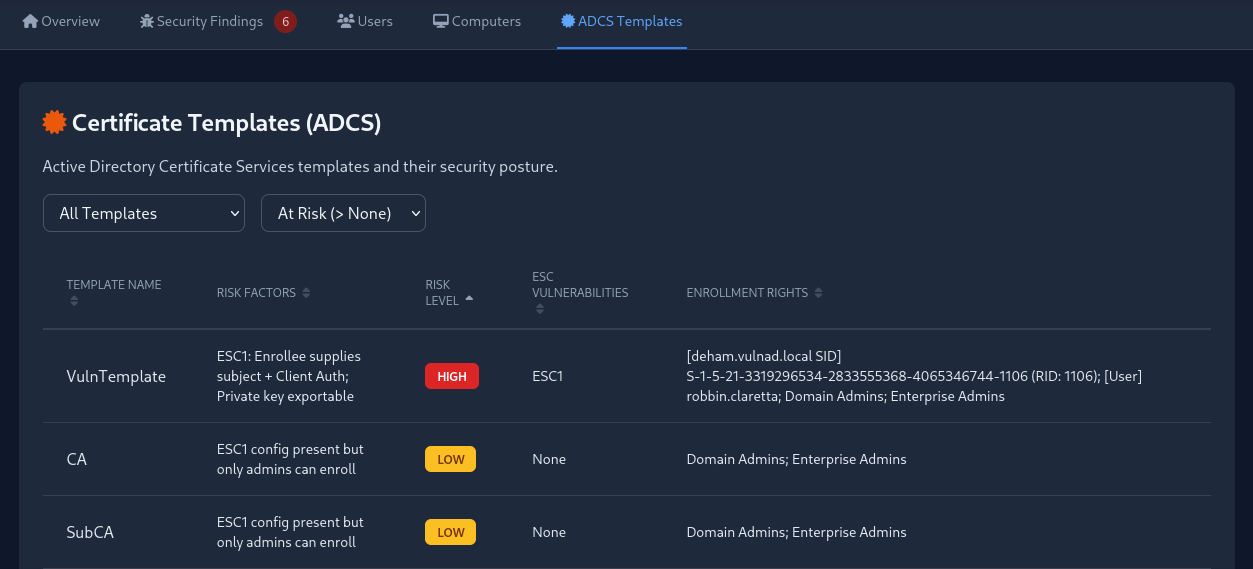
adcsorcertificates✅💥- Detects ESC1, ESC2, ESC3, ESC4 and ESC9
DNS
dnszones✅dnsrecords✅
HTML Dashboard
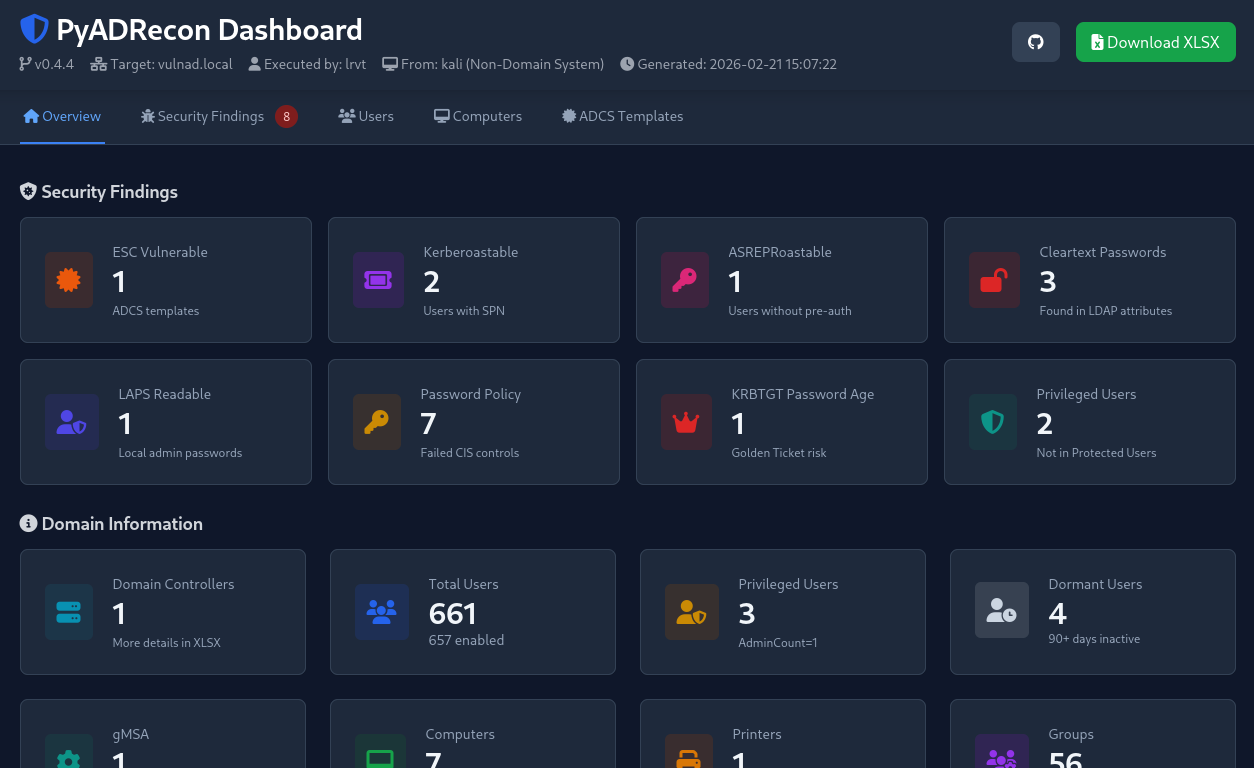
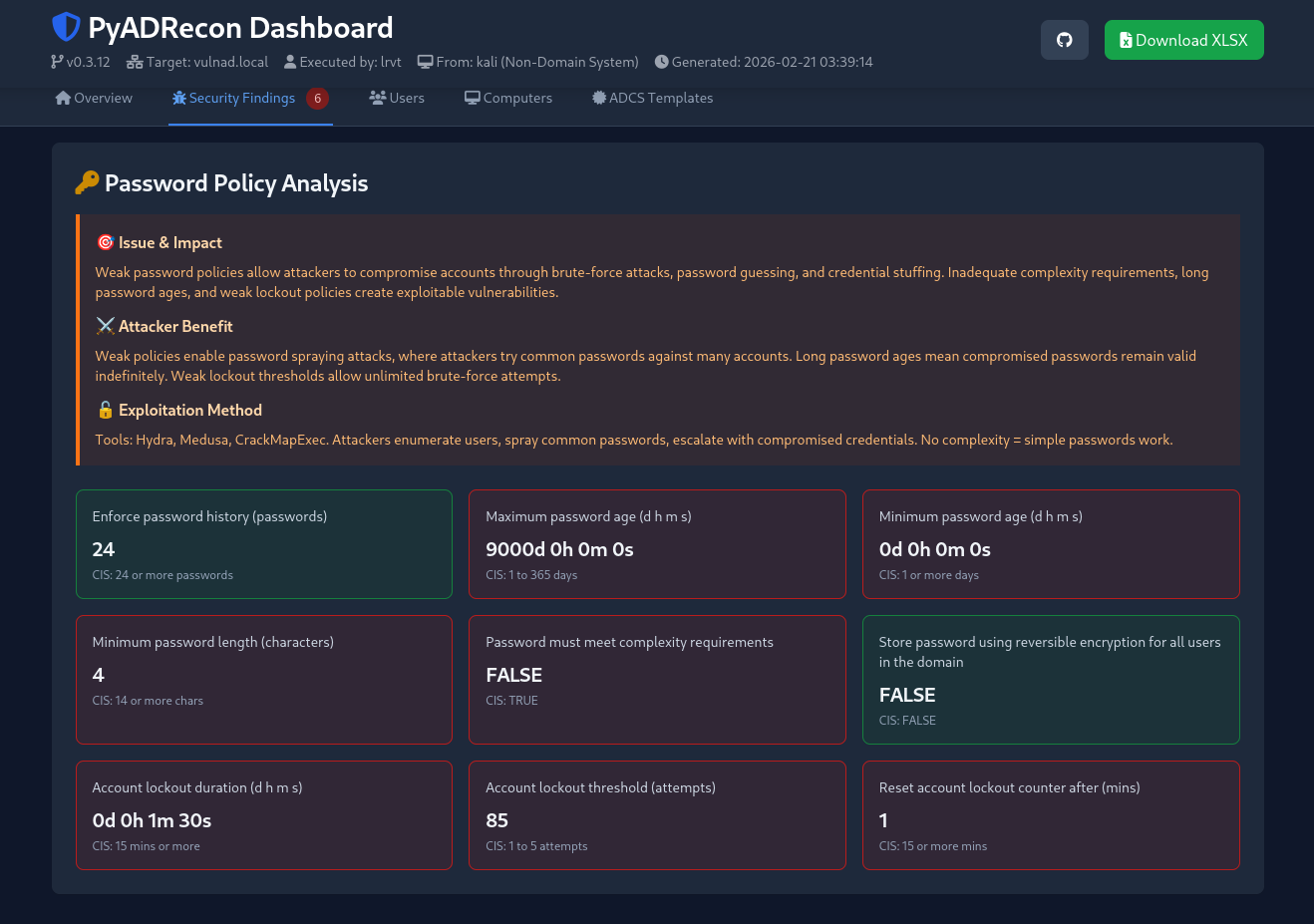
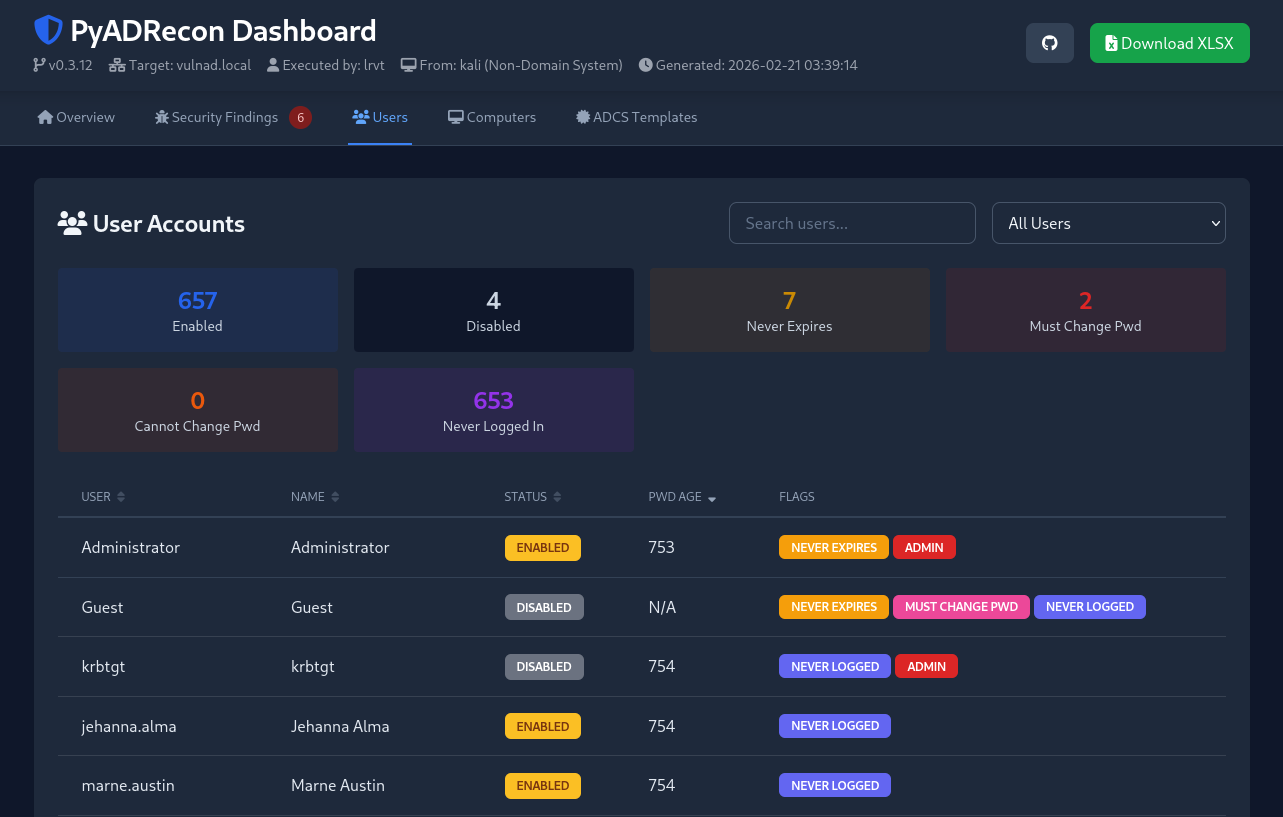
PyADRecon automatically generates an HTML dashboard containing key statistics and security findings when all collection modules are executed.
If needed, you can disable dashboard creation during initial data collection using --no-dashboard. The dashboard can later be generated from existing CSV files with --generate-dashboard-from <CSV_DIR>.
[!CAUTION] This is a beta feature. Displayed data may be falsely parsed or reported as issue. Take it with a grain of salt!
Acknowledgements
Many thanks to the following folks:
- S3cur3Th1sSh1t for a first Claude draft of this Python3 port
- Sense-of-Security for the original ADRecon script in PowerShell
- cannatag for the awesome ldap3 Python client
- Forta for the awesome impacket suite
- Anthropic for Claude LLMs
License
PyADRecon is released under the MIT License.
The following third-party libraries are used:
| Library | License |
|---|---|
| ldap3 | LGPL v3 |
| openpyxl | MIT |
| gssapi | MIT |
| impacket | Apache 2.0 |
| winkerberos | Apache 2.0 |
Please refer to the respective licenses of these libraries when using or redistributing this software.
1 maintainer

Metadata
1 maintainer
Release files for PyADRecon 0.13.7
For a detailed explanation of source distributions (sdists) and built distributions (wheels), please see the package formats documentation.
Source distribution (sdist)
| File | Size | Uploaded | |
|---|---|---|---|
| pyadrecon-0.13.7.tar.gz | 673.7 kB | Details |
Built distribution (wheel)
| File | Interpreter | ABI | Platform | Reset |
|---|---|---|---|---|
| pyadrecon-0.13.7-py3-none-any.whl | Python 3 | none | any | Details |
Total release size: 790.5 kB
Release files / pyadrecon-0.13.7.tar.gz
| Download URL | pyadrecon-0.13.7.tar.gz |
|---|---|
| Size | 673.7 kB |
| Tags | Source |
|
SHA-256 checksum How to use checksums |
fac076e40e4b0cc5ba1d9da4b05935ed8ac0fc22accde6b194d4b0b52cd90a1c
|
|
BLAKE2b-256 checksum How to use checksums |
0fb1adb0f34c636f20ffca20ba7a7cf9a87c627b4b70785d337bd003b1ec6ae3
|
| Upload date | |
|
Uploaded using Trusted Publishing? What is trusted publishing? |
Yes |
| Uploaded via |
twine/6.1.0 CPython/3.13.12
|
Provenance
Provenance describes where a file came from. On PyPI, provenance is shared via attestations, which provide a verifiable record of the build or publishing details. View details, limitations and caveats.


PyPI Publish Attestation
PyPI verified that this artifact, at this checksum, originated from the publisher listed below.
Signed by GitHub Actions, verified by PyPI on Jul 10, 2026.
Transparency logRelease files / pyadrecon-0.13.7-py3-none-any.whl
| Download URL | pyadrecon-0.13.7-py3-none-any.whl |
|---|---|
| Size | 116.8 kB |
| Tags | Python 3 |
|
SHA-256 checksum How to use checksums |
aa47290fed08068232464124fc032a0c24030ceb3e56d171182b2e8caaa18163
|
|
BLAKE2b-256 checksum How to use checksums |
0801a3d2e2b6484aa289ee4681857d671211731c6596357eeff096af8f101600
|
| Upload date | |
|
Uploaded using Trusted Publishing? What is trusted publishing? |
Yes |
| Uploaded via |
twine/6.1.0 CPython/3.13.12
|
Provenance
Provenance describes where a file came from. On PyPI, provenance is shared via attestations, which provide a verifiable record of the build or publishing details. View details, limitations and caveats.
PyPI Publish Attestation
PyPI verified that this artifact, at this checksum, originated from the publisher listed below.
Signed by GitHub Actions, verified by PyPI on Jul 10, 2026.
Transparency log













