
A Python library for generating (optimal) anisotropic power diagrams

Project description
PyAPD
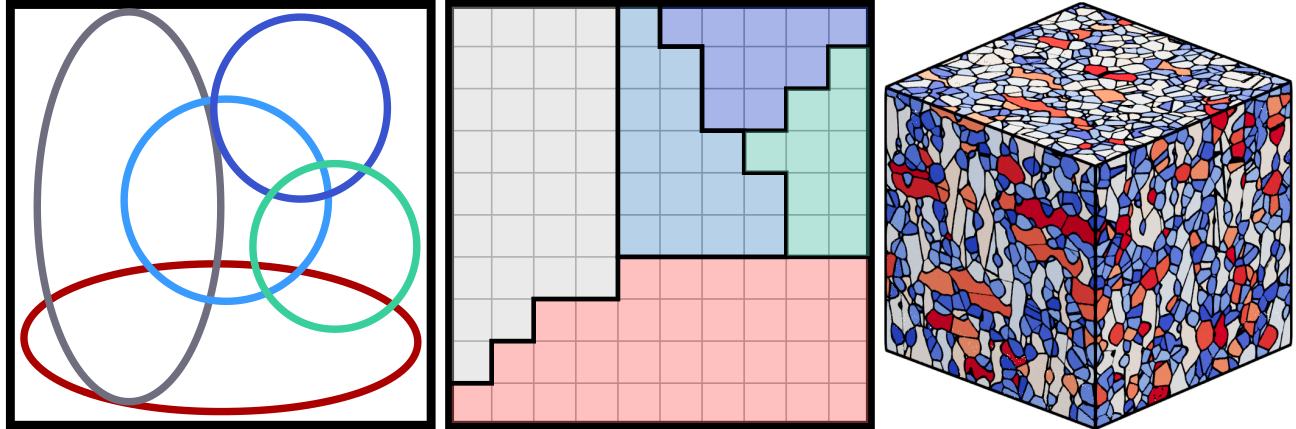
A Python library for computing (optimal) anisotropic power diagrams using GPU acceleration. Current main application concerns geometric modelling of polycrystalline materials with curved boundaries with grains of prescribed volumes and fine control over aspect ratio and location of the grains.
Installation
Install with pip:
pip install PyAPD
Example usage
See /notebooks/tutorials/example_usage.ipynb

Google Colab
To quickly test the speed of the GPU-acceleration, you can play around with the notebook example_usage.ipynb in Google Colab 
Note that by default the Google Colab runtime is CPU-only. To change to a GPU runtime, go to Runtime > Change runtime type and click on T4 GPU. Note that T4 GPU is considered pretty slow and is provided by Google Colab free of charge. To access the gold standard A100 GPU via Google Colab, a subscription is required.
For local use, if you do not have a GPU, you should expect a warning
[KeOps] Warning : Cuda libraries were not detected on the system ; using cpu only mode
but the library is fully functional.
Paper examples
This library is accompanied by the paper
- M. Buze, J. Feydy, S.M. Roper, K. Sedighiani, D.P. Bourne, Anisotropic power diagrams for polycrystal modelling: Efficient generation of curved grains via optimal transport, Computational Materials Science, Volume 245, 2024, DOI, LINK.
The examples presented in the paper can be found in /notebooks/paper_examples, which includes all the Jupyter notebooks as they were run, the data that was generated and the plots from the paper. For the ease of access, here we list them with links to view them statically in NBViewer and also a link to an interactive version in Google Colab. Note that the notebooks relying the loading of data will not work out of the box in Google Colab -- the relevant data will have to be loaded manually.
- Runtime tests
- APD generation
- Gathering data
- Plotting the data for the 2D case
- Gathering data
- Finding optimal APDs
- Gathering data
- Plotting the data for the 3D multi-phase case
- Gathering data
- EBSD data examples
- Fitting to data and artificial sample generation
- Pixel level comparison
- Fitting to data and artificial sample generation
- Additive manufacturing example
- APD generation
Citing this work
If you use PyAPD for academic research, you may cite the paper to which our library is tied as follows.
@article{PyAPD,
title = {Anisotropic power diagrams for polycrystal modelling: Efficient generation of curved grains via optimal transport},
journal = {Computational Materials Science},
volume = {245},
pages = {113317},
year = {2024},
issn = {0927-0256},
doi = {https://doi.org/10.1016/j.commatsci.2024.113317},
url = {https://www.sciencedirect.com/science/article/pii/S092702562400538X},
author = {M. Buze and J. Feydy and S.M. Roper and K. Sedighiani and D.P. Bourne},
keywords = {Anisotropic power diagrams, Polycrystalline materials, Microstructure generation, Optimal transport},
}
Related projects
Release history Release notifications | RSS feed


Download files
Download the file for your platform. If you're not sure which to choose, learn more about installing packages.
Source Distribution
File details
Details for the file pyapd-0.1.3.tar.gz.
File metadata
- Download URL: pyapd-0.1.3.tar.gz
- Upload date:
- Size: 21.0 kB
- Tags: Source
- Uploaded using Trusted Publishing? No
- Uploaded via: twine/5.0.0 CPython/3.12.3
File hashes
| Algorithm | Hash digest | |
|---|---|---|
| SHA256 |
b1773ac739e45698cb311963d720e486a8c8e0474f78a89f358193cb5db9e14d
|
|
| MD5 |
4c838205a228f78eb92b773225ba866f
|
|
| BLAKE2b-256 |
36d2c7c7d7e949f0dff0697a7a880ceec899daaf930bc44b2a717cb80016555b
|






