
PyBADS: Bayesian Adaptive Direct Search in Python




PyBADS is one of the open-source tools for fitting models to data from Luigi Acerbi's group at the University of Helsinki. Check out our other tools, such as PyVBMC for the posterior and the model evidence and PyIBS for models that can only be simulated.
What is it?
PyBADS is a Python implementation of the Bayesian Adaptive Direct Search (BADS) algorithm for solving difficult and mildly expensive optimization problems, originally implemented in MATLAB. BADS has been intensively tested for fitting a variety of computational models, and is currently being used in many computational labs around the world (see Google Scholar for many example applications).
In a benchmark with real model-fitting problems from computational and cognitive neuroscience, BADS performed on par or better than many other common and state-of-the-art optimizers, as shown in the original NeurIPS paper [2].
PyBADS requires no specific tuning and runs off-the-shelf like other Python optimizers (e.g., scipy.optimize.minimize).
Note: If you are interested in estimating posterior distributions (i.e., uncertainty and error bars) over model parameters, and not just point estimates, you might also want to check out Variational Bayesian Monte Carlo for Python (PyVBMC), a package for Bayesian posterior and model inference which can be used in synergy with PyBADS. PyBADS and PyVBMC are among the lab's tools for fitting models to data.
What's new in PyBADS 1.5
- Faster, with equal or better results. On our benchmark problems, PyBADS's own computations run almost twice as fast as in PyBADS 1.1.0, because each step is faster and runs need fewer evaluations, and it finds equal or better minima.
- Periodic variables. The option
periodic_varsnames the variables that are periodic, such as angles: BADS wraps each of them around its hard bounds, and the Gaussian process that models the objective is periodic along it (see Example 6 and the FAQ). - Fixed variables. A variable whose four bounds, hard and plausible, are equal is fixed at that value, and BADS optimizes the others (see the FAQ).
- Evaluations made before the run.
BADS(..., precomputed_evaluations=(X, y))gives a run evaluations of the target made before it, for instance by an earlier run. The run still starts fromx0and its initial design, but skips the points of the design that they hold; those nearest the incumbent join its Gaussian process from the first poll on, and none counts againstmax_fun_evals(see theBADSreference). - Seeded initial design.
random_seeddecides the initial design of a run, as it decides every other random draw; in 1.1.0 the design did not depend on the seed. The FAQ says how to make a run reproducible. - Closer to MATLAB BADS. PyBADS was checked line by line against MATLAB BADS 1.1.3, the reference implementation, and follows it more closely in many details, above all with noisy targets. The FAQ lists what differs from MATLAB BADS.
- Requirements. PyBADS needs gpyreg 1.4.0 or later, NumPy 2.0 or later, SciPy 1.13 or later and matplotlib 3.9 or later.
- FAQ, tips and a coding-agent skill. The documentation has a page of frequently asked questions, adapted from the MATLAB BADS FAQ with further questions on PyBADS; a run occasionally prints a short tip with a link to the documentation (
options={"show_tips": False}turns them off); and the PyBADS skill points a coding agent to the documentation relevant to its task (see Documentation).
The changelog lists what changed since PyBADS 1.1.0. Results differ from 1.1.0, also with a fixed seed. BADS checks the values of many options when it is created and refuses some that 1.1.0 accepted, and some calls and returned fields change: the changelog's list "Upgrading from 1.1.0" says what to check in an existing script.
Documentation
The full documentation is available at: https://acerbilab.github.io/pybads/
For coding agents, the PyBADS skill points to the
documentation relevant to each task. Give your agent that file, or copy the
skills/pybads folder into its skill directory. To update a copied skill,
copy the folder again from the PyBADS version you use.
When should I use PyBADS?
We recommend PyBADS for problems in which:
- the objective function landscape is rough (nonsmooth), typically due to numerical approximations or noise;
- the objective function is at least moderately expensive to compute (e.g., more than 0.1 s per function evaluation);
- the gradient is unavailable;
- the number of input parameters is up to about
D = 20.
The FAQ says what to use for other problems.
Installation
PyBADS is available via pip and conda-forge.
-
Install with:
python -m pip install pybadsor:
conda install --channel=conda-forge pybadsPyBADS requires Python version 3.10 or newer.
-
(Optional): Install Jupyter Notebook to run the examples. You can skip this step if your environment already has Jupyter Notebook, but be aware that if the wrong
jupyterexecutable is found on your path then import errors may arise.python -m pip install notebookor, with Conda:
conda install --channel=conda-forge jupyterThe example notebooks can then be accessed by running
python -m pybads
If you wish to install directly from latest source code, please see the instructions for developers and contributors.
Quick start
The typical workflow of PyBADS follows four steps:
- Define the target (or objective) function;
- Setup the problem configuration (optimization bounds, starting point, possible constraint violation function);
- Initialize and run the optimization;
- Examine and visualize the results.
Running the optimizer in step 3 only involves a couple of lines of code:
from pybads import BADS
# ...
bads = BADS(target, x0, lower_bounds, upper_bounds, plausible_lower_bounds, plausible_upper_bounds)
optimize_result = bads.optimize()
with input arguments:
target: the target function, it takes as input a vector and returns its function evaluation;x0: the starting point of the optimization problem. If it is not given, the starting point is drawn uniformly at random within the plausible bounds (log-uniformly for a variable that BADS maps through a log);lower_boundsandupper_bounds: hard lower and upper bounds for the optimization region (can be-infandinf, or bounded);plausible_lower_boundsandplausible_upper_bounds: plausible lower and upper bounds, that represent our best guess at bounding the region where the solution might lie;non_box_cons(optional): a callable function that denotes non-box constraint violations.
The outputs are:
optimize_result: anOptimizeResultobject which presents relevant information about the solution and the optimization problem. In particular:"x": the minimum point found by the optimizer;"fval": the value of the function at the given solution.
For a full list and description of the entries of the optimize_result object, see the OptimizeResult class documentation.
For a reproducible run, pass an integer seed when creating the BADS object, e.g. BADS(..., options={"random_seed": 42}); the seed is read when the object is created. On Apple Silicon Macs, two runs with the same seed make the same random draws but can end at slightly different points: with Apple's Accelerate as the linear algebra library of NumPy and SciPy (as in their wheels on PyPI), the last bits of a result depend on where its arrays lie in memory. For independent runs, leave random_seed unset or use different seeds. The seed controls only PyBADS's own random draws: if your target is noisy (e.g., simulation-based), seed its random number generator separately.
Next steps
Once installed, example Jupyter notebooks can be found in the pybads/examples directory. They can also be viewed statically on the main documentation pages. These examples represent a full tutorial that will walk you through the basic usage of PyBADS as well as some of its more advanced features, such as noisy targets.
For practical recommendations, such as how to set lower_bounds, upper_bounds and the plausible bounds, how to handle a noisy objective, and what to do when a run goes wrong, check out the PyBADS FAQ.
How does it work?
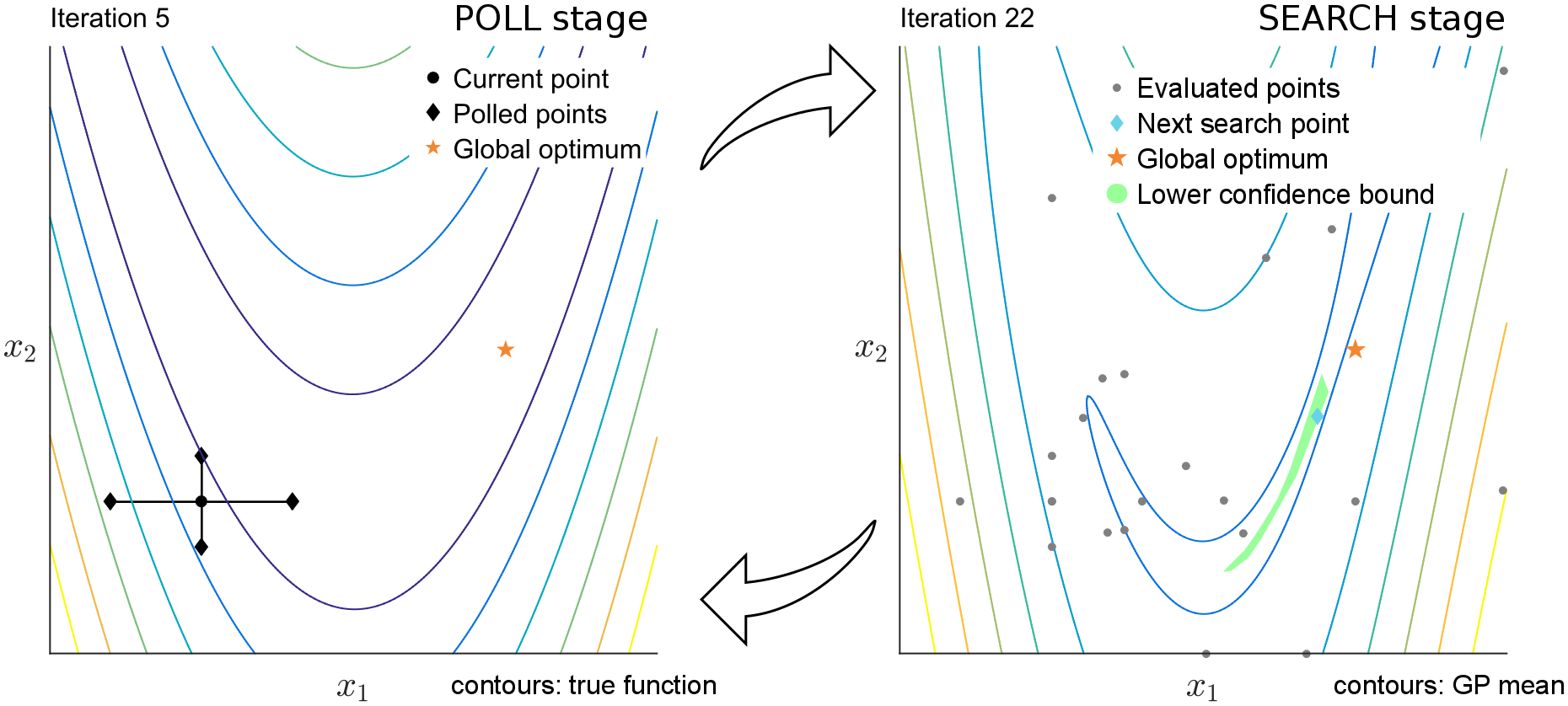
PyBADS/BADS follows a mesh adaptive direct search (MADS) procedure for function minimization that alternates poll steps and search steps (see Fig 1).
- In the poll stage, points are evaluated on a mesh by taking steps in one direction at a time, until an improvement is found or all directions have been tried. The step size is doubled in case of success, halved otherwise.
- In the search stage, a Gaussian process (GP) is fit to a (local) subset of the points evaluated so far. Then, we iteratively choose points to evaluate according to a lower confidence bound strategy that trades off between exploration of uncertain regions (high GP uncertainty) and exploitation of promising solutions (low GP mean).
Fig 1: BADS procedure. The poll's steps are equal in the normalized coordinates in which BADS works, where the plausible box spans [-1, 1] in every variable, and scale with the plausible box in the original coordinates, drawn here; in a variable that BADS maps through a log (positive bounds, and a plausible box that spans a factor of 10 or more), they grow with its value.
See here for a visualization of several optimizers at work, including BADS.
See the original BADS paper for more details (Acerbi and Ma, 2017).
Troubleshooting and contact
PyBADS is under active development. The original BADS algorithm has been extensively tested in several benchmarks and published papers, and some of the benchmarks have been replicated with PyBADS. However, as with any optimization method, you should double-check your results.
If you have trouble doing something with PyBADS, spot bugs or strange behavior, or you simply have some questions, please feel free to:
- Post in the lab's Discussions forum with questions or comments about PyBADS, your problems & applications;
- Open an issue on GitHub;
- Contact the project lead at luigi.acerbi@helsinki.fi, putting 'PyBADS' in the subject of the email.
References and citation
-
Singh, G. S. & Acerbi, L. (2024). PyBADS: Fast and robust black-box optimization in Python. Journal of Open Source Software, 9(94), 5694, https://doi.org/10.21105/joss.05694
-
Acerbi, L. & Ma, W. J. (2017). Practical Bayesian Optimization for Model Fitting with Bayesian Adaptive Direct Search. In Advances in Neural Information Processing Systems 30: 1834-1844. (paper + supplement on arXiv, NeurIPS Proceedings)
Please cite both references if you use PyBADS in your work (the 2017 paper introduced the framework, and the latest one is its Python library). You can cite PyBADS in your work with something along the lines of
We optimized the log likelihoods of our models using Bayesian adaptive direct search (BADS; Acerbi and Ma, 2017), via the PyBADS software (Singh and Acerbi, 2024). PyBADS alternates between a series of fast, local Bayesian optimization steps and a systematic, slower exploration of a mesh grid.
Besides formal citations, you can demonstrate your appreciation for PyBADS in the following ways:
- Star ⭐ the PyBADS repository on GitHub;
- Follow Luigi Acerbi on X or Bluesky for updates about BADS/PyBADS and other projects;
- Tell us about your model-fitting problem and your experience with PyBADS (positive or negative) in the lab's Discussions forum.
Note: If you are interested in estimating posterior distributions (i.e., uncertainty and error bars) over model parameters, and not just point estimates, you might also want to check out Variational Bayesian Monte Carlo for Python (PyVBMC), a package for Bayesian posterior and model inference which can be used in synergy with PyBADS. PyBADS and PyVBMC are among the lab's tools for fitting models to data.
BibTeX
@article{singh2024pybads,
  title={{PyBADS}: {F}ast and robust black-box optimization in {P}ython},
  author={Gurjeet Sangra Singh and Luigi Acerbi},
  publisher = {The Open Journal},
  journal = {Journal of Open Source Software},
  year = {2024},
  volume = {9},
  number = {94},
  pages = {5694},
  url = {https://doi.org/10.21105/joss.05694},
  doi = {10.21105/joss.05694},
}

@article{acerbi2017practical,
    title={Practical {B}ayesian Optimization for Model Fitting with {B}ayesian Adaptive Direct Search},
    author={Acerbi, Luigi and Ma, Wei Ji},
    journal={Advances in Neural Information Processing Systems},
    volume={30},
    pages={1834--1844},
    year={2017}
  }
License
PyBADS is released under the terms of the BSD 3-Clause License.
Acknowledgments
PyBADS is developed by members (past and current) of the Machine and Human Intelligence Group at the University of Helsinki and ELLIS Institute Finland. Starting from version 1.1, development of PyBADS has been assisted by coding agents, including Anthropic's Claude Opus 5.5. Work on the PyBADS package is supported by the Research Council of Finland (grants 356498 and 358980 to Luigi Acerbi) and its Flagship programme: Finnish Center for Artificial Intelligence FCAI.
2 maintainers


Metadata
2 maintainers
Release files for PyBADS 1.5.0
For a detailed explanation of source distributions (sdists) and built distributions (wheels), please see the package formats documentation.
Source distribution (sdist)
| File | Size | Uploaded | |
|---|---|---|---|
| pybads-1.5.0.tar.gz | 644.4 kB | Details |
Built distribution (wheel)
| File | Interpreter | ABI | Platform | Reset |
|---|---|---|---|---|
| pybads-1.5.0-py3-none-any.whl | Python 3 | none | any | Details |
Total release size: 1.2 MB
Release files / pybads-1.5.0.tar.gz
| Download URL | pybads-1.5.0.tar.gz |
|---|---|
| Size | 644.4 kB |
| Tags | Source |
|
SHA-256 checksum How to use checksums |
b657bd609d79dacddd41ab4a776d6bf36d57376172f9b4cf74a8bd703639997f
|
|
BLAKE2b-256 checksum How to use checksums |
c4c31349c86d8778c9709daaa4c9e55a928880b850ea037f4bb0ce8b902b3d1f
|
| Upload date | |
|
Uploaded using Trusted Publishing? What is trusted publishing? |
Yes |
| Uploaded via |
twine/7.0.0 CPython/3.13.14
|
Provenance
Provenance describes where a file came from. On PyPI, provenance is shared via attestations, which provide a verifiable record of the build or publishing details. View details, limitations and caveats.


PyPI Publish Attestation
PyPI verified that this artifact, at this checksum, originated from the publisher listed below.
Signed by GitHub Actions, verified by PyPI on Oct 6, 2026.
Transparency logRelease files / pybads-1.5.0-py3-none-any.whl
| Download URL | pybads-1.5.0-py3-none-any.whl |
|---|---|
| Size | 587.1 kB |
| Tags | Python 3 |
|
SHA-256 checksum How to use checksums |
6130cff2a99771225a2537ae90395f7582186f6f22827d88f9eb044ff990e222
|
|
BLAKE2b-256 checksum How to use checksums |
410198da59e77d868d6a9a375075959e49f7c80fdc72c552ad3f302dc9608c72
|
| Upload date | |
|
Uploaded using Trusted Publishing? What is trusted publishing? |
Yes |
| Uploaded via |
twine/7.0.0 CPython/3.13.14
|
Provenance
Provenance describes where a file came from. On PyPI, provenance is shared via attestations, which provide a verifiable record of the build or publishing details. View details, limitations and caveats.
PyPI Publish Attestation
PyPI verified that this artifact, at this checksum, originated from the publisher listed below.
Signed by GitHub Actions, verified by PyPI on Oct 6, 2026.
Transparency log













