
PyCBA — Python Continuous Beam Analysis
Fast, accurate continuous-beam analysis for the design, assessment and teaching of buildings and bridges —
from linear statics to plastic collapse, modal dynamics and moving-load bridge assessment.







PyCBA is a focused, dependable 1-D continuous-beam engine built on the matrix (direct)
stiffness method. It is deliberately not a general 2-D/3-D FE package — instead it does one
thing extremely well, with a clean API, light dependencies (numpy / scipy / matplotlib),
and an analysis core that powers a surprisingly broad toolkit.
import pycba as cba

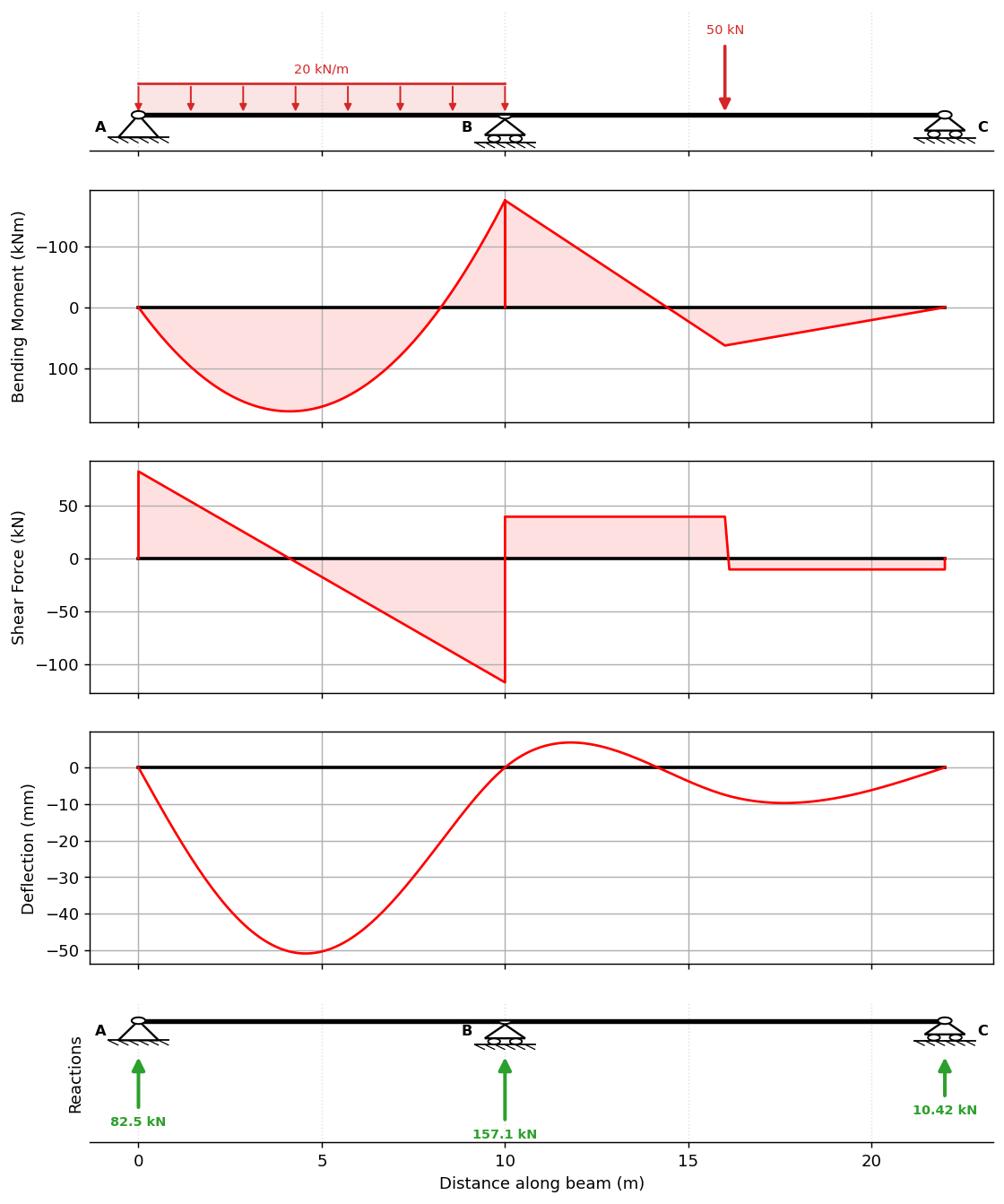
# A two-span continuous beam: 10 m + 12 m, EI = 30 000 kN·m², pinned supports
beam = cba.BeamAnalysis(L=[10, 12], EI=30_000, supports=["pin", "pin", "pin"])
beam.add_udl(i_member=1, w=20)         # 20 kN/m on span 1
beam.add_pl(i_member=2, p=50, a=6)     # 50 kN point load at mid-span 2
beam.analyze()

beam.plot_results()                    # bending moment, shear, deflection + reactions
print(beam.at(5.0))                    # -> {'M': 162.5, 'V': -17.5, 'R': 0.0, 'D': -0.05}
✨ What it does
Analysis
- Continuous beams of any number of spans, with pin / roller / fixed / vertical-spring / rotational-spring supports, prescribed settlements, and internal hinges — plus pre-solve mechanism detection.
- An element library: Euler–Bernoulli, Timoshenko (shear-deformable), non-prismatic (variable
EI), and beam-on-Winkler-foundation. - Nonlinear elasto-plastic analysis to collapse (plastic hinges, mechanism detection, collapse-mechanism plots).
- Free-vibration (modal) analysis — natural frequencies, periods and mode shapes.
Loads & bridges
- UDL, point, partial, trapezoidal, moment and imposed-curvature (creep / shrinkage / thermal) loads; load cases, combinations and patterned UDLs.
- Moving-load bridge assessment — influence lines, envelopes, coincident effects, lane UDLs and shear points / critical shear.
- Code load models — road & rail, from six nations — AASHTO HL-93, Eurocode LM1 / LM71, BS 5400 / CS 454 HB, CSA CL-625, China JTG, AREA Cooper E, AS 5100 M1600 / S1600 / 300LA, NAASRA T44 / MS18 — organised by region.
- A post-tensioning preprocessor for prestress.
Visualisation
- Beam & load schematics in matplotlib and publication-quality TikZ /
stanli. - Shaded bending-moment / shear / deflection diagrams, reaction plots, coincident-effects, mode-shape, collapse-mechanism and vehicle plots.
- An interactive Plotly backend, and selectable display unit systems (SI / US / N·mm).
Ergonomics
- Point queries
at(x), exportsto_dataframe()/to_csv(), a friendlysupports=API, and clear errors — all validated against closed-form solutions, with 370+ tests.
📦 Installation
pip install pycba                 # core
pip install "pycba[plotly]"       # + interactive plots
Requires Python 3.9+.
📚 Documentation & tutorials
Full documentation, a Theoretical Basis, and a dozen worked-example notebooks (bridges, foundations, modal, non-prismatic, nonlinear collapse, creep/shrinkage/thermal, the vehicle library, and more) are at ccaprani.github.io/pycba.
🌱 Origins
PyCBA began life as a Python port of Colin Caprani's MATLAB
Continuous Beam Analysis program (later
ported to C++ by Pierrot). It has since grown well beyond that
starting point into the toolkit above — but the spirit is unchanged: fast, exact, and a pleasure to use.
📄 License
PyCBA is released under the GNU Affero General Public License v3.0 (AGPL-3.0). In short:
you are free to use PyCBA for any purpose — including professional and commercial work — but
if you incorporate it into your own software, or offer it over a network (e.g. a hosted
or SaaS tool), that software must in turn be released under the AGPL. Contributions and issues
are welcome on GitHub.
1 maintainer

Metadata
1 maintainer
Release files for PyCBA 1.0.2
For a detailed explanation of source distributions (sdists) and built distributions (wheels), please see the package formats documentation.
Source distribution (sdist)
| File | Size | Uploaded | |
|---|---|---|---|
| pycba-1.0.2.tar.gz | 195.9 kB | Details |
Built distribution (wheel)
| File | Interpreter | ABI | Platform | Reset |
|---|---|---|---|---|
| pycba-1.0.2-py2.py3-none-any.whl | Python 3, Python 2 | none | any | Details |
Total release size: 349.1 kB
Release files / pycba-1.0.2.tar.gz
| Download URL | pycba-1.0.2.tar.gz |
|---|---|
| Size | 195.9 kB |
| Tags | Source |
|
SHA-256 checksum How to use checksums |
e8dce2c4861d23b8238ec38b59c7fc8894a797e2e426054f8918dacb1c26e41b
|
|
BLAKE2b-256 checksum How to use checksums |
6df47b4489b5d0074edb30ffdbe998a4b9086fc0bb4547347fbf823036272a5b
|
| Upload date | |
|
Uploaded using Trusted Publishing? What is trusted publishing? |
Yes |
| Uploaded via |
twine/7.0.0 CPython/3.13.14
|
Provenance
Provenance describes where a file came from. On PyPI, provenance is shared via attestations, which provide a verifiable record of the build or publishing details. View details, limitations and caveats.


PyPI Publish Attestation
PyPI verified that this artifact, at this checksum, originated from the publisher listed below.
Signed by GitHub Actions, verified by PyPI on Sep 15, 2026.
Transparency logRelease files / pycba-1.0.2-py2.py3-none-any.whl
| Download URL | pycba-1.0.2-py2.py3-none-any.whl |
|---|---|
| Size | 153.3 kB |
| Tags | Python 2 Python 3 |
|
SHA-256 checksum How to use checksums |
7259c9c19d116b230485f15e6d39805b4f22e6d7179d972d6e59407ad1cce890
|
|
BLAKE2b-256 checksum How to use checksums |
e94ed1c50ce4944c2d3675f63a20b8c720e8b218454b3789bcda951d5e4839f6
|
| Upload date | |
|
Uploaded using Trusted Publishing? What is trusted publishing? |
Yes |
| Uploaded via |
twine/7.0.0 CPython/3.13.14
|
Provenance
Provenance describes where a file came from. On PyPI, provenance is shared via attestations, which provide a verifiable record of the build or publishing details. View details, limitations and caveats.
PyPI Publish Attestation
PyPI verified that this artifact, at this checksum, originated from the publisher listed below.
Signed by GitHub Actions, verified by PyPI on Sep 15, 2026.
Transparency log













