
PyGlimmerMDS
Multidimensional scaling (MDS) for large data sets - a python implementation of the Glimmer algorithm.
[Glimmer: Multilevel MDS on the GPU - 2009 - IEEE TVCG - Ingram, Munzner, Olano]
Glimmer performs dimensionality reduction on high-dimensional data sets of many instances, avoiding the quadratic runtime behavior of naive MDS implementations by employing a multilevel (coarse to fine) approach. This implementation has a GPU switch, but also gives considerable speedup with only CPU nonetheless and makes MDS on large data sets feasible.
Glimmer is a metric MDS and uses Euclidean distance in the high-dimensional space as the dissimilarity measure. This is not the classical MDS that has a linear projection solution. Instead it solves the following optimization problem:
$$\underset{y_1,..,y_n}{\mathrm{argmin}} ~ \sum_{i=1}^n \sum_{j=i+1}^n \Big(\lVert x_i-x_j \rVert - \lVert y_i-y_j \rVert\Big) ^2 \quad \mathrm{where} x_i \in \mathbb{R}^D \mathrm{and} y_i \in \mathbb{R}^{d \ll D}$$
Installation
PyGlimmerMDS is available on PyPi and can be installed through pip.
pip install PyGlimmerMDS
or if you want to install a specific commit use
pip install git+https://github.com/hageldave/PyGlimmerMDS@<commit_hash>
How to use
Very briefly
Performing Glimmer on a data set works like this:
mds = Glimmer(decimation_factor=2, stress_ratio_tol=1-1e-5, rng=rng)
projection = mds.fit_transform(data) # alternative: projection, stress = execute_glimmer(data)
print(f"final stress={mds.stress}")
Enable GPU acceleration
The GPU implementation is based on CuPy, which is an optional dependency.
The GPU implementation will only be available if a CuPy package is installed.
Which CuPy package to install depends on the available hardware and driver (i.e. cupy-cuda12x, cupy-cuda13x, or cupy-rocm-7-0 as of writing). GPU acceleration can then be used as follows:
mds = Glimmer(gpu=True, ....)
# or
projection, stress = execute_glimmer_gpu(data, ....)
Complete example
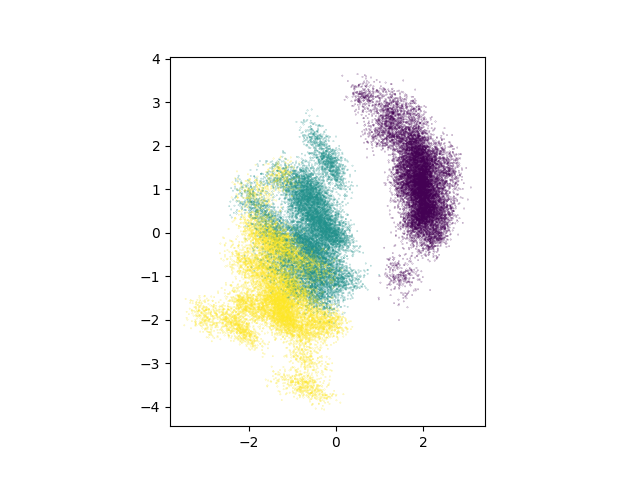
Jittering the Iris data set to produce a data set of 38,400 points. Performing Glimmer on this data set.
from pyglimmermds import Glimmer, execute_glimmer
from sklearn import preprocessing as prep
from sklearn import datasets
import numpy as np
import matplotlib.pyplot as plt

rng = np.random.default_rng(seed=0xBA0BAB)

# get iris data
dataset = datasets.load_iris()
data = dataset.data
labels = dataset.target
# duplicate data with added noise
for _ in range(8):
  data = np.vstack((data,data+(rng.random((data.shape[0], data.shape[1]))*0.2-.1)))
  labels = np.append(labels,labels)
print(data.shape)
print(labels.shape)

# perform MDS
data = prep.StandardScaler().fit_transform(data)
mds = Glimmer(decimation_factor=2, stress_ratio_tol=1-1e-5, rng=rng)
projection = mds.fit_transform(data) # alternative: projection, stress = execute_glimmer(data)
print(f"final stress={mds.stress}")

# show scatter plot
fig, ax = plt.subplots()
scatter = ax.scatter(projection[:, 0], projection[:, 1], c=labels, s=0.02)
ax.axis('equal')
plt.show(fig)
This video shows the layouting happening per level and iteration
https://github.com/user-attachments/assets/aa9f7a8c-1c03-46a3-8ee1-19b3d2d4033e
1 maintainer

Metadata
1 maintainer
Release files for PyGlimmerMDS 1.2.1
For a detailed explanation of source distributions (sdists) and built distributions (wheels), please see the package formats documentation.
Source distribution (sdist)
| File | Size | Uploaded | |
|---|---|---|---|
| pyglimmermds-1.2.1.tar.gz | 14.8 kB | Details |
Built distribution (wheel)
| File | Interpreter | ABI | Platform | Reset |
|---|---|---|---|---|
| pyglimmermds-1.2.1-py3-none-any.whl | Python 3 | none | any | Details |
Total release size: 34.7 kB
Release files / pyglimmermds-1.2.1.tar.gz
| Download URL | pyglimmermds-1.2.1.tar.gz |
|---|---|
| Size | 14.8 kB |
| Tags | Source |
|
SHA-256 checksum How to use checksums |
a412389ba13d1493dc9287501f4c13882204590ec0f82ad0675f0c9155c2f777
|
|
BLAKE2b-256 checksum How to use checksums |
b97aebc23b800fd6c9fe2714c1c560a8aa468bd053c9065a357dc19444512002
|
| Upload date | |
|
Uploaded using Trusted Publishing? What is trusted publishing? |
No |
| Uploaded via |
twine/6.2.0 CPython/3.10.12
|
Release files / pyglimmermds-1.2.1-py3-none-any.whl
| Download URL | pyglimmermds-1.2.1-py3-none-any.whl |
|---|---|
| Size | 19.9 kB |
| Tags | Python 3 |
|
SHA-256 checksum How to use checksums |
3faf397d08d1ea086e65df8576e723ac6b674351edad0bdfe373a174958e9b16
|
|
BLAKE2b-256 checksum How to use checksums |
0a7110a75c9642907c083c6ec0897314800b3f94a331fd6b092cc964a6db1c05
|
| Upload date | |
|
Uploaded using Trusted Publishing? What is trusted publishing? |
No |
| Uploaded via |
twine/6.2.0 CPython/3.10.12
|














