
a package to quantify atlas registered brain data
Verified details
These details have been verified by PyPIProject links
GitHub Statistics
Maintainers

Project description
PyNutil
PyNutil is still under development and the API is subject to change
PyNutil is a Python library for brain-wide quantification and spatial analysis of features in serial section images from the brain. It aims to replicate the Quantifier feature of the Nutil software (RRID: SCR_017183).
PyNutil is able to integrate outputs from atlas registration software and image segmentation software in order to produce atlas based quantifications, 3D point clouds, and 3D heatmaps of brain derived data.

For more information about the QUINT workflow: https://quint-workflow.readthedocs.io/en/latest/
Available Atlases
PyNutil can be run using a custom atlas in .nrrd format (e.g. tests/test_data/Allen_mouse_2017_atlas)
PyNutil can also be used with the atlases available in the BrainGlobe_Atlas API.
Installation
Python package
pip install PyNutil
Running demos
The scripts in demos/ assume PyNutil is importable as an installed package.
For development, install in editable mode from the repository root:
pip install -e .
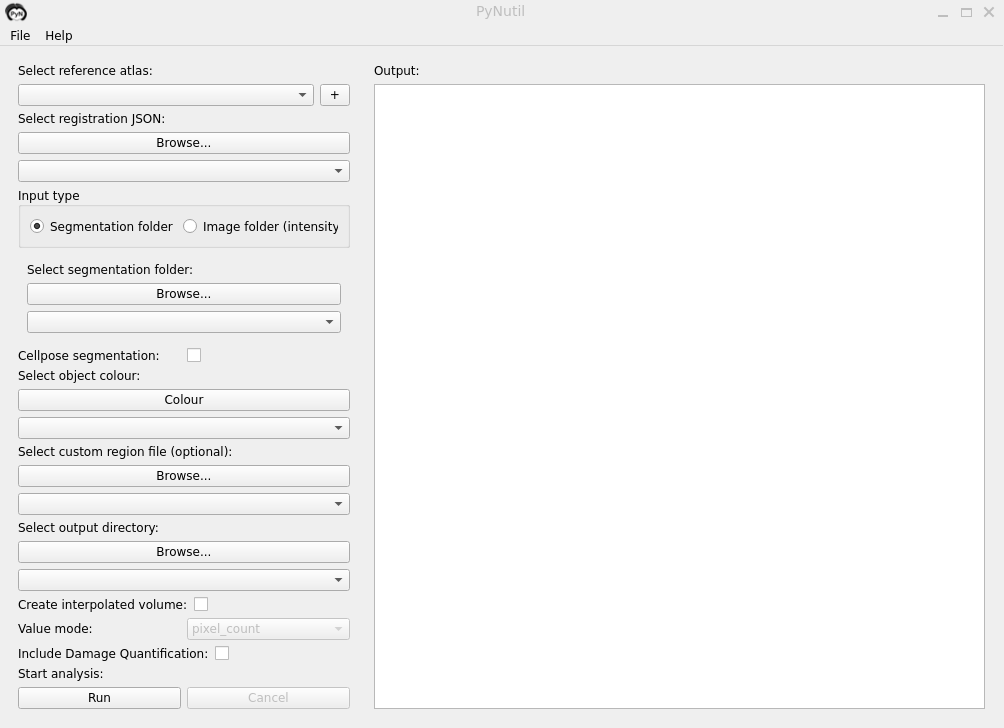
GUI
download the executable for Windows and macOS via the GitHub releases tab
Usage
PyNutil requires Python 3.8 or above.
As input, PyNutil requires:
- An atlas
- A corresponding alignment JSON created with the QuickNII or VisuAlign software.
- A segmentation file for each brain section with the features to be quantified displayed with a unique RGB colour code (it currently accepts many image formats: png, jpg, jpeg, etc).
from PyNutil import PyNutil

"""
Here we define a quantifier object
The segmentations should be images which come out of ilastik, segmenting objects-of-interest
The alignment json should be from DeepSlice, QuickNII, or VisuAlign, it defines the sections position in an atlas
The colour says which colour is the object you want to quantify in your segmentation. It is defined in RGB
Finally the atlas name is the relevant atlas from brainglobe_atlasapi or a custom atlas in nrrd format.

basic_example.py (brainglobe_atlasapi)
basic_example_custom_atlas.py (custom atlas)

"""
pnt = PyNutil(
    segmentation_folder='../tests/test_data/non_linear_allen_mouse/segmentations/',
    alignment_json='../tests/test_data/non_linear_allen_mouse/alignment.json',
    colour=[0, 0, 0],
    atlas_name='allen_mouse_25um'
    #If you would like to use cellpose segmentations add:
    #segmentation_format = 'cellpose'
)

#optionally, if you want to generate a 3D heatmap
pnt.interpolate_volume()

pnt.get_coordinates(object_cutoff=0)

pnt.quantify_coordinates()

pnt.save_analysis("PyNutil/test_result/myResults")
PyNutil generates a series of reports in the folder which you specify.
Per-Hemisphere Quantification
If you use an atlas which has a hemisphere map (All brainglobe atlases have this, it is a volume in the shape of the atlas with 1 in the left hemisphere and 2 in the right) PyNutil will generate per-hemisphere quantifications in addition to total numbers. In addition, PyNutil will also genearte additional per-hemisphere point cloud files for viewing in meshview.
Damage Quantification
The QCAlign tool allows you to mark damaged areas on your section. This means that these damaged areas are excluded from your point clouds. In addition, PyNutil will separately quantify damaged and undamaged areas. Note the undamaged and damaged column names.
Meshview json files
PyNutil will produce meshview json files. These can be opened in MeshView for the Allen Mouse or for the Waxholm Rat
https://github.com/user-attachments/assets/d3a43ca9-133e-40d1-a1b9-9a359deabf2d
Siibra explorer compatible NifTI files
If you have interpolated your volume you will find an interpolated NifTI volume in your output directory. This can be dragged and dropped directly into siibra explorer. If you share your data you can also include a shareable link to your data in the Siibra viewer. These files are also viewable in ITK-SNAP.
https://github.com/user-attachments/assets/30ca7f7f-92f5-4d83-a92a-b29603181b8f
Interpreting the Results
Each column name has the following definition
| Column | Definition |
|---|---|
| idx | The atlas ID of the region. |
| name | The name of atlas region. |
| r | The amount of red in the RGB value for the region colour. |
| g | The amount of green in the RGB value for the region colour. |
| b | The amount of blue in the RGB value for the region colour. |
| Region area | Area representing the region on the segmentation in pixel values. |
| Object count | Number of objects located in the region. An object is a disconnected group of pixels |
| Object pixels | Number of pixels representing objects in this region. |
| Object area | Area representing objects in this region (object pixels x pixel scale). |
| Area fraction | Ratio of Object pixels to Region pixels (Object pixels / Region pixels). |
| Left hemi | For each of the other columns, what is that value for the left hemisphere alone |
| Right hemi | For each of the other columns, what is that value for the right hemisphere alone |
| Damaged | For each of the other columns, what is that value for the areas marked damaged alone |
| Undamaged | For each of the other columns, what is that value for the areas marked undamaged alone |
If you choose to measure the intensity of images rather than segmentations you will not get object counts. Instead you will get
| Column | Definition |
|---|---|
| Sum intensity | The sum of all image pixels in a region. |
| Mean inensity | The mean of all image pixels in a region. |
Feature Requests
We are open to feature requests 😊 Simply open an issue in the GitHub describing the feature you would like to see.
Acknowledgements
PyNutil is developed at the Neural Systems Laboratory at the Institute of Basic Medical Sciences, University of Oslo, Norway with support from the EBRAINS infrastructure, and funding support from the European Union’s Horizon 2020 Framework Programme for Research and Innovation under the Framework Partnership Agreement No. 650003 (HBP FPA).
Contributors
Harry Carey, Sharon C Yates, Gergely Csucs, Arda Balkir, Ingvild Bjerke, Rembrandt Bakker, Nicolaas Groeneboom, Maja A Puchades, Jan G Bjaalie.
Licence
GNU General Public License v3
Related articles
Yates SC, Groeneboom NE, Coello C, et al. & Bjaalie JG (2019) QUINT: Workflow for Quantification and Spatial Analysis of Features in Histological Images From Rodent Brain. Front. Neuroinform. 13:75. https://doi.org/10.3389/fninf.2019.00075
Groeneboom NE, Yates SC, Puchades MA and Bjaalie JG. Nutil: A Pre- and Post-processing Toolbox for Histological Rodent Brain Section Images. Front. Neuroinform. 2020,14:37. https://doi.org/10.3389/fninf.2020.00037
Puchades MA, Csucs G, Lederberger D, Leergaard TB and Bjaalie JG. Spatial registration of serial microscopic brain images to three-dimensional reference atlases with the QuickNII tool. PLosONE, 2019, 14(5): e0216796. https://doi.org/10.1371/journal.pone.0216796
Carey H, Pegios M, Martin L, Saleeba C, Turner A, Everett N, Puchades M, Bjaalie J, McMullan S. DeepSlice: rapid fully automatic registration of mouse brain imaging to a volumetric atlas. BioRxiv. https://doi.org/10.1101/2022.04.28.489953
Berg S., Kutra D., Kroeger T., Straehle C.N., Kausler B.X., Haubold C., et al. (2019) ilastik:interactive machine learning for (bio) image analysis. Nat Methods. 16, 1226–1232. https://doi.org/10.1038/s41592-019-0582-9
Contact us
Report issues here on GitHub or email: support@ebrains.eu
Project details
Verified details
These details have been verified by PyPIProject links
GitHub Statistics
Maintainers
Release history Release notifications | RSS feed


Download files
Download the file for your platform. If you're not sure which to choose, learn more about installing packages.
Source Distribution
Built Distribution
Filter files by name, interpreter, ABI, and platform.
If you're not sure about the file name format, learn more about wheel file names.
Copy a direct link to the current filters
File details
Details for the file pynutil-0.5.1.tar.gz.
File metadata
- Download URL: pynutil-0.5.1.tar.gz
- Upload date:
- Size: 72.5 kB
- Tags: Source
- Uploaded using Trusted Publishing? Yes
- Uploaded via: twine/6.1.0 CPython/3.13.7
File hashes
| Algorithm | Hash digest | |
|---|---|---|
| SHA256 |
c893b84e3a6597acf8bca499b90fb2590535fbfd01a3591b831b2bf909cea4d7
|
|
| MD5 |
6210ec698b6aec57ab87531040b4fa6f
|
|
| BLAKE2b-256 |
b5e101dbfe2491e121ab61debea97f8ccbcddeed3d1fd6f21537219e4161ffa0
|
Provenance
The following attestation bundles were made for pynutil-0.5.1.tar.gz:
Publisher:
publish-to-pypi.yml on Neural-Systems-at-UIO/PyNutil
-
Statement:
-
Statement type:
https://in-toto.io/Statement/v1 -
Predicate type:
https://docs.pypi.org/attestations/publish/v1 -
Subject name:
pynutil-0.5.1.tar.gz -
Subject digest:
c893b84e3a6597acf8bca499b90fb2590535fbfd01a3591b831b2bf909cea4d7 - Sigstore transparency entry: 1056943817
- Sigstore integration time:
-
Permalink:
Neural-Systems-at-UIO/PyNutil@bea08e1a1764950cd20bf771917bf51e5e12793b -
Branch / Tag:
refs/tags/v0.5.1 - Owner: https://github.com/Neural-Systems-at-UIO
-
Access:
public
-
Token Issuer:
https://token.actions.githubusercontent.com -
Runner Environment:
github-hosted -
Publication workflow:
publish-to-pypi.yml@bea08e1a1764950cd20bf771917bf51e5e12793b -
Trigger Event:
release
-
Statement type:
File details
Details for the file pynutil-0.5.1-py3-none-any.whl.
File metadata
- Download URL: pynutil-0.5.1-py3-none-any.whl
- Upload date:
- Size: 84.4 kB
- Tags: Python 3
- Uploaded using Trusted Publishing? Yes
- Uploaded via: twine/6.1.0 CPython/3.13.7
File hashes
| Algorithm | Hash digest | |
|---|---|---|
| SHA256 |
51061a7aecdf1cf411529da0730d5e2ff0f1217734b5d7b8e610b2992b7f7990
|
|
| MD5 |
aa3f5dea4714d4b1d4de37ea4d760da3
|
|
| BLAKE2b-256 |
9ff24bb4237825c73614ba8daedb1a07383c7aeedf54de59cc26caebd5c76774
|
Provenance
The following attestation bundles were made for pynutil-0.5.1-py3-none-any.whl:
Publisher:
publish-to-pypi.yml on Neural-Systems-at-UIO/PyNutil
-
Statement:
-
Statement type:
https://in-toto.io/Statement/v1 -
Predicate type:
https://docs.pypi.org/attestations/publish/v1 -
Subject name:
pynutil-0.5.1-py3-none-any.whl -
Subject digest:
51061a7aecdf1cf411529da0730d5e2ff0f1217734b5d7b8e610b2992b7f7990 - Sigstore transparency entry: 1056943818
- Sigstore integration time:
-
Permalink:
Neural-Systems-at-UIO/PyNutil@bea08e1a1764950cd20bf771917bf51e5e12793b -
Branch / Tag:
refs/tags/v0.5.1 - Owner: https://github.com/Neural-Systems-at-UIO
-
Access:
public
-
Token Issuer:
https://token.actions.githubusercontent.com -
Runner Environment:
github-hosted -
Publication workflow:
publish-to-pypi.yml@bea08e1a1764950cd20bf771917bf51e5e12793b -
Trigger Event:
release
-
Statement type:






