
PyThermoLinkDB is a Python package providing a robust and efficient interface between `PyThermoDB` and other applications.

Project description
PyThermoLinkDB
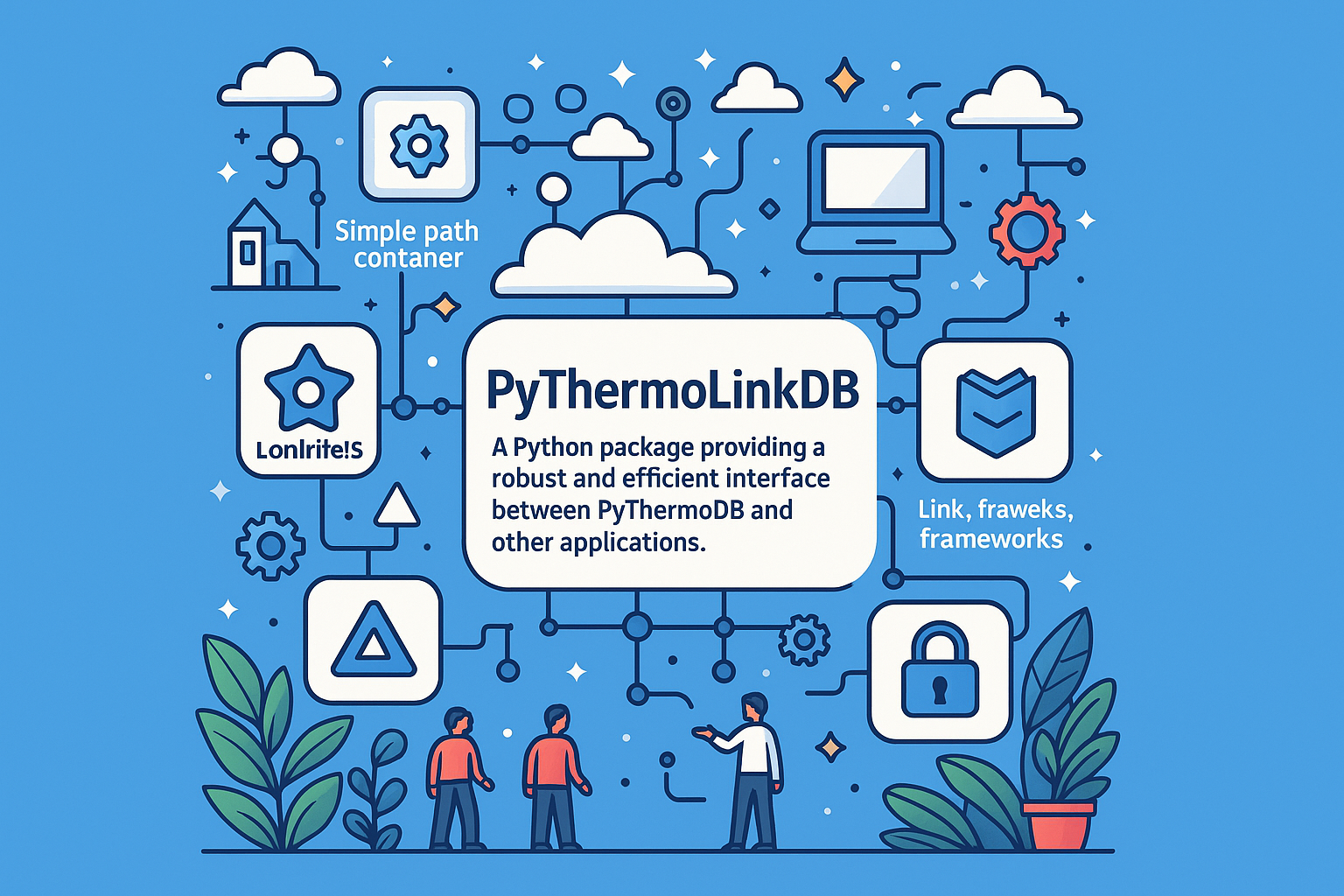



PyThermoLinkDB is a Python package providing a robust and efficient interface between PyThermoDB and other applications. It enables seamless thermodynamic data exchange, integration, and analysis. With PyThermoLinkDB, developers can easily link PyThermoDB to various tools, frameworks, and databases, streamlining thermodynamic workflows.
✨ Key Features
- 🔹 Simple and intuitive API
- ⚡ Efficient data transfer and integration
- 📂 Compatible with multiple data formats
- 📚 Extensive documentation and examples
Ideal for researchers, engineers, and developers working with thermodynamic data, PyThermoLinkDB simplifies data integration and analysis, accelerating scientific discoveries and industrial applications.
🌐 Google Colab
You can run PyThermoLinkDB in Google Colab:
- Basic Usage 1

📥 Installation
Install pyThermoLinkDB and PyThermoDB with pip
pip install pyThermoLinkDB
pip install PyThermoDB
🛠️ Usage Example
🔄 Load ThermoDB
This section demonstrates how to load thermodynamic data files from PyThermoDB.
Multiple thermodynamic databases are imported: one for CO2, one for methanol, and one for NRTL interaction parameters. Each database is loaded from a pickle file using the load_thermodb function, and then verified with the check() method to ensure data integrity.
# import packages/modules
import os
from rich import print
import pyThermoLinkDB as ptdblink
import pyThermoDB as ptdb

# SECTION CO2
CO2_thermodb_file = os.path.join(
    os.getcwd(), 'test', 'carbon dioxide-1.pkl')
# load
CO2_thermodb = ptdb.load_thermodb(CO2_thermodb_file)
print(type(CO2_thermodb))

# check
print(CO2_thermodb.check())

# SECTION methanol
# thermodb file name
MeOH_thermodb_file = os.path.join(os.getcwd(), 'test', 'methanol-1.pkl')
print(f"thermodb file: {MeOH_thermodb_file}")
# load
MeOH_thermodb = ptdb.load_thermodb(MeOH_thermodb_file)
print(type(MeOH_thermodb))

MeOH_thermodb

# check
print(MeOH_thermodb.check())

# SECTION nrtl
# thermodb file name
nrtl_thermodb_file = os.path.join(
    os.getcwd(), 'test', 'thermodb_nrtl_1.pkl')
print(f"thermodb file: {nrtl_thermodb_file}")
# load
nrtl_thermodb = ptdb.load_thermodb(nrtl_thermodb_file)
print(type(nrtl_thermodb))

# check
print(nrtl_thermodb.check())
🔌 Initialize Thermodb Hub
This section demonstrates how to initialize a ThermoDB hub using the init() function, which creates a central repository for thermodynamic data.
The code shows adding different component databases (methanol, CO2) as well as interaction parameter data (NRTL) to the hub. The items() method is used to list all components currently stored in the hub.
# init thermodb hub
thub1 = ptdblink.init()
print(type(thub1))

# add component thermodb
thub1.add_thermodb('MeOH', MeOH_thermodb)
thub1.add_thermodb('CO2', CO2_thermodb)
# matrix data
thub1.add_thermodb('NRTL', nrtl_thermodb)

# get components
print(thub1.items())
⚙️ ThermoDB Link Configuration
This section shows the format of the YAML configuration file used to define thermodynamic properties and equations for different compounds. Each component has a DATA section for properties (like critical pressure, temperature) and an EQUATIONS section for thermodynamic relationships. The configuration file structure helps maintain consistent property mapping across the database.
You can use markdown (.md), YAML (.yml), or text (.txt) files to set the ThermoDB configuration. It is also possible to define a variable directly in your code and add the content of a .yml, .txt, or .md file as a string, as long as the format is correct and parsable.
Thermodb rule format (thermodb_config.yml):
CO2:
  DATA:
    Pc: Pc
    Tc: Tc
    AcFa: AcFa
  EQUATIONS:
    vapor-pressure: VaPr
    heat-capacity: Cp_IG
acetylene:
  DATA:
    Pc: Pc
    Tc: Tc
    AcFa: AcFa
  EQUATIONS:
    vapor-pressure: VaPr
## CO2

    - DATA:
        Pc: Pc
        Tc: Tc
        AcFa: AcFa
    - EQUATIONS:
        vapor-pressure: VaPr
        heat-capacity: Cp_IG
# CO2
- DATA:
Pc: Pc
Tc: Tc
AcFa: AcFa
- EQUATIONS:
vapor-pressure: VaPr
heat-capacity: Cp_IG
# add thermodb rule
thermodb_config_file = os.path.join(os.getcwd(), 'test', 'thermodb_config.yml')

# all components
res_ = thub1.config_thermodb_rule(thermodb_config_file)
# selected components
#res_ = thub1.config_thermodb_rule(thermodb_config_file, names=["MeOH", "CO2"])
print(res_)
🔧 Add/Update ThermoDB Rule
This section demonstrates how to add or update a ThermoDB rule for a specific chemical compound (e.g., CO2). The rule includes critical data properties and equations related to the compound, which are then added to the ThermoDB using the add_thermodb_rule method.
# update thermodb rule
thermodb_rule_CO2 = {
    'DATA': {
        'Pc': 'Pc1',
        'Tc': 'Tc1',
        'AcFa': 'AcFa1'
    },
    'EQUATIONS': {
        'vapor-pressure': 'VaPr1',
        'heat-capacity': 'Cp_IG1'
    }
}

# add thermodb rule for CO2
thub1.add_thermodb_rule('CO2', thermodb_rule_CO2)
🗑️ Delete ThermoDB Rule
This section demonstrates how to delete a specific ThermoDB rule using the delete_thermodb_rule method. In this example, the rule associated with 'CO2' is being removed.
# delete thermodb rule for CO2
thub1.delete_thermodb_rule('CO2')
🔨 Build ThermoDB Hub
This section demonstrates the process of building data sources and equation sources using the build method, and then prints the resulting objects. Additionally, it showcases accessing and printing the hub attribute.
# build
datasource, equationsource = thub1.build()
print(datasource)
print(equationsource)

# hub
print(thub1.hub)
📊 Retrieve Data/Equation
This section demonstrates how to access various thermodynamic data and equations from the built ThermoDB hub. Examples include retrieving critical properties (Pc, Tc) for different components, NRTL interaction parameters, and calculating values using vapor pressure and activity coefficient equations at specified conditions.
# CO2 data
dt1_ = datasource['CO2']['Pc']
print(type(dt1_))
print(dt1_)

# MeOH data
dt2_ = datasource['MeOH']['Tc']
print(type(dt2_))
print(dt2_)

# NRTL data
dt3_ = datasource['NRTL']['alpha_i_j']
print(type(dt3_))
print(dt3_.ij("Alpha_methanol_ethanol"))

# CO2 equation
eq1_ = equationsource['CO2']['VaPr']
print(type(eq1_))
print(eq1_)
print(eq1_.args)
print(eq1_.cal(T=298.15))

# nrtl equation
eq2_ = equationsource['NRTL']['tau_i_j']
print(type(eq2_))
print(eq2_)
print(eq2_.args)
print(eq2_.cal(T=298.15))
❓ FAQ
For any question, contact me on LinkedIn
👨💻 Authors
Release history Release notifications | RSS feed


Download files
Download the file for your platform. If you're not sure which to choose, learn more about installing packages.
Source Distribution
Built Distribution
Filter files by name, interpreter, ABI, and platform.
If you're not sure about the file name format, learn more about wheel file names.
Copy a direct link to the current filters
File details
Details for the file pythermolinkdb-1.4.10.tar.gz.
File metadata
- Download URL: pythermolinkdb-1.4.10.tar.gz
- Upload date:
- Size: 34.9 kB
- Tags: Source
- Uploaded using Trusted Publishing? No
- Uploaded via: uv/0.7.8
File hashes
| Algorithm | Hash digest | |
|---|---|---|
| SHA256 |
0ea833b487c00b8c88d0ea726b06dd2638b99cdaa9f250be222fb22286c730ec
|
|
| MD5 |
4e1a44738f643dc90c0241f5b5aa8c64
|
|
| BLAKE2b-256 |
03708e785fca04b149b28f69bf0f5e75bed732581e120cf6b5c91f9656ab16cc
|
File details
Details for the file pythermolinkdb-1.4.10-py3-none-any.whl.
File metadata
- Download URL: pythermolinkdb-1.4.10-py3-none-any.whl
- Upload date:
- Size: 43.0 kB
- Tags: Python 3
- Uploaded using Trusted Publishing? No
- Uploaded via: uv/0.7.8
File hashes
| Algorithm | Hash digest | |
|---|---|---|
| SHA256 |
1b7be3d2a53d9fef77f814ce04b8a35bf5dcae79f5fb86942b42d5e89169d790
|
|
| MD5 |
8b29fd476a256a1d857ffc4755ba5600
|
|
| BLAKE2b-256 |
e6748286d37d6dfdb1d6f49abc18797d8eab2c84ee1b0ce610851569e412fcfc
|






