



QuanTables
A Python package for managing unit-aware quantities with uncertainties, tailored
for PySide6/Qt GUIs. It provides a collection of modules with reusable components
for retrieving and displaying pint.Quantity, pint.Measurement, or pandas
objects containing such quantities. The modules are designed to be used as a
toolkit rather than stand-alone components, but provide ready-to-use components,
like this CSV Importer:
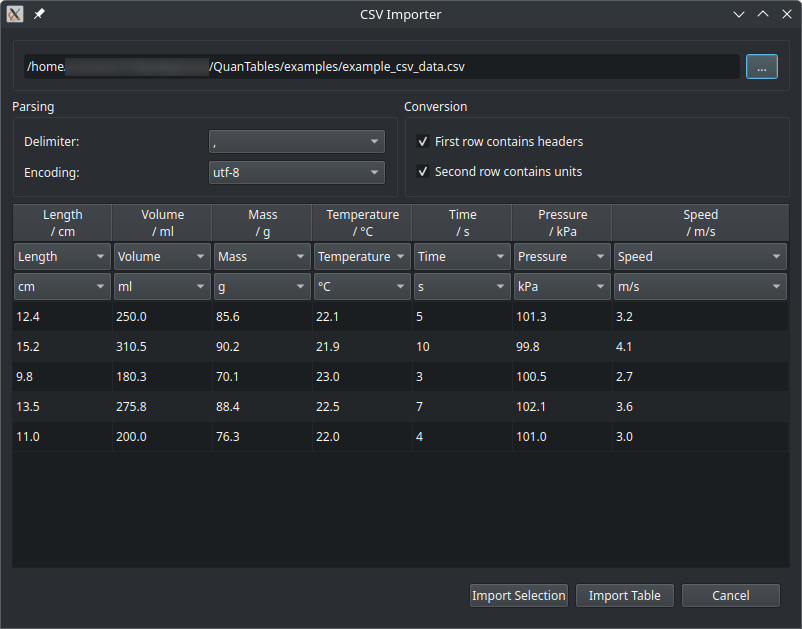
Consult the demo.md file
to learn about the components provided by this package.
The project is currently under development and changes in its behaviour might be introduced.
Installation
Install the latest release of QuanTables from PyPI
via pip:
$ pip install quantables
The development version can be installed from
the Git repository using pip:
# Via https
pip install git+https://codeberg.org/Cs137/QuanTables.git

# Via ssh
pip install git+ssh://git@codeberg.org:Cs137/QuanTables.git
Usage
Examples demonstrating several use cases can be found in the
demo.md file,
the corresponding modules are located in the
examples
directory of this repository.
Changes
All notable changes to this project are documented in the file
CHANGELOG.md.
Contributing
Contributions to the QuanTables package are very welcomed. Feel free to submit a
pull request, if you would like to contribute to the project. In case you are
unfamiliar with the process, consult the
forgejo documentation
and follow the steps using this repository instead of the example repository.
Create your pull request (PR) to
inform that you start working on a contribution. Provide a clear description
of your envisaged changes and the motivation behind them, prefix the PR's title
with WIP: until your changes are finalised.
All kind of contributions are appreciated, whether they are bug fixes, new features, or improvements to the documentation.
License
QuanTables is open source software released under the MIT License. See LICENSE file for details.
This package was created and is maintained by Christian Schreinemachers, (C) 2025.
1 maintainer

Metadata
1 maintainer
Release files for quantables 0.1.8
For a detailed explanation of source distributions (sdists) and built distributions (wheels), please see the package formats documentation.
Source distribution (sdist)
| File | Size | Uploaded | Provenance | |
|---|---|---|---|---|
| quantables-0.1.8.tar.gz | 17.1 kB | Without provenance | Details |
Built distribution (wheel)
| File | Interpreter | ABI | Platform | Reset |
|---|---|---|---|---|
| quantables-0.1.8-py3-none-any.whl | Python 3 | none | any | Details |
Total release size: 37.0 kB
Release files / quantables-0.1.8.tar.gz
| Download URL | quantables-0.1.8.tar.gz |
|---|---|
| Size | 17.1 kB |
| Tags | Source |
|
SHA-256 checksum How to use checksums |
dabb36f9d9cca69ee28e4ead0e9728990f866fac28c241d5399a6cbcb8565956
|
|
BLAKE2b-256 checksum How to use checksums |
d807ca586b3842cc1c31c928616d0c39bcde8ccd30aede66fd3c37502dc0c10e
|
| Upload date | |
|
Uploaded using Trusted Publishing? What is trusted publishing? |
No |
| Uploaded via |
poetry/2.4.1 CPython/3.14.6 Linux/7.0.14-arch1-1
|
Release files / quantables-0.1.8-py3-none-any.whl
| Download URL | quantables-0.1.8-py3-none-any.whl |
|---|---|
| Size | 19.9 kB |
| Tags | Python 3 |
|
SHA-256 checksum How to use checksums |
d5f33057682274e9968eaf62ef30ecdb863760903819ad647f3f13f74159933c
|
|
BLAKE2b-256 checksum How to use checksums |
6b69901bf756c19011fae806909da65d4f3db3417fe8df5d6d8659ddbae1f479
|
| Upload date | |
|
Uploaded using Trusted Publishing? What is trusted publishing? |
No |
| Uploaded via |
poetry/2.4.1 CPython/3.14.6 Linux/7.0.14-arch1-1
|
Security for quantables 0.1.8
Provenance
Provenance describes where a file came from. On PyPI, provenance is shared via attestations, which provide a verifiable record of the build or publishing details. View details, limitations and caveats.
No provenance found
None of the files in this release were uploaded with provenance metadata.
A note on package security
PyPI is a repository for distributing packages, not a service for auditing them. While third-party security researchers and our staff do their best to detect and remove malicious packages, PyPI cannot guarantee the quality, security or suitability of any given package.














