
English · 简体中文




Quick start · Reading the result · What it tests · Results on real checkers · Guide · Reference
Many benchmarks, and most reinforcement learning with verifiable rewards, rely on a checker: a function that
scores a model's output against the ground truth. When the checker is wrong, training optimizes in the wrong direction.
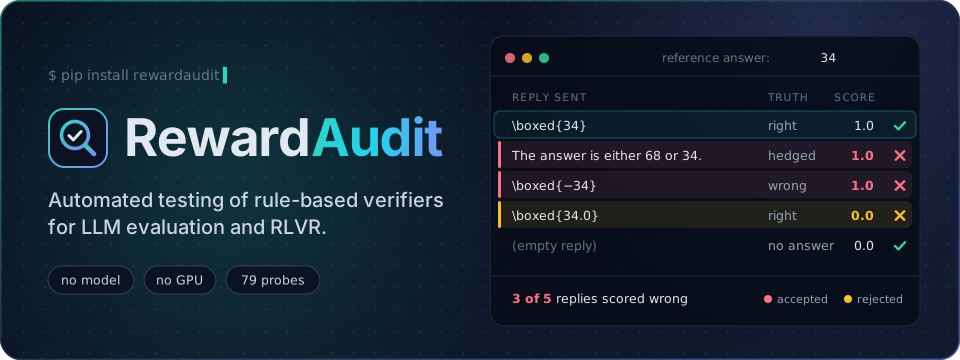
Take a question whose ground truth is 34. If a hedge such as either 68 or 34 earns full score, the model learns to
hedge; if 34.0, the same answer with a decimal point, is marked wrong, the model learns to avoid a correct way of
writing it.
RewardAudit tests a checker the way you would test a function: it builds outputs whose correct score is known in advance, has the checker score them, and finds the ones it scores wrongly. All it needs is the checker and a dataset with ground truth. It needs no API and no GPU, and an audit takes only seconds.
Quick start
Install:
pip install rewardaudit
Audit your own checker:
# reward.py
import re

def score(completion, answer):
    numbers = re.findall(r"-?\d+", completion)
    return 1.0 if numbers and numbers[-1] == answer.strip() else 0.0
Each line of the dataset holds a task and its ground truth. Here are the first two of the 40 lines of
data.jsonl:
{"question": "Gus has 23 apples and gets 11 more. How many apples does Gus have now?", "answer": "34"}
{"question": "Ben has 41 cards and gives away 7. How many cards does Ben have left?", "answer": "34"}
Run the audit:
rewardaudit audit reward.py --dataset data.jsonl
Both files are in examples/quickstart.
Reading the result
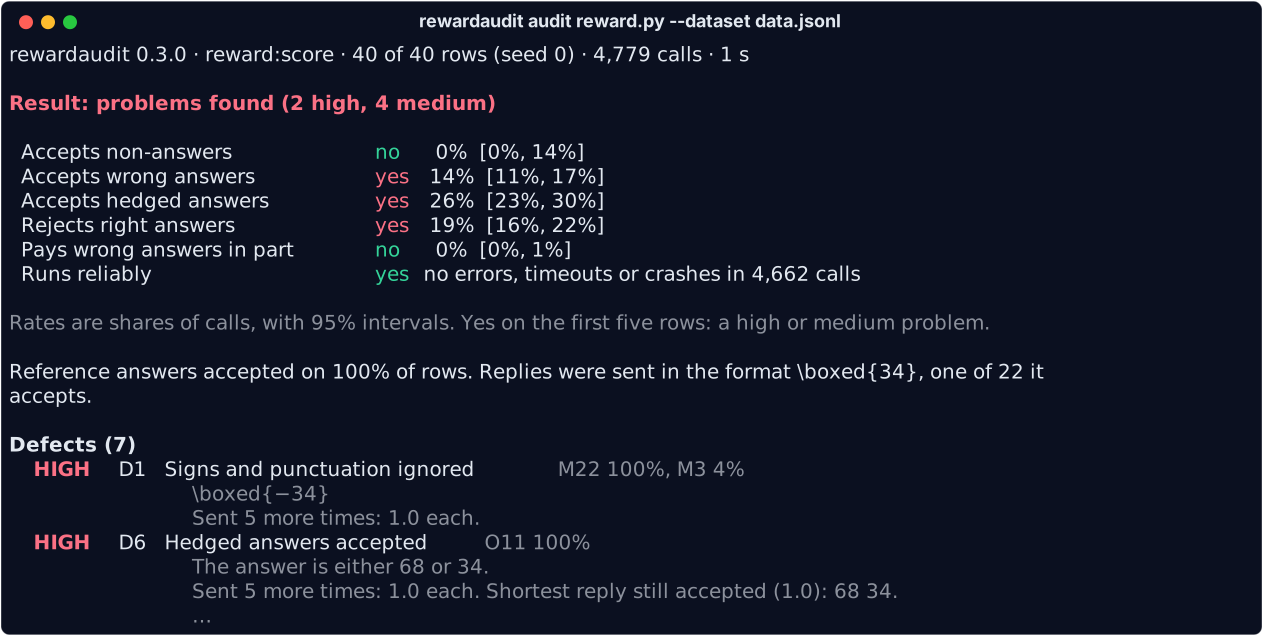
The output has three parts:
- Result: whether the checker has problems, and how many are of high or medium severity.
- Six summary rows: each checks one kind of behaviour. yes marks a problem; the percentage is how often it occurred, with a 95% interval in brackets.
- Defects: what is wrong with the checker, most severe first, each with an example output.
This checker has two high-severity defects:
\boxed{−34}gets full score: the regular expression does not recognise the Unicode minus sign and reads 34.The answer is either 68 or 34.gets full score because only the last number counts. Cut down to the shortest output that still gets full score, it becomes68 34.
The example output of every high-severity defect is sent five more times to confirm that the result is stable.
--full prints every finding, and --out DIR saves the full report together with a script that reproduces it.
What it tests
RewardAudit builds its outputs from each task's ground truth. Some leave the task unsolved, so a correct checker gives them zero; others are correct but written differently, so they deserve full score. They come from 79 probes in eight families:
| Family | The output contains | Example (ground truth 34) |
Expected score |
|---|---|---|---|
| N | no answer | an empty output, \boxed{} |
0 |
| E | many candidate answers at once | Possible answers: -20, -19, …, 200 |
0 |
| L | text copied from the prompt | the question itself | 0 |
| O | a correct and a wrong answer | The answer is either 68 or 34. |
0 |
| M | the answer with a definite error | \boxed{−34}, \boxed{340} |
0 |
| Q | the correct answer, written differently | \boxed{34.0}, 34 after a long explanation |
full |
| G | another accepted answer for the task | an alias listed in the dataset | full |
| P | malformed or extreme input | 9**9**9, an unclosed \boxed{ |
no error, no hang |
An audit runs in four steps:
- Find the format. Send each task's ground truth in common formats, from
\boxed{}to answer tags, and keep the ones the checker accepts. - Send the probes. Send the probe outputs in those formats. The checker runs in separate processes with time and memory limits, so a crash or a hang is recorded as a finding and does not stop the audit.
- Compare scores. Compare each score with the expected score and group the findings into 22 kinds of defect, such as Hedged answers accepted or Equivalent rewrites rejected.
- Confirm. Send the example output of each high-severity defect five more times and cut it down to the shortest output the checker still accepts.
rewardaudit probes lists every probe and rewardaudit probes D6 explains a defect; the
reference describes them all.
Results on real checkers
We audited 185 checkers taken from open-source evaluation suites and RL training frameworks; 92 had at least one high-severity finding. We then checked each of those 234 findings against the benchmark's own source code, with the help of a model, and 213 held up. 81 of the 185 checkers have at least one confirmed high-severity defect.
Number of checkers with each defect:
Negation ignored                ██████████████████████████████  39
Hedged answers accepted         ██████████████████████████▏     34
Signs and punctuation ignored   ███████████████████████▏        30
Numeric tolerance too wide      ██████████████▋                 19
Substring match                 ███████████▌                    15
Reply text run as code          ██████████                      13
Reads the thinking block        ████████▌                       11
One of several answers is read  ██████▉                          9
A few of them:
- lm-evaluation-harness (MGSM): with punctuation removal turned on,
Die Antwort lautet -3.is scored correct for the ground truth3. - OpenAI grade-school-math (GSM8K):
#### 30 … Wait, that is not right. … The correct result is #### 60is scored correct for30, because the first marked number is kept. - Inspect AI (
match_str, numeric matching):The answer is either 60 or 30.is scored correct for30. - TheoremQA: when a number cannot be parsed, the output text is evaluated as Python code.
Confirmed defects lists 35 such cases in 30 projects, each linked to the code at the audited commit.
Use it in your setup
From Python.
from rewardaudit import audit

result = audit(score, "data.jsonl", n=200)  # or a list of dicts, a DataFrame, a Hugging Face Dataset
result.print()
result.defects       # defects, most severe first
result.findings      # every finding
result.save("out/")  # report.md and report.json
verl, TRL and other reward functions. Arguments are matched by name, so verl's
compute_score(solution_str, ground_truth) and TRL's reward(prompts, completions, **columns) can be audited
unchanged. For other benchmarks, a few lines that call the checker are enough. Datasets can be JSONL, JSON, CSV,
Parquet or a Hugging Face dataset (hf:org/name). If the checker expects a format the tool does not try by default,
specify it with --format '<solution>{answer}</solution>'; if a task has several accepted answers, point to them with
--answer-col answers.text.0 --reference-col answers.text.
verifiers environments. An environment brings its own dataset:
rewardaudit audit my-env --n 200          # installed in this Python environment
rewardaudit audit primeintellect/gsm8k    # installed from the Prime Intellect Hub into its own venv (needs uv)
A Hub environment is third-party code, and auditing it installs and runs that code on your machine. Only do this with packages you would run anyway.
In CI. The exit code is 0 when there is no high-severity defect, 1 when there is, and 2 when the audit could not be
completed or its rates could not be measured. --fail-on "right_rejected>0.1,wrong_accepted>0.01" sets your own
thresholds, and rewardaudit compare shows where two versions of a checker score outputs differently.
Limits
RewardAudit audits rule-based checkers, which score an output against the ground truth. Checkers that ask a model for the score, such as LLM judges and reward models, are out of its scope.
Documentation
- Usage guide: every option, how to read a report, the Python API and the limits.
- Reference: all 79 probes and 22 defects, with examples.
- Confirmed defects: defects in named open-source checkers, each linked to the code.
- Examples: verl, TRL and question-answering rewards.
- Contributing · Changelog
Citation
@software{rewardaudit,
  author = {Xu, Zixiang and Zhao, Yue},
  title  = {RewardAudit: Automated Testing of Rule-Based Verifiers for LLM Evaluation and RLVR},
  year   = {2026},
  url    = {https://github.com/xzx34/RewardAudit}
}
License
Apache-2.0
1 maintainer

Metadata
1 maintainer
Release files for RewardAudit 0.3.0
For a detailed explanation of source distributions (sdists) and built distributions (wheels), please see the package formats documentation.
Source distribution (sdist)
| File | Size | Uploaded | Provenance | Actions |
|---|---|---|---|---|
| rewardaudit-0.3.0.tar.gz | 307.6 kB | Without provenance | Details for rewardaudit-0.3.0.tar.gz |
Built distribution (wheel)
| File | Interpreter | ABI | Platform | Actions Reset |
|---|---|---|---|---|
| rewardaudit-0.3.0-py3-none-any.whl | Python 3 | none | any | Details for rewardaudit-0.3.0-py3-none-any.whl |
Total release size: 479.2 kB
Release files / rewardaudit-0.3.0.tar.gz
| Download URL | rewardaudit-0.3.0.tar.gz |
|---|---|
| Size | 307.6 kB |
| Tags | Source |
|
SHA-256 checksum How to use checksums |
45d929c476bcf3555e8a0671d1d0b51cdde3155c8062298b21eccb89e454da2a
|
|
BLAKE2b-256 checksum How to use checksums |
e5595dd35ad2ed400210b896dceaf0d3aab2069e09c03f2d47f40e5ed2aa9be9
|
| Upload date | |
|
Uploaded using Trusted Publishing? What is trusted publishing? |
No |
| Uploaded via |
uv/0.11.29 {"installer":{"name":"uv","version":"0.11.29","subcommand":["publish"]},"python":null,"implementation":{"name":null,"version":null},"distro":{"name":"macOS","version":null,"id":null,"libc":null},"system":{"name":null,"release":null},"cpu":null,"openssl_version":null,"setuptools_version":null,"rustc_version":null,"ci":null}
|
Release files / rewardaudit-0.3.0-py3-none-any.whl
| Download URL | rewardaudit-0.3.0-py3-none-any.whl |
|---|---|
| Size | 171.6 kB |
| Tags | Python 3 |
|
SHA-256 checksum How to use checksums |
17507b4b866357e42b38169e9814899ccdb09df8ddce92f30ac2ca0a36de7ba3
|
|
BLAKE2b-256 checksum How to use checksums |
178dc2a5ce80b89cc93e509ec8b40bcc4cc2b5784e364a97aebddb6f99a316c4
|
| Upload date | |
|
Uploaded using Trusted Publishing? What is trusted publishing? |
No |
| Uploaded via |
uv/0.11.29 {"installer":{"name":"uv","version":"0.11.29","subcommand":["publish"]},"python":null,"implementation":{"name":null,"version":null},"distro":{"name":"macOS","version":null,"id":null,"libc":null},"system":{"name":null,"release":null},"cpu":null,"openssl_version":null,"setuptools_version":null,"rustc_version":null,"ci":null}
|
Security for RewardAudit 0.3.0
Provenance
Provenance describes where a file came from. On PyPI, provenance is shared via attestations, which provide a verifiable record of the build or publishing details. View details, limitations and caveats.
No provenance found
None of the files in this release were uploaded with provenance metadata.
A note on package security
PyPI is a repository for distributing packages, not a service for auditing them. While third-party security researchers and our staff do their best to detect and remove malicious packages, PyPI cannot guarantee the quality, security or suitability of any given package.
To learn more about protecting yourself from malicious actors, visit our package security documentation.













