
Extensible MDAO framework with zero boilerplate integration and plug-and-play optimization.

Project description
SmartMDAO 🚀
Extensible MDAO framework with zero boilerplate integration and plug-and-play optimization.



SmartMDAO is a lightweight, purely Pythonic framework for Multidisciplinary Design Analysis and Optimization (MDAO). Define your disciplines as plain Python functions, and SmartMDAO maps the dependency graph, converges cyclic feedback loops, caches expensive calls, and bridges straight into your optimizer of choice.
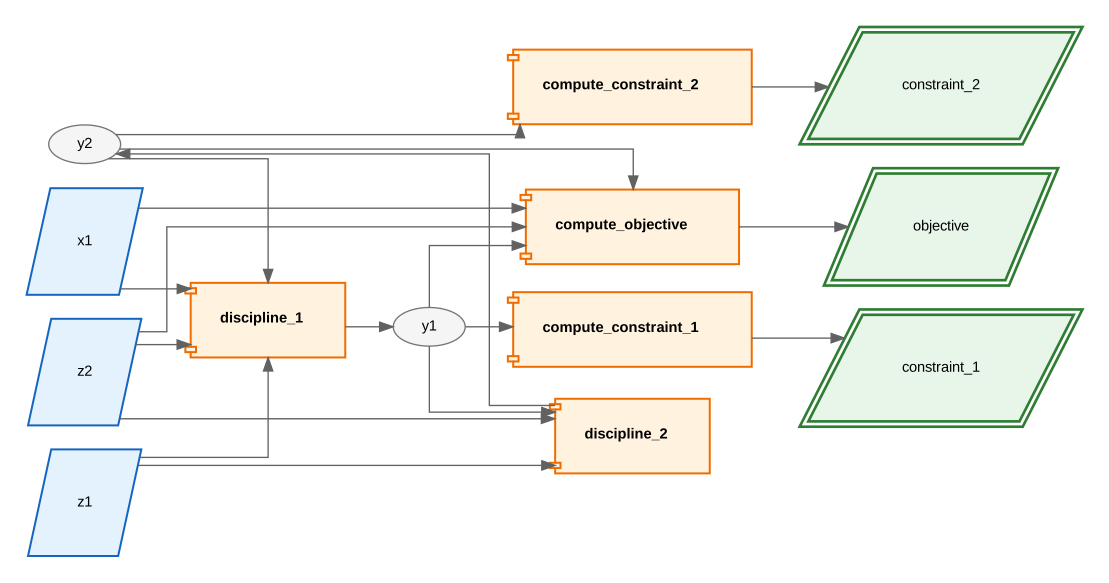
🔍 See It In Action
Without SmartMDAO — you hand-write the convergence loop and track state yourself:
y2 = 1.0  # initial guess
for _ in range(100):
    y1 = z1 ** 2 + z2 + x1 - 0.2 * y2
    y2_next = math.sqrt(abs(y1)) + z1 + z2
    if abs(y2_next - y2) < 1e-6:
        break
    y2 = y2_next
With SmartMDAO — declare each discipline once; the y1 ↔ y2 cycle is found and converged for you:
@pipeline.step(outputs=["y1"])
def discipline_1(z1, z2, x1, y2): return z1 ** 2 + z2 + x1 - 0.2 * y2

@pipeline.step(outputs=["y2"])
def discipline_2(z1, z2, y1): return math.sqrt(abs(y1)) + z1 + z2

pipeline.run(z1=1.0, z2=1.0, x1=1.0, y2=1.0)
🌟 Why SmartMDAO?
- Effortless MDA — no DSL, just
@pipeline.stepand standard type hints. Works with plain types, dataclasses, or your own objects. - Built-in Caching — layer
@cached(RAM, HDF5, Pickle) onto expensive functions for instant speedups. - Agnostic MDO — define your
OptimizationProblemonce, then run it through any backend with a single string:optimize(problem, backend="scipy")orbackend="openturns". Bring your own via@register_backend, or drop straight toPipelineEvaluatorfor full control. - Type-Safe — static validation catches mismatched disciplines before a single step runs; opt-in runtime checks catch the rest.
- Built Also for Researchers — solvers are plain
Protocolclasses, so custom MDA convergence algorithms drop in without touching the core framework.
⚡ Full Quick Start: Caching, Constraints & Optimization (click to expand)
Here is how easily you can solve the classic Sellar coupled problem end-to-end, from caching through optimization - swapping the solver backend with a single string.
import math
import logging
from smartmdao import (
    Pipeline,
    HybridSolver,
    PipelineEvaluator,
    OptimizationProblem,
    ConstraintSpec,
    optimize,
    cached,
    MemoryBackend,
    configure_logging
)

# --- Setup Logging and Cache ---
configure_logging(level=logging.WARNING)
mem_cache = MemoryBackend() # HDF5 and Pickle also available

# ==============================================================================
# PART 1: Initialize the Pipeline with the HybridSolver
# ==============================================================================
# The HybridSolver automatically detects and converges cyclic dependencies
pipeline = Pipeline(
    solver=HybridSolver(max_iterations=100, tolerance=1e-6)
)

# ==============================================================================
# PART 2: Define the Sellar Disciplines (MDA)
# ==============================================================================
@pipeline.step(outputs=["y1"])
@cached(mem_cache) # Instantly cache this discipline to speed up evaluations
def discipline_1(z1: float, z2: float, x1: float, y2: float) -> float:
    return (z1 ** 2) + z2 + x1 - (0.2 * y2)

@pipeline.step(outputs=["y2"])
@cached(mem_cache)
def discipline_2(z1: float, z2: float, y1: float) -> float:
    return math.sqrt(abs(y1)) + z1 + z2

@pipeline.step(outputs=["objective"])
@cached(mem_cache)
def compute_objective(x1: float, z2: float, y1: float, y2: float) -> float:
    return (x1 ** 2) + z2 + (y1 ** 2) + math.exp(-y2)

@pipeline.step(outputs=["constraint_1"])
@cached(mem_cache)
def compute_constraint_1(y1: float) -> float:
    """Constraint formulation: 3.16 - y1 <= 0"""
    return 3.16 - y1

@pipeline.step(outputs=["constraint_2"])
@cached(mem_cache)
def compute_constraint_2(y2: float) -> float:
    """Constraint formulation: y2 - 24.0 <= 0"""
    return y2 - 24.0

# ==============================================================================
# PART 3: Bridge the Pipeline to an Optimizer-Agnostic Problem
# ==============================================================================
evaluator = PipelineEvaluator(
    pipeline=pipeline,
    design_vars=["z1", "z2", "x1"],
    constants={"y2": 1.0} # Initial guess to kick off the cycle
)

# Both backends expect h(x) >= 0; Sellar's constraints are naturally written
# as g(x) <= 0, so we flip the sign with multiplier=-1.0.
problem = OptimizationProblem(
    evaluator=evaluator,
    initial_guess=[1.0, 1.0, 1.0],
    bounds=[(-10.0, 10.0), (0.0, 10.0), (0.0, 10.0)],
    objective="objective",
    constraints=[
        ConstraintSpec(name="constraint_1", multiplier=-1.0),
        ConstraintSpec(name="constraint_2", multiplier=-1.0),
    ],
)

# ==============================================================================
# PART 4: Run the *same* problem through two different backends
# ==============================================================================
for backend_name in ("scipy", "openturns"):
    result = optimize(problem, backend=backend_name)
    print(f"[{backend_name:>9}] objective={result.objective_value:.4f}")
🧠 Advanced Examples
The Quick Start above just scratches the surface! Notably:
readme_quick_start.py— the complete version of the Quick Start above, including SciPy's rawminimize()call, full state extraction, and pipeline visualization.optimizer_backends_demo.py— define oneOptimizationProblemand run the exact same Sellar problem throughscipy,openturns, and a custom registered backend, just by swapping a string.type_validation_demo.py— static and runtime type validation,Optional/Unionsupport, and writing a customTypeChecker.
For deeper nesting, custom convergence solvers, or more complex multidisciplinary systems, check out the scripts folder in our GitHub repository.
📦 Installation
SmartMDAO is available on PyPI. We recommend using uv for lightning-fast installation, but standard pip works perfectly.
Using uv:
uv add smartmdao
Using pip:
pip install smartmdao
(Note: Visualization features require the graphviz system binary to be installed on your OS).
Installing Graphviz (Optional System Requirement)
While smartmdao works perfectly on its own, generating pipeline diagrams requires the graphviz system binary to be installed on your OS.
macOS (Homebrew):
brew install graphviz
Linux (Ubuntu/Debian):
sudo apt-get install graphviz
Windows (winget):
winget install graphviz
(Alternatively, you can download the Windows installer directly from the official Graphviz website)
🤝 Contributing & License
Contributions are welcome! Please feel free to submit a Pull Request.This project is licensed under the MIT License - see the LICENSE file for details.


Download files
Download the file for your platform. If you're not sure which to choose, learn more about installing packages.
Source Distribution
Built Distribution
Filter files by name, interpreter, ABI, and platform.
If you're not sure about the file name format, learn more about wheel file names.
Copy a direct link to the current filters
File details
Details for the file smartmdao-1.4.0.tar.gz.
File metadata
- Download URL: smartmdao-1.4.0.tar.gz
- Upload date:
- Size: 246.2 kB
- Tags: Source
- Uploaded using Trusted Publishing? No
- Uploaded via: twine/6.2.0 CPython/3.11.14
File hashes
| Algorithm | Hash digest | |
|---|---|---|
| SHA256 |
051d62f833fbf1f8111e6af886c51fc1c702ab30832214b944d0f8ca7fcf9d74
|
|
| MD5 |
1e24f7afc6c6a2dd712662f1f831e7df
|
|
| BLAKE2b-256 |
a10583117a61fb31c49bbf17b0aa5df58f6947bf4e814f7a2b0f9291356f0789
|
File details
Details for the file smartmdao-1.4.0-py3-none-any.whl.
File metadata
- Download URL: smartmdao-1.4.0-py3-none-any.whl
- Upload date:
- Size: 25.4 kB
- Tags: Python 3
- Uploaded using Trusted Publishing? No
- Uploaded via: twine/6.2.0 CPython/3.11.14
File hashes
| Algorithm | Hash digest | |
|---|---|---|
| SHA256 |
801c2cea67559b5dc50dc71faf1cdb699446b3932aad465d592092e7df497474
|
|
| MD5 |
a12607853c6f6a19876cec2756f25999
|
|
| BLAKE2b-256 |
ad3f48d3d12b694d20224ebe49b90a87d5608e311e712baaf5e2d79f7c9b81f7
|






