
Sparse Matrix Recommender (SMR) Python package
Introduction
This Python package, SparseMatrixRecommender, has different functions for computations of recommendations
based on (user) profile or history using Sparse Linear Algebra (SLA). The package mirrors
the Mathematica implementation [AAp1].
(There is also a corresponding implementation in R; see [AAp2]).
The package is based on a certain "standard" Information retrieval paradigm -- it utilizes Latent Semantic Indexing (LSI) functions like IDF, TF-IDF, etc. Hence, the package also has document-term matrix creation functions and LSI application functions. I included them in the package since I wanted to minimize the external package dependencies.
The package includes two data-sets dfTitanic and dfMushroom in order to make easier the
writing of introductory examples and unit tests.
For more theoretical description see the article "Mapping Sparse Matrix Recommender to Streams Blending Recommender" , [AA1].
For detailed examples see the files "SMR-experiments-large-data.py" and "SMR-creation-from-long-form.py".
The list of features and its implementation status is given in the org-mode file "SparseMatrixRecommender-work-plan.org".
Remark: "SMR" stands for "Sparse Matrix Recommender". Most of the operations of this Python package mirror the operations of the software monads "SMRMon-WL", "SMRMon-R", [AAp1, AAp2].
Workflows
Here is a diagram that encompasses the workflows this package supports (or will support):
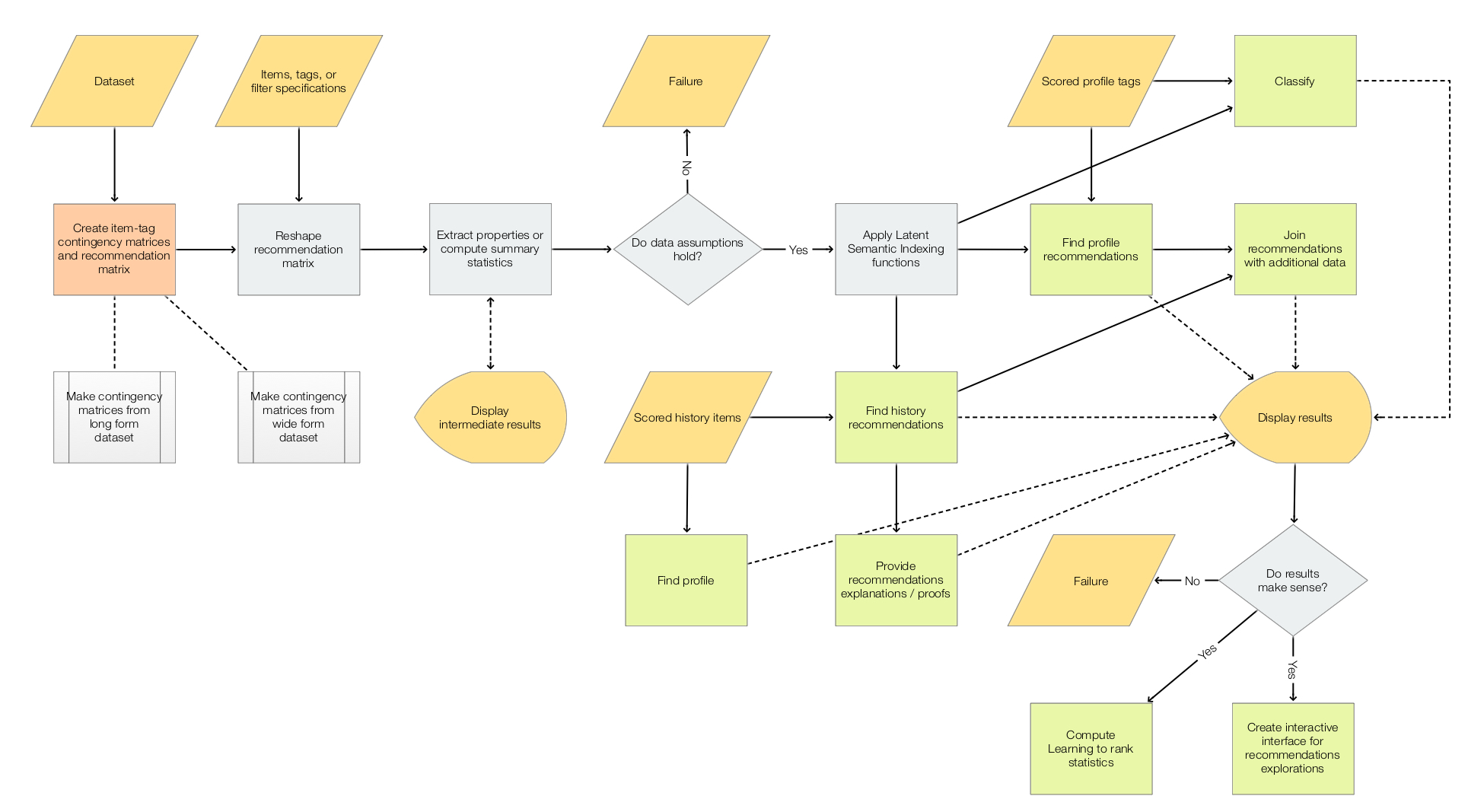
Here is narration of a certain workflow scenario:
- Get a dataset.
- Create contingency matrices for a given identifier column and a set of "tag type" columns.
- Examine recommender matrix statistics.
- If the assumptions about the data hold apply LSI functions.
- For example, the "usual trio" IDF, Frequency, Cosine.
- Do (verify) example profile recommendations.
- If satisfactory results are obtained use the recommender as a nearest neighbors classifier.
Monadic design
Here is a diagram of typical pipeline building using a SparseMatrixRecommender object:
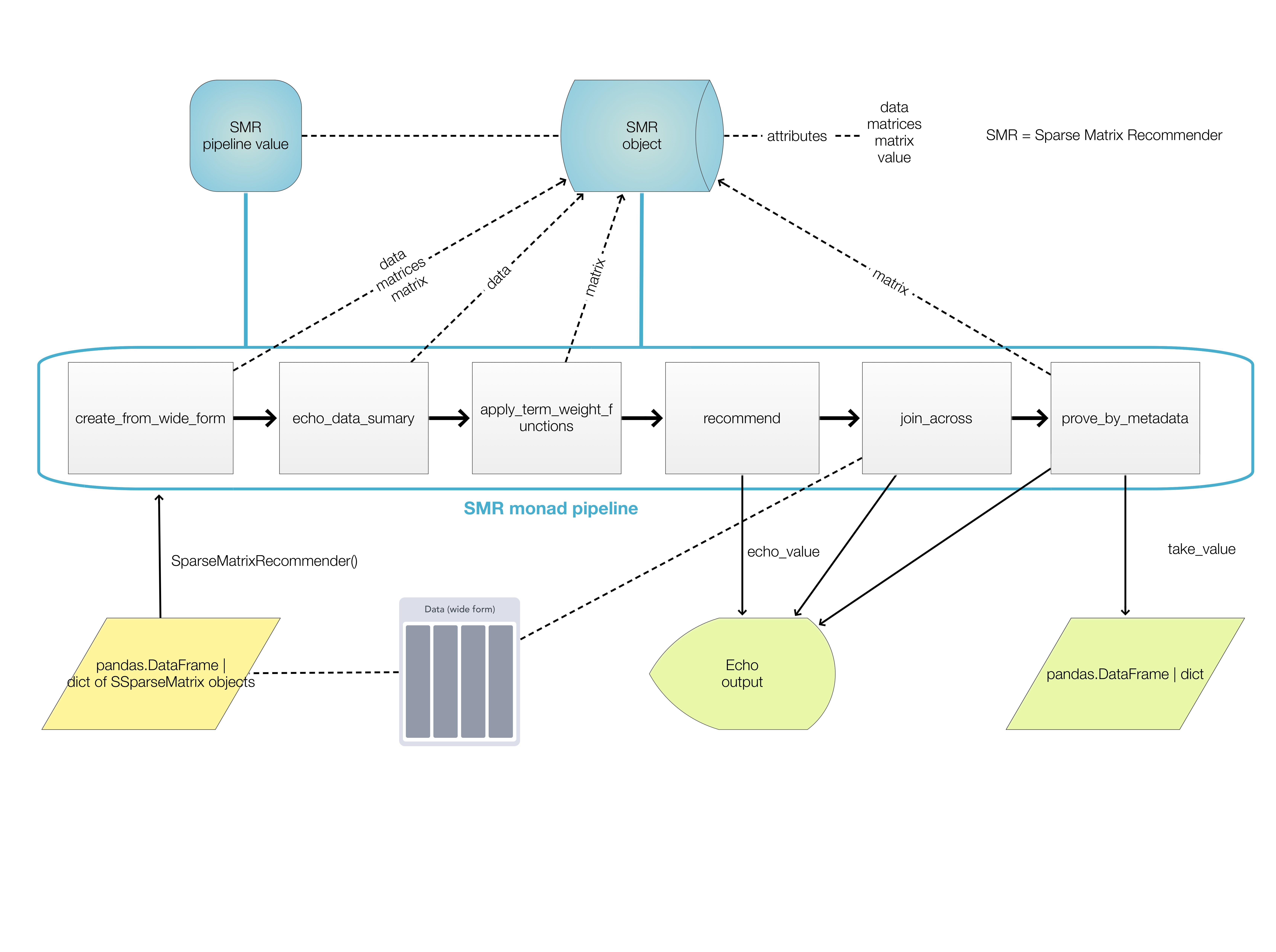
Remark: The monadic design allows "pipelining" of the SMR operations -- see the usage example section.
Installation
To install from GitHub use the shell command:
python -m pip install git+https://github.com/antononcube/Python-packages.git#egg=SparseMatrixRecommender\&subdirectory=SparseMatrixRecommender
To install from PyPI:
python -m pip install SparseMatrixRecommender
Related Python packages
This package is based on the Python package
SSparseMatrix,
[AAp5].
The package LatentSemanticAnalyzer, [AAp6], uses the cross tabulation and LSI functions of this package.
Usage example
Here is an example of an SMR pipeline for creation of a recommender over Titanic data and recommendations for the profile "passengerSex:male" and "passengerClass:1st":
from SparseMatrixRecommender.SparseMatrixRecommender import *
from SparseMatrixRecommender.DataLoaders import *

dfTitanic = load_titanic_data_frame()

smrObj = (SparseMatrixRecommender()
          .create_from_wide_form(data = dfTitanic,
                                 item_column_name="id",
                                 columns=None,
                                 add_tag_types_to_column_names=True,
                                 tag_value_separator=":")
          .apply_term_weight_functions(global_weight_func = "IDF",
                                       local_weight_func = "None",
                                       normalizer_func = "Cosine")
          .recommend_by_profile(profile=["passengerSex:male", "passengerClass:1st"],
                                nrecs=12)
          .join_across(data=dfTitanic, on="id")
          .echo_value())
Remark: More examples can be found the directory "./examples".
Related Mathematica packages
The software monad Mathematica package "MonadicSparseMatrixRecommender.m" [AAp1], provides recommendation pipelines similar to the pipelines created with this package.
Here is a Mathematica monadic pipeline that corresponds to the Python pipeline above:
smrObj =
  SMRMonUnit[]⟹
   SMRMonCreate[dfTitanic, "id",
                "AddTagTypesToColumnNames" -> True,
                "TagValueSeparator" -> ":"]⟹
   SMRMonApplyTermWeightFunctions["IDF", "None", "Cosine"]⟹
   SMRMonRecommendByProfile[{"passengerSex:male", "passengerClass:1st"}, 12]⟹
   SMRMonJoinAcross[dfTitanic, "id"]⟹
   SMRMonEchoValue[];
(Compare the pipeline diagram above with the corresponding diagram using Mathematica notation .)
Related R packages
The package
SMRMon-R,
[AAp2], implements a software monad for SMR workflows.
Most of SMRMon-R functions delegate to SparseMatrixRecommender.
The package
SparseMatrixRecommenderInterfaces,
[AAp3], provides functions for interactive
Shiny
interfaces for the recommenders made with SparseMatrixRecommender and/or SMRMon-R.
The package
LSAMon-R,
[AAp4], can be used to make matrices for SparseMatrixRecommender and/or SMRMon-R.
Here is the SMRMon-R pipeline that corresponds to the Python pipeline above:
smrObj <-
  SMRMonCreate( data = dfTitanic,
                itemColumnName = "id",
                addTagTypesToColumnNamesQ = TRUE,
                sep = ":") %>%
  SMRMonApplyTermWeightFunctions(globalWeightFunction = "IDF",
                                 localWeightFunction = "None",
                                 normalizerFunction = "Cosine") %>%
  SMRMonRecommendByProfile( profile = c("passengerSex:male", "passengerClass:1st"),
                            nrecs = 12) %>%
  SMRMonJoinAcross( data = dfTitanic, by = "id") %>%
  SMRMonEchoValue
Recommender comparison project
The project repository "Scalable Recommender Framework", [AAr1], has documents, diagrams, tests, and benchmarks of a recommender system implemented in multiple programming languages.
This Python recommender package is a decisive winner in the comparison -- see the first 10 min of the video recording [AAv1] or the benchmarks at [AAr1].
Code generation with natural language commands
Using grammar-based interpreters
The project "Raku for Prediction", [AAr2, AAv2, AAp6], has a Domain Specific Language (DSL) grammar and interpreters that allow the generation of SMR code for corresponding Mathematica, Python, R, and Raku packages.
Here is Command Line Interface (CLI) invocation example that generate code for this package:
> ToRecommenderWorkflowCode Python 'create with dfTitanic; apply the LSI functions IDF, None, Cosine;recommend by profile 1st and male'
obj = SparseMatrixRecommender().create_from_wide_form(data = dfTitanic).apply_term_weight_functions(global_weight_func = "IDF", local_weight_func = "None", normalizer_func = "Cosine").recommend_by_profile( profile = ["1st", "male"])
NLP Template Engine
Here is an example using the NLP Template Engine, [AAr2, AAv3]:
Concretize["create with dfTitanic; apply the LSI functions IDF, None, Cosine;recommend by profile 1st and male",
 "TargetLanguage" -> "Python"]

(*
"smrObj = (SparseMatrixRecommender()
 .create_from_wide_form(data = None, item_column_name=\"id\", columns=None, add_tag_types_to_column_names=True, tag_value_separator=\":\")
 .apply_term_weight_functions(\"IDF\", \"None\", \"Cosine\")
 .recommend_by_profile(profile=[\"1st\", \"male\"], nrecs=profile)
 .join_across(data=None, on=\"id\")
 .echo_value())"
*)
References
Articles
[AA1] Anton Antonov, "Mapping Sparse Matrix Recommender to Streams Blending Recommender" (2017), MathematicaForPrediction at GitHub.
Mathematica/WL and R packages
[AAp1] Anton Antonov, Monadic Sparse Matrix Recommender Mathematica package, (2018), MathematicaForPrediction at GitHub.
[AAp2] Anton Antonov, Sparse Matrix Recommender Monad in R (2019), R-packages at GitHub/antononcube.
[AAp3] Anton Antonov, Sparse Matrix Recommender framework interface functions (2019), R-packages at GitHub/antononcube.
[AAp4] Anton Antonov, Latent Semantic Analysis Monad in R (2019), R-packages at GitHub/antononcube.
Python packages
[AAp5] Anton Antonov, SSparseMatrix package in Python (2021), Python-packages at GitHub/antononcube.
[AAp6] Anton Antonov, LatentSemanticAnalyzer package in Python (2021), Python-packages at GitHub/antononcube.
Raku packages
[AAp6] Anton Antonov, DSL::English::RecommenderWorkflows Raku package, (2018-2022), GitHub/antononcube. (At raku.land).
Repositories
[AAr1] Anton Antonov, Scalable Recommender Framework project, (2022) GitHub/antononcube.
[AAr2] Anton Antonov, "Raku for Prediction" book project, (2021-2022), GitHub/antononcube.
Videos
[AAv1] Anton Antonov, "TRC 2022 Implementation of ML algorithms in Raku", (2022), Anton A. Antonov's channel at YouTube.
[AAv2] Anton Antonov, "Raku for Prediction", (2021), The Raku Conference (TRC) at YouTube.
[AAv3] Anton Antonov, "NLP Template Engine, Part 1", (2021), Anton A. Antonov's channel at YouTube.
1 maintainer

Metadata
1 maintainer
Release files for SparseMatrixRecommender 0.2.0
For a detailed explanation of source distributions (sdists) and built distributions (wheels), please see the package formats documentation.
Source distribution (sdist)
| File | Size | Uploaded | |
|---|---|---|---|
| sparsematrixrecommender-0.2.0.tar.gz | 123.8 kB | Details |
Built distribution (wheel)
| File | Interpreter | ABI | Platform | Reset |
|---|---|---|---|---|
| sparsematrixrecommender-0.2.0-py3-none-any.whl | Python 3 | none | any | Details |
Total release size: 243.1 kB
Release files / sparsematrixrecommender-0.2.0.tar.gz
| Download URL | sparsematrixrecommender-0.2.0.tar.gz |
|---|---|
| Size | 123.8 kB |
| Tags | Source |
|
SHA-256 checksum How to use checksums |
2ee7b2e03ef241feaf728df6630bb12193da30a96ac1b261ec20188becc05a22
|
|
BLAKE2b-256 checksum How to use checksums |
58970298df3e2c80892985bb93db5d4f7c4f88b006483a7ffcf7175794a65280
|
| Upload date | |
|
Uploaded using Trusted Publishing? What is trusted publishing? |
No |
| Uploaded via |
twine/6.2.0 CPython/3.12.2
|
Release files / sparsematrixrecommender-0.2.0-py3-none-any.whl
| Download URL | sparsematrixrecommender-0.2.0-py3-none-any.whl |
|---|---|
| Size | 119.3 kB |
| Tags | Python 3 |
|
SHA-256 checksum How to use checksums |
24b4f0de0e4b826858f4aa5e88f2ce227369e93bf5beff2706e7d7e01ca9be94
|
|
BLAKE2b-256 checksum How to use checksums |
b0431cdf9ccfae6dc097d15de788d2dbda28e9d211cce61d40170bf7d894dab2
|
| Upload date | |
|
Uploaded using Trusted Publishing? What is trusted publishing? |
No |
| Uploaded via |
twine/6.2.0 CPython/3.12.2
|















