
MCP server for Things 3 with read/write support for tasks, projects, areas and tags.

Project description
Things 3 MCP Server
This Model Context Protocol (MCP) server lets you use Claude Desktop to interact with your task management data in Things 3. You can ask Claude or your MCP client of choice to create tasks, analyze projects, help manage priorities, and more.
This MCP server leverages a combination of the Things.py library and Things 3’s AppleScript support, enabling reading and writing to Things 3.
Why Things MCP?
This MCP server unlocks the power of AI for your task management:
- Natural Language Task Creation: Ask Claude to create richly-detailed tasks and descriptions in natural language
- Smart Task Analysis: Let Claude explore your project lists and focus areas and provide insights into your work
- GTD & Productivity Workflows: Let Claude help you implement productivity and prioritisation systems
- Seamless Integration: Works directly with your existing Things 3 data
Features
- Access to all major Things lists (Inbox, Today, Upcoming, Logbook, Someday, etc.)
- Project and Area management and assignment
- Tagging operations for tasks and projects
- Advanced search capabilities
- Recent items tracking
- Support for nested data (projects within areas, todos within projects)
- Checklist/Subtask support - Read and display existing checklist items from todos
Installation
Prerequisites
- Python 3.12+
- Claude Desktop
- Things 3 for MacOS
Step 1: Install the package
Option A: Install from PyPI in a virtual environment (recommended)
# Create a virtual environment in your home directory
python3 -m venv ~/.venvs/things3-mcp-env
source ~/.venvs/things3-mcp-env/bin/activate

# Install the package
pip install Things3-MCP-server==2.0.2
Option B: Install from source (for development/contributors)
# Install uv if you haven't already
curl -LsSf https://astral.sh/uv/install.sh | sh
# Restart your terminal afterwards

# Clone and install the package with development dependencies
git clone https://github.com/rossshannon/Things3-MCP
cd Things3-MCP
uv venv
uv pip install -e ".[dev]"  # Install in development mode with extra dependencies
Step 2: Configure Claude Desktop
Edit the Claude Desktop configuration file:
code ~/Library/Application\ Support/Claude/claude_desktop_config.json
Add the Things server to the mcpServers key in the configuration file:
Option A: Using PyPI package in virtual environment
{
    "mcpServers": {
        "things": {
            "command": "~/.venvs/things3-mcp-env/bin/Things3-MCP-server"
        }
    }
}
Option B: Using source installation (for development/contributors)
{
    "mcpServers": {
        "things": {
            "command": "uv",
            "args": [
                "--directory",
                "/ABSOLUTE/PATH/TO/PARENT/FOLDER/Things3-MCP",
                "run",
                "Things3-MCP-server"
            ]
        }
    }
}
Step 3: Restart Claude Desktop
Restart the Claude Desktop app to enable the integration.
Sample Usage with Claude Desktop
- “What’s on my todo list today?”
- “Create a todo to prepare for each of my 1-on-1s next week”
- “Evaluate my todos scheduled for today using the Eisenhower matrix.”
- “Help me conduct a GTD-style weekly review using Things.”
Tips
- Create a Project in Claude with custom instructions that explains how you use Things and organize areas, projects, tags, etc. Tell Claude what information you want included when it creates a new task (e.g., asking it to include relevant details in the task description, whether to use emojis, etc.).
- Try combining this with another MCP server that gives Claude access to your calendar. This will let you ask Claude to block time on your calendar for specific tasks, create tasks that relate to upcoming calendar events (e.g., prep for a meeting), etc.
Available Tools
List Views
get_inbox- Get todos from Inboxget_today- Get todos due todayget_upcoming- Get upcoming todosget_anytime- Get todos from Anytime listget_someday- Get todos from Someday listget_logbook- Get completed todosget_trash- Get trashed todos
Basic Operations
get_todos- Get todos, optionally filtered by projectget_projects- Get all projectsget_areas- Get all areas
Tag Operations
get_tags- Get all tagsget_tagged_items- Get items with a specific tag
Search Operations
search_todos- Simple search by title/notessearch_advanced- Advanced search with multiple filters
Time-based Operations
get_recent- Get recently created items
Modification Operations
add_todo- Create a new todo with full parameter supportadd_project- Create a new project with tags and todosupdate_todo- Update an existing todoupdate_project- Update an existing projectshow_item- Show a specific item or list in Thingssearch_items- Search for items in Things
Tool Parameters
get_todos
project_uuid(optional) - Filter todos by project
get_projects / get_areas / get_tags
include_items(optional, default: false) - Include contained items
search_advanced
status- Filter by status (incomplete/completed/canceled)start_date- Filter by start date (YYYY-MM-DD)deadline- Filter by deadline (YYYY-MM-DD)tag- Filter by tagarea- Filter by area UUIDtype- Filter by item type (to-do/project/heading)
get_recent
period- Time period (e.g., '3d', '1w', '2m', '1y')limit- Maximum number of items to return
add_todo
title- Title of the todonotes(optional) - Notes for the todo (supports Markdown formatting including checkboxes like- [ ] Task)when(optional) - When to schedule the todo (today, tomorrow, evening, anytime, someday, or YYYY-MM-DD)deadline(optional) - Deadline for the todo (YYYY-MM-DD)tags(optional) - Tags to apply to the todolist_titleorlist_id(optional) - Title or ID of project/area to add to- Note: While Things’ native checklist feature (i.e., subtasks) cannot be created via AppleScript, you and your LLMs can use Markdown checkboxes in the notes field to achieve similar functionality.

update_todo
id- ID of the todo to updatetitle(optional) - New titlenotes(optional) - New noteswhen(optional) - When to schedule the todo (today, tomorrow, evening, anytime, someday, or YYYY-MM-DD)deadline(optional) - Deadline for the todo (YYYY-MM-DD)tags(optional) - New tagscompleted(optional) - Mark as completedcanceled(optional) - Mark as canceledproject(optional) - Name of project to move the todo to (must exactly match an existing project title — look them up withget_projects)area_title(optional) - Title of the area to move the todo to (must exactly match an existing area title — look them up withget_areas)
add_project
title- Title of the projectnotes(optional) - Notes for the projectwhen(optional) - When to schedule the projectdeadline(optional) - Deadline for the projecttags(optional) - Tags to apply to the projectarea_titleorarea_id(optional) - Title or ID of area to add to (must exactly match an existing area title — look them up withget_areas)todos(optional) - Initial todos to create in the project
update_project
id- ID of the project to updatetitle(optional) - New titlenotes(optional) - New noteswhen(optional) - When to schedule the project (today, tomorrow, evening, anytime, someday, or YYYY-MM-DD)deadline(optional) - Deadline for the project (YYYY-MM-DD)tags(optional) - New tagscompleted(optional) - Mark as completedcanceled(optional) - Mark as canceled
show_item
id- ID of item to show, or one of: inbox, today, upcoming, anytime, someday, logbookquery(optional) - Optional query to filter byfilter_tags(optional) - Optional tags to filter by
Using Tags
Things will automatically create missing tags when they are added to a task or project. Configure your LLM to do a lookup of your tags first before making changes if you want to control this.
Development
This project uses pyproject.toml to manage dependencies and build configuration. It's built using the Model Context Protocol, which allows Claude to securely access tools and data.
Development Workflow
Setting up a development environment
# Clone the repository
git clone https://github.com/rossshannon/Things3-MCP
cd Things3-MCP

# Set up a virtual environment with development dependencies
uv venv
uv pip install -e ".[dev]"  # Install in development mode with extra dependencies
Testing changes during development
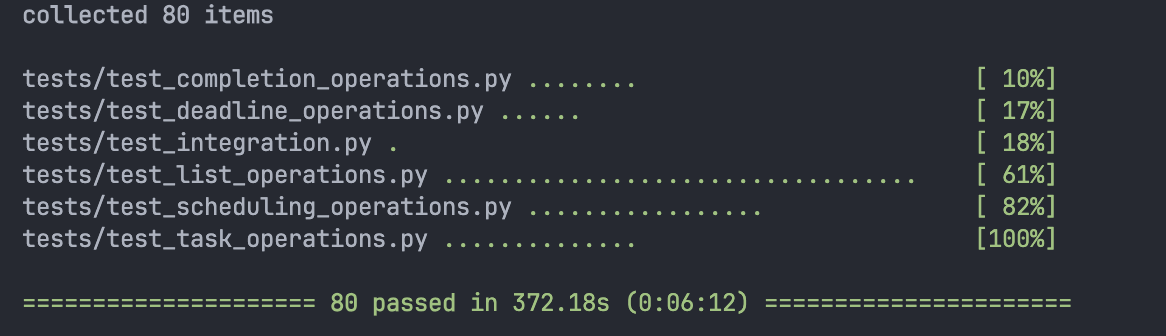
Run the comprehensive test suite to ensure everything is working as expected:
# Test the implementation
uv run pytest tests/
The tests clean up after themselves and don’t affect your existing data, so you can run them as often as you like.
Troubleshooting
The server includes error handling for:
- Invalid UUIDs
- Missing required parameters
- Things database access errors
- Data formatting errors
- Authentication token issues
- AppleScript execution failures
Common Issues
- Things app not running: Make sure the Things app is running on your Mac.
Checking Logs
All errors are logged and returned with descriptive messages. To review the MCP logs:
# Follow main logs in real-time
tail -f ~/.things-mcp/logs/things_mcp.log

# Check error logs
tail -f ~/.things-mcp/logs/things_mcp_errors.log

# View structured logs for analysis
cat ~/.things-mcp/logs/things_mcp_structured.json | jq

# Claude Desktop MCP logs
tail -n 20 -f ~/Library/Logs/Claude/mcp*.log
Acknowledgements
This MCP server was originally based on the Applescript bridge method from things-mcp by excelsier, which was in turn based on things-mcp by hald.


Download files
Download the file for your platform. If you're not sure which to choose, learn more about installing packages.
Source Distribution
Built Distribution
Filter files by name, interpreter, ABI, and platform.
If you're not sure about the file name format, learn more about wheel file names.
Copy a direct link to the current filters
File details
Details for the file things3_mcp_server-2.0.2.tar.gz.
File metadata
- Download URL: things3_mcp_server-2.0.2.tar.gz
- Upload date:
- Size: 25.7 kB
- Tags: Source
- Uploaded using Trusted Publishing? No
- Uploaded via: twine/6.1.0 CPython/3.12.0
File hashes
| Algorithm | Hash digest | |
|---|---|---|
| SHA256 |
840a1d9c53138ec42839dd4681233721f418ac09c44a27a5e8be691626c9520c
|
|
| MD5 |
94890a1553f656266b3f030cdf989b46
|
|
| BLAKE2b-256 |
6228cbec1c03970eb3c6f08386475544d7e559d9772247b943d1feed8ffbcdc5
|
File details
Details for the file things3_mcp_server-2.0.2-py3-none-any.whl.
File metadata
- Download URL: things3_mcp_server-2.0.2-py3-none-any.whl
- Upload date:
- Size: 23.8 kB
- Tags: Python 3
- Uploaded using Trusted Publishing? No
- Uploaded via: twine/6.1.0 CPython/3.12.0
File hashes
| Algorithm | Hash digest | |
|---|---|---|
| SHA256 |
3aaf1873c3fc45200dc92b2bcef878c2ab9e1b54cf46f64e10a05ebfba9c87d7
|
|
| MD5 |
ded174f45cf7d7c0e170fd3168b4e0c3
|
|
| BLAKE2b-256 |
f3dbb635dbca2db5ea34e7ef03d7f234233ad4e2e2ffe74f47323b5cd163e1a7
|






