
This release is a pre-release and may not be stable for production use.

Representation Learning on Topological Domains
Main Features • Installing TopoEmbedX • Getting Started • References








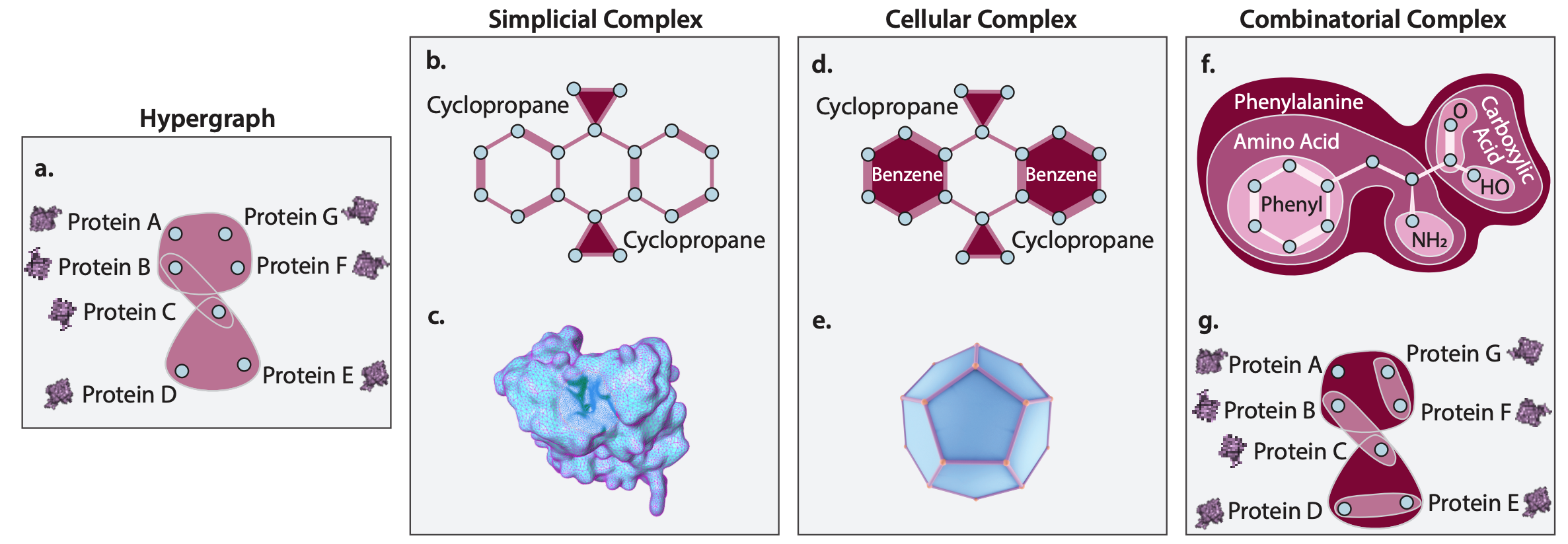
Many natural systems as diverse as social networks and proteins are characterized by relational structure. This is the structure of interactions between components in the system, such as social interactions between individuals or electrostatic interactions between atoms.
How can we conveniently represent data defined on such relational systems?
TopoEmbedX (TEX) is a package for representation learning on topological domains, the mathematical structures of relational systems.
🛠️ Main Features
Support of higher order representation learning algorithms such as:
- DeepCell,
- Cell2Vec,
- Higher Order Laplacian Eigenmaps, and
- Higher Order Geometric Laplacian Eigenmaps
for the topological domains supported in TopoNetX.
🤖 Installing TopoEmbedX
TopoEmbedX is available on PyPI and can be installed using pip.
pip install "pygsp @ git+https://github.com/epfl-lts2/pygsp@a3412ce7696c02c8a55439e89d0c9ab8ae863269"
pip install "karateclub @ git+https://github.com/benedekrozemberczki/karateclub@cb46a91df8dcbeb2570debcf6a9d0c518107a2de"
pip install topoembedx
The library depends on pygsp and karateclub, which did not receive updates
on PyPI for a long time. You have to manually install the latest versions from
GitHub for up-to-date Python and NetworkX compatibility.
🦾 Getting Started
import topoembedx as tex
import toponetx as tnx

# create a cell complex object with a few cells
cc = tnx.CellComplex([[1, 2, 3, 4], [3, 4, 5, 6, 7, 8]], ranks=2)

# create a model
model = tex.Cell2Vec()

# fit the model
model.fit(cc, neighborhood_type="adj", neighborhood_dim={"rank": 1, "via_rank": -1})
# here neighborhood_dim={"rank": 1, "via_rank": -1} specifies the dimension for
# which the cell embeddings are going to be computed.
# rank=1 means that the embeddings will be computed for the first dimension.
# The integer 'via_rank' is ignored and only considered
# when the input complex is a combinatorial complex or colored hypergraph.


# get the embeddings:
embeddings = model.get_embedding()
🧑💻 Install from source
To install the latest version from source, follow these steps:
- Clone a copy of
TopoEmbedXfrom source:
git clone https://github.com/pyt-team/TopoEmbedX
cd TopoEmbedX
- If you have already cloned
TopoEmbedXfrom source, update it:
git pull
- Install a recent version of
pygspandkarateclub:
pip install "pygsp @ git+https://github.com/epfl-lts2/pygsp@a3412ce7696c02c8a55439e89d0c9ab8ae863269"
pip install "karateclub @ git+https://github.com/benedekrozemberczki/karateclub@cb46a91df8dcbeb2570debcf6a9d0c518107a2de"
- Install
TopoEmbedXin editable mode:
pip install -e '.[all]'
- Install pre-commit hooks:
pre-commit install
🔍 References
To learn more about topological representation learning.
- Mustafa Hajij, Ghada Zamzmi, Theodore Papamarkou, Nina Miolane, Aldo Guzmán-Sáenz, Karthikeyan Natesan Ramamurthy, Tolga Birdal, Tamal K. Dey, Soham Mukherjee, Shreyas N. Samaga, Neal Livesay, Robin Walters, Paul Rosen, Michael T. Schaub. Topological Deep Learning: Going Beyond Graph Data.
@misc{hajij2023topological,
      title={Topological Deep Learning: Going Beyond Graph Data},
      author={Mustafa Hajij and Ghada Zamzmi and Theodore Papamarkou and Nina Miolane and Aldo Guzmán-Sáenz and Karthikeyan Natesan Ramamurthy and Tolga Birdal and Tamal K. Dey and Soham Mukherjee and Shreyas N. Samaga and Neal Livesay and Robin Walters and Paul Rosen and Michael T. Schaub},
      year={2023},
      eprint={2206.00606},
      archivePrefix={arXiv},
      primaryClass={cs.LG}
}
Figure from:
- Mathilde Papillon, Sophia Sanborn, Mustafa Hajij, Nina Miolane. Architectures of Topological Deep Learning: A Survey on Topological Neural Networks.
@misc{papillon2023architectures,
      title={Architectures of Topological Deep Learning: A Survey on Topological Neural Networks},
      author={Mathilde Papillon and Sophia Sanborn and Mustafa Hajij and Nina Miolane},
      year={2023},
      eprint={2304.10031},
      archivePrefix={arXiv},
      primaryClass={cs.LG}
}
Funding

Partially funded by the European Union (ERC, HIGH-HOPeS, 101039827). Views and opinions expressed are however those of the author(s) only and do not necessarily reflect those of the European Union or the European Research Council Executive Agency. Neither the European Union nor the granting authority can be held responsible for them.
Partially funded by the National Science Foundation (DMS-2134231, DMS-2134241).
1 maintainer

Metadata
1 maintainer
Release files for TopoEmbedX 0.0.2.dev131
For a detailed explanation of source distributions (sdists) and built distributions (wheels), please see the package formats documentation.
Source distribution (sdist)
| File | Size | Uploaded | Provenance | |
|---|---|---|---|---|
| topoembedx-0.0.2.dev131.tar.gz | 393.3 kB | Without provenance | Details |
Built distribution (wheel)
| File | Interpreter | ABI | Platform | Reset |
|---|---|---|---|---|
| TopoEmbedX-0.0.2.dev131-py3-none-any.whl | Python 3 | none | any | Details |
Total release size: 414.1 kB
Release files / topoembedx-0.0.2.dev131.tar.gz
| Download URL | topoembedx-0.0.2.dev131.tar.gz |
|---|---|
| Size | 393.3 kB |
| Tags | Source |
|
SHA-256 checksum How to use checksums |
b80cadaef1bd84e6799e97eb7e95524b0c97de8c7b69f65d8b0c91d58db6f7ca
|
|
BLAKE2b-256 checksum How to use checksums |
2ef0e0c6a85f609bc0cd19cc92c651f0881b06d76f4a5339d13adb814b7569ce
|
| Upload date | |
|
Uploaded using Trusted Publishing? What is trusted publishing? |
No |
| Uploaded via |
twine/5.1.1 CPython/3.11.3
|
Release files / TopoEmbedX-0.0.2.dev131-py3-none-any.whl
| Download URL | TopoEmbedX-0.0.2.dev131-py3-none-any.whl |
|---|---|
| Size | 20.8 kB |
| Tags | Python 3 |
|
SHA-256 checksum How to use checksums |
58bd277c981034efda7680be0b8b7dd5f5234c8887d553ce1632201c77a82643
|
|
BLAKE2b-256 checksum How to use checksums |
df81644982390810fb21557d63cae71194e05fdb6ec24200bf1f6a58f6ba7a50
|
| Upload date | |
|
Uploaded using Trusted Publishing? What is trusted publishing? |
No |
| Uploaded via |
twine/5.1.1 CPython/3.11.3
|
Security for TopoEmbedX 0.0.2.dev131
Provenance
Provenance describes where a file came from. On PyPI, provenance is shared via attestations, which provide a verifiable record of the build or publishing details. View details, limitations and caveats.
No provenance found
None of the files in this release were uploaded with provenance metadata.
A note on package security
PyPI is a repository for distributing packages, not a service for auditing them. While third-party security researchers and our staff do their best to detect and remove malicious packages, PyPI cannot guarantee the quality, security or suitability of any given package.
To learn more about protecting yourself from malicious actors, visit our package security documentation.














