

WebServerIdentifier
Description
This package identifies Web servers using an aggressive technique based on the maximum size of the URI. In some configurations this technique can even identify web servers placed behind a proxy web server without any identifiable content.
For more information about this technique, please read this PDF (github.io).
This technique performs an in depth identification with certain configurations. An example is available at the bottom of this README.
Requirements
This package require:
- python3
- python3 Standard Library
- PythonToolsKit
Installation
pip install WebServerIdentifier
Usages
Command lines
python3 -m WebServerIdentifier -h                    # Use python module
python3 WebServerIdentifier.pyz --help               # Use python executable

WebIdentify -d -v -m HEAD identify 127.0.0.1         # Use console script entry point
WebIdentify -i 1 identify 127.0.0.1:8000             # Spoof multiple targets (verbose mode)
WebIdentify -m HEAD getmaxuri 127.0.0.1:8000         # Spoof range of targets
WebIdentify -d -v -m HEAD -i 1 getmaxuri 127.0.0.1   # Spoof all network

WebIdentify 127.0.0.1 127.0.0.0/29 -s -t 1   # Semi (spoof only gateway IP for the targets, interval is 1 seconds)
WebIdentify 127.0.0.1 127.0.0.0/29 -i 127.0. # Use the loopback interface

WebIdentify 172.16.10.1 172.16.0.33 -p       # Passive mode
Python3
from WebServerIdentifier import WebServerIdentifier, _create_unverified_context

identifier = WebServerIdentifier("127.0.0.1", baseuri="/", ssl=True, context=_create_unverified_context(), port=8000, interval=0.5, timeout=2)
identifier = WebServerIdentifier("127.0.0.1")

response = identifier.request()
response.status
response.reason

r = identifier.request(method="HEAD", size=65535)
r.status
r.reason

for size, r in identifier.get_max_URI_size():
    print(size, r.status, r.reason)

for size, r in identifier.get_max_URI_size(method="HEAD"): pass

for r, size, servers in identifier.identify_server(): pass

for r, size, servers in identifier.identify_server(method="HEAD"):
    print(size, r.status, r.reason, servers)

server = server.pop()
In depth identification
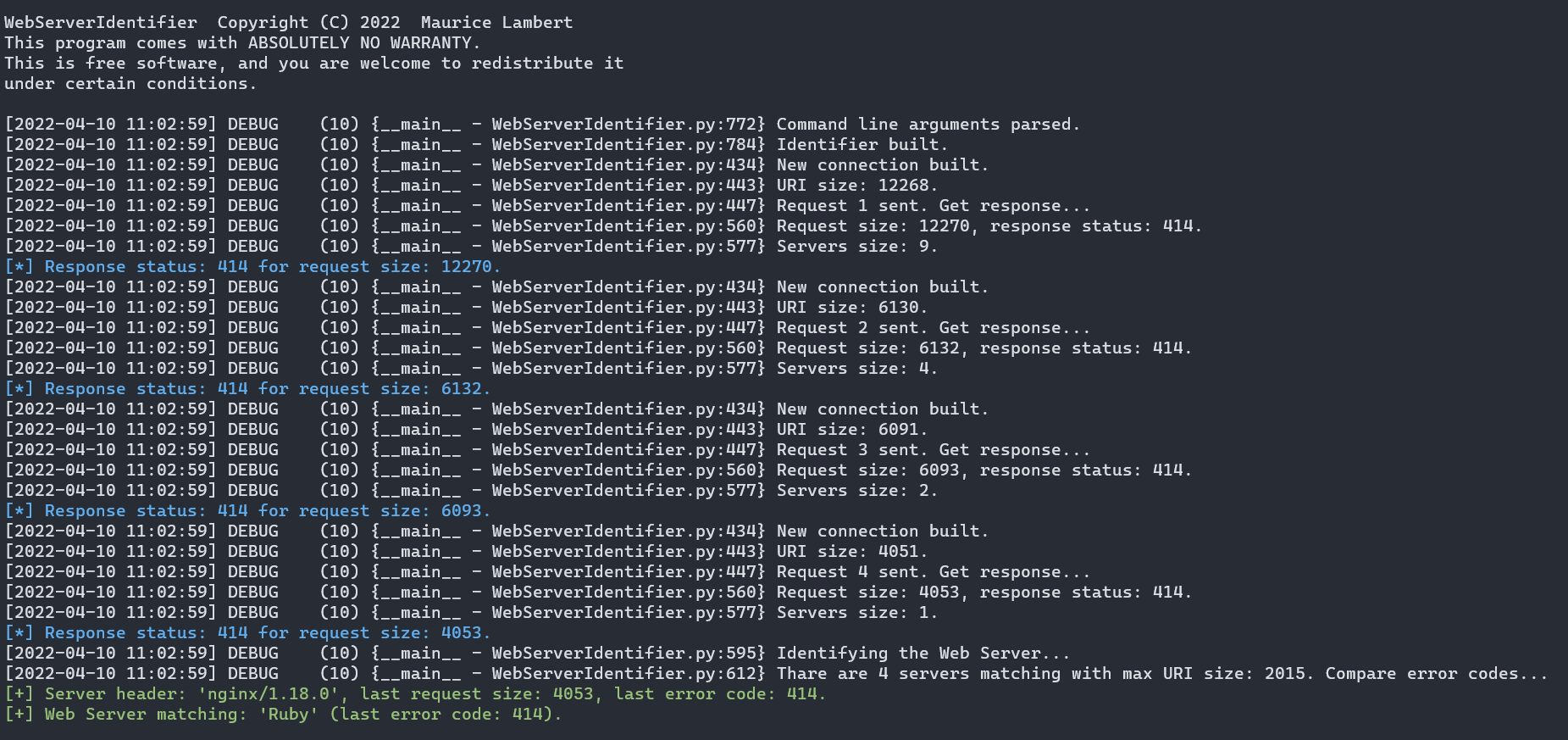
In this example, we have a ruby web server protected by an NGINX web proxy. The maximum ruby web server URI size is 2015 characters and the maximum NGINX web proxy URI size is 6132 characters. It is possible to detect the ruby web server without any specific content, this screenshot proves it:
Links
Help
usage: WebServerIdentifier.py [-h] [--method METHOD] [--baseuri BASEURI] [--interval INTERVAL] [--ssl] [--timeout TIMEOUT] [--verbose] [--debug] {identify,getmaxuri} target

This package identifies target's web server.

positional arguments:
  {identify,getmaxuri}  Identify the target's web server or get the maximum size of the URI.
  target                Host targeted (examples: 10.101.10.101:8000, example.com)

optional arguments:
  -h, --help            show this help message and exit
  --method METHOD, -m METHOD
                        HTTP method to request the Web Server
  --baseuri BASEURI, -b BASEURI
                        Base URI to request the target.
  --interval INTERVAL, -i INTERVAL
                        Requests interval.
  --ssl, -s             Use HTTPS (SSL, encryption).
  --timeout TIMEOUT, -t TIMEOUT
                        Set timeout for HTTP requests.
  --verbose, -v         Active verbose mode.
  --debug, -d           Active debugging mode (set level debug for all loggers).
Licence
Licensed under the GPL, version 3.
1 maintainer

Metadata
1 maintainer
Release files for WebServerIdentifier 1.1.0
For a detailed explanation of source distributions (sdists) and built distributions (wheels), please see the package formats documentation.
Source distribution (sdist)
| File | Size | Uploaded | Provenance | Actions |
|---|---|---|---|---|
| WebServerIdentifier-1.1.0.tar.gz | 28.6 kB | Without provenance | Details for WebServerIdentifier-1.1.0.tar.gz |
Release files / WebServerIdentifier-1.1.0.tar.gz
| Download URL | WebServerIdentifier-1.1.0.tar.gz |
|---|---|
| Size | 28.6 kB |
| Tags | Source |
|
SHA-256 checksum How to use checksums |
9b6347c65066dba81e347ccfeb3f43c9400ac34a17c42aae98cb085f6849df40
|
|
BLAKE2b-256 checksum How to use checksums |
9435fe0fe3bf3d5a207611c0d77e9c02761a1da325a4ad54bfe679ff43962049
|
| Upload date | |
|
Uploaded using Trusted Publishing? What is trusted publishing? |
No |
| Uploaded via |
twine/4.0.0 CPython/3.10.4
|
Security for WebServerIdentifier 1.1.0
Provenance
Provenance describes where a file came from. On PyPI, provenance is shared via attestations, which provide a verifiable record of the build or publishing details. View details, limitations and caveats.
No provenance found
None of the files in this release were uploaded with provenance metadata.
A note on package security
PyPI is a repository for distributing packages, not a service for auditing them. While third-party security researchers and our staff do their best to detect and remove malicious packages, PyPI cannot guarantee the quality, security or suitability of any given package.
To learn more about protecting yourself from malicious actors, visit our package security documentation.














