
aadhaarguard
Find and redact Indian personal data in text. Despite the name it covers 15 kinds, not just Aadhaar: PAN, GSTIN, UPI IDs, mobile numbers, bank accounts, cards, vehicle registrations, driving licences and more (full list below). Pure Python, no dependencies, Python 3.10+.



General-purpose PII tools handle emails and US-style numbers well, but they mostly don't know Indian formats. A regex for "12 digits" flags every order ID in your logs. aadhaarguard checks the check digits that Indian IDs carry (Verhoeff for Aadhaar, mod-36 for GSTIN, Luhn for cards) and looks for keywords like "aadhaar", "a/c" or "आधार" near a match before it reports anything ambiguous.
Try it in 30 seconds
pip install aadhaarguard
echo "Aadhaar 3588 1399 8697, UPI ravi@okaxis, order 4521" | aadhaarguard redact --style partial
Aadhaar XXXX XXXX 8697, UPI rXXX@okaxis, order 4521
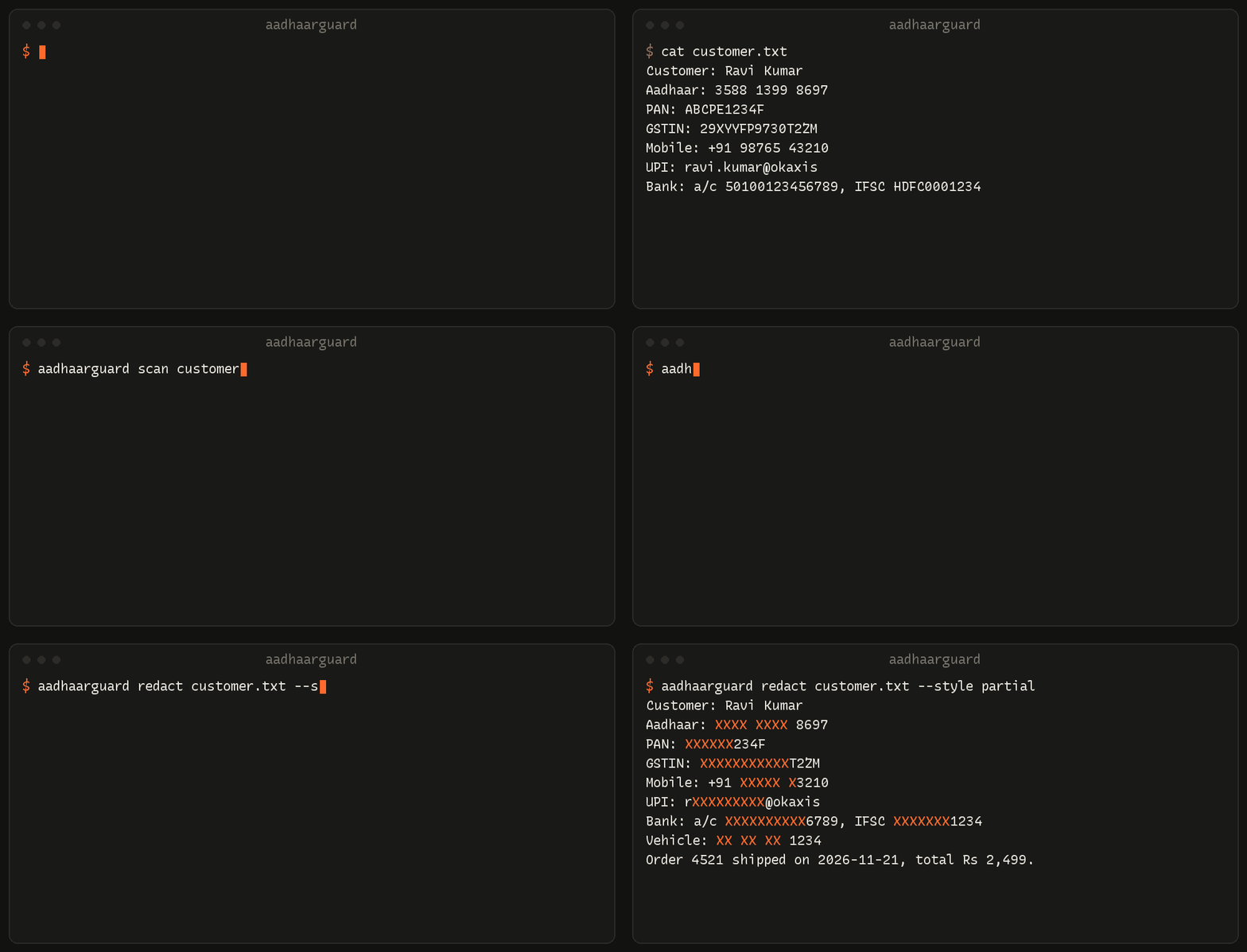
The order number is left alone because it isn't a valid identifier. The demo above runs the same CLI on examples/customer.txt.
Command line
$ aadhaarguard scan examples/customer.txt
examples/customer.txt:2:10: aadhaar XXXX XXXX 8697 (0.90)
examples/customer.txt:3:6: pan XXXXXX234F (0.99)
examples/customer.txt:4:8: gstin XXXXXXXXXXXT2ZM (0.99)
examples/customer.txt:5:9: phone +91 XXXXX X3210 (0.99)
examples/customer.txt:6:6: upi rXXXXXXXXX@okaxis (0.99)
examples/customer.txt:7:11: bank_account XXXXXXXXXX6789 (0.75)
examples/customer.txt:7:32: ifsc XXXXXXX1234 (0.85)
examples/customer.txt:8:10: vehicle XX XX XX 1234 (0.95)

8 finding(s) in 1 file(s)
scan exits with 1 when it finds something, so it works in CI and pre-commit.
Values are partially masked in the output so the scan itself doesn't leak data
into CI logs. Pass --show to see full values, or --json for machine output.
$ aadhaarguard redact examples/customer.txt --style partial
Customer: Ravi Kumar
Aadhaar: XXXX XXXX 8697
PAN: XXXXXX234F
...
Order 4521 shipped on 2026-11-21, total Rs 2,499.
Other options: -o out.txt, -i (in place), --kinds aadhaar,pan,
--min-confidence 0.8, -I (also match lowercase IDs). aadhaarguard kinds lists
every detector.
Python
from aadhaarguard import scan, redact

text = "Aadhaar 3588 1399 8697, call +91 98765 43210"

for m in scan(text):
    print(m.kind, m.value, m.start, m.end, m.confidence)
# aadhaar 3588 1399 8697 8 22 0.9
# phone +91 98765 43210 29 44 0.99

redact(text)                    # 'Aadhaar [AADHAAR], call [PHONE]'
redact(text, style="partial")   # 'Aadhaar XXXX XXXX 8697, call +91 XXXXX X3210'
redact(text, style="mask")      # 'Aadhaar XXXX XXXX XXXX, call +XX XXXXX XXXXX'
redact(text, style="hash")      # 'Aadhaar [AADHAAR:e786c1b9d1], call [PHONE:1a6f46a8fa]' (keyed, see below)
Use Scanner to keep settings:
from aadhaarguard import Scanner

s = Scanner(kinds=["aadhaar", "pan", "phone"], min_confidence=0.8, ignore_case=True)
s.contains_pii(user_message)
Redacting logs
import logging
from aadhaarguard import RedactingFilter

handler = logging.StreamHandler()
handler.addFilter(RedactingFilter(style="partial"))
logging.basicConfig(level=logging.INFO, handlers=[handler])

logging.info("payment from %s", "9876543210@ybl")
# payment from 9XXXXXXXXX@ybl
The filter redacts the formatted message and any exception traceback.
Test data
aadhaarguard.fake generates checksum-valid values for fixtures:
from aadhaarguard.fake import Faker

f = Faker(seed=42)
f.aadhaar(), f.pan(), f.gstin(state="27"), f.phone(), f.upi(), f.card(), f.vehicle()
A random valid-looking Aadhaar or phone number can still belong to a real person. Use these as test fixtures only.
What it detects
| kind | format | validation |
|---|---|---|
aadhaar |
12 digits, groups of 4 optional | first digit 2-9, Verhoeff checksum |
aadhaar_vid |
16 digits | Verhoeff; needs keyword "VID" |
pan |
AAAAA9999A |
4th letter must be a valid holder type |
gstin |
15 chars | state code 01-38/97/99, embedded PAN, check character |
ifsc |
AAAA0XXXXXX |
5th char is 0 |
upi |
name@handle |
known handles (okaxis, ybl, paytm...) score higher; emails excluded |
email |
standard | |
phone |
9876543210, +91 98765 43210, 098765 43210, 987 654 3210 |
starts 6-9 |
card |
13-19 digits | Luhn |
vehicle |
MH 12 AB 1234, 22 BH 1234 AA |
real state codes; BH year ≥ 21 |
driving_licence |
MH14 20110062821 |
state code, issue year not in future |
passport |
J8369854 |
needs keyword |
voter_id |
ABC1234567 |
needs keyword |
bank_account |
9-18 digits | needs keyword ("account", "a/c", "खाता") |
pincode |
560001 |
needs keyword |
How matching works
- Each detector's regex finds candidates.
- A score function rejects candidates that fail validation (bad checksum,
wrong state code, repeated digits like
9999999999) and gives the rest a base confidence. - If a keyword for that kind appears within 40 characters before or 20 after the match, confidence goes up by 0.15. Kinds marked "needs keyword" are dropped without one.
- Where matches overlap, the one with its own keyword nearby wins, then the
higher confidence, then the longer span. So a GSTIN wins over the PAN inside
it, and
a/c 50100123456789counts as an account number even though it happens to pass the card checksum.
The default threshold is 0.5. Use 0.8 or higher if false positives cost more than misses.
Limitations
- Bare 12-digit numbers. About 1 in 10 random 12-digit numbers starting
2-9 passes the Verhoeff check, so an order ID can be reported as an Aadhaar
(confidence 0.75 without a keyword). Raise
--min-confidenceto 0.8 to only report Aadhaar numbers that have a keyword nearby. - No checksum exists (or is public) for PAN, IFSC, passport, voter ID or vehicle numbers, so these rely on format and keywords.
- Names and addresses are not detected. That needs NER (for example Presidio or spaCy); aadhaarguard covers structured identifiers only.
- Uppercase by default for PAN, GSTIN, IFSC, passport, voter ID and DL,
because official formats are uppercase and it's about 4x faster. Use
ignore_case=True/-Ifor user-typed input. Vehicle plates are always uppercase-only, so English phrases like "or 12 1234" aren't flagged. - Hash style uses HMAC-SHA256 with a random key per
Scanner. Aadhaar has only about 10^11 possible values, so a plain unkeyed hash could be reversed by brute force. Passkey=to get the same hashes across runs, and keep that key secret. - Speed. About 1.7 MB/s on log-like text and over 60 MB/s on text without
digits; about 130 µs to redact one log line (
python scripts/benchmark.py, laptop CPU). That's fine for logs, chat messages and CI scans. For multi-gigabyte data dumps, run it in parallel.
pre-commit
repos:
  - repo: https://github.com/Pratix005/aadhaarguard
    rev: v0.2.1
    hooks:
      - id: aadhaarguard
Development
git clone https://github.com/Pratix005/aadhaarguard
cd aadhaarguard
python -m venv .venv && .venv/bin/pip install -e ".[dev]"   # Windows: .venv\Scripts\pip
pytest
python scripts/make_demo.py regenerates docs/demo.gif from real CLI
output (needs pip install pillow).
New detectors and more UPI handles are welcome; see CONTRIBUTING.md.
License
Apache 2.0
1 maintainer

Metadata
1 maintainer
Release files for aadhaarguard 0.2.1
For a detailed explanation of source distributions (sdists) and built distributions (wheels), please see the package formats documentation.
Source distribution (sdist)
| File | Size | Uploaded | Provenance | Actions |
|---|---|---|---|---|
| aadhaarguard-0.2.1.tar.gz | 29.7 kB | Without provenance | Details for aadhaarguard-0.2.1.tar.gz |
Built distribution (wheel)
| File | Interpreter | ABI | Platform | Actions Reset |
|---|---|---|---|---|
| aadhaarguard-0.2.1-py3-none-any.whl | Python 3 | none | any | Details for aadhaarguard-0.2.1-py3-none-any.whl |
Total release size: 53.0 kB
Release files / aadhaarguard-0.2.1.tar.gz
| Download URL | aadhaarguard-0.2.1.tar.gz |
|---|---|
| Size | 29.7 kB |
| Tags | Source |
|
SHA-256 checksum How to use checksums |
269aef275c7bc58c9508da923cf8b0f10a91bd32eaf413878cd10de545c8d793
|
|
BLAKE2b-256 checksum How to use checksums |
1521beb4cf7350937dc4c9a9cb777a489a31d748228bf98d605c5142389ec596
|
| Upload date | |
|
Uploaded using Trusted Publishing? What is trusted publishing? |
No |
| Uploaded via |
twine/7.0.0 CPython/3.12.10
|
Release files / aadhaarguard-0.2.1-py3-none-any.whl
| Download URL | aadhaarguard-0.2.1-py3-none-any.whl |
|---|---|
| Size | 23.3 kB |
| Tags | Python 3 |
|
SHA-256 checksum How to use checksums |
b8635748c62136d4649c9481276fbcf440da2c8120ca5446fd6a53b0ca0c9060
|
|
BLAKE2b-256 checksum How to use checksums |
80d083543cd246575951c27d73adfd3a426cdf54e8d58bfe5c5e14714b6a3170
|
| Upload date | |
|
Uploaded using Trusted Publishing? What is trusted publishing? |
No |
| Uploaded via |
twine/7.0.0 CPython/3.12.10
|
Security for aadhaarguard 0.2.1
Provenance
Provenance describes where a file came from. On PyPI, provenance is shared via attestations, which provide a verifiable record of the build or publishing details. View details, limitations and caveats.
No provenance found
None of the files in this release were uploaded with provenance metadata.
A note on package security
PyPI is a repository for distributing packages, not a service for auditing them. While third-party security researchers and our staff do their best to detect and remove malicious packages, PyPI cannot guarantee the quality, security or suitability of any given package.
To learn more about protecting yourself from malicious actors, visit our package security documentation.














