




Apache-2.0 · Python 3.9–3.13 · Linux · macOS · Windows · zero network, by design
Ten seconds · What it catches · Where it sits · Three doors · Honest coverage · Why trust the answer · Roadmap · In your product
Ten seconds
$ pip3 install aas-submodel-validate
$ smtv --example
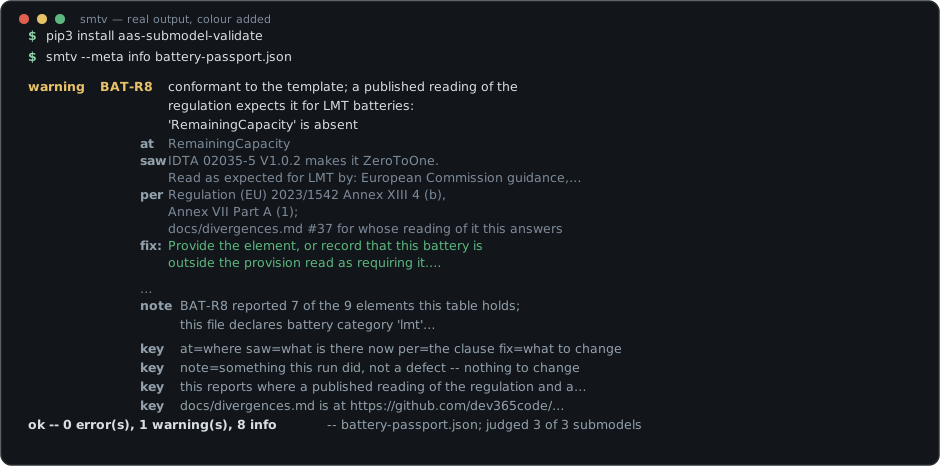
Every finding says what is wrong, where, and how to fix it — and shows the evidence where there is evidence to show. A rule without a remedy sentence does not ship. On the bundled official example all 87 findings carry a place and a remedy, and 10 carry a saw line; the other 77 are relayed metamodel findings, which name a path and no value. Here is the one this project exists for — a battery passport whose template permits an element to be absent while a published reading of the regulation expects it. Those are two different questions and they get two different answers:
$ smtv --meta info your-battery-passport.json
warning BAT-R8   conformant to the template; a published reading of the regulation expects it for LMT batteries: 'RemainingCapacity' is absent
        at   RemainingCapacity
        saw  IDTA 02035-5 V1.0.2 makes it ZeroToOne. Read as expected for LMT by: European Commission guidance, Digital Batteries Passport -- data point by category v2.0, data point 62; BatteryPass-Ready Data Attribute Longlist v1.3 (draft) row 60. Asked anywhere under the submodel: this rule is about the data being present, not about where the template puts it
        per  Regulation (EU) 2023/1542 Annex XIII 4 (b), Annex VII Part A (1); docs/divergences.md #37 for whose reading of it this answers
        fix: Provide the element, or record that this battery is outside the provision read as requiring it. The template will not ask for it -- that is the point of the finding.
…
ok -- 0 error(s), 1 warning(s), 8 info -- your-battery-passport.json; judged 3 of 3 submodels
Note what it does not say. Not "not to the regulation": the tool has a
published reading of a provision, never the provision speaking. And not
"for every battery"—the file states lmt, Annex VII Part A applies to
"stationary battery energy storage systems and LMT batteries", and the
Commission's own guidance marks this element not to be filled for an
electric vehicle. A finding that ignored the category would tell one
manufacturer to add what another's guidance forbids.
Three sources have to agree before an element is reported this way — the
clause itself carrying no where applicable, the Commission's data point,
and the long list — and that agreement is asserted in the test suite, not
remembered. It has to be: the element this page led with until 0.1.3 was
EnergyRoundTripEfficiencyFade, and Annex IV Part A (4) reads "Where
applicable, energy round trip efficiency and its fade". See
docs/divergences.md #37.
The … is four lines: the one that accounts for the 8 info — the
relayed metamodel findings, folded into a count unless you ask for them
— the coverage note quoted further down, and the two-line key naming
the labels this run printed. Notes are printed and not counted; the
folded line is counted and not printed in full. The
summary opens ok because the exit code is 0: a disagreement with a
reading of the regulation is a warning, so it does not fail your build unless you ask
it to (-W makes a warning exit 1). That is deliberate. This tool answers for
the template; the law is somebody's reading of the law, and reading is
not a thing to fail a pipeline on without being told to.
The second command above needs no file of your own, no clone and no network: the example IDTA publishes travels in the wheel, under the same CC BY 4.0 licence as the templates beside it (see NOTICE). It is unmodified, defects and all — it raises findings, which is the point of shipping that one rather than a clean file written to pass. A first verdict that says ok proves nothing about a validator.
If pip3 is not the spelling on your machine, python3 -m pip install aas-submodel-validate usually is — py -m pip install aas-submodel-validate on Windows. If smtv is then command not found, pip printed the directory it installed into — put that on your PATH, or run the tool as python3 -m aas_submodel_validate.
A second sample, generated by the test suite and stale-checked on every build
error   SMT-D1   no submodel declares a semanticId this tool has a template table for
        saw  semanticId value(s): urn:somecompany:docs
        per  IDTA 02004-2-0 §2.4, Table 2; IDTA 02003-2-0-1 §2
        fix: If the submodel means one of the templates this tool has a table for, give it that template's semanticId: 0173-1#01-AHF578#003 for Handover Documentation (IDTA 02004); 0173-1#01-AHX837#002 for Technical Data (IDTA 02003). If it means a template this tool has no table for, leave the identifier alone -- it is doing its job, and this finding only says nothing here judged the submodel against a template.
key     saw=what is there now per=the clause fix=what to change
FAILED -- 1 error(s), 0 warning(s), 0 info -- machine-docs.json; judged 0 of 1 submodel
Reading a finding
Four labelled lines under each one, and a finding uses the ones it has. The tool prints the key itself, above the summary, so the screen carries it and not only this page:
key at=where saw=what is there now per=the clause fix=what to change
at |
where in the submodel — the path of idShorts down to the element |
saw |
what was actually there, so you can tell this finding from a similar one |
per |
the clause this reading comes from, for when you have to cite it |
fix |
what to change. Every finding has one; a finding without a remedy is a complaint |
note |
something this run did, not a defect in the file. Nothing to change — which is why a note has no fix |
Below the findings: one line per channel that was folded, then the
notes, then the key, then the summary. The metamodel channel is folded
by default — it is relayed from aas-core3.0 rather than read off a
template, and on the official example it is 77 of 87 findings. Folded,
not dropped: the summary still counts them and --show-meta lists them.
-f json is never folded.
The summary line opens with the verdict, ok or FAILED — the same
answer the exit code gives, reached once and printed as well as
returned. Then how many of each severity, the file, and how many of its
submodels were judged. Under -W the findings are identical and the
verdict is not, which is the case the word is there for.
(not a full verdict: some of it was not judged) is appended whenever
something in the input did not come out to be judged — a path that
could not be opened, an archive or a chain of relationships that could
not be followed, a part refused or stopped short on, a document that
would not parse or could not be built — and the X findings above it
say which. That is a different thing from a document that was judged
and failed.
What it catches
Five of the 126, in the words the tool actually prints:
| You ship this | smtv says |
|---|---|
A DocumentVersion whose StatusValue is released |
HD-D6 · StatusValue is outside the vocabulary — saw 'released' |
ClassificationSystem written VDI2770:2020 |
HDL5 · ClassificationSystem spells the VDI system non-canonically |
A Document with no VDI 2770 classification at all |
HD-D2 · no DocumentClassification declares the mandatory VDI 2770 classification system |
A ClassName given only in German |
HD-D4 · ClassName has no English entry — saw languages present: de |
An LMT battery passport with no RemainingCapacity |
BAT-R8 · conformant to the template; a published reading of the regulation expects it for LMT batteries |
Each of those five carries an at, a saw where there is evidence to show, the clause it reads from, and a sentence saying what to change.
Where it sits
flowchart LR
    A["Authoring<br/>CAD · CMS · ERP"] --> B["AAS submodel<br/>.aasx · .json · .xml"]
    B --> C{"Is it well formed?"}
    C -->|"aas-core3.0<br/>metamodel"| D["Relayed here,<br/>never re-implemented"]
    B --> E{"Is it the submodel<br/>it claims to be?"}
    E -->|"this project"| F["Template conformance<br/>+ regulation, where they differ"]
    F --> G["Delivery<br/>to the operator"]
    classDef mine fill:#a8721c,stroke:#7a5313,color:#fff
    class E,F mine
A file can be perfectly valid against the AAS metamodel and still not be the submodel it claims to be: the wrong cardinalities, the wrong semantic identifiers, a mandatory VDI 2770 classification missing. That gap is the whole of this project. Metamodel checking is delegated to aas-core3.0 and reported in a separate channel, never re-invented here.
Three doors, one judgement
| Door | For | Command |
|---|---|---|
| Terminal | a machine with pip | pip3 install aas-submodel-validate then smtv file.aasx |
| Single file | a machine with no package manager | carry smtv.pyz, run python3 smtv.pyz file.aasx (py smtv.pyz file.aasx on Windows) |
| A build | a pipeline that reads exit codes | smtv -q -W file.aasx — 0 pass, 1 findings, 2 could not run |
The same rules and the same verdict behind all three. There is no browser door and no hosted service; nothing here uploads a file anywhere, because nothing here opens a socket.
For a machine with no package manager, take smtv.pyz from the
releases page
— built and checksummed there, and carrying build provenance you can
verify with gh attestation verify from 0.1.1 on — or build it yourself
from a
clone where there is a network, and carry it:
python3 tools/build_zipapp.py           # from a clone; or download it
python3 dist/smtv.pyz --example         # a verdict, with nothing else on the machine
python3 dist/smtv.pyz your-submodel.aasx
Everything is inside it — this package and its one dependency — and nothing is compiled, so the same file runs on Linux, macOS and Windows, and it is an ordinary zip anyone who has to approve it can open and read. Two builds of one tree that resolve the same dependency version are byte-identical, so the hash on a release page is the hash of the file you carried in. The dependency is a range and not a pin, so a build made after upstream publishes again is a different file — which is why the release page's hash is the one to check against, and not one you produce later.
Honest coverage
A verdict says how much of your file a template answered for, and the battery rules say how much of their own table they were able to answer for. Neither number is decoration.
One limit is worth knowing before you rely on a pass. Matching goes
by semanticId, so an element whose identifier is wrong matches no row —
and the rules for everything inside it are rules about a row that was
never reached. Measured by tools/scope_silence.py over the 86
generated rules, of which the corpus fixtures carry 69: a wrong last
character — what a version bump writes, #002 to #003 — leaves 18 of
them speaking only through the near-miss lint, and a character wrong
inside a path segment — what a hand-edited file gets — leaves the same
18 saying nothing at all. That difference is the whole argument for the
lint, and for what is still missing after it: it catches a version
drift, which is what it was built for, and catches nothing else. This is written up
with the measurement in
docs/divergences.md
#23; closing it needs a rule this project does not have yet, and it is
on the roadmap rather than in this release. Here is that second one whole, as the
tool writes it — one line, unfolded:
note BAT-R8 reported 1 of the 9 elements this table holds; this file declares battery category 'lmt', and the reading recorded here does not require 2 of the table's conditional elements for it, so those were not asked. A further 6 belong to submodels this file does not carry, so nothing here could look for them. Read from IDTA 02035-1 V1.0, IDTA 02035-4 V1.0.1, IDTA 02035-5 V1.0.2. Both figures are a floor, not a measurement: the templates cite no provision of the law, so the join behind the table matched attributes by name, and name matching misses every element whose label differs from the prose, and reaches a nested one only when its label happens to match.
A verdict that reached the rules says how many submodels a template
answered for — judged 1 of 3 submodels, or no submodels to judge
when the input held none. A submodel that declares itself a template is
a specification and not an instance, so it is set aside rather than
judged: the summary says how many were, a note names them, and
--require-all-judged does not ask for what cannot be given. An input that was refused carries no judged clause at
all — it says (not a full verdict: some of it was not judged), because
nothing was judged and a coverage figure about it would be an
invention. An environment carries submodels this tool has no business
judging, so an unjudged one is a number and not a finding;
--require-all-judged turns that number into an exit code when your
pipeline needs it to.
A verdict also says when a rule was never put. A generated rule lives
inside a scope, and a scope opens only when an element matches the row
that names it — so an element the reader cannot identify takes what is
under it out of the run, quietly, with nothing wrong in what remained.
Where that happens the summary says 1 rule not asked and
summary.rulesNotAsked names which. It is not a finding and it moves no
exit code: it says the run did not look, which is a different sentence
from there was nothing to see. smtv --example prints one, on the
official IDTA example, for a list that wears its item's identifier.
The number counts submodels a template table answered for, and nothing
else. Rules that need no template — the container checks, the battery
table — report on a submodel that the count still calls unjudged, which
is why a file can show judged 0 of 1 and a finding in the same
breath.
Why trust the answer
- Every finding has a remedy. A rule that cannot say what to change does not get registered; the suite refuses it.
- It will not stay silent. An input where nothing matches a template this tool has is an error, not a shrug — silence about a file it could not judge is the one answer a validator must never give.
- It refuses rather than guesses. A refused input exits 2, not 1: "could not run" and "ran and failed" are different sentences, and the report says which.
- Offline, always. No network call in any code path. The single-file build is an ordinary zip with no compiled artefacts — a reviewer can read every line of it before it crosses a threshold.
- Bounded by what it opens, not by what arrives. A container declares far more than it holds: a few hundred kilobytes can declare hundreds of megabytes. This reader opens only what the relationship chain hands it, asks whether a supplemental part exists by name rather than by reading it, and compares a member's declared size against its limits before anything is decompressed — so a member it will not use costs it nothing, and there is no point at which one is inflated and then discarded. Measured on an archive of two hundred members declaring 400 MB: the bytes it charged itself are three orders of magnitude below what the file claimed, and the suite holds that as a ledger assertion rather than a stopwatch.
- Deterministic. Two builds of one tree produce the same bytes; two runs over one file produce the same report, ordered.
- Every chosen reading is written down. Where the published template and its own published example disagree — and they do — docs/divergences.md records which reading this tool follows and the evidence for it.
- A gate is not trusted here until it has been made to fail. One that has never failed is one nobody has tested, and it is indistinguishable from one that cannot.
Roadmap
An item moves right only when it is built and verified. These counts are
the registry's, and the suite fails when they drift from it; smtv --rules lists the rules one per line and ends with the relayed
metamodel channel, so that listing is one line longer than the count.
timeline
    title Where aas-submodel-validate is going
    Shipped : Three IDTA templates — 02004 Handover Documentation, 02003 Technical Data, 02035-2 Digital Battery Passport part 2
            : 126 rules, 86 of them generated from the vendored official template files
            : The battery passport read against Regulation (EU) 2023/1542 where template and law disagree
            : Machine-readable obligation indexes, joined and published with their coverage stated as a floor
            : Versioned JSON report, exit codes, reproducible single-file build
    Building : Deeper coverage of the three templates already supported
    Planned : Further IDTA templates, chosen by what people bring
            : The rest of the battery obligation index, once a rule can read a battery's category
            : An evidence bundle a reviewer can file — one command, report plus provenance
            : Cross-checks with neighbouring standards — VDI 2770, iiRDS
When aas-submodel-validate is not the tool
- You need metamodel conformance. That is aas-core3.0's job, and aas-test-engines is the official conformance tooling for the metamodel, serialisation, AASX packaging and APIs. As of v1.0.3 its submodel-template layer covers two templates (Contact Information, Digital Nameplate); this project is the complementary layer for the three it supports.
- You need a file repaired. There is no
--fix. A validator that edits your file has to be trusted twice. - Your submodel is of a kind not listed above. It will say so — clearly, and as an error — rather than pass it quietly.
- You want a hosted check. There is none, on purpose.
What it refuses to do is written down in docs/scope.md.
Putting it in a build
smtv -q -W your-submodel.aasx # 0 pass, 1 findings, 2 could not run
-W fails on every warning, including the ones relayed from
aas-core3.0 about the metamodel. Those are not always somebody else's
problem — on the official example, 45 of the 77 are about the submodel
itself, and most of those clear by deleting an idShort the metamodel
says should not be there — so they are
warnings like any other until you say otherwise:
smtv -q -W --meta info your-submodel.aasx
--meta sets that channel's severity to error, warning (the
default) or info. At info it is still reported and still counted;
-W simply no longer fails on it. One dial, so there is no second flag
to disagree with the first.
Two more that decide exit codes, both for the case where the tool cannot speak to your file:
--allow-unmatched— an input where nothing declares a submodel identifier this tool has a table for is an error by default, because silence about a file it could not judge at all is the one answer a validator must never give. When that is expected — a repository where most submodels are of other kinds — this makes it a note instead. It says nothing about a file where some submodels matched and others did not; that is the next flag's question.--require-all-judged— an environment can hold submodels this tool has no business judging, sojudged 1 of 3is a number rather than a finding and the run still exits 0. If your pipeline reads only the exit code, this makes partial coverage fail rather than pass quietly. It also covers the emptiest case: an input holding no submodels at all, which the summary reports asno submodels to judge. That one already fails by default — nothing matched, soSMT-D1is an error — and--allow-unmatchedis what turns it into a pass. The two flags together say the thing neither says alone: an unmatched submodel is not an error, and it is not coverage either.
Reads .aasx (OPC containers, XML or JSON payload), AAS environment
.json/.xml, and bare Submodel .json/.xml. Exit codes: 0 nothing at error
severity, 1 at least one error, 2 could not run — which covers a path
that cannot be read and an input this reader refused, since nothing about
either was judged. Warnings do not fail a build unless you ask with
-W, and info never does. -f json writes a versioned
machine-readable report, described in
docs/report-schema.md.
One dependency
(aas-core3.0),
pure Python, no C extensions. Both wheels fit on a USB stick and
install with --no-index --find-links; the single file above needs not
even that.
What it checks
126 rules, 116 of them across three IDTA templates — 86 generated from the vendored
official template files (cardinality, element kinds, value types,
semantic identifiers at every nesting level), 30 hand-written where a
template file cannot speak. Of the nine that belong to no template,
five are about the input itself — how it is packaged, whether it parses,
and how much of it this reader will take in — and two are about whether
a template this tool knows applies, and which one. The last two read the
battery
passport against Regulation (EU) 2023/1542 rather than against a
template, over IDTA 02035-1, 02035-4 and 02035-5: one names a submodel
identifier that two published templates claim, and one reports an
element a template permits to be absent that a published legal reading
expects — a file can be conformant to its template while a published
reading of the regulation expects more of it, and those are different
answers. None of the nine is expected of every battery category the
sources name, so it reports a row only where the file states its own
category; the rest are counted in the report and left unsaid, because
saying them without the category would tell one manufacturer to add
what another's guidance
forbids. Most of a battery passport is submodels this tool has no table
for; the exception is part 2, which declares 02004's identifier and so
is judged. A package holding part 2 comes back with a verdict. One
holding only the other parts draws SMT-D1 and exits 1 — "nothing here
matched a template I have", which is true and is not a defect in the
file. --allow-unmatched is for that. X1, X2 and X4 are about the AASX/OPC
package the submodel arrives in; X3 says a document would not parse,
packaged or bare; and X5 is this reader's own bound on how much it will
take in, whichever way it arrives. One, SMT-D1, asks whether
the input brought a submodel this tool knows at all; and one, SMT-D2,
says which template answered wherever two published templates share one
submodel identifier and something had to choose.
| template | generated | hand-written |
|---|---|---|
| IDTA 02004 Handover Documentation 2.0.1 | 38 | the mandatory VDI 2770 classification and its twelve classes, English class names, the status vocabulary, dates that are dates, files that exist in the container, references that resolve |
| IDTA 02003 Technical Data 2.0.1 | 26 | dates that are dates, files that exist in the container, references that resolve |
| IDTA 02035-2 Digital Battery Passport part 2 1.0 | 22 | 02004's, minus the three whose elements this template drops |
02003 declares open content: §3.5 says the set of suitable semanticIds is not restricted, so its 36 placeholder elements generate no rules and a manufacturer's own properties pass without complaint. Near-miss identifiers are diagnosed rather than silently unmatched, in all three.
IDTA 02035-2 (Digital Battery Passport, part 2) publishes IDTA 02004's
submodel identifier and asks for less than it does, so which of the two
answers has to be chosen. Today that choice is the caller's:
--profile 02035-2 judges by the battery passport's table,
--profile 02004 by the Handover template's, and without the flag 02004
answers as it always has. Whenever a file declares the profile or the
flag is used, the report says which template answered and counts the
checks the two disagree about — what this run asked that the other would
not, or what it did not ask that the other would (SMT-D2). Without the flag, a plain
02004 file draws nothing here, because nothing had to choose; ask for
--profile 02004 and SMT-D2 says so at info, because then something
did.
Beside the validator, data/battery-passport/ publishes machine-readable
indexes of what a battery passport is required to carry -- Annex XIII of
Regulation (EU) 2023/1542, the Commission's data-point guidance, the
BatteryPass-Ready Data Attribute Longlist v1.3, and the IDTA 02035/02099 templates -- with a
join across all four whose coverage is stated as a floor. The sources
are pinned by hash, not mirrored; data/battery-passport/README.md says
how to rebuild every index from them.
The AAS metamodel itself is relayed from aas-core3.0's verification in
a separate meta channel (the JSON field is kind) — warnings by
default, folded into one line unless --show-meta, --meta error to
promote — and never re-implemented here.
The rule counts (126, 86), the drift figures above and the sample are pinned by the test suite and fail the build when they go stale.
Using this validator in your product
What is stable, what is not, and where to ask
The contract is the report and the exit codes. -f json writes a
document with a schemaVersion, described field by field in
docs/report-schema.md.
Keys are added without moving the version; nothing is renamed or removed
under one. Exit codes are 0, 1 and 2 and mean what the page above says.
There is no importable Python API yet — the supported way to call this
from another program is the command and the JSON:
import json, subprocess

done = subprocess.run(["smtv", "-f", "json", "submodel.aasx"],
                      capture_output=True, text=True)
if done.returncode == 2:            # could not run; nothing was judged
    raise SystemExit(done.stderr)
report = json.loads(done.stdout)
for finding in report["findings"]:
    print(finding["rule"], finding["severity"], finding["message"], finding["fix"])
Versions and updates. The package is in 0.x, and that is the
honest statement of what may change. The reading behind a rule, the set
of findings a given file draws, and the exit code that follows from them
have all moved between releases here — 0.1.3 judged seven of fifty-two
corpus inputs differently, and five of those changed an exit code. Every
such change is listed in
CHANGELOG.md
with the reading behind it, under a paragraph that names the exit codes
that move. If you gate a build on the exit code, read that file before
upgrading.
What has not moved is the report. schemaVersion is 1; keys are added
without moving it, and nothing has been renamed or removed under it. No
rule id has been renamed or reused — the ids of the last release are
written down in the test suite and checked against every build, because
a rule id is a citation somebody else made. Vendored IDTA template files
are pinned by commit and verified by hash on every run of the suite, so
an upstream change cannot arrive silently.
Packaging and internals are not a contract: there is no importable Python API, and the module layout and what the wheel carries beyond the paths named above may change in any release.
Support. Open an issue; where to send it and what makes a report answerable is in SUPPORT.md. A question about a file this tool judged wrongly is worth most while the reading it disagrees with can still be changed.
Stewardship
One maintainer. That is the risk and it goes first: no company behind
this, no consortium, and nobody else who could cut a release tomorrow.
What can be done about it has been. The licence is Apache-2.0. Every
generated file is written by a generator that travels in the source
distribution beside it, the vendored official material carries the
hashes it was verified against, and the test suite ships too — so a fork
inherits a tree that can rebuild and re-check itself rather than a pile
of output nobody can regenerate. Those tests are checked against their
own mutations: python3 tools/mutation_table.py lists each gate and the
mistake it catches, and --run applies each mistake and confirms a test
fails. That is the most one maintainer can
honestly offer, and it is worth more than a promise about response
times, which is why there is no promise about response times.
Every chosen reading of a template is in docs/divergences.md with the evidence for it; what this project refuses to do is in docs/scope.md; what a report promises is in docs/report-schema.md. Where those three disagree with the code, the code is the defect.
Licence
Apache-2.0, © 2026 Wooyong Lee. Contributions need a Signed-off-by
line (DCO); see CONTRIBUTING.md.
This is an unofficial project, not affiliated with or endorsed by IDTA or the Eclipse BaSyx project. "AAS", "Asset Administration Shell" and template identifiers are used descriptively.
1 maintainer

Release files for aas-submodel-validate 0.2.0
For a detailed explanation of source distributions (sdists) and built distributions (wheels), please see the package formats documentation.
Source distribution (sdist)
| File | Size | Uploaded | |
|---|---|---|---|
| aas_submodel_validate-0.2.0.tar.gz | 2.0 MB | Details |
Built distribution (wheel)
| File | Interpreter | ABI | Platform | Reset |
|---|---|---|---|---|
| aas_submodel_validate-0.2.0-py3-none-any.whl | Python 3 | none | any | Details |
Total release size: 2.3 MB
Release files / aas_submodel_validate-0.2.0.tar.gz
| Download URL | aas_submodel_validate-0.2.0.tar.gz |
|---|---|
| Size | 2.0 MB |
| Tags | Source |
|
SHA-256 checksum How to use checksums |
a0b662788dae2f1d6a00972c9e4a820e65e78906dbadb735d11cda0b0dd93a8c
|
|
BLAKE2b-256 checksum How to use checksums |
58a1b6f4cb01ffedb77698beeeab5eb2857a7c5356496ae58e631fa6c6f35e18
|
| Upload date | |
|
Uploaded using Trusted Publishing? What is trusted publishing? |
Yes |
| Uploaded via |
twine/7.0.0 CPython/3.13.14
|
Provenance
Provenance describes where a file came from. On PyPI, provenance is shared via attestations, which provide a verifiable record of the build or publishing details. View details, limitations and caveats.


PyPI Publish Attestation
PyPI verified that this artifact, at this checksum, originated from the publisher listed below.
Signed by GitHub Actions, verified by PyPI on Sep 15, 2026.
Transparency logRelease files / aas_submodel_validate-0.2.0-py3-none-any.whl
| Download URL | aas_submodel_validate-0.2.0-py3-none-any.whl |
|---|---|
| Size | 300.9 kB |
| Tags | Python 3 |
|
SHA-256 checksum How to use checksums |
10873846bc77f8e3c5578fbaac9025a8b05406f3399e9612276477a623a6d390
|
|
BLAKE2b-256 checksum How to use checksums |
89c7c701c64c2508c490087074edc0dff7f052d2d24254d56935265f7482c1e5
|
| Upload date | |
|
Uploaded using Trusted Publishing? What is trusted publishing? |
Yes |
| Uploaded via |
twine/7.0.0 CPython/3.13.14
|
Provenance
Provenance describes where a file came from. On PyPI, provenance is shared via attestations, which provide a verifiable record of the build or publishing details. View details, limitations and caveats.
PyPI Publish Attestation
PyPI verified that this artifact, at this checksum, originated from the publisher listed below.
Signed by GitHub Actions, verified by PyPI on Sep 15, 2026.
Transparency log













