
abi3audit



Read the Trail of Bits blog post about how we find bugs with abi3audit!
abi3audit scans Python extensions for abi3 violations and inconsistencies.
It can scan individual (unpackaged) shared objects, packaged wheels, or entire package version histories.
This project is maintained in part by Trail of Bits. This is not an official Trail of Bits product.
Index
Motivation
CPython (the reference implementation of Python) defines a stable API and corresponding
ABI ("abi3"). In principle, any CPython extension can be built against this
API/ABI and will remain forward compatible with future minor versions of CPython.
In other words: if you build against the stable ABI for Python 3.5, your
extension should work without modification on Python 3.9.
The stable ABI simplifies packaging of CPython extensions, since the packager
only needs to build one abi3 wheel that targets the minimum supported Python
version.
To signal that a Python wheel contains abi3-compatible extensions,
the Python packaging ecosystem uses the abi3 wheel tag, e.g.:
pyrage-1.0.1-cp37-abi3-manylinux_2_5_x86_64.manylinux1_x86_64.whl
Unfortunately, there is no actual enforcement of abi3 compliance
in Python extensions at install or runtime: a wheel (or independent
shared object) that is tagged as abi3 is assumed to be abi3, but
is not validated in any way.
To make matters worse, there is no formal connection between the flag
(--py-limited-api)
that controls wheel tagging and the build macros
(Py_LIMITED_API)
that actually lock a Python extension into a specific abi3 version.
As a result: it is very easy to compile a Python extension for the wrong abi3
version, or to tag a Python wheel as abi3 without actually compiling it
as abi3-compatible.
This has serious security and reliability implications: non-stable parts of the CPython ABI can change between minor versions, resulting in crashes, unpredictable behavior, or potentially exploitable memory corruption when a Python extension incorrectly assumes the parameters of a function or layout of a structure.
Installation
abi3audit is available via pip:
pip install abi3audit
Usage
You can run abi3audit as a standalone program, or via python -m abi3audit:
abi3audit --help
python -m abi3audit --help
Examples
Audit a single shared object, wheel, or PyPI package:
# audit a local copy of an abi3 extension
abi3audit procmaps.abi3.so

# audit a local copy of an abi3 wheel
abi3audit procmaps-0.5.0-cp36-abi3-manylinux2010_x86_64.whl

# audit every abi3 wheel for the package 'procmaps' on PyPI
abi3audit procmaps
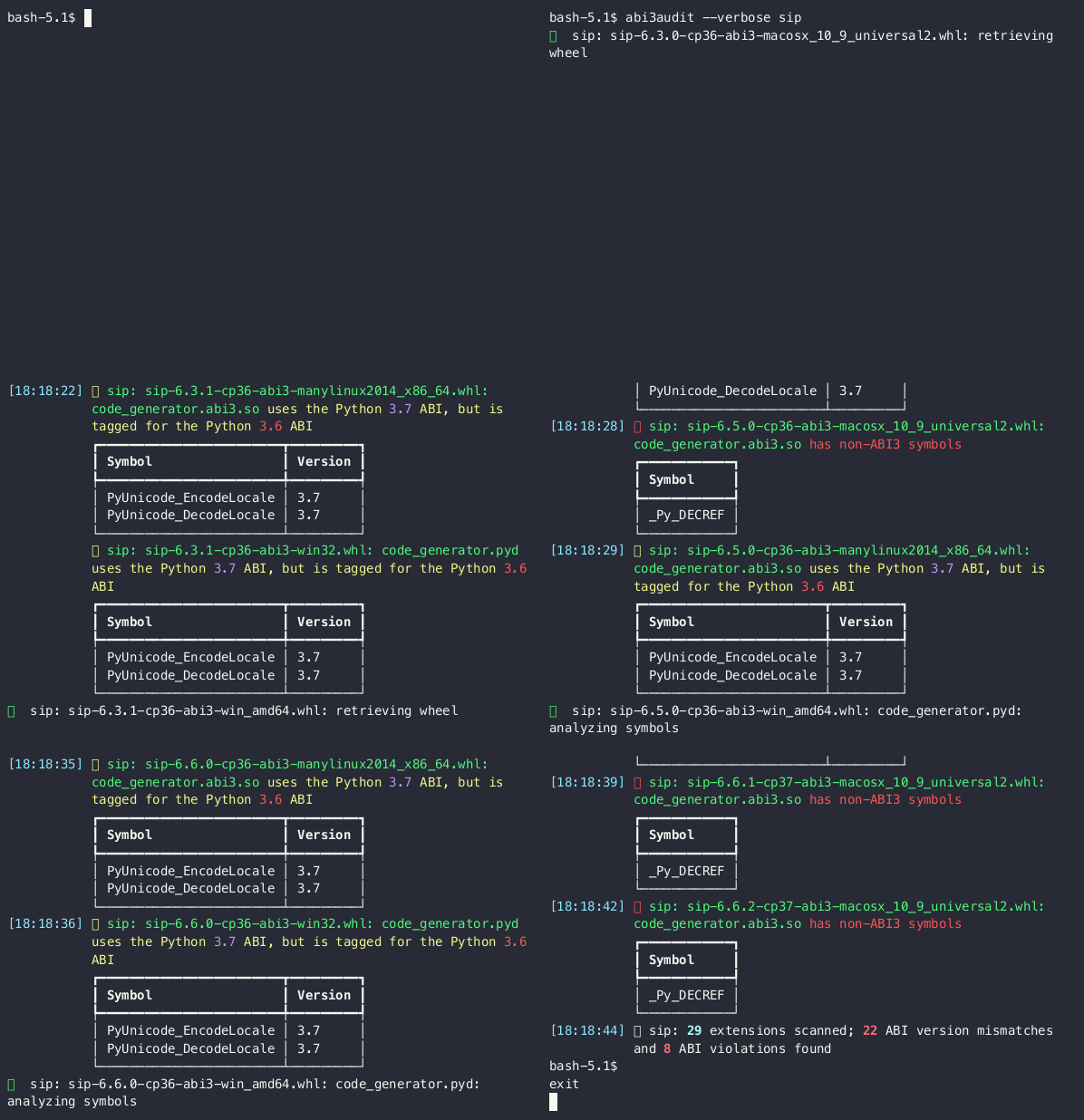
Show additional detail (pretty tables and individual violations) while auditing:
abi3audit procmaps --verbose
yields:
[17:59:46] 👎 procmaps:
           procmaps-0.5.0-cp36-abi3-manylinux2010_x86_64.whl: procmaps.abi3.so
           uses the Python 3.10 ABI, but is tagged for the Python 3.6 ABI
           ┏━━━━━━━━━━━━━━━━━━━━━━━━━┳━━━━━━━━━┓
           ┃ Symbol                  ┃ Version ┃
           ┡━━━━━━━━━━━━━━━━━━━━━━━━━╇━━━━━━━━━┩
           │ PyUnicode_AsUTF8AndSize │ 3.10    │
           └─────────────────────────┴─────────┘
[17:59:47] 💁 procmaps: 2 extensions scanned; 1 ABI version mismatches and 0
           ABI violations found
Generate a JSON report for each input:
abi3audit procmaps --report | python -m json.tool
yields:
{
  "specs": {
    "procmaps": {
      "kind": "package",
      "package": {
        "procmaps-0.5.0-cp36-abi3-manylinux2010_x86_64.whl": [
          {
            "name": "procmaps.abi3.so",
            "result": {
              "is_abi3": true,
              "is_abi3_baseline_compatible": false,
              "baseline": "3.6",
              "computed": "3.10",
              "non_abi3_symbols": [],
              "future_abi3_objects": {
                "PyUnicode_AsUTF8AndSize": "3.10"
              }
            }
          }
        ],
        "procmaps-0.6.1-cp37-abi3-manylinux_2_5_x86_64.manylinux1_x86_64.whl": [
          {
            "name": "procmaps.abi3.so",
            "result": {
              "is_abi3": true,
              "is_abi3_baseline_compatible": true,
              "baseline": "3.7",
              "computed": "3.7",
              "non_abi3_symbols": [],
              "future_abi3_objects": {}
            }
          }
        ]
      }
    }
  }
}
Limitations
abi3audit is a best-effort tool, with some of the same limitations as
auditwheel. In particular:
-
abi3auditcannot check for dynamic abi3 violations, such as an extension that callsdlsym(3)to invoke a non-abi3 function at runtime. -
abi3auditcan confirm the presence of abi3-compatible symbols, but does not have an exhaustive list of abi3-incompatible symbols. Instead, it looks for violations by looking for symbols that start withPy_or_Py_that are not in the abi3 compatibility list. This is unlikely to result in false positives, but could if an extension incorrectly uses those reserved prefixes. -
When auditing a "bare" shared object (e.g.
foo.abi3.so),abi3auditcannot assume anything about the minimum intended abi3 version. Instead, it defaults to the lowest known abi3 version (abi3-cp32) and warns on any version mismatches (e.g., a symbol that was only stabilized in 3.6). This can result in false positives, so users are encouraged to audit entire wheels or packages instead (since they contain the sufficient metadata). -
abi3auditconsiders the abi3 version when a symbol was stabilized, not introduced. In other words:abi3auditwill produce a warning when anabi3-cp36extension contains a function stabilized in 3.7, even if that function was introduced in 3.6. This is not a false positive (it is an ABI version mismatch), but it's generally not a source of bugs. -
abi3auditchecks both the "local" and "external" symbols for each extension, for formats that support both. It does this to catch symbols that have been inlined, such as_Py_DECREF. However, if the extension's symbol table has been stripped, these may be missed.
Licensing
abi3audit is licensed under the MIT license.
abi3audit includes ASN.1 and Mach-O parsers generated from
definitions provided by the Kaitai Struct project.
These vendored parsers are licensed by the Kaitai Struct authors under the MIT
license.
1 maintainer

Release files for abi3audit 0.0.26
For a detailed explanation of source distributions (sdists) and built distributions (wheels), please see the package formats documentation.
Source distribution (sdist)
| File | Size | Uploaded | |
|---|---|---|---|
| abi3audit-0.0.26.tar.gz | 29.4 kB | Details |
Built distribution (wheel)
| File | Interpreter | ABI | Platform | Reset |
|---|---|---|---|---|
| abi3audit-0.0.26-py3-none-any.whl | Python 3 | none | any | Details |
Total release size: 59.7 kB
Release files / abi3audit-0.0.26.tar.gz
| Download URL | abi3audit-0.0.26.tar.gz |
|---|---|
| Size | 29.4 kB |
| Tags | Source |
|
SHA-256 checksum How to use checksums |
44b5fa5ddc8acdfdbd221f400d48b8a205df519e8f4c6d57a349837ac88d0ff8
|
|
BLAKE2b-256 checksum How to use checksums |
992dfa16448d36021e36caa71acda36e25be8f6315b9c740b1be8bdae5c76257
|
| Upload date | |
|
Uploaded using Trusted Publishing? What is trusted publishing? |
Yes |
| Uploaded via |
uv/0.9.26 {"installer":{"name":"uv","version":"0.9.26","subcommand":["publish"]},"python":null,"implementation":{"name":null,"version":null},"distro":{"name":"Ubuntu","version":"24.04","id":"noble","libc":null},"system":{"name":null,"release":null},"cpu":null,"openssl_version":null,"setuptools_version":null,"rustc_version":null,"ci":true}
|
Provenance
Provenance describes where a file came from. On PyPI, provenance is shared via attestations, which provide a verifiable record of the build or publishing details. View details, limitations and caveats.


PyPI Publish Attestation
PyPI verified that this artifact, at this checksum, originated from the publisher listed below.
Signed by GitHub Actions, verified by PyPI on Jan 23, 2026.
Transparency logRelease files / abi3audit-0.0.26-py3-none-any.whl
| Download URL | abi3audit-0.0.26-py3-none-any.whl |
|---|---|
| Size | 30.3 kB |
| Tags | Python 3 |
|
SHA-256 checksum How to use checksums |
b94b774984e50ec03481c1dda88c48079f6baec870b263bf7f5e7415feb8802d
|
|
BLAKE2b-256 checksum How to use checksums |
75a84bbc458cc2dcb14b0a13be9593bb70f7d424c8244e632e16dbf4aa6cb778
|
| Upload date | |
|
Uploaded using Trusted Publishing? What is trusted publishing? |
Yes |
| Uploaded via |
uv/0.9.26 {"installer":{"name":"uv","version":"0.9.26","subcommand":["publish"]},"python":null,"implementation":{"name":null,"version":null},"distro":{"name":"Ubuntu","version":"24.04","id":"noble","libc":null},"system":{"name":null,"release":null},"cpu":null,"openssl_version":null,"setuptools_version":null,"rustc_version":null,"ci":true}
|
Provenance
Provenance describes where a file came from. On PyPI, provenance is shared via attestations, which provide a verifiable record of the build or publishing details. View details, limitations and caveats.
PyPI Publish Attestation
PyPI verified that this artifact, at this checksum, originated from the publisher listed below.
Signed by GitHub Actions, verified by PyPI on Jan 23, 2026.
Transparency log













