
A Python library for modeling univariate time series using the Generalized Least Deviation Method (GLDM) First, and Second orders.Generalized Least Deviation Method High Order (GLDMHO) Third, Fourth, and Fifth orders.

Project description
abotaleb1
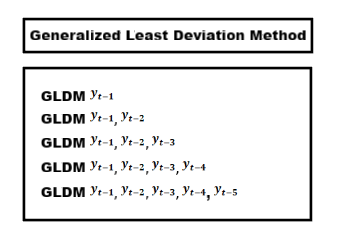
abotaleb1 is a Python package (version 1.0.0) designed for modeling univariate time series using the first to fifth-order Generalized Least Deviation Method (GLDM). This method leverages previous time step values ($y_{t-1}$, $y_{t-2}$, $y_{t-3}$, $y_{t-4}$, $y_{t-5}$) to forecast the current value ($y_t$), providing accurate and efficient predictions for various time series applications.
Model Details and Coefficients
In the Generalized Least Deviation Method (GLDM), the number of coefficients and the lagged variables used increase with the order of the method:
-
First Order: Uses one lagged variable to forecast $y_t$.
- Lagged Variables: $y_{t-1}$
- Coefficients: 2 coefficients
- $a_1$, $a_2$
-
Second Order: Uses two lagged variables to forecast $y_t$.
- Lagged Variables: $y_{t-1}$, $y_{t-2}$
- Coefficients: 5 coefficients
- $a_1$, $a_2$, $a_3$, $a_4$, $a_5$
-
Third Order: Uses three lagged variables to forecast $y_t$.
- Lagged Variables: $y_{t-1}$, $y_{t-2}$, $y_{t-3}$
- Coefficients: 9 coefficients
- $a_1$, $a_2$, $a_3$, $a_4$, $a_5$, $a_6$, $a_7$, $a_8$, $a_9$
-
Fourth Order: Uses four lagged variables to forecast $y_t$.
- Lagged Variables: $y_{t-1}$, $y_{t-2}$, $y_{t-3}$, $y_{t-4}$
- Coefficients: 14 coefficients
- $a_1$, $a_2$, $a_3$, $a_4$, $a_5$, $a_6$, $a_7$, $a_8$, $a_9$, $a_{10}$, $a_{11}$, $a_{12}$, $a_{13}$, $a_{14}$
-
Fifth Order: Uses five lagged variables to forecast $y_t$.
- Lagged Variables: $y_{t-1}$, $y_{t-2}$, $y_{t-3}$, $y_{t-4}$, $y_{t-5}$
- Coefficients: 20 coefficients
- $a_1$, $a_2$, $a_3$, $a_4$, $a_5$, $a_6$, $a_7$, $a_8$, $a_9$, $a_{10}$, $a_{11}$, $a_{12}$, $a_{13}$, $a_{14}$, $a_{15}$, $a_{16}$, $a_{17}$, $a_{18}$, $a_{19}$, $a_{20}$
Table of Contents
Features
- First-Order GLDM: Utilizes previous time step values for forecasting, making it suitable for univariate time series analysis.
- Easy Integration: Simple and intuitive API allows seamless integration into existing projects and workflows.
- Automated Outputs: Automatically generates visualizations and evaluation metrics upon model execution.
- Performance Metrics: Provides detailed insights into model performance, including evaluation metrics, solution systems, execution time, and memory usage.
- Lightweight: Minimal dependencies ensure easy installation and quick setup.
- Extensible: Designed to allow future enhancements and integration of higher-order GLDM methods.
Installation
The abotaleb1 package provides implementations of the Generalized Least Deviation Method (GLDM) for modeling univariate time series data. Here is a detailed guide on how to use it.
Installation
First, make sure the abotaleb1 package is installed. If it's available via pip, you can install it using:
pip install abotaleb1
You can install abotaleb1 using pip, or from the source code.
Via pip
Ensure you have pip installed. Then, run:
pip install abotaleb1
From Source
If you prefer to install the package from the source, follow these steps:
Clone the Repository
git clone https://github.com/abotalebmostafa11/GLDMHO
gitverse https://gitverse.ru/mostafa/GLDM?tab=readme
Data Format
Input File Format
The input.txt file should be formatted as follows:
| Line | Content | Description |
|---|---|---|
| 1 | : |
Separator indicating the start of data sections |
| 2 | m ts |
- m: Length of the time series<br ts |
| 3 | yt |
First data point of the first time series |
| 4 | yt_1 |
Second data point of the first time series |
| 5 | yt_2 |
Third data point of the first time series |
| ... | ... |
... |
| ... | ... |
... |
m*ts + 2 |
yt_m |
m-th data point of the ts-th time series |
The default input data is expected to be in a file named input.txt. The data structure should follow the format below, which is exemplified using an NDVI dataset:
| Data: 15 1 |
|---|
| 0.2950428571 |
| 0.3935857143 |
| 0.5285714286 |
| 0.6218285714 |
| 0.6637285714 |
| 0.6701142857 |
| 0.6759714286 |
| 0.6935285714 |
| 0.6907857143 |
| 0.6777857143 |
| 0.6159142857 |
| 0.5291714286 |
| 0.4574714286 |
| 0.4132 |
| 0.3973 |
Explanation: First Line (15 1): 15: Length of the time series data. 1: Number of univariate time series (in this example we have only one time series). Subsequent Lines: Each line represents a data point in the time series. Ensure that your input.txt follows this structure for the library to function correctly.
Usage
Running the Model To utilize the gldmabotaleb library, follow these simple steps:
Prepare Your Data: Ensure your data is saved in input.txt with the correct format.
Run the Model:
from abotaleb1 import GLDM1, GLDM2, GLDM3, GLDM4, GLDM5 Initializing the Models **Create instances of each GLDM model:
Initialize models
GLDM1 = GLDM1()
GLDM2 = GLDM2()
GLDM3 = GLDM3()
GLDM4 = GLDM4()
GLDM5 = GLDM5()
Running the Models
Execute the run() method on each model instance to perform the modeling:
Run models
GLDM1.run()
GLDM2.run()
GLDM3.run()
GLDM4.run()
GLDM5.run()
What Happens When You Run the gldm1 Model Execution: The GLDM model runs using the first-order method. Automated Outputs: Figures: Visualizations of the time series and forecasting results are saved automatically. Output File (output.txt): Contains model evaluations, Model coefficients ($a_1$, $a_2$), metrics, solution systems, time consumption, and memory usage. Generalized Least Deviation Method (GLDM)
The Generalized Least Deviation Method (GLDM) is used for modeling univariate time series. In GLDM, the number of coefficients increases with the order of the method:
-
First Order: 2 coefficients
- $a_1$, $a_2$
-
Second Order: 5 coefficients
- $a_1$, $a_2$, $a_3$, $a_4$, $a_5$
-
Third Order: 9 coefficients
- $a_1$, $a_2$, $a_3$, $a_4$, $a_5$, $a_6$, $a_7$, $a_8$, $a_9$
-
Fourth Order: 14 coefficients
- $a_1$, $a_2$, $a_3$, $a_4$, $a_5$, $a_6$, $a_7$, $a_8$, $a_9$, $a_{10}$, $a_{11}$, $a_{12}$, $a_{13}$, $a_{14}$
-
Fifth Order: 20 coefficients
- $a_1$, $a_2$, $a_3$, $a_4$, $a_5$, $a_6$, $a_7$, $a_8$, $a_9$, $a_{10}$, $a_{11}$, $a_{12}$, $a_{13}$, $a_{14}$, $a_{15}$, $a_{16}$, $a_{17}$, $a_{18}$, $a_{19}$, $a_{20}$
Outputs
After running the model, the following outputs are generated: Figures: Visual representations of the time series data and forecasting results. These figures are typically saved in formats like .png in the directory where the script is executed. output.txt: A comprehensive report including: Model Evaluation Metrics: Assessing the performance of the GLDM model (e.g., Mean Absolute Error, Root Mean Squared Error). Solution System: Details of the mathematical solution applied by the GLDM. Performance Metrics: Time taken to run the model and memory consumed during execution.
Example
Here's a step-by-step example to demonstrate how to use gldmabotaleb:
- Prepare input.txt Create a file named input.txt in the same directory as your script with the following content:
| Data: 15 1 |
|---|
| 0.2950428571 |
| 0.3935857143 |
| 0.5285714286 |
| 0.6218285714 |
| 0.6637285714 |
| 0.6701142857 |
| 0.6759714286 |
| 0.6935285714 |
| 0.6907857143 |
| 0.6777857143 |
| 0.6159142857 |
| 0.5291714286 |
| 0.4574714286 |
| 0.4132 |
| 0.3973 |
- Create and Run the Script Create a Python script (e.g., run_model.py) with the following content: import sys from gldmabotaleb import run
Run the GLDM model with the input data
run("input.txt") 3. Review the Outputs Figures: Check the generated visualizations in your directory. These may include plots of the original time series, forecasted values, and residuals. output.txt: Open the file to review model evaluations and performance metrics. This file provides insights into the accuracy and efficiency of the GLDM model applied to your data.
License
© 2024 Author: Mostafa Abotaleb
MIT License
Release history Release notifications | RSS feed

Download files
Download the file for your platform. If you're not sure which to choose, learn more about installing packages.
Source Distribution
File details
Details for the file abotaleb1-2.0.0.tar.gz.
File metadata
- Download URL: abotaleb1-2.0.0.tar.gz
- Upload date:
- Size: 24.7 kB
- Tags: Source
- Uploaded using Trusted Publishing? No
- Uploaded via: twine/5.1.1 CPython/3.9.0
File hashes
| Algorithm | Hash digest | |
|---|---|---|
| SHA256 |
19b6dd6da3fda7c825dc7fb9c1b41213eb773841e2fd140981b35ce40fcea4aa
|
|
| MD5 |
7e90d565c5a8c7da147703d48db3f1f3
|
|
| BLAKE2b-256 |
e5f5e1ec3efd92eb9ca16d95ca45d864f8ad47c76c9ec15daaffdfe7d69ca90e
|






