
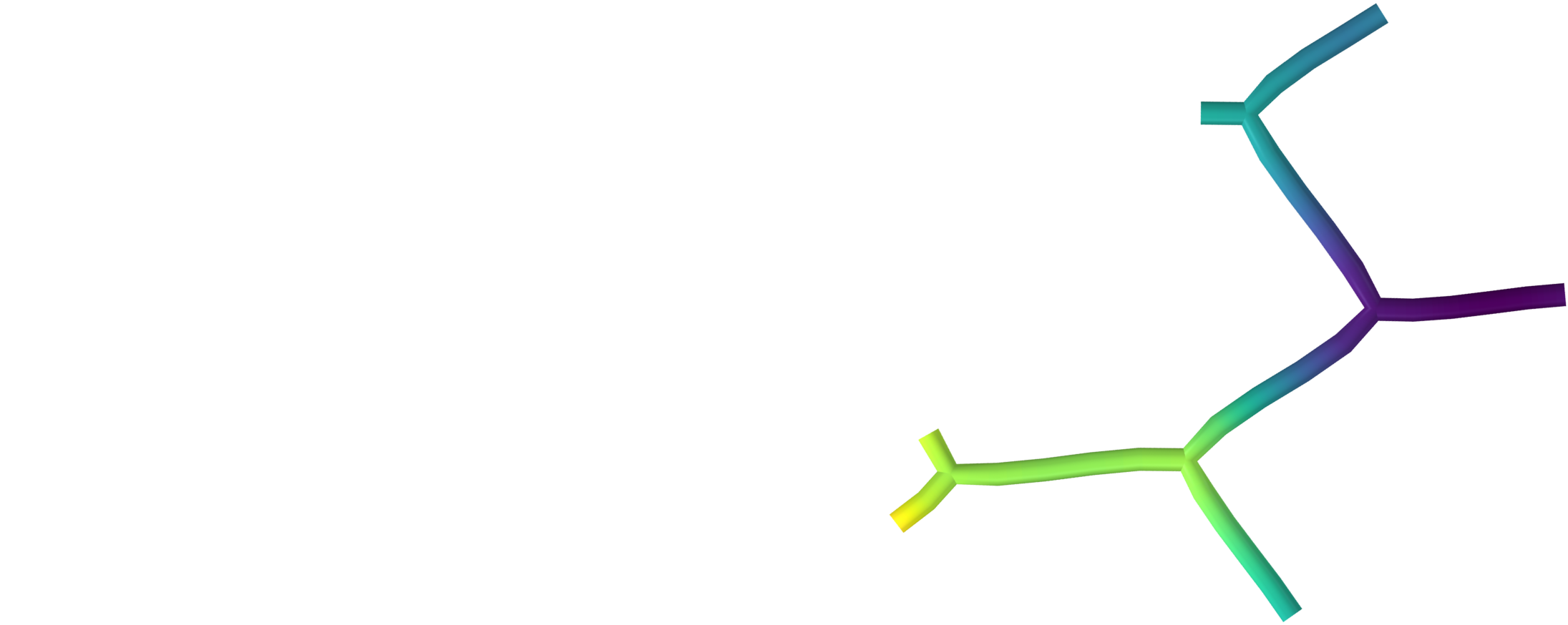
abqhom



abqhom is an open-source Python framework for first-order computational
homogenization of two- and three-dimensional unit cells and representative
volume elements. It connects geometry and meshing in
Gmsh with finite element analysis in
Abaqus. Continuum, truss, beam,
and shell constituents may occur separately or together in mixed-dimensional
cells.
The package provides the scale-transition machinery around an Abaqus analysis. Abaqus remains responsible for element formulations, constitutive integration, nonlinear solution procedures, and output databases.
Capabilities
- Periodic and affine boundary conditions for two- and three-dimensional cells.
- Linear, finite-strain, nonlinear-elastic, and path-dependent analyses using Abaqus material models and solution procedures.
- Periodic translational and rotational constraints for continuum and structural finite elements.
- Ownership-consistent treatment of structural members on periodic boundaries through automatic removal of redundant copies. A complete cell can instead be retained when its response is weighted consistently.
- Effective first Piola–Kirchhoff stress recovery from element nodal forces and incremental microscopic work for discrete Hill–Mandel checks.
- Nonconforming structural–continuum coupling through Abaqus embedded constraints.
- VTK export through Paraqus.
Scope
Two-dimensional cells must be rectangular in the global X₁–X₂ plane with X₃ = 0. Three-dimensional cells must be cuboidal and aligned with the global coordinate axes. Periodic meshes require one-to-one matching nodes on opposite boundaries. The effective medium is a first-order Cauchy continuum, and imposed macroscopic curvature and element warping degrees of freedom are not supported.
See the complete modeling assumptions and limitations before applying the framework to a new cell topology.
Requirements
- Python 3.9 or newer for package installation and runtime creation.
- Abaqus 2018 or newer with Abaqus/CAE and the solver.
- Gmsh 4.9.4 or newer.
- NumPy as supplied with Abaqus.
- Paraqus 1.0.2 or newer.
backports.weakreffor legacy Abaqus releases using Python 2.7.
The source supports both legacy Python 2.7-based Abaqus releases and current Python 3-based releases. Larger examples may require a full Abaqus license.
Installation
Install the released package in a regular Python environment and create the isolated Abaqus runtime with the supplied helper:
python -m pip install abqhom
abqhom-install-abaqus
If Gmsh initialization fails inside Abaqus on Linux because of a native
library conflict, the installation documentation
describes an optional --gmsh-deepbind compatibility mode.
The helper does not modify the Abaqus installation. It creates a versioned
runtime below ~/.abqhom/abaqus-runtime containing only abqhom, Gmsh,
Paraqus, and the weak-reference backport. Activate the generated script in the
shell from which Abaqus will be launched.
The installation guide describes activation on Windows and Linux, cluster usage, and setup verification.
Quick start
The examples are maintained in the source repository and are not installed with the Python package. Clone the repository, activate the runtime, and run the simple-cubic beam-lattice tutorial from its directory:
git clone https://github.com/jstollberg/abqhom.git
cd abqhom/examples/beam_lattice_simple_cubic_3d
abaqus cae noGUI=main.py
The script constructs and periodically meshes the complete lattice, weights the boundary-member stiffnesses by their ownership, evaluates six independent small-strain cases, compares the axial stiffness with its analytical value, and writes CSV and VTK output.
See the
beam_lattice_simple_cubic_3d/main.py
source for the minimal complete workflow and the
examples overview for the full tutorial collection.
Examples
The concise tutorials under examples/ cover beam and shell
lattices, continuum composites, embedded mixed-dimensional cells,
finite-strain hyperelasticity, cyclic plasticity, and imported periodic
meshes.
The larger paper_examples reproduce the numerical
studies from the
accompanying preprint.
| Example | Study |
|---|---|
01_small_strain_verification |
Mixed continuum–shell–beam verification |
02_hyperelastic_octet_lattice |
Imperfect hyperelastic Octet lattice and supercell comparison |
03_elastoplastic_sandwich_cell |
Cyclic plasticity and effective yield surfaces |
Execution order and generated data products are documented in the
paper_examples README.
Documentation and support
The online documentation contains the installation guide, modeling assumptions, user workflow, examples, API reference, and testing instructions. Questions, bug reports, and feature requests can be submitted through GitHub Issues. Contributions are welcome. See CONTRIBUTING.md for the development workflow and submission guidelines.
Citation
If you use abqhom in your research, please cite the
accompanying preprint:
@article{stollberg_2026,
  title = {Nonlinear homogenization of periodic unit cells composed of mixed continuum and structural elements with variationally consistent boundary-member reduction},
  author = {Stollberg, Jonathan and Schillinger, Dominik},
  year = {2026},
  journal = {arXiv preprint arXiv:2611.14770},
  doi = {10.48550/arXiv.2611.14770}
}
Development disclosure
Generative AI tools assisted with code review, refactoring, documentation, and language editing. All resulting changes were reviewed and tested by the author, who remains responsible for the software and documentation.
License
Copyright (C) 2023-2026 Jonathan Stollberg.
Distributed under the terms of the GNU General Public License v3.0 or later.
See LICENSE for the license text.
1 maintainer

Metadata
1 maintainer
Release files for abqhom 0.1.0
For a detailed explanation of source distributions (sdists) and built distributions (wheels), please see the package formats documentation.
Source distribution (sdist)
| File | Size | Uploaded | Provenance | Actions |
|---|---|---|---|---|
| abqhom-0.1.0.tar.gz | 91.7 kB | Without provenance | Details for abqhom-0.1.0.tar.gz |
Built distribution (wheel)
| File | Interpreter | ABI | Platform | Actions Reset |
|---|---|---|---|---|
| abqhom-0.1.0-py3-none-any.whl | Python 3 | none | any | Details for abqhom-0.1.0-py3-none-any.whl |
Total release size: 188.4 kB
Release files / abqhom-0.1.0.tar.gz
| Download URL | abqhom-0.1.0.tar.gz |
|---|---|
| Size | 91.7 kB |
| Tags | Source |
|
SHA-256 checksum How to use checksums |
9140d4f4f121e88cecd38a38b6aa5b7ab24e57a77207124ce2be4d38606ee14a
|
|
BLAKE2b-256 checksum How to use checksums |
3e4a2682ded713310df4883b373cb08843d7ffb4a888e8a01985a74a99701fa0
|
| Upload date | |
|
Uploaded using Trusted Publishing? What is trusted publishing? |
No |
| Uploaded via |
twine/7.0.0 CPython/3.14.8
|
Release files / abqhom-0.1.0-py3-none-any.whl
| Download URL | abqhom-0.1.0-py3-none-any.whl |
|---|---|
| Size | 96.7 kB |
| Tags | Python 3 |
|
SHA-256 checksum How to use checksums |
ac7c6ef97177bbc9326371b56431aaa6db4cf58e2e177f4f203e36954330c018
|
|
BLAKE2b-256 checksum How to use checksums |
f0f66d22e5002118d7b913e6b199bc4844b59f9cb350349c4113c787f5476f50
|
| Upload date | |
|
Uploaded using Trusted Publishing? What is trusted publishing? |
No |
| Uploaded via |
twine/7.0.0 CPython/3.14.8
|
Security for abqhom 0.1.0
Provenance
Provenance describes where a file came from. On PyPI, provenance is shared via attestations, which provide a verifiable record of the build or publishing details. View details, limitations and caveats.
No provenance found
None of the files in this release were uploaded with provenance metadata.
A note on package security
PyPI is a repository for distributing packages, not a service for auditing them. While third-party security researchers and our staff do their best to detect and remove malicious packages, PyPI cannot guarantee the quality, security or suitability of any given package.
To learn more about protecting yourself from malicious actors, visit our package security documentation.













