
Acherion

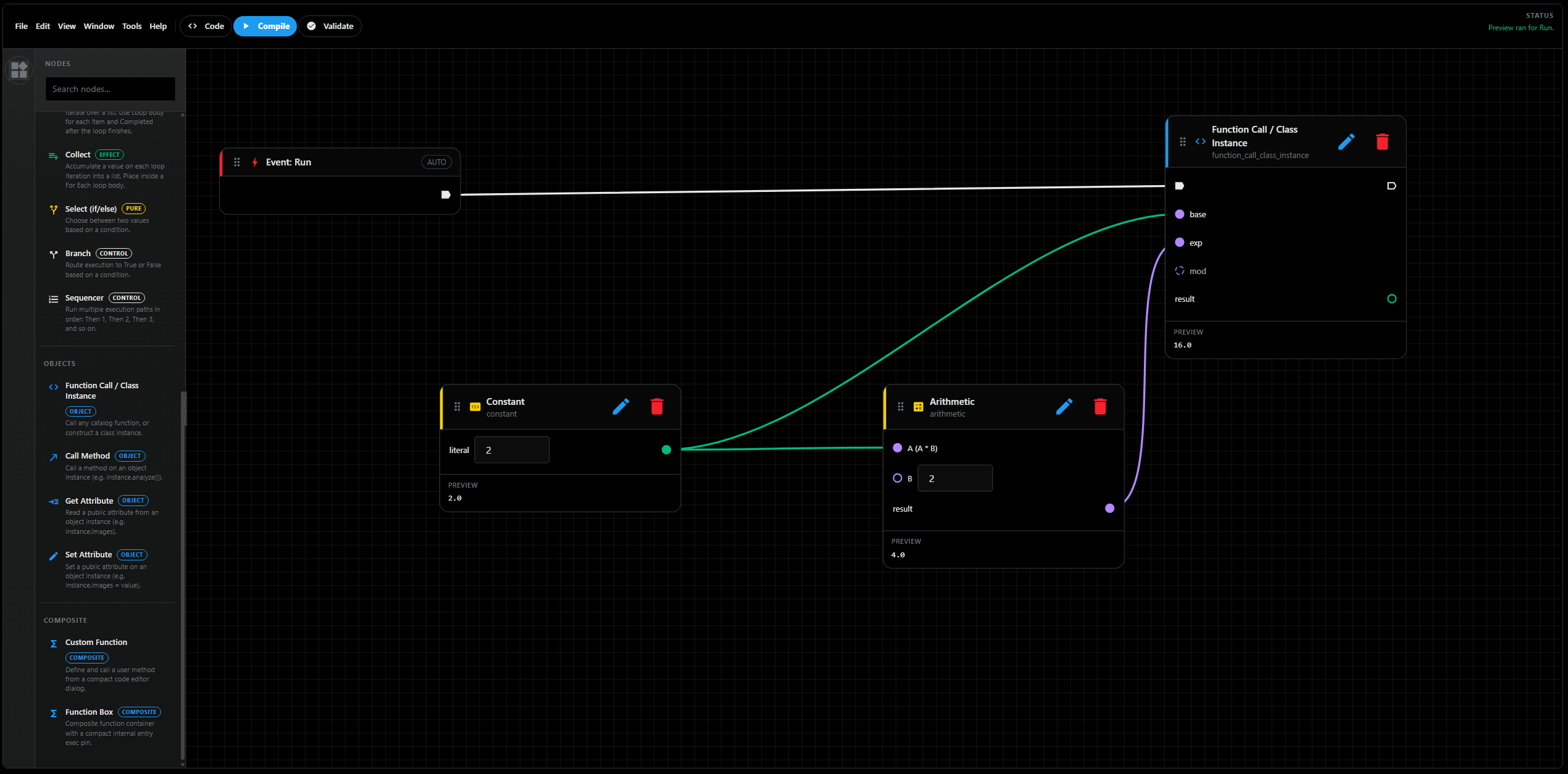
Acherion is an embeddable flow-graph editor and runtime workbench for Python. It provides a NiceGUI-based visual designer, a typed graph/runtime API, and a standalone host that compiles graphs into executable Python code.
What Acherion provides
- A standalone workbench you can launch with
acherionorpython -m acherion - A reusable NiceGUI workbench component for embedding inside your own app
- A typed graph model for saving, restoring, compiling, and executing graphs
- Preview execution hooks with transient runtime bindings and value summaries
- Built-in NumPy and Plotly support for array- and figure-oriented nodes
- Extension points for custom hosts, catalog modules, preview adapters, and validation helpers
Installation
Install the published package:
pip install acherion
Install from source for local development:
pip install -e ".[dev]"
Python 3.11 or newer is required.
Standalone quick start
Run the packaged standalone workbench:
acherion
Equivalent entry points:
python -m acherion
from acherion.app import main

main(host='127.0.0.1', port=8081, reload=False)
The standalone app mounts a full-screen Acherion workbench with:
- the graph designer
- the generated-code pane
- live preview execution for the default
runevent - graph-to-Python validation through the standalone host
Embedding quick start
The core API lives in acherion. The NiceGUI embedding layer lives in
acherion.embed.
from nicegui import ui

from acherion import StandaloneAcherionHost
from acherion.embed import AcherionWorkbench


persisted_graph: dict[str, object] = {}


@ui.page('/')
def index() -> None:
		workbench: AcherionWorkbench | None = None

		def handle_change() -> None:
				if workbench is None:
						return
				persisted_graph.clear()
				persisted_graph.update(workbench.designer.to_dict())

		workbench = AcherionWorkbench(
				host=StandaloneAcherionHost(),
				on_change=handle_change,
				refresh_code_after_build=True,
			theme_overrides={
				'surface': '#111827',
				'text': '#f9fafb',
				'primary': '#22c55e',
				'sidebar_panel_bg': 'rgba(255,255,255,0.05)',
			},
		)
		workbench.build()
		workbench.designer.set_graph_from_dict(persisted_graph)


ui.run()
This uses the generic standalone host, but the workbench can also run against
your own host implementation through AcherionHost or compose_acherion_host.
Passing theme_overrides opts the embedded workbench into Acherion's scoped
theme CSS without restyling the rest of the host application. Keys can be the
semantic aliases shown above or raw CSS variable names like --oe-bg and
--ach-sidebar-panel-bg. Pass an empty dict if you want the default Acherion
embedded theme with no overrides.
You can also switch themes after build():
workbench.set_theme_overrides({
	'surface': '#ffffff',
	'text': '#0f172a',
	'primary': '#2563eb',
})

workbench.set_theme_overrides({
	'surface': '#0f172a',
	'text': '#e2e8f0',
	'primary': '#38bdf8',
})

workbench.clear_theme_overrides()
clear_theme_overrides() disables the scoped embedded Acherion theme and lets
the surrounding host application styling take over again.
Core concepts
Graph model
AcherionGraphis the serializable top-level graph object.AcherionNodestores one node's kind, title, id, and params.AcherionDesigner.to_dict()returns a JSON-safe representation.AcherionDesigner.set_graph_from_dict()restores persisted state.
Workbench layer
AcherionWorkbenchwrapsAcherionDesignerwith code-view and validation behavior.AcherionWorkbench.generated_user_code()returns the current compiled code.AcherionWorkbenchsupports callbacks for change handling, validation, preview execution, and custom code views.
Host layer
An AcherionHost is responsible for integrating the designer with your app.
Hosts provide:
- external event definitions
- code generation
- runtime bindings for previews or generated code
- graph normalization/system-node sync
- host-owned configuration UI for special nodes
Runtime helpers
The standalone runtime helpers in acherion are useful even outside the UI:
from acherion import compile_acherion_graph, execute_acherion_graph
They compile a graph into Python source and execute the generated event handler with optional scoped bindings.
Extension points
Acherion exposes several host-facing registration hooks:
register_catalog_module_specsto expose Python modules in the function catalogregister_preview_value_adapterto customize preview summaries/type tagsregister_acherion_validation_extensionto extend validation globalsregister_acherion_node_definitionto add or replace node metadata
Custom node definitions are only part of the story: if you introduce a new node kind, your host/compiler also needs to know how to emit runtime code for it.
Documentation set
Repository documentation is split into focused guides:
docs/overview.mdfor architecture and feature overviewdocs/standalone.mdfor standalone usage and persistence patternsdocs/embedding.mdfor NiceGUI embedding and host compositiondocs/extending.mdfor catalogs, validation, preview, and node extension hooksdocs/releasing.mdfor local packaging checks and GitHub/PyPI release flow
Contributing
Contributions are welcome, especially changes that improve the public runtime API, embedded workbench behavior, packaging flow, and documentation.
For local development:
pip install -e ".[dev]"
python -m pytest
python -m build --sdist --wheel
python -m twine check dist/*
When adding regression coverage, prefer behavior-focused tests over brittle UI snapshots. The most useful tests in this repository usually validate:
- public API behavior
- graph compile and execution paths
- theme override normalization and generated CSS contracts
- extension and registration hooks
This repository uses conventional commits and semantic versioning. Pull request titles and merge commits should follow the same convention, for example:
feat: add preview regression coveragefix: preserve theme override aliasesdocs: clarify embedded host setup
In general:
- use
feat:for user-visible capabilities or meaningful public API expansion - use
fix:orperf:for patch-level runtime changes - add or update focused regression tests when changing behavior that users rely on
Packaging and release
Build distributions locally with:
python -m build --sdist --wheel
python -m twine check dist/*
This repository includes GitHub Actions workflows for CI, conventional-commit
enforcement, semantic versioned GitHub releases, and trusted publisher releases
to PyPI. See docs/releasing.md for the operational flow.
1 maintainer

Metadata
1 maintainer
Release files for acherion 0.9.3
For a detailed explanation of source distributions (sdists) and built distributions (wheels), please see the package formats documentation.
Source distribution (sdist)
| File | Size | Uploaded | Provenance | |
|---|---|---|---|---|
| acherion-0.9.3.tar.gz | 196.1 kB | With provenance | Details |
Built distribution (wheel)
| File | Interpreter | ABI | Platform | Reset |
|---|---|---|---|---|
| acherion-0.9.3-py3-none-any.whl | Python 3 | none | any | Details |
Total release size: 411.3 kB
Release files / acherion-0.9.3.tar.gz
| Download URL | acherion-0.9.3.tar.gz |
|---|---|
| Size | 196.1 kB |
| Tags | Source |
|
SHA-256 checksum How to use checksums |
35c63d46b2a999ee0b82cc6ca031e0e9d36f4faddf9532a81a106cacac12d5cd
|
|
BLAKE2b-256 checksum How to use checksums |
1d3d05196d92ab0f4ad3f50139e1a669efc7561fdbc803e86c45ae768a661293
|
| Upload date | |
|
Uploaded using Trusted Publishing? What is trusted publishing? |
Yes |
| Uploaded via |
twine/7.0.0 CPython/3.13.14
|
Provenance
Provenance describes where a file came from. On PyPI, provenance is shared via attestations, which provide a verifiable record of the build or publishing details. View details, limitations and caveats.


PyPI Publish Attestation
PyPI verified that this artifact, at this checksum, originated from the publisher listed below.
Signed by GitHub Actions, verified by PyPI on Oct 15, 2026.
Transparency logRelease files / acherion-0.9.3-py3-none-any.whl
| Download URL | acherion-0.9.3-py3-none-any.whl |
|---|---|
| Size | 215.2 kB |
| Tags | Python 3 |
|
SHA-256 checksum How to use checksums |
79fd598e020ee36f4cadf2f957b781f9e23cdb8a82de02371598a3b8ffdd71cc
|
|
BLAKE2b-256 checksum How to use checksums |
15b1bc9a934661ac8f715d03e1464364cba2faf87f9c1e652ecc7138136d83e9
|
| Upload date | |
|
Uploaded using Trusted Publishing? What is trusted publishing? |
Yes |
| Uploaded via |
twine/7.0.0 CPython/3.13.14
|
Provenance
Provenance describes where a file came from. On PyPI, provenance is shared via attestations, which provide a verifiable record of the build or publishing details. View details, limitations and caveats.
PyPI Publish Attestation
PyPI verified that this artifact, at this checksum, originated from the publisher listed below.
Signed by GitHub Actions, verified by PyPI on Oct 15, 2026.
Transparency logSecurity for acherion 0.9.3
Provenance
Provenance describes where a file came from. On PyPI, provenance is shared via attestations, which provide a verifiable record of the build or publishing details. View details, limitations and caveats.
Full provenance
All 2 files in this release have been uploaded with provenance metadata.
Attestation for acherion-0.9.3.tar.gz
PyPI Publish Attestation
PyPI verified that this artifact, at this checksum, originated from the publisher listed below.
Signed by GitHub Actions, verified by PyPI on Oct 15, 2026.
Transparency logA note on package security
PyPI is a repository for distributing packages, not a service for auditing them. While third-party security researchers and our staff do their best to detect and remove malicious packages, PyPI cannot guarantee the quality, security or suitability of any given package.














