
8-bit Adafactor Optimizer with Fused CUDA Kernels

Project description



An 8-bit Adafactor optimizer featuring fused CUDA kernels and log-space block-wise quantization, designed to further reduce optimizer state memory while maintaining low step overhead and stability — suitable for large models such as LLMs and diffusion models.
Key Features
- Log-Space Quantization: Maps the second moment (variance) to the log2 space before 8-bit quantization. This approach accommodates the long-tail distribution of variances, reducing the risk of small second-moment estimates being truncated to zero and improving overall training stability.
- Fused CUDA Kernels: Combines dequantization, EMA updates, Warp-Shuffle reductions, and requantization into single kernels. It utilizes
float4vectorization to optimize memory bandwidth usage. - APOLLO Subspace Projection with Fira Limiter: Opt-in random subspace projection that estimates gradient scaling in a low-rank subspace for faster convergence with the Fira Norm-Growth Limiter to suppress destructive gradient spikes.
- Zero CPU-GPU Sync: Eliminates implicit synchronizations (e.g., D2H copies) in the control flow, ensuring the GPU computation pipeline runs without blocking.
- Cross-Platform JIT: Uses Just-In-Time (JIT) compilation for straightforward setup across both Windows and Linux environments.
Performance
- Memory Footprint: Due to Adafactor's factorized second-moment estimation and 8-bit quantization, the optimizer state memory usage is generally lower than that of
AdamW8Bit. - Training Speed: The fused kernel design and reduced synchronization overhead allow it to achieve step times comparable to other mainstream 8-bit optimizers.
- Quantization Precision: The second moment (variance) in Adafactor is strictly non-negative and spans multiple orders of magnitude. By mapping it to
UINT8in log2 space rather than linear space, the optimizer preserves relative precision for small variances, mitigating the instability often caused by outlier gradients in standard 8-bit quantization.
Installation
This project uses JIT (Just-In-Time) compilation.
Please ensure torch and ninja are installed, and a CUDA compiler (such as MSVC or GCC) is available in your environment.
If CUDA compilation fails, the optimizer will automatically fall back to the pure PyTorch implementation.
From PyPI
pip install -U adafactor8bit
From Source
pip install git+https://github.com/yanfeiwong/adafactor-8bit.git
Note: The first time you instantiate the optimizer (or run the example script), it will automatically trigger the JIT compilation of the CUDA source code in the background. This may take anywhere from a few seconds to a couple of minutes depending on your system, and the terminal might appear unresponsive. Once compiled, the binary will be cached, and all subsequent runs will be instantaneous.
Usage Example
It is recommended to use param_groups to keep sensitive layers (Embedding, Norm, Bias) in FP32, enabling 8-bit quantization only for large 2D weight matrices.
import torch
import torch.nn as nn
from adafactor8bit import Adafactor8Bit

def get_param_groups(model, weight_decay=1e-2):
    decay, no_decay = [], []
    for name, param in model.named_parameters():
        if not param.requires_grad: continue
        # Protect 1D tensors, biases, norms, and embeddings
        if param.ndim <= 1 or "bias" in name or "norm" in name or "embed" in name:
            no_decay.append(param)
        else:
            decay.append(param)

    return [
        {"params": decay, "weight_decay": weight_decay, "quantize": True},
        {"params": no_decay, "weight_decay": 0.0, "quantize": False}
    ]

model = MyModel().cuda()
optimizer = Adafactor8Bit(
    get_param_groups(model),
    lr=1e-3,
    # For continual learning with external scheduler
    relative_step=False,     # Disable internal LR scheduling
    beta2=0.999,             # Lock EMA window to prevent "blunting" over steps

    # --- 🚀 Uncomment to try the new APOLLO Subspace Projection ---
    # Simulates full-rank adaptive scaling in a low-rank space for faster convergence.
    # apollo_rank=256,             # 0 to disable. 256 is the official APOLLO default.
)

# Training loop...
For a complete example, please refer to basic_usage.py.
Advanced Configuration
Continual Learning (beta2 & relative_step)
By default, Adafactor's second-moment decay rate dynamically decays with the training step, and the internal learning rate schedule (relative_step) scales the learning rate accordingly.
For endless fine-tuning or lifelong learning, this often leads to overly small learning rates and "blunted" second-moment estimates. To avoid these issues and keep the optimizer responsive:
- Set
relative_step=Falseto disable the built-in LR schedule (allowing you to use an external scheduler). - Set
beta2=0.999to lock the EMA window (similar to Adam).
Decoupled Weight Decay (scale_weight_decay=False)
By default, Adafactor's weight decay is coupled with the parameter's RMS scale.
- If you prefer the AdamW-style decoupled weight decay, set
scale_weight_decay=False.
No-Compiler Environments (use_cuda_kernel=False)
If you are in an environment without a CUDA compiler and want to bypass JIT compilation entirely:
- Set
use_cuda_kernel=Falseto fall back to the pure PyTorch implementation.
APOLLO Low-Rank Subspace Projection
Enable the APOLLO path to compute gradient scaling factors in a memory-efficient low-rank subspace. Compared to Adafactor's standard row/column factorization (which assumes spatial independence), APOLLO uses random subspace projection to capture richer covariance information, potentially leading to faster convergence while keeping memory overhead extremely low.
apollo_rank: The target rank for the projection subspace. The default is0(disabled). Setting it to256might work well for most 1B to 7B models.
Note: Setting this to1(APOLLO-Mini style) pushes VRAM savings to the limit (saves even more VRAM than the Adafactor path). However, the original APOLLO-Mini relies on Adam's first-moment (beta1) to smooth out noise. Since our implementation uses a pure second-moment architecture, rank=1 may lead to distorted scaling factors and training instability.apollo_scale_type: Determines how the scaling factor is applied.'channel'applies it per channel (Standard APOLLO), while'tensor'applies it globally (APOLLO-Mini).apollo_update_proj_gap: Steps between projection matrix refreshes. Defaults to200. Setting this too small may cause frequent oscillations due to abrupt basis mutations, while setting it too large might cause the projection space to become stale and fail to track the drift of the gradient manifold.apollo_factorize(Experimental): Applies Adafactor's row/column factorization within the low-rank subspace. Mathematically, this leverages the norm-preserving property of random projections to approximate the variance of the primary dimension, while the secondary dimension's variance is estimated across random bases, introducing inherent noise. This dual-compression mechanism drastically reduces optimizer state overhead. Note that for smaller models, the actual VRAM savings might be marginal, and the introduced noise could impact convergence stability. Use with caution.
Learning Rate Guide for Beginners
If you are migrating from optimizers like AdamW, Adafactor's learning rate behavior might feel a bit different. This is mainly due to the scale_parameter option.
-
scale_parameter=True(default) Because of RMS scaling, a very smalllr(e.g.,1e-5) often leads to extremely slow progress. Start withlr=1e-3and adjust in the range1e-4–5e-3if needed. -
scale_parameter=FalseDisables RMS scaling, making the update scale more similar to AdamW. Use the learning rates you're familiar with for AdamW and tune as usual. (Note: the second moment is still factorized, so behavior is not identical.)
These are safe starting points. Always validate on your own task and batch size.
Acknowledgements
Thanks to Noam Shazeer and Mitchell Stern for proposing the original Adafactor algorithm in the paper Adafactor: Adaptive Learning Rates with Sublinear Memory Cost.
Thanks to Tim Dettmers for the inspiration from the paper 8-BIT OPTIMIZERS VIA BLOCK-WISE QUANTIZATION and the bitsandbytes library.
Thanks to Hanqing Zhu, Zhenyu Zhang, and the team for proposing the approximated gradient scaling method in the paper APOLLO: SGD-Like Memory, AdamW-level Performance.
Thanks to Xi Chen, Kaituo Feng, and the team for the Norm-Growth Limiter mechanism introduced in Fira: Can We Achieve Full-rank Training of LLMs Under Low-rank Constraint?.
Thanks to the PyTorch team for providing the foundational Optimizer implementation and the C++ Extension toolchain.
Thanks to the large language models Qwen and DeepSeek for valuable technical discussions and code reviews on CUDA low-level optimization, memory safety mechanisms, and cross-platform compilation pipeline design.
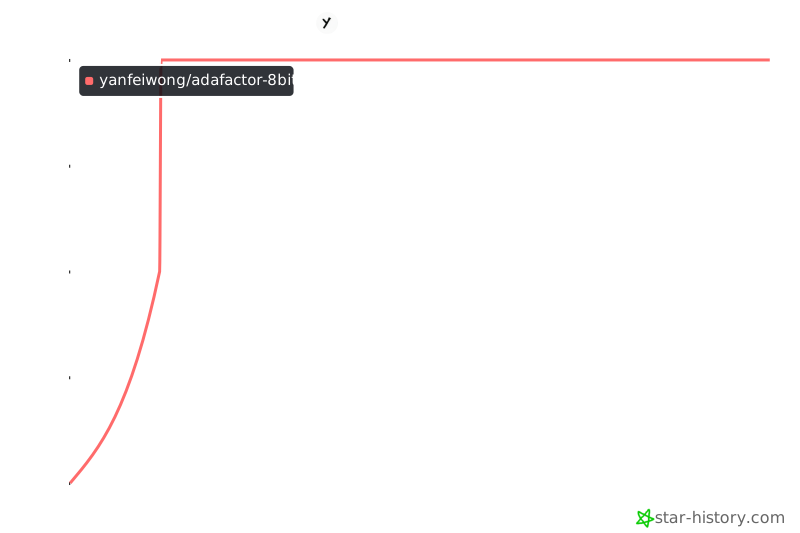
Star History
License
Release history Release notifications | RSS feed


Download files
Download the file for your platform. If you're not sure which to choose, learn more about installing packages.
Source Distribution
Built Distribution
Filter files by name, interpreter, ABI, and platform.
If you're not sure about the file name format, learn more about wheel file names.
Copy a direct link to the current filters
File details
Details for the file adafactor8bit-0.1.8.tar.gz.
File metadata
- Download URL: adafactor8bit-0.1.8.tar.gz
- Upload date:
- Size: 23.1 kB
- Tags: Source
- Uploaded using Trusted Publishing? No
- Uploaded via: twine/6.2.0 CPython/3.13.9
File hashes
| Algorithm | Hash digest | |
|---|---|---|
| SHA256 |
8cd97218614a99ba279faf27272971a608558c89838cfc99f7220c298da5d809
|
|
| MD5 |
b92a132fec300f0f112f3d3403d8a9c7
|
|
| BLAKE2b-256 |
148509748c8894786a527121b880e2356df7d815426738c45ecc9d1365b102c4
|
File details
Details for the file adafactor8bit-0.1.8-py3-none-any.whl.
File metadata
- Download URL: adafactor8bit-0.1.8-py3-none-any.whl
- Upload date:
- Size: 18.8 kB
- Tags: Python 3
- Uploaded using Trusted Publishing? No
- Uploaded via: twine/6.2.0 CPython/3.13.9
File hashes
| Algorithm | Hash digest | |
|---|---|---|
| SHA256 |
1b20323fe6d427d9f5bcfec994a10c686b68828daa05dd1f311f0c82cf81fd18
|
|
| MD5 |
a3a55d6c7ab1d0821b4a42e5c7df7b44
|
|
| BLAKE2b-256 |
d65f194fde19529568d8de0556f2b6abf2eb5f01e116fa77a49dcc27205e57fc
|






