
adeploy
We build adeploy, an universal deployment tool for Kubernetes that supports rendering and deployment of lightweight
Jinja templated k8s manifests and also Helm charts.
We’ve added support for ...
- using Jinja variables from per cluster, namespaces or release configuration
- easy secret management based on Gopass or other command line based password managers
- running deployment tests in CI/CD pipelines
- previewing and patching upstream Helm Charts before deploying
- extending upstream Helm Charts with custom Jinja-templates manifests
- handy templating for labels, annotations, probes, resource limits and other metadata
... and even more to make your daily work with k8s easier.
Documentation & Support
adeployis Open Source and hosted on GitHub: https://github.com/awesome-it/adeploy.- You can report issues on GitHub: https://github.com/awesome-it/adeploy/issues.
- Find the documentation at https://awesome-it.de/docs/adeploy/latest.
Examples
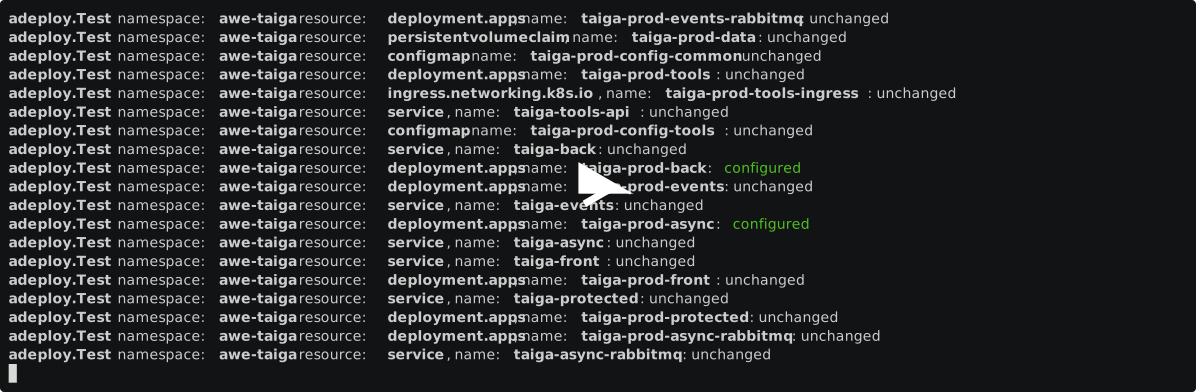
This is how you can render, test (preview) and deploy a Helm Chart:
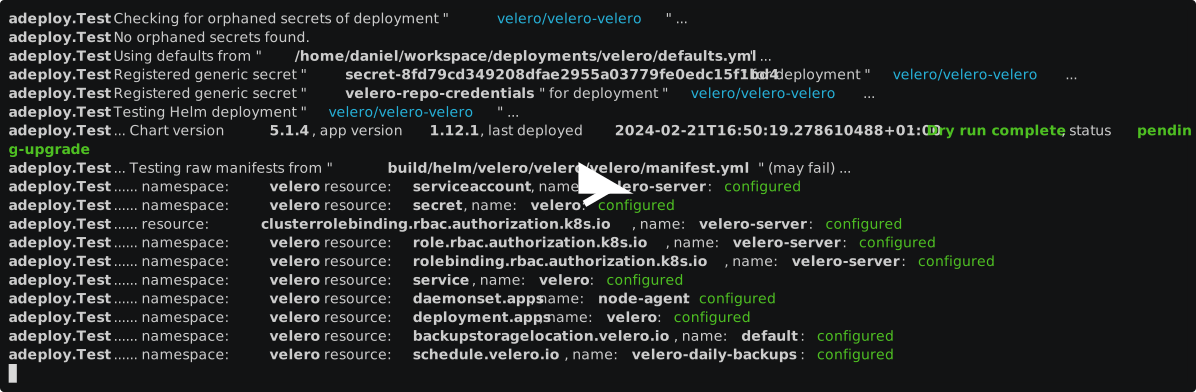
Or you can render, test (preview) and deploy Jinja-templated manifests:
You'll find some examples in the example directory.
Getting Started
You can find adeploy on GitHub. But it is recommended to install
or upgrade adeploy using pipx :
$ pipx install adeploy
$ pipx upgrade adeploy
You should now be able to run adeploy from the command line:
adeploy --help
You can now start to use adeploy.
See the usage documentation to start using adeploy.
Read More
1 maintainer

Metadata
1 maintainer
Release files for adeploy 1.3.4
For a detailed explanation of source distributions (sdists) and built distributions (wheels), please see the package formats documentation.
Source distribution (sdist)
| File | Size | Uploaded | Provenance | |
|---|---|---|---|---|
| adeploy-1.3.4.tar.gz | 251.2 kB | Without provenance | Details |
Built distribution (wheel)
| File | Interpreter | ABI | Platform | Reset |
|---|---|---|---|---|
| adeploy-1.3.4-py3-none-any.whl | Python 3 | none | any | Details |
Total release size: 322.9 kB
Release files / adeploy-1.3.4.tar.gz
| Download URL | adeploy-1.3.4.tar.gz |
|---|---|
| Size | 251.2 kB |
| Tags | Source |
|
SHA-256 checksum How to use checksums |
4a3328b064d2c28279342c236aac38adcece5a56a50c4218efef04860f01d582
|
|
BLAKE2b-256 checksum How to use checksums |
9df2738b77c49b739bc0798771e97f637f2bd1bceb9a7a0b382d306574ddef35
|
| Upload date | |
|
Uploaded using Trusted Publishing? What is trusted publishing? |
No |
| Uploaded via |
uv/0.12.9 {"installer":{"name":"uv","version":"0.12.9","subcommand":["publish"]},"python":null,"implementation":{"name":null,"version":null},"distro":{"name":"Alpine Linux","version":"3.24.1","id":null,"libc":null},"system":{"name":null,"release":null},"cpu":null,"openssl_version":null,"setuptools_version":null,"rustc_version":null,"ci":true}
|
Release files / adeploy-1.3.4-py3-none-any.whl
| Download URL | adeploy-1.3.4-py3-none-any.whl |
|---|---|
| Size | 71.6 kB |
| Tags | Python 3 |
|
SHA-256 checksum How to use checksums |
88e002477bbce72ea2f11f297591aad9e3fc1101cf8162ae49d4c4037db1d254
|
|
BLAKE2b-256 checksum How to use checksums |
35f97022fb7b025927ac4c204c372e3fda4881dd58092a2d6254a1cf820e3de4
|
| Upload date | |
|
Uploaded using Trusted Publishing? What is trusted publishing? |
No |
| Uploaded via |
uv/0.12.9 {"installer":{"name":"uv","version":"0.12.9","subcommand":["publish"]},"python":null,"implementation":{"name":null,"version":null},"distro":{"name":"Alpine Linux","version":"3.24.1","id":null,"libc":null},"system":{"name":null,"release":null},"cpu":null,"openssl_version":null,"setuptools_version":null,"rustc_version":null,"ci":true}
|
Security for adeploy 1.3.4
Provenance
Provenance describes where a file came from. On PyPI, provenance is shared via attestations, which provide a verifiable record of the build or publishing details. View details, limitations and caveats.
No provenance found
None of the files in this release were uploaded with provenance metadata.
A note on package security
PyPI is a repository for distributing packages, not a service for auditing them. While third-party security researchers and our staff do their best to detect and remove malicious packages, PyPI cannot guarantee the quality, security or suitability of any given package.














