
This release is a pre-release and may not be stable for production use.
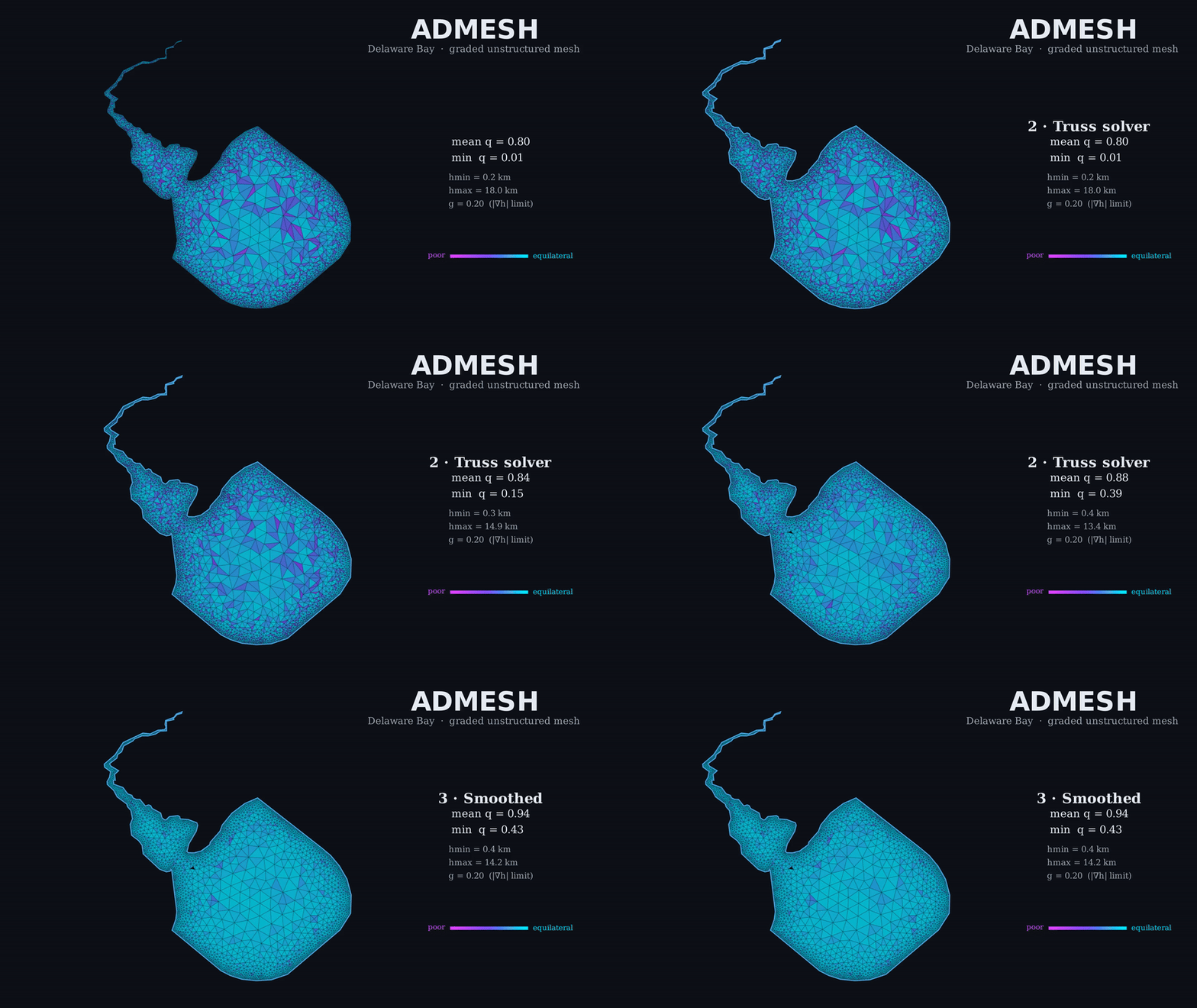
An ADvanced, automatic unstructured MESH generator for 2D shallow-water models
Automatic unstructured mesh generation for shallow-water models, in Python and MATLAB
Dominik Mattioli1†, Colton Conroy, Dustin West, Ethan Kubatko2
†Corresponding author | 1Unaffiliated | 2Ohio State University (






Lineage: Two branches of ADMESH descend from the 2012 original by Conroy et al.. The original group's current MATLAB line is ADMESH+ v3 (OSU-CHIL/ADMESH; archived at 10.5281/zenodo.10242565). Younghun Kang maintains it with Ethan Kubatko. It adds constraint extraction for coupled 1D–2D hydrodynamic models, a revised medial-axis method, and GUI components (Kang & Kubatko, 2024). This repository is the parallel branch. It holds the 2012 library in Python, with the MATLAB source alongside at
src/matlab/.
Table of Contents
- Status & Roadmap
- One call turns a coastline into an ADCIRC-ready triangular mesh
- Installation
- Quick start
- Public API
- Pipeline
- Performance
- Limitations
- Citation
- Documentation, Contributing, License
1. Status & Roadmap
Current release: 1.0.0b1 (October 2026), beta. The public API (admesh.__all__, listed in Public API) is fixed for 1.x. The admesh.<stage> compatibility modules stay through 1.x and are removed no earlier than 2.0; the canonical path is admesh._stages.<stage>. CHANGELOG.md lists earlier releases.
New in 1.0:
triangulate_batchruns 5.1× faster on 8 workers (see Batch meshing).- The domain registry reads Valence manifest schemas 0.3 and 0.4.
triangulatetakes an opt-inmedial_method:"grid","octree"or"vdt"."vdt"is the vector distance transform of Kang & Kubatko (2024).benchmarks/medial_vdt.mdrecords why"vdt"stays opt-in.- A browser app at admesh.domattioli.com runs the ADMESH package in the page through Pyodide. Files stay on the user's computer. The documentation is at admesh.domattioli.com/docs.
- Now: the 1.0.0b1 beta, then 1.0.0; address open issues; 1D–2D internal-constraint extraction from Kang & Kubatko (2024) (#186).
- Next: single-mesh parallelization (#216); pre- and post-processing for quality improvement; native kernels for the remaining hot stages.
- Future: 3D ADMESH (#220); then formal integration within a unified ecosystem with
(quads),
(mesh data structure and smoothing).
2. One call turns a coastline into an ADCIRC-ready triangular mesh
triangulate() takes a domain and two edge-length bounds and returns a validated mesh. Boundary treatment and relaxation follow from the geometry. The caller composes the size field. Without one, the size is uniform at h_max.
- Physics-based sizing is opt-in. Stage modules compute edge length from four inputs: boundary curvature, channel width (medial axis), bathymetric gradient, and dominant tidal wavelength. A
minstack composes them.compose_size_fieldadds custom callables.triangulateleaves the stack off by default (see Limitations). Graded sizing needs asize_field,user_contribs, orbackground="octree". - Four domain sources.
triangulate()accepts aDomain, a TOML or JSON polygon file, an existingfort.14, or a registry slug. To re-mesh a legacy grid, useDomain.from_mesh(read_fort14(...)). - Native ADCIRC and Gmsh I/O. The package reads and writes
fort.14with node ids, IBTYPE codes, and 6-decimal coordinates (precision=is configurable). It also reads and writes.msh(Gmsh 2.2 ASCII) for non-ADCIRC solvers. - Adaptive background grid for multiscale domains.
background="octree"evaluates the size field on a 2:1-balanced quadtree instead of a uniform grid. The quadtree is vectorized and refines where medial-axis and channel widths demand it. On a flat size field, the result equals the uniform-grid result. On a graded field, refinement concentrates where the field changes. - Python and MATLAB agree. The 13 numerical stages exist in both languages. The pytest suite pins the Python stages to MATLAB reference fixtures where the exported
.npzis present.Domain,Mesh, andBoundarySegmentare frozen, typed dataclasses. A Numba-JIT solver replaces the original C MEX, so installation needs no compile step.
3. Installation
pip install admesh2D                 # core: NumPy, SciPy, Numba, Shapely
pip install "admesh2D[viz]"          # + chilmesh for mesh.plot() / plot_quality() / plot_layers()
pip install "admesh2D[registry]"     # + huggingface_hub for on-demand registry downloads
The PyPI distribution is
admesh2D. The import name isadmesh.pip install admeshinstalls an unrelated C library for STL repair. That build fails withoutadmesh/stl.h.
Requires Python 3.10 or newer. From source:
git clone https://github.com/domattioli/ADMESH.git
cd ADMESH && pip install -e ".[dev]"
4. Quick start
import admesh
from admesh import domains

# 1. Built-in domain, uniform sizing at h_max (h_min bounds any supplied size field).
mesh = admesh.triangulate(domains.NOTCHED_RECTANGLE, h_max=0.2, h_min=0.02)
mesh.to_fort14("notched.14")           # or mesh.to_msh("notched.msh")

# 2. Re-mesh an existing ADCIRC grid at a new resolution.
old = admesh.read_fort14("legacy.14")
mesh = admesh.triangulate(admesh.Domain.from_mesh(old), h_min=50.0, h_max=2000.0)

# 3. Mesh a registry domain with the adaptive background grid.
mesh = admesh.triangulate(
    admesh.load_domain_from_registry("BaranjaHill"),
    h_max=0.1, h_min=0.01, background="octree",
)
print(mesh.n_nodes, mesh.n_elements, mesh.quality.mean())

# 4. Mesh many domains at once on a process pool. Output order and results
#    match a serial loop exactly.
meshes = admesh.triangulate_batch(
    ["coast_a.json", "coast_b.json", "coast_c.json"], n_jobs=3, h_max=0.1, h_min=0.01,
)
mesh is a frozen Mesh dataclass. Its fields are nodes, elements, boundaries (each a BoundarySegment with a BoundaryType code), optional bathymetry, and per-element quality. BoundaryType is an IntEnum over ADCIRC IBTYPE codes (OPEN=0, MAINLAND=1, ISLAND=11, MAINLAND_FLUX=20). Paired-edge and weir codes (3/4/13/24) pass through as plain int. Only the first node id of each record is kept. The paired-node and weir-height columns are dropped. Built-in domains: UNIT_SQUARE, UNIT_DISK, L_SHAPE, ANNULUS, NOTCHED_RECTANGLE.
5. Public API
triangulate() is the entry point. The package also ships the surrounding workflow. Every name below is exported in admesh.__all__.
| Need | Call | Notes |
|---|---|---|
| Size control | h_min, h_max, size_field=, user_contribs=, combine=, medial_method= |
The default is uniform at h_max. compose_size_field composes stage-module contributions (curvature, medial axis, bathymetry, tide) and custom callables that map (N, 2) points to edge length. medial_method is None by default. It adds a channel-width contribution from one of three medial-axis methods: "grid", "octree" or "vdt". |
| Multiscale domains | background="octree" |
Evaluates the size field on a quadtree with leaf-graph gradient limiting. The default is "uniform". |
| Reproducibility | seed=, initial_points=, max_iter=, ttol=, dptol= |
Warm-start from a previous point set. Iteration stops at max_iter, dptol, or an empty edge set. |
| Many meshes | triangulate_batch(domains, n_jobs=None, **kwargs) |
Runs triangulate on a process pool and returns meshes in input order, identical to a serial loop. Parallel runs need picklable domains: paths, registry slugs, or a Domain with a module-level SDF. n_jobs=1 runs in-process. |
| Quality gate | quality_gate=(min_q, mean_q) |
The default is (0.30, 0.60). A mesh below it raises ValueError. Pass (0.0, 0.0) to disable. |
| ADCIRC I/O | read_fort14, write_fort14, Mesh.to_fort14 |
Round-trips nodes, elements, and boundary segments. Fort14ParseError reports line, expected, actual. |
| Gmsh I/O | read_msh, write_msh, Mesh.to_msh |
Gmsh 2.2 ASCII. Boundary labels map to BoundaryType. GmshParseError reports malformed input. |
| Domain sources | load_domain_from_{toml,json,fort14,registry}, list_available_domains |
A path or slug may also be passed to triangulate() directly. Formats in docs/DOMAIN_IO.md. |
| Quality metrics | mesh_quality, right_iso_quality |
Equilateral and right-isosceles targets. |
| Valence balancing | balance_valence_triangles, compute_valence, get_valence_report |
Edge flipping toward degree-6 interior nodes, quality-guarded. |
| Quad preparation | smooth_for_quadrangulation |
Right-isosceles smoother for downstream tri-to-quad fusion (CHILmesh, OceanMesh2D, ADCIRC v55+). |
Plotting ([viz]) |
Mesh.plot, Mesh.plot_quality, Mesh.plot_layers |
Delegates to CHILmesh. Returns a Matplotlib axis. |
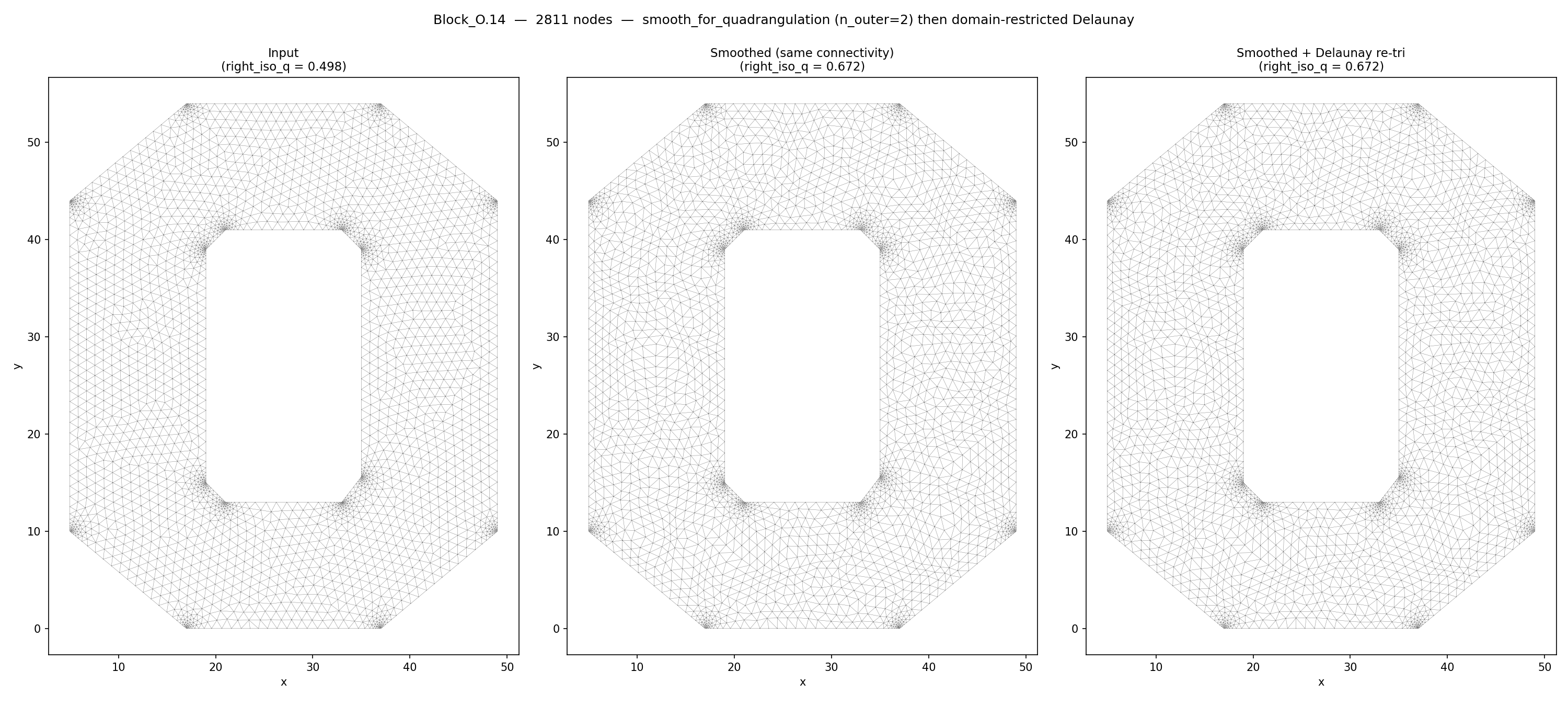
smooth_for_quadrangulation on the Block-O fixture (2,811 nodes): right-isosceles quality rises from 0.498 to 0.672 with connectivity unchanged.
6. Pipeline
triangulate() composes the stage modules below. With a Domain input, it drives the distmesh relaxation directly and applies the size field the caller supplied. The stage modules under admesh/_stages/ match the MATLAB library one to one. They are locked. The public API composes them and never modifies them.
flowchart LR
    A["Domain<br>(SDF / polygon file / fort.14 / registry)"] --> B["Background grid<br>(uniform or octree)"]
    B --> C["Size field<br>(curvature + medial axis<br>+ bathymetry + tide, min-stacked)"]
    C --> D["distmesh2d<br>(truss equilibrium, Numba)"]
    D --> E["Mesh<br>(quality, boundaries, fort.14 / .msh)"]
7. Numba kernels yield a 26.6× end-to-end speedup on the Western North Atlantic benchmark
The Numba-JIT signed-distance kernel and the solve_iter smoother cut end-to-end generation from 1257.5 s (v0.2.1) to 47.2 s (v0.5.0) at hmin=0.05, g=0.10, niter=120. Mean element quality moved from 0.963 to 0.962.
| v0.2.1 | v0.5.0 (Numba) | |
|---|---|---|
| total | 1257.5 s | 47.2 s |
| nodes / elements | 49 377 / 93 655 | 49 377 / 93 642 |
| mean element quality | 0.963 | 0.962 |
An experimental C++ distmesh kernel (unreleased, src/admesh/_cpp/) runs the same case in 29.1 s in the in-repo harness. That figure is a development measurement of unreleased code. The per-stage breakdown and the version-comparison harness are in benchmarks/. The benchmark standard going forward is the ENPAC 2003 tidal database (272,913 nodes).
Reproduce or extend the benchmark with one --ref <git-ref>=<label> per column. The 0.2.1 and 0.5.0 tags are not published on this remote. Compare v0.5.1 against the working tree, or pass commit hashes:
python benchmarks/compare_versions.py --hist \
    --ref v0.5.1=v0.5.1 --ref current=dev \
    --mesh tests/fixtures/fort14/adcirc_examples/wnat_test.14 \
    --domain benchmarks/data/wnat_onur_boundary.json \
    --hmin 0.05 --g 0.10 --niter 120
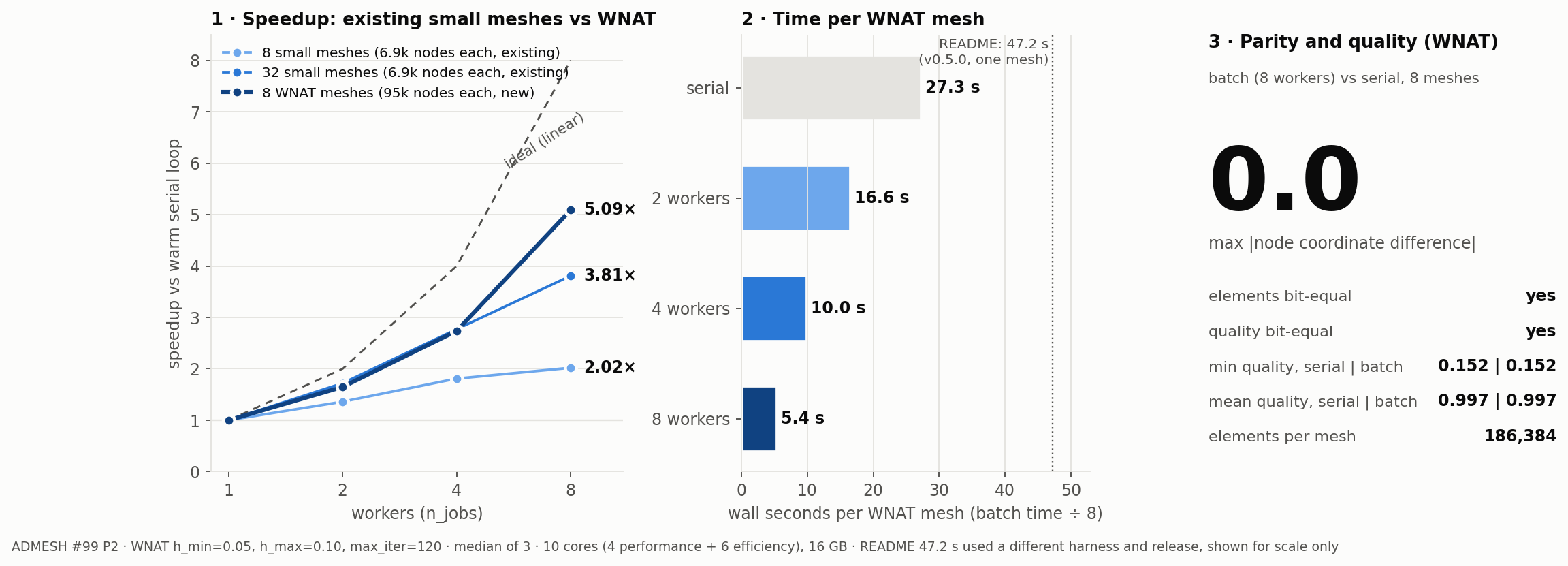
Batch meshing runs 5.1× faster on 8 workers
triangulate_batch meshes several domains in parallel. The test used 8 Western North Atlantic meshes (94,777 nodes each, h_min=0.05, h_max=0.10, max_iter=120). 8 workers cut wall time from 218 s to 43 s, a 5.09× speedup. The figure is the median of 3 runs on a 10-core Apple Silicon machine (4 performance and 6 efficiency cores). Every batch mesh is bit-identical to the serial result: same nodes, elements, and quality.
| workers | wall time, 8 meshes | speedup | seconds per mesh |
|---|---|---|---|
| 1 (serial loop) | 218 s | 1.00× | 27.3 |
| 2 | 133 s | 1.65× | 16.6 |
| 4 | 80 s | 2.74× | 10.0 |
| 8 | 43 s | 5.09× | 5.4 |
Each worker process needs about 0.5 s to start, so small meshes gain less. 8 meshes of about 6,900 nodes reach 2.0×. 32 meshes reach 3.8×. For a few small meshes, a plain loop is faster.
PYTHONPATH=src python scripts/bench_batch.py --wnat # P2 gate: >= 4.0x at 8 workers, about 25 min
8. Limitations
- Triangles only, in 2-D. The package does not generate quads, 3-D meshes, or anisotropic elements. For quads:
- Two mesh formats. The package supports ADCIRC
fort.14and Gmsh 2.2 ASCII.msh. It does not support SMS 2dm, Gmsh 4.x binary, or netCDF. - The 2012 algorithm as published. The 13 stage modules implement the 2012 method, including its medial-axis step. The vector-distance-transform medial axis of Kang & Kubatko (2024) is available as the opt-in
medial_method="vdt". It was written from the article text. It is not the default, andbenchmarks/medial_vdt.mdrecords why. The 1D–2D constraint extraction of that article is not implemented. - Quality is parameter-driven.
h_min,h_max, and the grading rate set what the truss solver can reach. Largeh_max/h_minratios lower minimum quality.quality_gateis a post-hoc check that raisesValueError. The solver does not enforce it. Loosen the gate when the parameters legitimately lower quality. - Default sizing is uniform. With only
h_min/h_max,triangulatemeshes ath_maxeverywhere. The curvature, medial-axis, bathymetry, and tide contributions exist as stage modules. They are not wired in as the default (issue #65). The caller composes them or selectsbackground="octree". - Generated meshes carry no bathymetry.
Mesh.bathymetryisNoneaftertriangulate.Domain.from_meshre-derives boundary rings and does not preserve the source labels. The fort.14 domain loader uses the first land segment only. - fort.14 fidelity is structural. Coordinates are written to 6 decimals. IBTYPE 3/4/13/24 paired-node and weir columns are not preserved.
- No oscillation or stagnation detection. The
triangulaterelaxation loop exits onmax_iter,dptol, or an empty edge set. - The octree grid is opt-in and adds build cost on small uniform domains. On a flat size field, it reproduces the uniform result at higher cost. The benefit appears on multiscale fields.
- One process per mesh, CPU only. Numba accelerates the SDF kernel and the size-field solver. The distmesh relaxation dominates wall-clock time on large domains. It is not parallelized.
- The graphical interface is a browser app. It runs at admesh.domattioli.com, without Numba or the C++ accelerator. The documentation is at admesh.domattioli.com/docs.
9. Citation
Algorithm (cite the original paper):
Conroy, C.J., Kubatko, E.J. & West, D.W. (2012). ADMESH: an advanced, automatic unstructured mesh generator for shallow water models. Ocean Dynamics 62, 1503–1517. https://doi.org/10.1007/s10236-012-0574-0
This software (cite the archived release):
Mattioli, D.O., Conroy, C.J., West, D.W., Kubatko, E.J. (2026). ADMESH: automatic unstructured triangular mesh generator for 2D shallow-water models (Python). Zenodo. https://doi.org/10.5281/zenodo.20264085
Upstream MATLAB line (ADMESH+, if you use or compare against it):
Kang, Y. & Kubatko, E.J. (2024). An automatic mesh generator for coupled 1D–2D hydrodynamic models. Geoscientific Model Development 17, 1603–1625. https://doi.org/10.5194/gmd-17-1603-2024
Kang, Y., Kubatko, E.J., Conroy, C.J. & West, D.W. (2023). Younghun-Kang/ADMESH: v3.0.1. Zenodo. https://doi.org/10.5281/zenodo.10242565
A CITATION.cff feeds GitHub's "Cite this repository" button. Version-specific DOIs are on the Zenodo record.
10. Documentation, Contributing, License
Documentation. The API reference is in the docstrings (triangulate, Domain, Mesh, BoundarySegment, the I/O functions, the 13 stage modules) and under docs/api/. The workflow guides are docs/quickstart.md and docs/DOMAIN_IO.md (TOML, JSON, fort.14 domain formats, registry). The design notes and the porting log are docs/PORTING_NOTES.md and docs/adr/. Rendered examples are in docs/gallery/.
Contributing. Issues and pull requests are accepted on GitHub. See CONTRIBUTING.md.
- Theory (algorithm, size-field formulation, ADCIRC integration): Colton Conroy | Ethan Kubatko
- Upstream MATLAB line (ADMESH+ v3: 1D–2D constraints, medial axis, GUI): Younghun Kang | Ethan Kubatko
- This repository (Python and MATLAB, active maintenance): Dominik Mattioli
Acknowledgement. Code added after the original MATLAB port was written using AI coding tools built on Anthropic and OpenAI models. The 13 ported stages are checked against the MATLAB reference tests.
License. Apache 2.0, see LICENSE.
1 maintainer

Metadata
1 maintainer
Release files for admesh2D 1.0.0b1
For a detailed explanation of source distributions (sdists) and built distributions (wheels), please see the package formats documentation.
Source distribution (sdist)
| File | Size | Uploaded | |
|---|---|---|---|
| admesh2d-1.0.0b1.tar.gz | 134.5 kB | Details |
Built distributions (wheels)
Total release size: 2.9 MB
Release files / admesh2d-1.0.0b1.tar.gz
| Download URL | admesh2d-1.0.0b1.tar.gz |
|---|---|
| Size | 134.5 kB |
| Tags | Source |
|
SHA-256 checksum How to use checksums |
675f487d1b5876fb5c067d5e1fcf43e958b45adc8e70209110dc1fb39a8f3ee0
|
|
BLAKE2b-256 checksum How to use checksums |
f3bd77ab6d212e300de97b3b4e2e6f4995f3b034f484700f88362b72585cd5e9
|
| Upload date | |
|
Uploaded using Trusted Publishing? What is trusted publishing? |
No |
| Uploaded via |
twine/7.0.0 CPython/3.11.16
|
Release files / admesh2d-1.0.0b1-cp313-cp313-manylinux_2_24_x86_64.manylinux_2_28_x86_64.whl
| Download URL | admesh2d-1.0.0b1-cp313-cp313-manylinux_2_24_x86_64.manylinux_2_28_x86_64.whl |
|---|---|
| Size | 242.8 kB |
| Tags | CPython 3.13 Linux glibc 2.24+ x86-64 Linux glibc 2.28+ x86-64 |
|
SHA-256 checksum How to use checksums |
6fe87d8b1a8a3ec80c6ddad0cba76225d2590dfd1cc75703098526bf459b9ed3
|
|
BLAKE2b-256 checksum How to use checksums |
d0fb66c3e0500a1b87c21a091f7b5324c4f18453621f82e81e4f7402378aecac
|
| Upload date | |
|
Uploaded using Trusted Publishing? What is trusted publishing? |
No |
| Uploaded via |
twine/7.0.0 CPython/3.11.16
|
Release files / admesh2d-1.0.0b1-cp313-cp313-macosx_11_0_arm64.whl
| Download URL | admesh2d-1.0.0b1-cp313-cp313-macosx_11_0_arm64.whl |
|---|---|
| Size | 228.6 kB |
| Tags | CPython 3.13 macOS 11.0+ ARM64 |
|
SHA-256 checksum How to use checksums |
4e5f816fe2e1cdb1792b8e9c767e8f71560f095585a372b9494fbd6c7bfd7c24
|
|
BLAKE2b-256 checksum How to use checksums |
23af24cc4e6baabf3d5a648c4bd8d2c074366f8d63645177fe7b085725feab27
|
| Upload date | |
|
Uploaded using Trusted Publishing? What is trusted publishing? |
No |
| Uploaded via |
twine/7.0.0 CPython/3.11.16
|
Release files / admesh2d-1.0.0b1-cp313-cp313-macosx_10_13_x86_64.whl
| Download URL | admesh2d-1.0.0b1-cp313-cp313-macosx_10_13_x86_64.whl |
|---|---|
| Size | 233.3 kB |
| Tags | CPython 3.13 macOS 10.13+ x86-64 |
|
SHA-256 checksum How to use checksums |
688719622186ef27d6bb4cffb5fc4b2a3e46712d08f3ccdb8351c28c26fcdb80
|
|
BLAKE2b-256 checksum How to use checksums |
c338cb5d6dfd8d28fb81495fb78867b97ef42d3a63eee8aa53c58c15866506f8
|
| Upload date | |
|
Uploaded using Trusted Publishing? What is trusted publishing? |
No |
| Uploaded via |
twine/7.0.0 CPython/3.11.16
|
Release files / admesh2d-1.0.0b1-cp312-cp312-manylinux_2_24_x86_64.manylinux_2_28_x86_64.whl
| Download URL | admesh2d-1.0.0b1-cp312-cp312-manylinux_2_24_x86_64.manylinux_2_28_x86_64.whl |
|---|---|
| Size | 242.8 kB |
| Tags | CPython 3.12 Linux glibc 2.24+ x86-64 Linux glibc 2.28+ x86-64 |
|
SHA-256 checksum How to use checksums |
16a716addbaa9b93c9842696736d4a5b6f8c4ab7d5334f335af3ce1e587b94cd
|
|
BLAKE2b-256 checksum How to use checksums |
a32399366056f7196666b794669d160238ec6f07a3385f0a9ad6adc33ff9bd13
|
| Upload date | |
|
Uploaded using Trusted Publishing? What is trusted publishing? |
No |
| Uploaded via |
twine/7.0.0 CPython/3.11.16
|
Release files / admesh2d-1.0.0b1-cp312-cp312-macosx_11_0_arm64.whl
| Download URL | admesh2d-1.0.0b1-cp312-cp312-macosx_11_0_arm64.whl |
|---|---|
| Size | 228.6 kB |
| Tags | CPython 3.12 macOS 11.0+ ARM64 |
|
SHA-256 checksum How to use checksums |
5f329a2bfda698156c1d375263848a6f5f90df0875da2b2d9828de39561b2283
|
|
BLAKE2b-256 checksum How to use checksums |
b2e646f4a962744a4bfcfadb63b9a55993e5f5a460d8259df7366e77a1c58524
|
| Upload date | |
|
Uploaded using Trusted Publishing? What is trusted publishing? |
No |
| Uploaded via |
twine/7.0.0 CPython/3.11.16
|
Release files / admesh2d-1.0.0b1-cp312-cp312-macosx_10_13_x86_64.whl
| Download URL | admesh2d-1.0.0b1-cp312-cp312-macosx_10_13_x86_64.whl |
|---|---|
| Size | 233.2 kB |
| Tags | CPython 3.12 macOS 10.13+ x86-64 |
|
SHA-256 checksum How to use checksums |
24ea41f5939ac48b24f89b941ccfd524b597e4a3f32a948776e7f37674a289e8
|
|
BLAKE2b-256 checksum How to use checksums |
aa3ddcf237d29aeea9bd0e581ca965f2d7eccd033c344eca58e8e4b818e094e7
|
| Upload date | |
|
Uploaded using Trusted Publishing? What is trusted publishing? |
No |
| Uploaded via |
twine/7.0.0 CPython/3.11.16
|
Release files / admesh2d-1.0.0b1-cp311-cp311-manylinux_2_24_x86_64.manylinux_2_28_x86_64.whl
| Download URL | admesh2d-1.0.0b1-cp311-cp311-manylinux_2_24_x86_64.manylinux_2_28_x86_64.whl |
|---|---|
| Size | 241.5 kB |
| Tags | CPython 3.11 Linux glibc 2.24+ x86-64 Linux glibc 2.28+ x86-64 |
|
SHA-256 checksum How to use checksums |
b08e1ca37cbb6472c7392299293e70a731d0ac0bd15afe7192363f69df95207c
|
|
BLAKE2b-256 checksum How to use checksums |
4aada808403255f0fe19162baac62d3a4b571268cc506eb3f1ec54513620d257
|
| Upload date | |
|
Uploaded using Trusted Publishing? What is trusted publishing? |
No |
| Uploaded via |
twine/7.0.0 CPython/3.11.16
|
Release files / admesh2d-1.0.0b1-cp311-cp311-macosx_11_0_arm64.whl
| Download URL | admesh2d-1.0.0b1-cp311-cp311-macosx_11_0_arm64.whl |
|---|---|
| Size | 227.1 kB |
| Tags | CPython 3.11 macOS 11.0+ ARM64 |
|
SHA-256 checksum How to use checksums |
702454009a3ecd7f3ea0b138aed267bc9cda9e94a631cc55a87c32ef77eac6ab
|
|
BLAKE2b-256 checksum How to use checksums |
0b46996fadc8732fff6c234e6c62f0772bd16faad76936ae4bc7fd9976c083b6
|
| Upload date | |
|
Uploaded using Trusted Publishing? What is trusted publishing? |
No |
| Uploaded via |
twine/7.0.0 CPython/3.11.16
|
Release files / admesh2d-1.0.0b1-cp311-cp311-macosx_10_9_x86_64.whl
| Download URL | admesh2d-1.0.0b1-cp311-cp311-macosx_10_9_x86_64.whl |
|---|---|
| Size | 231.4 kB |
| Tags | CPython 3.11 macOS 10.9+ x86-64 |
|
SHA-256 checksum How to use checksums |
cef179273ad04ece03470c44f0288fc927c4660141ab28ac5877a9e05a0d68cf
|
|
BLAKE2b-256 checksum How to use checksums |
e87495d759fe02627e2c530de8ae2164be7ec0dd14b2d0dfb160a3e55f13e91a
|
| Upload date | |
|
Uploaded using Trusted Publishing? What is trusted publishing? |
No |
| Uploaded via |
twine/7.0.0 CPython/3.11.16
|
Release files / admesh2d-1.0.0b1-cp310-cp310-manylinux_2_24_x86_64.manylinux_2_28_x86_64.whl
| Download URL | admesh2d-1.0.0b1-cp310-cp310-manylinux_2_24_x86_64.manylinux_2_28_x86_64.whl |
|---|---|
| Size | 240.4 kB |
| Tags | CPython 3.10 Linux glibc 2.24+ x86-64 Linux glibc 2.28+ x86-64 |
|
SHA-256 checksum How to use checksums |
b593078d1dba1a9173f72e1b7cbf4d47ce79f066b7d10b1175f723dd02986ccb
|
|
BLAKE2b-256 checksum How to use checksums |
b23e5a4bc9863c921f6afdd1a682cf119c515086e77b78bf22ee1bd4e616a815
|
| Upload date | |
|
Uploaded using Trusted Publishing? What is trusted publishing? |
No |
| Uploaded via |
twine/7.0.0 CPython/3.11.16
|
Release files / admesh2d-1.0.0b1-cp310-cp310-macosx_11_0_arm64.whl
| Download URL | admesh2d-1.0.0b1-cp310-cp310-macosx_11_0_arm64.whl |
|---|---|
| Size | 225.8 kB |
| Tags | CPython 3.10 macOS 11.0+ ARM64 |
|
SHA-256 checksum How to use checksums |
b82de6e550cdfc6b328abd554704e57df9efffa3074318ad29ba999d5801da36
|
|
BLAKE2b-256 checksum How to use checksums |
06271b97acf3620a55ad398b6967dee4d94cffe3e66f6b08141288bbba47cc3b
|
| Upload date | |
|
Uploaded using Trusted Publishing? What is trusted publishing? |
No |
| Uploaded via |
twine/7.0.0 CPython/3.11.16
|
Release files / admesh2d-1.0.0b1-cp310-cp310-macosx_10_9_x86_64.whl
| Download URL | admesh2d-1.0.0b1-cp310-cp310-macosx_10_9_x86_64.whl |
|---|---|
| Size | 229.9 kB |
| Tags | CPython 3.10 macOS 10.9+ x86-64 |
|
SHA-256 checksum How to use checksums |
9dd0bf1e6e52636b317af7f0a05140a8b2fa0760d0c6d6946b0593ad8a3e87f0
|
|
BLAKE2b-256 checksum How to use checksums |
a385854addaf40a8bd05907c4439bbf3ca9b3bd1641a5e88e896b9e0464a5b75
|
| Upload date | |
|
Uploaded using Trusted Publishing? What is trusted publishing? |
No |
| Uploaded via |
twine/7.0.0 CPython/3.11.16
|














