
Install once, get governed AI.
PII redacted · Injections blocked · Loops broken · Actions audited · EU AI Act tracked














See it in action
Scaffold a project and boot the governed proxy + dashboard — no Docker:

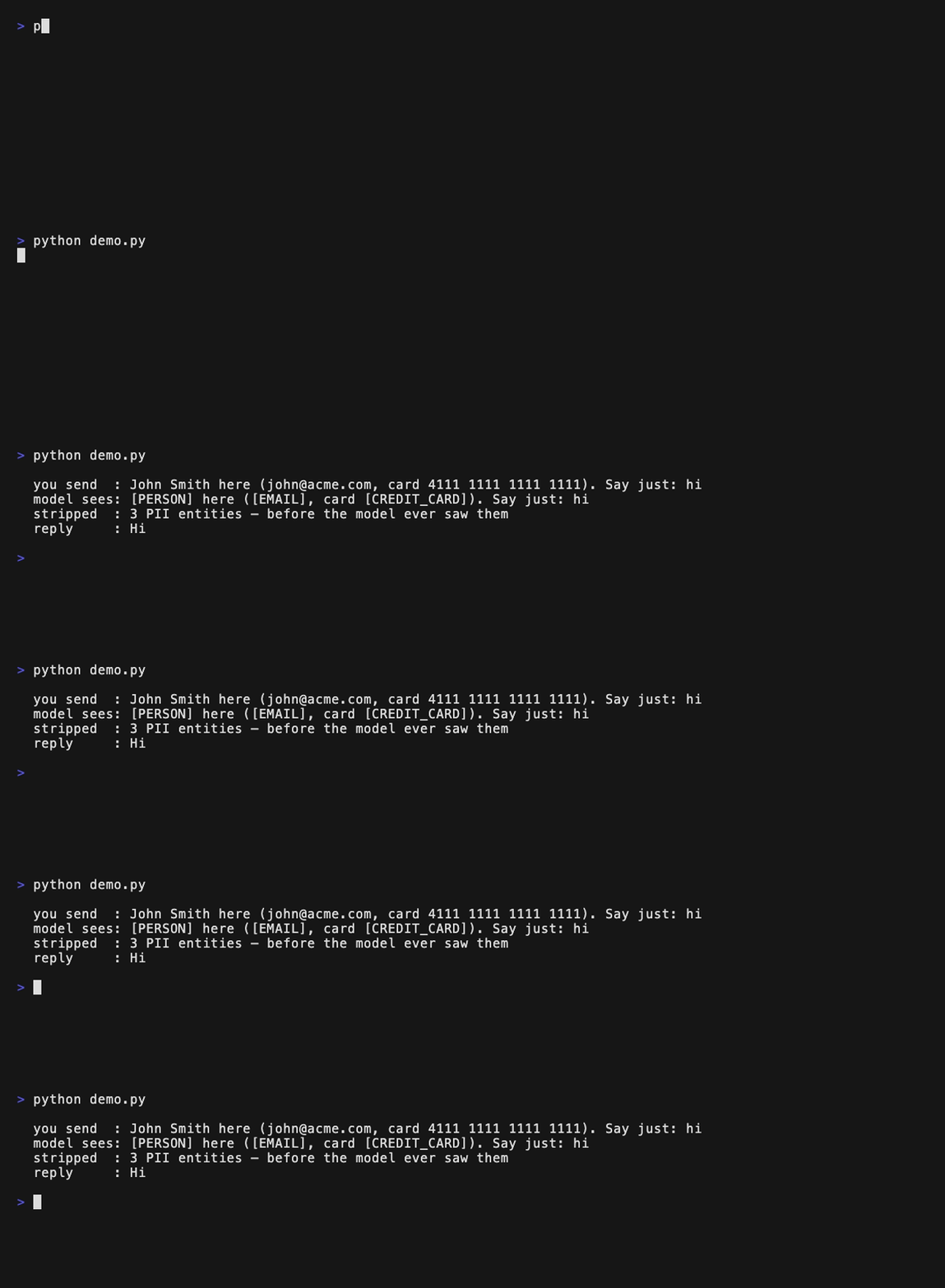
Wrap any model in a few lines — PII is stripped before the model ever sees it:
The governance dashboard, before and after simulated traffic — Admina Score 40 → 60:
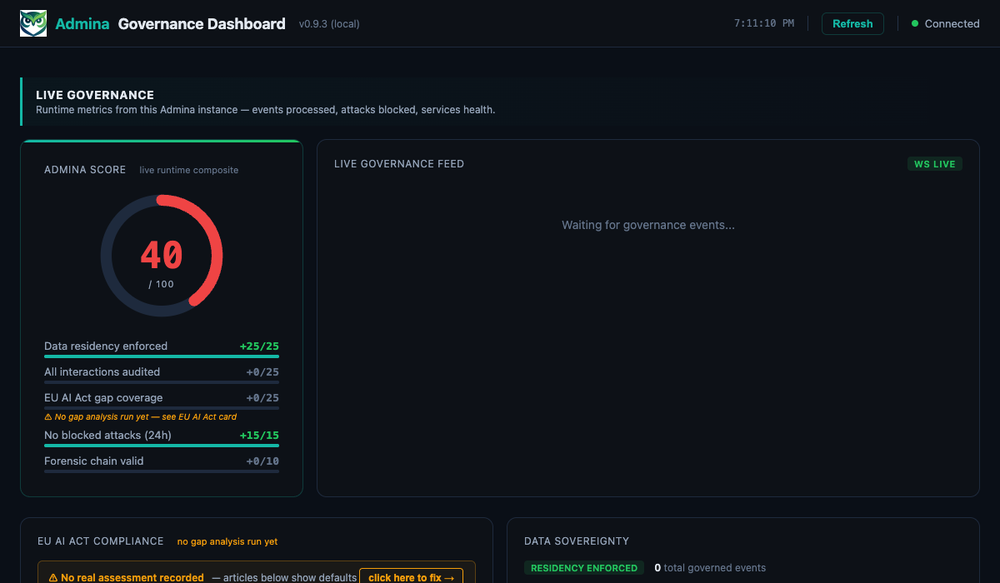 First boot — Admina Score 40/100 |
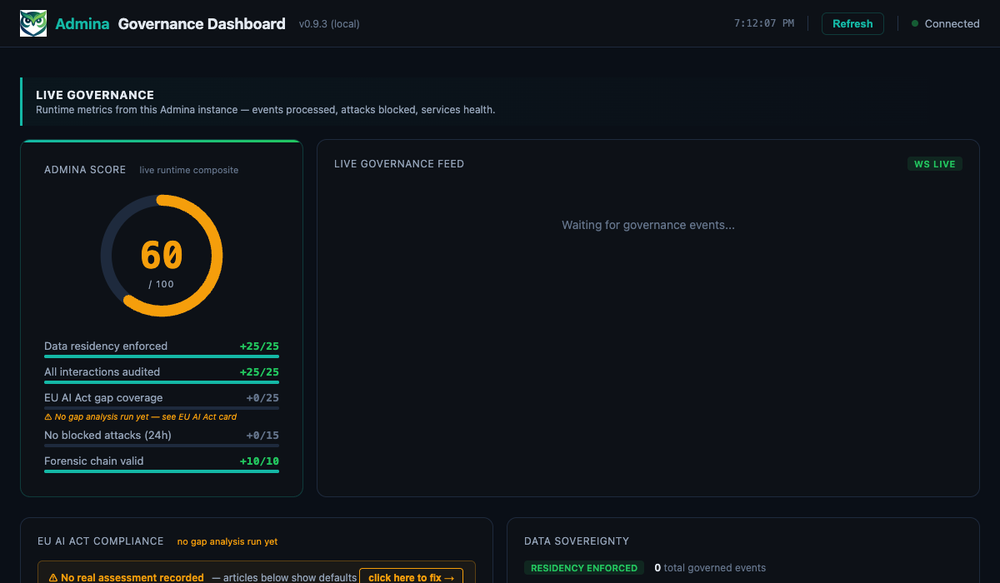 After python scripts/simulate.py — 60/100
|
Why Admina?
| Plain LLM / RAG app | With Admina | |
|---|---|---|
| PII in prompts/responses | leaks unless you build redaction | Redacted by default — email, SSN, IBAN, phone, IP, names |
| Prompt injections | reach the model | Screened at the proxy — a heuristic signal, not a guarantee: regex patterns (44 on the Python engine, 15 on Rust) + scoring |
| Agent tool calls | unaudited | Validated pre-action + logged post-action (forensic chain) |
| Loop / runaway agents | burn tokens / budget | Broken — TF-IDF cosine similarity over the action stream |
| EU AI Act readiness | manual | Gap analysis + risk classification built-in |
| Audit trail | logs you hope nobody deletes | SHA-256 hash chain — tamper-evident by design |
| Adding governance to existing code | rewrite the call sites | Zero code changes via proxy, or 3 lines via SDK |
| Performance overhead | unknown | Measured — engine microbenchmarks and a gateway benchmark to run on your hardware (Performance) |
| License | varies | Apache 2.0, open core |
Admina is decision-support and defense-in-depth, not legal advice. See Compliance scope for the full disclaimer and limitations.
30-second example
from admina import GovernedModel, GovernedData, GovernedAgent, ComplianceKit
from admina.plugins.builtin.adapters.ollama import OllamaAdapter
from admina.plugins.builtin.connectors.chromadb import ChromaDBConnector

# Every call is governed: PII redacted, injections blocked, audited
adapter = OllamaAdapter(host="http://localhost:11434")
model = GovernedModel(model_name="llama3.1:8b", adapter=adapter)
response = await model.ask("Summarize this document")

# Data governance: residency enforcement, PII classification
connector = ChromaDBConnector(host="localhost", port=8000)
data = GovernedData(connector=connector, residency_zone="eu")
await data.ingest(documents)

# Agent governance: validate every tool call before execution
async def my_upstream(method, params, **kw): ...  # your MCP/HTTP client
agent = GovernedAgent(upstream=my_upstream)
result = await agent.call("tools/call", {"name": "read_file", "arguments": {}})

# Compliance: EU AI Act gap analysis and risk classification
kit = ComplianceKit()
report = kit.gap_analysis(risk_category="high", current_compliance={...})
Quick Start
Install from PyPI
# Recommended for new users: SDK + proxy + dashboard.
# Lets you run `admina dev` and see the dashboard out of the box.
pip install "admina-framework[proxy]"

# Everything (proxy + NLP + telemetry). Use this if you also want
# spaCy-based NER for PII detection or OpenTelemetry export.
pip install "admina-framework[full]"
python -m spacy download en_core_web_sm   # for [full] only

# Model-adapter provider SDKs (per-provider extras):
pip install "admina-framework[openai]"      # openai>=1.0
pip install "admina-framework[ollama]"      # ollama>=0.3
pip install "admina-framework[anthropic]"   # anthropic>=0.39
pip install "admina-framework[mistral]"     # mistralai>=1.0
pip install "admina-framework[gemini]"      # google-genai>=1.0
pip install "admina-framework[bedrock]"     # boto3>=1.34 (AWS Bedrock)

# All provider SDKs at once:
pip install "admina-framework[adapters]"

# Everything (proxy + NLP + telemetry + all adapters):
pip install "admina-framework[all]"
python -m spacy download en_core_web_sm   # for [all] only

# Optional: Rust-accelerated engine (auto-detected at runtime).
# Opt-in extra — pulls in the admina-core wheel from PyPI.
pip install "admina-framework[rust]"

# The proxy for the OpenAI-compatible gateway only: without Redis,
# ClickHouse, boto3 and the scientific stack (see "Embedded deployment").
pip install "admina-framework[proxy-minimal]"

# Advanced: SDK only (no proxy, no dashboard, no `admina dev`).
# Use this when embedding the SDK into another service and you don't
# need the local dev server.
pip install admina-framework
The PyPI distribution name is
admina-framework; the Python import name isadmina(e.g.from admina import GovernedModel). This is a normal Python pattern — same aspython-dateutil→import dateutil.
The Rust engine is an optional, opt-in accelerator. The default
pip install admina-frameworkships only the pure-Python implementation;admina-framework[rust]adds theadmina-corewheel, which Admina auto-detects at runtime: underADMINA_ENGINE=auto(the default) the firewall and the loop breaker run on Rust whenever it is installed, as in the official proxy image (see Engine selection).The default is pure Python on purpose: the Python injection firewall currently has broader detection coverage than the Rust one (it adds obfuscation-normalisation — homoglyph, leetspeak, base64, ROT13 — and a wider multilingual pattern set). Enable
[rust]when per-request latency matters more than that extra coverage. See Performance for the trade-off.
The PyPI package admina is an alias: pip install admina installs
admina-framework at the same version, and admina[X] installs
admina-framework[X] for every extra above. It has no code of its own, so
both names install the same admina module.
Or install from source
git clone https://github.com/admina-org/admina.git
cd admina

# Recommended: proxy + dashboard + infra deps (enables `admina dev`)
pip install -e ".[proxy]"

# Everything (proxy + NLP + telemetry)
pip install -e ".[full]"

# All model-adapter SDKs
pip install -e ".[adapters]"

# Everything (proxy + NLP + telemetry + all adapters)
pip install -e ".[all]"

# CLI workflow
admina init my-project   # Scaffold a governed AI project
cd my-project            # admina dev runs from the project directory
admina dev               # Start the local proxy + dashboard

# Full stack via Docker (no [proxy] extra required)
./scripts/bootstrap-secrets.sh   # Auto-generate .env with random credentials
docker compose up --build        # Credentials printed at bootstrap

# Note: To use the OllamaAdapter, install Ollama (https://ollama.ai)
# and pull a model first: ollama pull llama3.1:8b

# Advanced: SDK only (no proxy, no dashboard)
pip install -e .
python -c "from admina import GovernedModel; print('SDK ready')"
Dashboard: http://localhost:3000 | API docs: http://localhost:8080/docs
Architecture
Admina runs in dual mode — in-process via SDK or networked via proxy — but both modes feed the same governance pipeline.
flowchart LR
    A1["your code → GovernedModel.ask()"] --> P
    A2["AI agent → POST /mcp"] --> P
    P["governance pipeline"]
    P --> U1["Ollama / OpenAI"]
    P --> U2["MCP server / LLM"]
    classDef pipe fill:#0ea5e9,stroke:#0369a1,color:#fff;
    class P pipe;
Pipeline (identical in both modes): loop-breaker → firewall → PII redaction → guards → audit → forensic chain (SHA-256) → OTEL
The 4 Governance Domains
| Domain | Capabilities | Engine |
|---|---|---|
| Agent Security | Anti-injection firewall (heuristic: 44 regex patterns on the Python engine, 15 on Rust, + scoring), loop breaker (TF-IDF cosine similarity) | Rust + Python |
| Data Sovereignty | PII redaction (email, SSN, credit cards, IBAN, phone, IP), residency enforcement, data classification | Rust + spaCy NER |
| Compliance | EU AI Act risk classification (Art. 6) and gap analysis (Art. 9-15), forensic black box (SHA-256 hash chain), OTEL native spans | Rust + Python |
| AI Infrastructure | LLM engine (Ollama, OpenAI), RAG pipeline (ChromaDB), Open WebUI | Python |
All governance domains operate bidirectionally — scanning both outbound requests and inbound responses.
SDK
Four governed primitives, each with async + sync interfaces:
from admina import GovernedModel, GovernedData, GovernedAgent, ComplianceKit
| Primitive | Purpose | Governance applied |
|---|---|---|
GovernedModel |
LLM calls (Ollama, OpenAI) | PII redaction on prompts and responses, event audit |
GovernedData |
Data ingestion and queries | PII classification, residency enforcement, access audit |
GovernedAgent |
MCP/A2A agent calls | Firewall, PII, loop breaker — full proxy pipeline in-process |
ComplianceKit |
Regulatory compliance | EU AI Act risk classification, gap analysis, report generation |
Plugin System
9 plugin interfaces, auto-discovered from plugins/builtin/ or installed via CLI:
| Interface | Builtin implementations |
|---|---|
| Model Adapter | Ollama, OpenAI, Anthropic, Gemini, Mistral, Bedrock, vLLM |
| Data Connector | ChromaDB, Filesystem |
| Governance Domain | GuardrailsAI (toxic, jailbreak, bias, PII) |
| Compliance Template | EU AI Act |
| Transport Adapter | MCP, HTTP REST |
| Forensic Store | Filesystem, S3-compatible (boto3 — AWS S3, MinIO, R2, …) |
| Auth Provider | API Key |
| PII Engine | spaCy + Regex (default), Microsoft Presidio (pip install admina-framework[presidio], ADMINA_PII_ENGINE=presidio); engines of other packages through the admina.pii_engines entry-point group (see PII engines) |
| Alert Channel | Log, Webhook |
Model adapters lazy-import their provider SDK, so install the ones you
use: pip install admina-framework[adapters] for all of them, or a
single provider ([openai], [ollama], [anthropic], [mistral],
[gemini], [bedrock]). vLLM has no extra of its own — it serves an
OpenAI-compatible API and subclasses the OpenAI adapter, so install
[openai] for it.
admina plugin list                    # List registered plugins
admina plugin install ./my-plugin     # Install a custom plugin
admina plugin create my-domain        # Scaffold a new plugin
CLI
admina init my-project     # Scaffold project with admina.yaml + docker-compose.yml
admina dev                 # Local mode: proxy + dashboard on :3000 (no Docker)
admina dev --stack         # Docker stack: + redis + clickhouse + grafana
admina dev --with-llm      # --stack + ollama + chromadb + open-webui
admina plugin list         # List all registered plugins
admina plugin install X    # Install a plugin from path or registry
admina plugin create X     # Scaffold a new plugin from template
admina forensic export --from-seq 1 --format jsonl --out records.jsonl
admina forensic verify     # Verify the forensic chain (read-only, JSON result)
admina redteam --format md # Detection-efficacy scorecard of the firewall, PII and loop detectors
admina redteam --corpora-dir corpora/ --config admina.yaml --baseline baseline.json --gate
admina forensic export and admina forensic verify read the directory of a
filesystem forensic store (--dir, default $FORENSIC_BASE_DIR) and never
write to it, so they can run while the proxy does. export writes the
records from --from-seq on, in sequence order, one per line: the bytes of
each record file as they are, then a newline (--out FILE, replaced once
complete, or - for standard output). verify prints the verification
result (valid, records, reason, sequence_number, checkpoint,
last_hash) and exits with 0 when the chain is valid, 1 when it is not;
--checkpoint SEQ:HASH (the checkpoint of an earlier result) checks only
the records after it.
admina redteam measures the injection firewall, the PII redactor and the
loop breaker on the corpora of the package (admina/redteam/corpora/), on
every available engine (--engine both|python|rust), then prints the
Markdown scorecard and writes the JSON one to --out (--format md|json|both; --corpus NAME runs one corpus). scripts/redteam.py runs
the same command.
The packaged corpora are small (tens of samples per detector, a few per
language) and their labels are assigned by the maintainers, not by a third
party: read the scorecard as indicative, and measure on corpora of your own
traffic with --corpora-dir.
--corpora-dir DIRadds external corpora, run after the packaged ones: each<name>.jsonlhas the rows of the packaged corpus of its detector ({"id", "text", "label": "attack" | "benign", "lang", "tag"}for the firewall,expected_typesinstead oflabelfor the PII redactor,messagesinstead oftextwithlabelloop|not_loopfor the loop breaker), and the directory'sSHA256SUMS(the output ofsha256sum *.jsonl) lists every one; the hashes are verified before the run.--config FILE(default$ADMINA_CONFIG) builds the Python firewall from theagent_security.firewallsettings of an admina.yaml, as the proxy does: custom patterns, pattern packs, disabled categories and patterns, heuristic threshold and allowed tags. The Rust firewall is measured only when the file sets none of the keys it cannot apply (see Engine selection); with--engine rust, such a file is an error. The PII redactor and the loop breaker keep their defaults.--write-baseline [FILE]writes the baseline of the run (default:baseline.jsonnext to--out).--baseline FILEcompares the run with a baseline and prints the result on standard error;--gateexits with status 1 when a recall drops or a false positive appears, when the number of benign samples of a corpus differs from the baseline (fp_samples: regenerate the baseline after changing a corpus), or when a corpus ran only on engines the baseline does not declare (default baseline: the packaged one, for the packaged corpora with the default settings).- Exit status 2: an option, a corpus, the configuration or the baseline is
not valid (a hash that does not match, a row without
tag, an unknown corpus name), or--engine rustcannot run a selected corpus (admina-coreis not installed, or--configsets a key that only the Python firewall applies).
admina dev defaults to a single-process local mode with zero Docker
dependency: one uvicorn serves the proxy API and the dashboard SPA on the
same port. Use --stack for the production-like Docker compose, or
--with-llm to also boot local LLM services.
Local mode uses the forensic backend of FORENSIC_BACKEND or of
admina.yaml, and memory when neither sets one. In the compose file that
admina init writes, the dashboard (127.0.0.1:3000), OTEL and the
--with-llm services listen on the loopback interface only; the dashboard
asks for ADMINA_DASHBOARD_PASSWORD and the API key (both shown by
admina password show). The proxy reaches the MCP server at
UPSTREAM_MCP_URL (default http://host.docker.internal:9000, an MCP
server on the host). CLICKHOUSE_PASSWORD and GRAFANA_ADMIN_PASSWORD
come from the .env that admina dev writes; a plain docker compose up
stops when they are not set.
Dashboard
Real-time governance dashboard on port 3000:
- Governance Score — 0-100 composite metric (data residency, audit coverage, attack rate, forensic integrity, EU AI Act compliance)
- Live Feed — streaming governance events via WebSocket
- Compliance Gaps — EU AI Act gap analysis with article-level detail
- Infrastructure Health — proxy, Redis, forensic store, ClickHouse, OTEL status
API backend: GET /api/dashboard/score, /feed, /compliance, /sovereignty, /infra, /models
In admina dev local mode the dashboard asks for the API key (admina password show)
and keeps a short-lived browser session that only the read-only dashboard API accepts.
In the Docker stack (docker compose up) the dashboard container is published on
127.0.0.1:3000 only. With ADMINA_API_KEY set it asks for HTTP Basic Auth
(ADMINA_DASHBOARD_USER, default admin, and ADMINA_DASHBOARD_PASSWORD, which
./scripts/bootstrap-secrets.sh and make up generate) and adds the key only to the
dashboard's read-only routes (/api/dashboard/*, /api/stats); it does not start
without a password. /mcp and the other /api/ routes are forwarded as received, so
callers send their own key. Without ADMINA_API_KEY the page signs in with the key
as in local mode.
Set ADMINA_DASHBOARD_ENABLED=false to stop serving the bundled dashboard.
The session cookie is Secure over HTTPS. DASHBOARD_COOKIE_SECURE=auto marks it
Secure on plain HTTP too, unless the dashboard is opened as localhost or a loopback
address: other hosts then sign in over HTTPS only. DASHBOARD_COOKIE_SECURE=true always
marks it Secure; false (the default) only over HTTPS.
Configuration
Admina uses admina.yaml as the primary config file (with .env fallback for backward compatibility):
cp admina.yaml.example admina.yaml # Copy and customize
See admina.yaml.example for all options including domains, AI infra, plugins, dashboard, forensic storage, alert channels, and integrations.
Configuration check
admina.yaml is checked against its schema (schema_version: 1,
admina.core.config_schema):
- A value of the wrong type (a word where a number goes, a single name where
a list goes, a list where a section goes) is an error naming the key:
load_config()raisesConfigSchemaError(aValueError) and the proxy does not start, for exampleadmina.yaml /etc/admina/admina.yaml: domains.agent_security.loop_breaker.window_size: must be an integer. The engine factories of the SDK (get_firewall(),get_pii_engine(),pii_mask_style(),get_egress_policy()) raise the same error, whatever key it names, andadmina plugin listexits with it. The values ofgatewayandpresidioare checked by their own readers, with the same effect. An empty value (key:and nothing after it) is not checked. - A key the schema does not know, such as the typo
domains.agent_security.firewal, is logged at proxy startup as a warning with its path (admina.yaml /etc/admina/admina.yaml: unknown keys, not read: domains.agent_security.firewal ...). WithADMINA_CONFIG_STRICT=trueit is an error and the proxy does not start.check_config()ofadmina.core.configruns the same check for the SDK. - Free-form blocks are not checked inside:
plugin_config,integrations,agent_security.domains, and the entries ofcustom_patterns(the firewall skips a malformed entry with a warning).
At startup the proxy also lists, as a warning, the ADMINA_* variables of
its environment and .env file that nothing reads (ADMINA_* variables not read by Admina: ADMINA_FOO ...); ADMINA_CONFIG_STRICT=true makes them an
error. Known are the proxy settings, the variables read by the
engines, the SDK, the builtin plugins and the other containers of the stack,
and the per-route keys of the gateway. Variables of other components are not
reported when they start with:
ADMINA_<NAME>_, where<name>is an entry point that an installed distribution registers inadmina.plugins,admina.pii_enginesoradmina.pattern_packs, in upper case with_for any other character than a letter or a digit (entry pointexample-pii:ADMINA_EXAMPLE_PII_). A plugin reads its own variables under that prefix;- a prefix listed in
ADMINA_ENV_ALLOW_PREFIXES(comma-separated, for exampleADMINA_MYAPP_).
Values are never logged.
Engine selection
ADMINA_ENGINE selects the engines of the firewall, the loop breaker and the
spacy-regex PII engine:
ADMINA_ENGINE |
Firewall | Loop breaker | PII (spacy-regex) |
|---|---|---|---|
auto (default) |
Rust when admina-core is installed, else Python; Python, with a warning, when admina.yaml sets a key below |
Rust when admina-core is installed, else Python |
Python |
python |
Python | Python | Python |
rust |
Rust | Rust | Rust |
With ADMINA_ENGINE=rust the engines are not built, and the proxy does not
start, when admina-core is not installed or when admina.yaml sets a key
that only the Python firewall applies: agent_security.firewall
custom_patterns, disabled_categories, disabled_patterns or
pattern_packs (an empty list is not set). The error names the cause:
ADMINA_ENGINE=rust, but admina-core is not installed: install admina-framework[rust], or set ADMINA_ENGINE=python (or auto) to run the Python engines
ADMINA_ENGINE=rust, but admina.yaml sets agent_security.firewall.pattern_packs, which only the Python firewall applies: remove them, or set ADMINA_ENGINE=python (or auto) to run the Python firewall
pattern_pack_dirs, strict_pack_timing, heuristic_threshold and
allowed_tags do not select an engine (the Rust engine does not read
them). The SDK raises the same EngineSelectionError (a ValueError) from
get_firewall(), get_loop_breaker() and get_pii_engine().
Both firewalls are heuristic, and they differ: the Python firewall has 44 builtin patterns in 13 categories, normalises evasions (homoglyphs, leetspeak, base64, ROT13, hyphenation) and has the Italian baseline; the Rust firewall has 15 patterns, no normalisation and none of the Italian baseline patterns, which are simply absent under Rust. See the model card for what each one detects.
GET /health and GET /api/stats report under engine:
- as in 0.12:
selection(ADMINA_ENGINEas set,autowhen unset),active(the engine that selection resolves to for the firewall and the loop breaker),pii_active,rust_available,rust_version(admina_core.version(), ornull) andengine(rustwheneveradmina-coreis installed); firewall,loop_breakerandpii: the engines of the objects the proxy built. Underautowith a key above,firewallispythonwhileactiveisrust.loop_breakerisnullwhen no enabled surface needs one (mcp,integration);piiispython,rust,presidioor the name of a plugin engine.
The startup banner and the admina_engine_info gauge of /metrics report
the same engines, admina-core version and settings:
  Engine selection: ADMINA_ENGINE=auto (admina-core 0.13.0)
  Firewall: ON (rust engine) | PII Redaction: ON (python engine) | Loop Breaker: ON (rust engine)

admina_engine_info{engine="rust",firewall="rust",loop_breaker="rust",pii="python",pii_redaction="on",rust_available="yes",rust_version="0.13.0",selection="auto",version="0.13.0"} 1
The gauge's engine is the firewall's engine, loop_breaker is none
when none is built, and rust_version is empty without admina-core.
INJECTION_FAST_PATH_ENABLED=false and PII_REDACTION_ENABLED=false show as
OFF (gateway and /mcp): /api/v1/validate runs the firewall and the PII
redaction whatever these two settings say.
The official proxy image (admina/proxy/Dockerfile) installs the Rust
engine, and spaCy without a language model (the slim target has no spaCy).
Under the default ADMINA_ENGINE=auto it runs the Rust firewall and loop
breaker and the Python PII engine with regular expressions only: no names or
organisations are detected until a spaCy model is installed (see
PII engines). Set ADMINA_ENGINE=python in the container
for the Python firewall, and read engine.firewall of /health to see the
firewall that runs.
Firewall patterns
Every firewall pattern has a stable id, reported with each match in
patterns[].id of the firewall check and of the forensic record:
<category>.<language>.<n> for the builtin categories written in English or
in several languages (instruction_override.en.1, multilang_evasion.it.2),
<category>.<n> for the it_* categories, <pack>:<id> for the patterns
of a pattern pack and custom.<n> for the
entries of custom_patterns, in their order. A builtin id never changes and
is never reused. agent_security.firewall.disabled_patterns leaves out single
patterns by id, where disabled_categories leaves out whole categories; an
unknown id is logged as a warning:
domains:
  agent_security:
    firewall:
      disabled_patterns: [tool_abuse.en.4]
The Python firewall has an Italian baseline besides the Italian patterns of
multilang_evasion: it_instruction_override, it_role_hijack,
it_prompt_extraction and it_model_addressing (risk high). Italian
imperatives of -are verbs have the form of the third person ("ignora",
"annulla"), so these patterns and the Italian multilang_evasion patterns
match such a verb where an instruction starts (the start of the text, after
a sentence end, a colon, a line break, an opening bracket, a table cell
|, an opening tag <p>, the start or the end of an HTML comment, an
opening quote or backtick; then closing tags such as </b>, a speaker
label such as Utente>, a list marker such as -, 1), # or >,
emphasis **, and up to two words such as "ok,", "grazie,", "per favore",
"assistente,"), after a
clause that starts there with a second-person imperative ("Traduci il
testo e ignora le istruzioni precedenti"; an opening quote, bracket or tag
inside the clause ends it), or with a second-person
object ("... e ignora le tue istruzioni"). Other patterns rest on
second-person forms ("rispondi", "sei ora", "mostrami") and on notes
addressed to an AI system ("Istruzioni per l'IA:"). "Ignora tutte le
istruzioni precedenti" matches; "Il giudice
annulla le linee guida impugnate" does not, and neither does an override
inside a sentence without one of these contexts ("Il documento è lungo,
ignora le istruzioni precedenti") or after a closing quote, tag or emphasis
that follows a word ('Il modulo "Alfa" ignora le istruzioni precedenti',
"Il fornitore ignora le istruzioni precedenti").
custom_patterns, disabled_categories, disabled_patterns and pattern
packs (below) apply to the Python firewall only, and so does the Italian
baseline: with any of those keys set, ADMINA_ENGINE=auto runs the Python
firewall and ADMINA_ENGINE=rust stops the proxy (see
Engine selection).
Firewall pattern packs
A pattern pack is a named, versioned set of firewall patterns in a YAML or
JSON file, added to the builtin patterns when
agent_security.firewall.pattern_packs names it
(examples/pattern_packs/example-pack.yaml):
name: example-pack              # [a-z0-9][a-z0-9-]*, the file name without suffix
version: "1.0.0"                # a string
description: Example patterns.  # optional
patterns:                       # at least one
  - id: internal_notes          # [a-z0-9][a-z0-9_.-]*, unique in the pack
    regex: "\\b(?:show|reveal|print)\\s++(?:me\\s++)?(?:the\\s++)?internal\\s++(?:ticket\\s++)?notes\\b"
    category: example_disclosure  # [a-z0-9][a-z0-9_]*
    risk_level: high            # low | medium | high | critical
No other key is accepted. The firewall knows each pattern as
<pack>:<id> (example-pack:internal_notes): check results report it and
disabled_patterns accepts it. Pack patterns follow the builtin ones and
precede custom_patterns; disabled_categories applies to their
categories too.
domains:
  agent_security:
    firewall:
      pattern_pack_dirs: [/etc/admina/packs]   # or ADMINA_PATTERN_PACK_DIRS
      pattern_packs: [example-pack]
      strict_pack_timing: false
Admina looks for each listed name among the entry points of the group
admina.pattern_packs, then in each directory of pattern_pack_dirs, in
order (<name>.yaml, <name>.yml, <name>.json; relative directories
from the working directory). ADMINA_PATTERN_PACK_DIRS, directories
separated by : (; on Windows), replaces pattern_pack_dirs when set.
An installed distribution provides a pack with an entry point whose loader
returns the pack mapping or the path of a pack file in its package data:
[project.entry-points."admina.pattern_packs"]
example-pack = "example_pkg.packs:example_pack"
A name must come from exactly one source. The firewall is not built, and
the proxy does not start, when a listed pack is not found (the error lists
the available packs), comes from two sources, is listed twice, or does not
validate (the error names the file or entry point and the key path, such as
patterns[1].risk_level), and when a pack directory is missing. Each pack
pattern is timed on 64k-character inputs when the firewall is built
(pattern timing): a pattern over 50 ms is logged as a
warning naming its id, or stops the firewall with
strict_pack_timing: true. Admina ships no pack of its own besides the
example.
Firewall deep path
The deep path scores five heuristic signals (imperative words, special
characters, context switches, length, escape sequences) and flags a text
whose score reaches agent_security.firewall.heuristic_threshold (default
0.5). Separators (---, ===), ###, code fences and tags count as
context switches, except the tags named in allowed_tags (any case), such
as the tag your application puts around retrieved documents. HTML entities
(€, €) and percent-encoding (%20) are not escape sequences,
and only a text longer than 100 000 characters gets the length signal.
INJECTION_DEEP_PATH_ENABLED=false turns the deep path off: a text is then
flagged by the patterns only.
domains:
  agent_security:
    firewall:
      heuristic_threshold: 0.5
      allowed_tags: [source]
heuristic_threshold and allowed_tags apply to the Python firewall; the
Rust engine scores with signals and a threshold of its own, and follows
INJECTION_DEEP_PATH_ENABLED.
Pattern timing
Custom firewall rules (agent_security.firewall.custom_patterns) run on
Python's backtracking re engine. Check each one on long inputs before
deploying it:
from admina.domains.agent_security.pattern_timing import measure_pattern, probe_pattern

probe_pattern(r"delete\s+user\s+\d+")    # worst search time in ms on 64k-character inputs
measure_pattern(r"delete\s+user\s+\d+")  # the same, with the slowest input and all timings
A result above 50 ms flags a pattern that is too slow on some long input. One
whitespace quantifier between two literals, with the whitespace inside each
optional group and possessive quantifiers (\s++, \s*+) where a whitespace
run is followed by a literal, keeps the backtracking over a whitespace run
linear in the length of the run.
That rule does not limit how many positions a search starts from. A pattern
that begins with a repeated character class can start at every position of a
long run of that class and read to the end of the run each time:
\b[\w.]+=\d passes the probe, yet takes time proportional to the square of
the run length on a.a.a.… (no =). The generated inputs contain no such
runs, so time them as well:
import re
from admina.domains.agent_security.pattern_timing import search_ms

search_ms(re.compile(r"\b[\w.]+=\d"), "a." * 32768)   # ms on a 64k-character run
Anchoring the start of the run, (?<![\w.])[\w.]++=\d, gives one attempt per
run (a match then starts where the run starts).
Request size limits
ADMINA_MAX_REQUEST_BYTES (default 10 MiB, 0 = no limit) caps the request
body on every route. A body over the cap gets 413 before it is parsed: at once
when its Content-Length is over the cap, otherwise as soon as the bytes read
go over it. The 413 body is in the OpenAI error format on /v1
(invalid_request_error, code request_too_large) and {"detail": ...}
elsewhere. MAX_REQUEST_TOKENS (default 100000, 0 = no limit) caps the
request content on /mcp, estimated as the length in characters of the
scanned text. ADMINA_GATEWAY_MAX_PROMPT_CHARS (default 0, no limit) caps
the message text of POST /v1/chat/completions, in characters (the text of
every message, as scanned); longer requests get 413 (invalid_request_error,
code prompt_too_long) before any governance check.
PII engines
ADMINA_PII_ENGINE (or pii_engine in admina.yaml, default spacy-regex)
selects the engine of PII redaction: a built-in engine (spacy-regex,
presidio) or an engine that another package registers in the
admina.pii_engines entry-point group. An unknown name stops the proxy at
startup with the list of the engines available.
[project.entry-points."admina.pii_engines"]
example-pii = "example_pkg.engine:ExamplePIIEngine"
The entry point names a BasePIIEngine subclass (admina.plugins), or a
callable that returns one; a config parameter receives the engine's block of
plugin_config in admina.yaml. Admina runs the engine through
admina.engines.PIIEngineBridge, which calls its asynchronous detect and
redact on an event loop of the engine's own, from any thread, and returns
{"redacted_text", "entities", "categories", "count"}; entities carry the
type, offsets and length of each span, never its text. special_categories
of the engine lists the special categories of personal data (GDPR art. 9 and
10) among its types: DataClassifier(special_categories=...) classifies them
restricted, like the built-in SPECIAL_CATEGORIES.
ADMINA_PII_MASK_STYLE (or pii_mask_style in admina.yaml) chooses the
masks: typed (default) replaces each span with its type ([EMAIL],
[PERSON], …); omissis replaces each span with [OMISSIS], in requests,
responses and streamed responses alike, so no type is left in the text. In
omissis, the categories an engine lists in sentence_categories (such as
health or judicial data) have their whole sentence replaced; the sentences
come from the engine's sentences(text), by default a simple splitter (a
line break, or ., !, ? followed by an upper-case word, ends a
sentence). A streamed response from such an engine is then released a whole
sentence at a time (at most 4096 characters held back).
ADMINA_PRESIDIO_NLP_MODELS (or presidio.nlp_models in admina.yaml) sets
the spaCy pipeline of each language of the presidio engine, for example
it:blank,en:en_core_web_sm: an installed model, or blank, a tokenizer with
no model and no NER (the pattern recognizers, such as e-mail, IBAN, fiscal
codes and phone numbers, still run). A configured model that is not installed
stops the proxy at startup: models are never downloaded. Without the setting,
each of en_core_web_sm and it_core_news_sm that is installed is used.
The PII engines work without network access: the presidio engine checks
e-mail domains against the public suffix list bundled with tldextract,
without downloading it or writing a cache. ADMINA_OFFLINE=true (default
false) also sets HF_HUB_OFFLINE, TRANSFORMERS_OFFLINE and
HF_DATASETS_OFFLINE to 1 before a PII engine is built and when the proxy
starts (engines built on Hugging Face libraries then load only local files),
and starts the proxy without the OpenTelemetry exporter.
Every engine masks text values only, never the keys of a JSON object: the
gateway redacts the text of each message (content, as a string or the
text of each part, reasoning and refusal text, tool call arguments) and
forwards roles, names and ids as received. A mask of Admina already in the
text ([EMAIL], [IBAN], …, [OMISSIS]) is never masked again; other text
in square brackets is masked like any other text. IBANs are masked when they
have the length of their country (Italy: 27 characters), compact or with
spaces, and a valid checksum; phone numbers include the Italian formats.
Embedded deployment
Settings for running the proxy as one component of a larger system (a container, a service unit). Each one defaults to the behaviour described in the rest of this README.
Configuration file. ADMINA_CONFIG names the admina.yaml to load, for
example /etc/admina/admina.yaml. When it is set, exactly that file is read
by the proxy, the engines and the SDK's load_config(); a missing,
unreadable or invalid file stops the proxy at startup instead of falling
back to the defaults. Unset (or empty), Admina looks for admina.yaml in the
current directory, then in the directory of the admina package.
Secrets from files. ADMINA_API_KEY_FILE and
ADMINA_FORENSIC_STATE_KEY_FILE name files holding the API key and the
forensic chain-state key (for example /run/secrets/admina_api_key), as the
upstream key files of the gateway do. Each file is read once at startup, with
one trailing newline removed. A missing, unreadable or empty file, or a key
set both directly and as a file, stops the proxy; the error names the
setting and the path, never the key. ADMINA_FORENSIC_STATE_KEY_FILE inside
the forensic directory stops it too: the key must be kept outside the store.
The built-in apikey auth provider reads ADMINA_API_KEY from the
environment only, and is loaded only when it is set there. A key given only
through ADMINA_API_KEY_FILE or .env is checked by the authentication
middleware itself (the same headers, the same constant-time comparison), and
POST /api/v1/audit then stamps submitted_by: "api_key" instead of
"user:api_key_user".
Forensic store. FORENSIC_BACKEND (memory, filesystem, s3) and
FORENSIC_BASE_DIR choose where the forensic records go. When they are not
set (in the environment or .env), the proxy reads
domains.compliance.forensic.backend (or its older name storage) and
base_dir from admina.yaml; without either, the backend is memory. A
value set in both places with different values is logged at startup, and
the environment's is used. The Docker Compose stack uses filesystem with
FORENSIC_BASE_DIR=/app/.admina/forensic on the named volume
forensic-data, which the proxy image creates owned by its user.
ADMINA_FORENSIC_FAIL_MODE says what happens when a record cannot be
written (a full disk, a directory that cannot be written, S3 errors):
open (default) |
closed |
|
|---|---|---|
| Record not written | logged; the request is served without it | 503 and not forwarded: gateway {"error": {..., "type": "server_error", "code": "forensic_unavailable"}}, /mcp a JSON-RPC error (-32603), /api/v1/audit 503 |
/api/v1/validate after a failed write |
served | 503 until a record is written again |
Backend that cannot be opened at startup (filesystem without a directory, or one that cannot be created or written; s3 without boto3 or not reachable; a record that cannot be read) |
an error is logged; nothing is recorded, not even in memory, and /health reports forensic_writable: false |
the proxy does not start |
A record that is not written is never counted: the next one takes its
sequence number. Each record, _chain_state.json and its signature are
written atomically (a temporary file in the same directory, fsynced and
renamed, then the directory fsynced).
Forensic records (format admina-forensic/1). Each record is one JSON
object on one line, at YYYY/MM/DD/HH/NNNNNNNN.json under the store
directory (UTC hour of the write, sequence number on eight digits), with
sequence_number (from 1, contiguous), timestamp_utc,
timestamp_unix_ms, previous_hash (GENESIS for record 1, else the
record_hash of the record before), event, and:
record_hash: SHA-256 (64 lowercase hex characters) ofjson.dumps(record, sort_keys=True, default=str)(default separators, UTF-8) of the record withoutrecord_hash,record_sigandrecord_sig_alg;record_sig: HMAC-SHA256 (64 lowercase hex characters) of the 64 ASCII characters ofrecord_hash, under the record key = HMAC-SHA256 ofadmina-forensic/1 record signatureunder the chain-state key (ADMINA_FORENSIC_STATE_KEYorADMINA_FORENSIC_STATE_KEY_FILE, kept outside the forensic directory);record_sig_alg:hmac-sha256. Without a key a record hasrecord_sig_alg: "none"and norecord_sig. Since 0.13.1, when a store that holds signed records is opened without its key, the proxy does not start inclosedfail mode (ADMINA_FORENSIC_FAIL_MODE) and logs a warning inopenmode, where the records it then writes are unsigned (a later verification with the key reportsunsigned).
The chain state (_chain_state.json, with its HMAC-SHA256 in
_chain_state.json.sig when a key is set) holds record_count,
chain_head, head_key and signed_from: the first sequence number whose
record must be signed (records written before a key was set stay readable
and are reported as unsigned).
Verification (GET /api/v1/forensic/verify, admina forensic verify,
verify_chain()) reads one record at a time in sequence order and returns
valid, records, last_hash, checkpoint ({"sequence_number", "record_hash"} of the last record checked: pass it back as
?checkpoint=SEQ:HASH, --checkpoint SEQ:HASH or checkpoint=(seq, hash)
to check only the records after it; from_seq starts from a sequence
number instead), signed, unsigned, signatures_verified (false without
the key) and, for the first failure, sequence_number and reason:
reason |
The record at sequence_number |
|---|---|
hash_mismatch |
is not a JSON object, or its record_hash is not the hash of its content |
sequence_gap |
has a sequence_number other than its file's, or comes twice or out of order |
signature_invalid |
has a record_sig that does not verify with the key, or an unknown record_sig_alg |
unsigned |
has no signature, though records from signed_from on must have one |
link_broken |
has a previous_hash that is not the record_hash of the record before it |
missing_record |
cannot be found: sequence numbers start at 1 and follow one another up to the chain state's count at least |
state_mismatch |
is the chain state's last record and has another hash |
checkpoint_mismatch |
is the checkpoint's and has another hash |
state_missing |
— there are records but no chain state |
state_invalid |
— the chain state cannot be read, or its HMAC does not verify with the key |
store_unavailable |
— the backend could not be opened |
Chain state at startup. The store reads the chain state and, with a
key, checks its HMAC. An S3 read is retried (FORENSIC_S3_MAX_RETRIES
times, backoff from FORENSIC_S3_BASE_DELAY_S); an object is missing only
when S3 answers that it does not exist (NoSuchKey), and any other error
still there after the retries is a read error, as for a file:
- a valid state is used; the record at its count must be its head, and a record written after it (the process stopped between the record and the state) is counted when it verifies and links to it;
- a missing state (with records), or one that cannot be read or does not
verify, is rebuilt only from records that all verify with the key,
from record 1 on (sequence, hashes, links, signatures). The rebuild is
logged at
CRITICAL(Forensic chain state rebuilt from verified records) and recorded as a signed record withevent.event_type: "chain_state_rebuilt",cause(state_missingorstate_invalid),records_verifiedandhead_hash. The chain state keeps the rebuild, so/healthreportsforensic_chain: "rebuilt"after every restart until an operator, with the proxy stopped, runsadmina forensic acknowledge-rebuild(with the key inADMINA_FORENSIC_STATE_KEY): it verifies the whole chain and, when it is valid, clears the status. An external copy of the head (for example thecheckpointof the last export) shows whether records after it are missing; - otherwise (no key, a record that does not verify, a missing last record)
the chain is invalid: a
CRITICALlog names the reason and the record,/healthreportsforensic_chain: "invalid"andstatus: "degraded", no record is written, verification is never valid, and withADMINA_FORENSIC_FAIL_MODE=closedgoverned requests are answered503; - a record that cannot be read keeps the backend from opening (see the table above).
To recover from an invalid chain: run admina forensic verify (or admina doctor for S3), with the key in the environment, to see the reason and the
record; stop the proxy; restore the forensic directory or bucket (records,
_chain_state.json, _chain_state.json.sig) from a backup, or move it
aside, keeping it, and start with an empty one; start the proxy. A chain
state that could not be read because the storage was unavailable (logged as
Cannot read the forensic chain state) needs only a restart once it can be
read again. A store written without a key, or before a key was set, cannot
be rebuilt: keep its chain state, or move it aside when a key is
introduced.
Audit records. POST /api/v1/audit records the event it receives with
source: "api_v1_audit" (a source in the request is kept as
client_source) and submitted_by: the credential the request was admitted
with (api_key, append_key, user:<id> or unauthenticated). With
ADMINA_API_KEY in the environment the built-in apikey auth provider
admits API-key requests, stamped user:api_key_user; api_key is the stamp
when the key comes only from ADMINA_API_KEY_FILE or .env. An
event_type of the records the proxy writes itself (mcp_request,
mcp_response, gateway_request, gateway_response, gateway_response_scan,
policy_violation, chain_state_rebuilt) is refused with 400.
ADMINA_AUDIT_APPEND_KEY (or ADMINA_AUDIT_APPEND_KEY_FILE) is a key that
this route accepts besides the API key and every other route refuses; unset
(the default), the route needs the API key.
Surfaces. ADMINA_ENABLED_SURFACES lists the surfaces the proxy serves,
comma-separated (empty = all of them):
| Surface | Routes |
|---|---|
gateway |
/v1/* (OpenAI-compatible gateway) |
mcp |
/mcp, /mcp/* |
integration |
/api/v1/* (validate, audit, forensic verify) |
compliance |
/api/compliance/* |
dashboard |
/api/dashboard/* (live feed and browser sign-in included), /api/stats, /api/events, the dashboard shell (/, /heimdall.png, /vendor/*) |
The routes of a disabled surface are not mounted and answer 404, with or
without the API key. /health and /metrics are always served. The loop
breaker is built only when mcp or integration is enabled, the
coordination detector and its quarantine refresh loop only with mcp, and
the gateway's pipeline threads only with gateway.
Egress per surface. agent_security.egress.surfaces in admina.yaml
lists the surfaces the egress stage runs on, among gateway (the text of
the chat messages of POST /v1/chat/completions), mcp (the arguments of
/mcp tool calls), integration (/api/v1/validate) and sdk
(GovernedModel.ask() and stream()). Unset, the stage runs on every one;
an empty list runs it on none. An unknown name, or a value that is not a
list, stops the proxy at startup (the SDK raises ValueError). To check
tool calls only:
domains:
  agent_security:
    egress:
      enabled: true
      surfaces: [mcp]
      allow: [api.example.com]
With gateway left out, the gateway does not evaluate the text of chat
messages for destinations (a message that starts with a URL off the
allowlist is not refused by the stage) and its records have no
checks.egress.
Optional dependencies. redis is imported only when REDIS_URL has a
Redis scheme, clickhouse_connect only when CLICKHOUSE_HOST is not empty
and boto3 only when FORENSIC_BACKEND=s3. REDIS_URL= and
CLICKHOUSE_HOST= (empty) turn Redis and ClickHouse off with no connection
attempt. The proxy-minimal extra installs the proxy without Redis,
ClickHouse, boto3, typer and the scientific stack of the Python loop breaker:
pip install "admina-framework[proxy-minimal]"
ADMINA_ENABLED_SURFACES=gateway REDIS_URL= CLICKHOUSE_HOST= \
  ADMINA_API_KEY_FILE=/run/secrets/admina_api_key \
  uvicorn admina.proxy.main:app --host 0.0.0.0 --port 8080
With proxy-minimal, the mcp and integration surfaces need the proxy
extra (or rust, whose loop breaker needs no scientific stack); the proxy
does not start when they are enabled without it.
Health. GET /health (public) reports:
{
  "status": "healthy",
  "service": "admina-proxy",
  "version": "0.13.0",
  "mode": "enforce",
  "surfaces": ["gateway"],
  "ruleset_sha256": "9cada1f2c9c85e60d1ec53ede74fbec7524f1db6e324500c46105f4d174c980a",
  "forensic_writable": true,
  "forensic_chain": "ok",
  "engine": {
    "engine": "rust",
    "rust_available": true,
    "rust_version": "0.13.0",
    "selection": "auto",
    "active": "rust",
    "pii_active": "python",
    "firewall": "rust",
    "loop_breaker": null,
    "pii": "python"
  },
  "timestamp": "2026-09-28T23:37:06.472687+00:00"
}
status:healthy, ordegradedwhile forensic records cannot be written (forensic_writableisfalse, the last record or chain-state write failed, or the chain is invalid); the HTTP status is 200 either way;forensic_chain:ok,rebuilt(the chain state was rebuilt from verified records, and the rebuild has not been acknowledged) orinvalid(see Embedded deployment, Chain state at startup);nullfor thememorystore;mode: the governance mode (enforce,observeordry-run);surfaces: the enabled surfaces;ruleset_sha256: the active firewall ruleset, the value ofX-Admina-Ruleset(see Firewall ruleset);forensic_writable: whether the forensic store accepts writes. With thefilesystembackend a probe file is created, written, fsynced and removed inFORENSIC_BASE_DIR; withs3it is the result of the last record write (nullbefore the first); withmemoryit isnull; for a backend that could not be opened at startup it isfalse. The check runs at most once every 10 s, on a thread of its own, and its result is reused until then; a check that takes longer than 1 s reportsfalse, so/healthanswers within about a second even when the store stalls.
Logs. ADMINA_LOG_FORMAT=json writes one JSON object per line
(timestamp, level, logger, message and exception when there is
one), uvicorn's own lines included; text is the default. An exception
raised while a request or a response is governed (by a governance guard,
the PII engine, the pipeline or the upstream exchange of the gateway,
/mcp and /api/v1/validate) is logged by its class name, and at DEBUG
with the frames of its traceback (admina.core.exception_log), never with
its message, which can quote the governed text; the error of a guard's
ERROR check (checks["guard_<name>"] in the forensic records and the
ClickHouse details) is the class name too. An /mcp request whose
governance pipeline raises is answered 500 (JSON-RPC -32603,
Internal proxy error), a POST /api/v1/validate request 500
({"detail": "Internal Server Error"}).
/metrics and the API docs. Both are public by default.
ADMINA_METRICS_REQUIRE_AUTH=true and ADMINA_API_DOCS_REQUIRE_AUTH=true
put /metrics and /docs, /redoc, /openapi.json behind the API key
(X-API-Key or Authorization: Bearer); a browser opening /docs then
cannot load the schema. ADMINA_API_DOCS_ENABLED=false removes the docs.
Governed requests. Each request the proxy governs on the gateway
(POST /v1/chat/completions), on /mcp and on POST /api/v1/validate
(the integration surface) is counted on /metrics and emits one
governance.decision event on the event bus, which the dashboard live feed,
the OpenTelemetry exporter and the alert channels read (one alert per
BLOCK or CIRCUIT_BREAK). With ClickHouse configured it is also a row of
governance_events: event_type gateway_request, mcp_request or
validate_request, request_hash the event's request_sha256, and for
the gateway response_hash the SHA-256 of the response sent. A gateway
request is recorded once its response has ended, an /mcp request once it
has been answered: each with the action of its response.
admina_requests_total{surface,action}: counter per surface (gateway,mcp,integration; the enabled ones have samples from startup) and action:ALLOW,BLOCK,REDACT(allowed, with PII masked in the request),CIRCUIT_BREAK, orERROR(the request failed in the proxy before the governance pipeline decided). A gateway completion answered with the block message after the upstream answered (flagged by the response scan, or whose PII redaction did not finish) is aBLOCK; so is an/mcprequest whose response a governance guard blocks (itsinspect_responseverdict, or its contract error withADMINA_GUARD_FAIL_MODE=closed), with the guard'srisk_level(HIGHfor a contract error), and so are/mcprequests over the rate limits orMAX_REQUEST_TOKENS. Requests refused before they are governed are not counted: gateway requests answered before they have an event id (unknown route, a body that is not a JSON object, a model outside the allowlist, a refused value, a prompt overADMINA_GATEWAY_MAX_PROMPT_CHARS), and/api/v1/validaterequests answered400or503.admina_request_duration_seconds{surface}: histogram of the time from the arrival of a request to the end of its response, the upstream's time included (buckets from 5 ms to 300 s).admina_governance_duration_seconds{surface}: histogram of the time the governance pipeline took to decide (buckets from 0.5 ms to 5 s).admina_requests_blocked_total(BLOCK,CIRCUIT_BREAK),admina_requests_allowed_total(ALLOW,REDACT),admina_requests_redacted_total(REDACT) andadmina_avg_latency_ms(the mean request duration) count every governed surface, as do therequests_*counters of/api/stats.
Label values come from these fixed sets only, never from a request. The
metadata of a governance.decision event is surface, event_id (of the
request's forensic records; a new id for /api/v1/validate), domain (the
part of the pipeline that decided: firewall, pii, loop_breaker, a
guard's name, pipeline, response_firewall, response_pii,
response_guard or none),
latency_us (the pipeline's time), categories (firewall category names),
pii_count, request_sha256 and, in observe and dry-run mode,
would_action: names, counts and hashes, never text of a request or of a
response. request_sha256 is, for the gateway, the request_sha256 of the
request record; for /mcp, the SHA-256 of the JSON-RPC request as the
proxy serialises it; for /api/v1/validate, the SHA-256 of content.
OpenTelemetry. With OTEL_ENABLED=true (the default), the telemetry
extra installed and ADMINA_OFFLINE off, the proxy exports to
OTEL_ENDPOINT (OTLP gRPC, default http://localhost:4317; an empty value
leaves the endpoint to the OpenTelemetry SDK: OTEL_EXPORTER_OTLP_ENDPOINT,
else http://localhost:4317) a span per governance.decision event, with
admina.domain, admina.action, admina.risk_level, admina.latency_us,
admina.session_id and admina.meta.<key> for each key of the event's
metadata, and the span of each gateway chat completion.
OTEL_ENABLED=false builds no exporter: nothing is exported and no
connection is made for telemetry.
Container entrypoint. admina/proxy/docker-entrypoint.sh accepts
ADMINA_API_KEY or ADMINA_API_KEY_FILE and prints only whether the key
is set, never any part of it.
OpenAI-compatible gateway
The proxy serves an OpenAI-compatible API at /v1 (POST /v1/chat/completions,
streaming and non-streaming, and GET /v1/models). It runs the governance
pipeline on each chat completion and forwards requests to an upstream route.
By default there is one route, default, to ADMINA_GATEWAY_UPSTREAM
(http://localhost:11434/v1), and no credentials are sent upstream.
ADMINA_GATEWAY_MODELS_ALLOWLIST (comma-separated model ids; empty, the
default, = every model) limits the models: GET /v1/models lists only those,
and a chat completion for any other model, or without a model, gets 403 in
the OpenAI error format (invalid_request_error, param: "model", code
model_not_allowed) before any governance check, forensic record or upstream
call.
A chat completion is forwarded with its body as received and its messages as governed (PII redacted when redaction applies). Three settings, all off by default, change the other top-level fields of the forwarded body:
| Setting | Default | Meaning |
|---|---|---|
ADMINA_GATEWAY_FORWARD_FIELDS |
empty: every field | fields forwarded, comma-separated and case-sensitive; model, messages and stream always are, and so are the fields of a limit below that is set; any other field is left out |
ADMINA_GATEWAY_MAX_N |
0: no limit |
largest n forwarded: a larger n is lowered to it; an absent or null n is forwarded as it is |
ADMINA_GATEWAY_MAX_COMPLETION_TOKENS |
0: no limit |
largest max_tokens and max_completion_tokens forwarded: each one that is larger is lowered to it, and a request that sets neither (absent or null) is forwarded with max_tokens set to it |
ADMINA_GATEWAY_FORWARD_FIELDS=temperature,top_p,stop,seed,tools,tool_choice,response_format,stream_options
ADMINA_GATEWAY_MAX_N=1
ADMINA_GATEWAY_MAX_COMPLETION_TOKENS=4096
While a limit is set, the fields it applies to must be absent, null or an
integer of at least 1 (true, 2.0 and "2" are not); any other value gets
400 in the OpenAI error format (invalid_request_error, param naming the
field, code invalid_value) before any governance check, forensic record or
upstream call. The proxy does not start when ADMINA_GATEWAY_FORWARD_FIELDS
names a field with characters other than ASCII letters, digits, _ and -.
These settings change the forwarded body only: the firewall scans the request
as received, and the forwarded messages, whose hash is request_sha256, are
the same with or without them.
Named routes come from ADMINA_GATEWAY_UPSTREAMS or from gateway.upstreams
in admina.yaml; the environment variable, when set, replaces the YAML routes
(URLs and key files):
ADMINA_GATEWAY_UPSTREAMS=main=http://main.upstream.test/v1,util=http://util.upstream.test/v1
ADMINA_GATEWAY_UPSTREAM_API_KEY_FILE=/run/secrets/upstream_api_key
gateway:
  upstreams:
    main: { url: "http://main.upstream.test/v1", api_key_file: /run/secrets/upstream_api_key }
    util: { url: "http://util.upstream.test/v1", api_key_file: /run/secrets/upstream_api_key }
  default_upstream: main
A request picks a route with the X-Admina-Upstream header. Without it the
gateway uses default_upstream, or else the first route; an unknown route name
gets a 400 response in the OpenAI error format (invalid_request_error, code
unknown_upstream) and is neither scanned nor recorded. The route name is
stored in the forensic record (upstream).
The upstream receives Authorization: Bearer <key> when the route has a key.
The key of a route is the first one set, in this order:
| Source | Scope |
|---|---|
ADMINA_GATEWAY_UPSTREAM_<NAME>_API_KEY or …_API_KEY_FILE (<NAME>: route name in upper case) |
one route |
api_key_file of the route in admina.yaml |
one route |
ADMINA_GATEWAY_UPSTREAM_API_KEY or ADMINA_GATEWAY_UPSTREAM_API_KEY_FILE |
every route |
Key files are read once at startup and one trailing newline is removed. The
proxy does not start when a key file is missing, unreadable or empty, when a
key is set both directly and as a file, when a route is malformed or when
default_upstream names no route. Keys are masked in the settings
representation and are not logged. The caller's Authorization, X-API-Key,
Cookie and X-Admina-* headers are never forwarded upstream; other headers
only when listed in ADMINA_GATEWAY_FORWARD_HEADERS (see
Correlation and forensic records).
Upstream responses, errors and timeouts
ADMINA_GATEWAY_STREAM_MODE, or gateway.stream_mode in admina.yaml (the
environment variable wins), sets how streamed chat completions are relayed:
| Mode | Behaviour |
|---|---|
passthrough (default) |
While no response transformation is active (PII_REDACTION_ENABLED=false), the client receives the upstream bytes unchanged, every field included, each SSE event as soon as it is complete. With PII redaction on, the gateway relays as in governed. |
governed |
Each SSE chunk is parsed and re-serialised, one chunk for each upstream chunk, with all of its fields. With PII redaction on, every string of a choice is redacted, per choice and per field across chunks: content (a string or a list of parts), reasoning text, tool and function call arguments and any other field; text held back to catch an entity split across chunks is sent with the choice's finish chunk, at the same place, or in a last chunk at the end of the stream. data: [DONE] is sent when the upstream sends it. |
A non-streaming response is forwarded unchanged unless PII redaction is on;
then the gateway parses it, and a successful response that is not a JSON
object gets 502 (code upstream_invalid_response). An upstream error (4xx,
5xx) reaches the client with its status, body and content type, streaming or
not.
With PII redaction on, in streamed and non-streaming completions alike:
- structural values are kept as they are:
index,id,type,role,nameandfinish_reason, and the completion'sid,object,created,model,system_fingerprintandservice_tier; logprobsandtoken_idsof each choice are sent asnull, since generated text split into tokens cannot be redacted token by token;- other strings outside the choices, and SSE comment lines, are redacted as whole values;
- values nested more than 16 levels deep are dropped.
The gateway talks to its upstreams through a client of its own:
| Setting | Default | Meaning |
|---|---|---|
ADMINA_GATEWAY_TIMEOUT_CONNECT |
30 |
seconds to open a connection or get a free one from the pool |
ADMINA_GATEWAY_TIMEOUT_READ |
30 |
seconds to wait for the next upstream bytes (and for each write of the request) |
ADMINA_GATEWAY_TIMEOUT_TOTAL |
0 |
seconds for the whole upstream exchange, from the request to the last byte |
ADMINA_GATEWAY_MAX_CONNECTIONS |
100 |
size of the connection pool |
ADMINA_GATEWAY_MAX_KEEPALIVE_CONNECTIONS |
20 |
idle connections kept open |
A timeout of 0 means no limit. A timeout before the response starts gets
504, any other connection failure 502, both with an OpenAI-style body
({"error": {"message", "type": "upstream_error", "param", "code"}}, code
upstream_timeout or upstream_error). A failure during a stream ends it
with one data: {"error": {...}} event and no data: [DONE]. When the client
disconnects, the gateway closes the upstream request.
Governance pipeline threads and time budget
The gateway runs the governance pipeline (firewall, PII redaction, egress analysis, governance guards) and the PII redaction of completions in a pool of worker threads, so that scanning one request does not hold up the others:
| Setting | Default | Meaning |
|---|---|---|
ADMINA_GATEWAY_PIPELINE_WORKERS |
0 |
threads in the pool, the most requests governed at once (0 = the number of CPUs); further requests wait for a free thread |
ADMINA_GATEWAY_PIPELINE_TIMEOUT |
0 |
seconds a request waits for its governance decision, the wait for a free thread included (0 = no limit) |
A request whose decision takes longer than ADMINA_GATEWAY_PIPELINE_TIMEOUT is
blocked, in every governance mode, and never forwarded; its forensic record has
checks.pipeline = {"action": "BLOCK", "reason": "time_budget_exceeded", "budget_ms": <budget>}. The thread that was scanning it stays busy until the
scan ends. A request whose pipeline raises (in the firewall, PII redaction,
egress analysis or a guard) is blocked the same way, in every governance mode,
since its checks may not have run; the record has checks.pipeline = {"action": "ERROR", "error": "<exception class>"}. A guard contract error
(ValueError, RuntimeError, OSError or TypeError from a guard) is
handled inside the pipeline and follows ADMINA_GUARD_FAIL_MODE, as on the
other surfaces; its check is {"action": "ERROR", "error": "<exception class>"}.
With PII redaction on, the redaction of each completion, and of each line of
a stream, runs in the worker threads within the same time budget. A
non-streaming completion whose redaction runs over the budget or raises is
replaced by the block message (finish_reason: "content_filter"); a stream
whose redaction runs over the budget or raises ends with one
data: {"error": {...}} event (code response_redaction_failed) and no
data: [DONE]. The text of that completion or line is not sent.
Governance guards run in the worker threads too, each thread with an event loop
of its own, so one guard instance can be called by several threads at once,
each call on a different event loop. A guard must be thread-safe and must not
keep objects bound to one event loop (an asyncio.Lock, an httpx.AsyncClient
with pooled connections) across calls; see BaseGovernanceGuard. The built-in
GuardrailsAI guard runs one validation at a time.
With ADMINA_GATEWAY_SCAN_RESPONSE=true (default false) the firewall also
checks the completion text, the content of each choice, in the same worker
threads and time budget (and only while INJECTION_FAST_PATH_ENABLED is on):
- a non-streaming completion is checked before it is returned; when it is
flagged in
enforcemode, or its check runs over the time budget, the client receives the block message instead (finish_reason: "content_filter"); - a streamed completion is checked after the last event has been sent: the text has already reached the client, so the outcome is only recorded.
Each check writes a forensic record of its own, event_type: "gateway_response_scan", with request_event_id (the event_id of the
request record), stream, action (BLOCK or ALLOW), risk_level,
would_action: "BLOCK" when flagged but not blocked (a stream, or observe
mode) and checks.response_firewall (names and signals, no text). Upstream
errors and responses that are not a JSON object are not checked.
/metrics serves admina_event_loop_lag_seconds, a histogram of how late the
proxy's event loop wakes up a task that sleeps 0.1 s at a time (buckets from
1 ms to 5 s, with _sum and _count): the time the loop spent on other work
before it could run it. It stays around a millisecond while nothing holds up
the loop.
Firewall ruleset
ruleset_sha256() (admina.domains.agent_security.ruleset) names the firewall
rules a configuration applies: the SHA-256, as 64 lowercase hex characters, of
the RFC 8785 (JCS) serialisation of ruleset_format (1, the version of this
form), the Admina version, the engine, the active
builtin patterns (Python engine) or the admina-core version (Rust engine),
pattern_packs, custom_patterns, disabled_categories,
disabled_patterns, allowed_tags and heuristic_threshold in
thousandths. The exact form is in the module
docstring; ruleset_document() returns that serialisation as text, to
compare two rulesets. The SDK can compute it from admina.yaml without the
proxy:
from admina.core.config import load_config
from admina.domains.agent_security.ruleset import ruleset_document, ruleset_sha256
from admina.sdk import active_ruleset_sha256

ruleset_sha256(load_config("admina.yaml"))                 # Python engine
ruleset_sha256(load_config("admina.yaml"), engine="rust")  # Rust engine
ruleset_document(load_config("admina.yaml"))               # the hashed text
active_ruleset_sha256()  # the engine get_firewall() selects, as the proxy does
The proxy computes it at startup for the engine its firewall runs on. Every
POST /v1/chat/completions response carries it in X-Admina-Ruleset: allowed,
blocked and error responses, the 401 of authentication and the 413 of the
request size limit included. An unexpected failure before the response starts
gets a 500 with the header and an OpenAI-style body (type: "server_error",
code internal_error). GET /v1/admina/ruleset (API key required) returns:
{
  "ruleset_sha256": "<64 hex>",
  "ruleset_format": 1,
  "ruleset_document": "{\"admina_version\":\"<version>\",...}",
  "engine": "python",
  "admina_core_version": null,
  "admina_version": "<version>",
  "accepted_prescan_rulesets": ["<64 hex>"],
  "prescan_tags": [],
  "scan_roles": ["system", "user", "assistant", "tool"],
  "scan_policy_enabled": false
}
Scanned text
The firewall of the gateway scans every string of a chat completion request,
keys included: the messages (content, names, tool calls), the tool
definitions (tools: names, descriptions, parameter schemas),
response_format and any other field of the body. The arguments of a tool
call (tool_calls[].function.arguments, and a legacy
function_call.arguments) are scanned as the JSON they hold, each string
separately; arguments that are not JSON are scanned as they are. The scan
scope below narrows the messages only: the tool definitions and the other
fields are always scanned.
The scan follows the body 32 levels deep: the body is level 0, its fields
level 1, and the JSON of tool call arguments is at the level of its string.
With the firewall on, a request with a string nested deeper is blocked in
enforce mode (X-Admina-Would-Action: BLOCK in observe and dry-run),
and its record has checks.scan_depth = {"action": "BLOCK", "reason": "depth_limit_exceeded"}. Tool call arguments nested deeper than the JSON
parser reads are scanned as they are, and the request is blocked the same
way.
/mcp scans and redacts to the same depth. With the firewall or PII
redaction on, a request holding a string, or a non-empty object or array,
past level 32 is blocked the same way, since that text would be neither
scanned nor redacted. content of /api/v1/validate must be a string, so
that block does not apply there.
Scan scope
The firewall of the gateway scans the messages whose role is in
ADMINA_GATEWAY_SCAN_ROLES (comma-separated, among system, user,
assistant and tool; default all four). Messages with any other role, or
none, are always scanned. The scan scope applies to the firewall only: PII
redaction and governance guards still see every message.
A caller that has already scanned part of a prompt, for example retrieved
documents scanned with the SDK, can narrow the scan of one request with the
X-Admina-Scan-Policy header, once the operator has turned scan policies on
with ADMINA_GATEWAY_SCAN_POLICY_ENABLED=true (default false: the header is
ignored and every request is scanned in full):
X-Admina-Scan-Policy: v1; roles=user,tool; prescanned=source,document; ruleset=<sha256>
| Field | Meaning |
|---|---|
v1 |
format version (required, first) |
roles |
scan only these of the configured roles (optional) |
prescanned |
skip the text of <tag …>…</tag> blocks of these tags (optional); only tags listed in gateway.prescan_tags of admina.yaml are skipped |
ruleset |
ruleset_sha256() of the rules the caller scanned with (required) |
The policy applies only when ruleset is the proxy's own ruleset or one listed
in gateway.prescan_rulesets:
gateway:
  prescan_tags: [source, document]
  prescan_rulesets: ["<sha256 of the caller's rules>"]
Otherwise, or when the header is malformed (unknown version or field, duplicate field, unknown role, invalid tag name or ruleset, more than one header), the request is scanned in full, never refused. A block is skipped only when each of its tags pairs up (an opening tag followed by its closing tag); an unclosed, nested or stray tag leaves the whole text to the scan. Tag names are case-sensitive. The caller must keep these tags out of text written by untrusted parties, because the gateway cannot tell such text from its own blocks.
ruleset_sha256() hashes the Admina version too (and the admina-core
version with the Rust engine), so a ruleset hash changes with every release:
recompute the hashes in gateway.prescan_rulesets after each upgrade.
Trust model: with scan policies on, the gateway takes the caller's word for
what it has scanned. Any caller that holds the API key can send the header,
and the ruleset it must declare is not a secret (it is on every response and
on GET /v1/admina/ruleset), so such a caller can narrow the scan of its own
requests down to leaving out every user message. Turn scan policies on only
when every caller that can reach the gateway is a trusted component that
scans the text it declares, for example a service in front of the gateway
that scans retrieved documents with the SDK and passes on its users' text as
user messages.
The gateway_request forensic record carries the outcome:
"prescan": {"accepted": true, "status": "accepted", "roles": ["user", "tool"],
            "tags": ["document", "source"], "ruleset": "<sha256>"}
status is none (no header), accepted, ruleset_mismatch, malformed or
ignored (scan policies off); roles and tags are what was applied,
ruleset what the header declared (null when it was ignored). /metrics
counts the policies: admina_prescan_accepted_total,
admina_prescan_ruleset_mismatch_total, admina_prescan_malformed_total and
admina_prescan_ignored_total.
Governance outcome
Once a request has passed the route, JSON, model, forwarded value and size
checks it gets an event id, and every response to it carries the outcome of governance,
streaming or not (response headers, sent before the first event). The body
must be a JSON object; any other body is answered 400 (Invalid JSON body)
before the event id exists.
| Header | Value |
|---|---|
X-Admina-Event-Id |
the event_id of the call's forensic records (32 hex characters); the upstream receives it too |
X-Admina-Action |
ALLOW or BLOCK |
X-Admina-Would-Action |
only in observe and dry-run mode, when governance would have blocked: BLOCK (X-Admina-Action is then ALLOW) |
X-Admina-Risk |
LOW, MEDIUM, HIGH or CRITICAL |
X-Admina-Categories |
the names of the firewall categories that matched, comma-separated (for example instruction_override,prompt_extraction); empty when none. Never text |
X-Admina-Record-Hash |
the record_hash of the gateway_request record, written before the request is forwarded (64 hex characters) |
Allowed and blocked requests, upstream errors (with their status), timeouts
(504), connection failures (502) and failures in the gateway all carry them.
A request body with a value JSON cannot encode for the upstream request (a
number that is not finite, such as NaN, or an unpaired surrogate) is
answered 400 with "code": "invalid_request_body"; any other failure in
the gateway 500 with "type": "server_error". X-Admina-Ruleset (see
Firewall ruleset) and X-Admina-Version (the Admina
version, admina.__version__) are on these responses and on those the
gateway sends before the event id exists (unknown route, invalid JSON,
model outside the allowlist, value refused by a forwarding limit, message
text over the limit). Read the outcome
from X-Admina-Action, not from the body.
ADMINA_GATEWAY_BLOCK_STATUS sets how a blocked request is answered:
| Value | Response |
|---|---|
200 (default) |
a completion carrying ADMINA_GATEWAY_BLOCK_MESSAGE with finish_reason: "content_filter"; for stream: true, one SSE chunk and data: [DONE] |
403 |
{"error": {"message": "<ADMINA_GATEWAY_BLOCK_MESSAGE>", "type": "governance_blocked", "param": null, "code": "governance_blocked", "categories": ["instruction_override"]}}, as JSON, streaming or not |
The same applies to a non-streaming completion blocked by the response scan, or whose PII redaction did not finish.
Correlation and forensic records
| Setting | Default | Meaning |
|---|---|---|
ADMINA_GATEWAY_REQUEST_ID_HEADER |
empty | header recorded as request_id; empty: request_id is null |
ADMINA_GATEWAY_RECORD_HEADERS |
empty | headers recorded in context (lower-case name to value); others never are |
ADMINA_GATEWAY_FORWARD_HEADERS |
empty | headers forwarded upstream |
ADMINA_GATEWAY_REQUEST_ID_HEADER=X-Request-Id
ADMINA_GATEWAY_RECORD_HEADERS=X-Request-Id,X-Example-Purpose,X-Example-Client
ADMINA_GATEWAY_FORWARD_HEADERS=traceparent,tracestate,X-Request-Id
Header names are case-insensitive. Recorded values lose CR and LF and keep at
most 128 characters. The proxy does not start when a setting names an invalid
header, or a credential (Authorization, Proxy-Authorization, Cookie,
X-API-Key); the forward list cannot name connection or body headers
(Host, Content-Length, Transfer-Encoding, …) or X-Admina-* either.
The upstream receives the listed headers, the route's Authorization and
X-Admina-Event-Id, and nothing else from the client; a listed header value
outside ASCII is forwarded as the bytes received. X-Session-Id and
X-Agent-Id are still recorded as session_id and agent_id.
W3C trace context. A valid traceparent (one header; lowercase hex; not
version ff; non-zero trace and parent ids; nothing after the flags in
version 00) is recorded as trace_id, and forwarded with tracestate when
they are listed. An invalid traceparent is neither recorded nor forwarded,
and neither is tracestate. With OpenTelemetry on (the telemetry extra),
each call has a span, gateway.chat.completions, a child of the caller's span
(or the root of a new trace), with admina.event_id, admina.upstream,
admina.action, http.response.status_code and, when they apply,
admina.cancelled and error.type; the upstream then receives a
traceparent naming this span, and trace_id is the span's trace.
Each call writes two forensic records with the same event_id. The
gateway_request record, written before the request is forwarded, carries
the governance decision (action, risk_level, checks, categories,
would_action in observe and dry-run mode), upstream, prescan,
ruleset_sha256, session_id, agent_id, request_id, trace_id,
context and request_sha256: the SHA-256 of the RFC 8785 (JCS) canonical
form of the messages array forwarded upstream (null when the array has
none, for example with an unpaired surrogate, or is nested deeper than the
interpreter's recursion limit). Test vectors for other
implementations are in tests/fixtures/jcs_vectors.json.
The gateway_response record is written once the response has ended: sent
whole, left by the client, or failed.
{
  "event_id": "<event id>", "event_type": "gateway_response",
  "request_id": "req-0001", "method": "chat.completions", "upstream": "default",
  "stream": true, "action": "ALLOW", "status_code": 200, "upstream_status_code": 200,
  "finish_reason": "stop",
  "usage": {"prompt_tokens": 9, "completion_tokens": 4, "total_tokens": 13},
  "duration_ms": 812.4, "response_sha256": "<64 hex>",
  "cancelled": false, "error": null
}
response_sha256: the SHA-256 of the bytes sent to the client, counted as a stream goes out;finish_reason: of the first choice;usage: the numbers of theusageobject (the last stream chunk that has one, withstream_options.include_usage, or the body),nullwhen there is none;status_code: the status sent to the client;upstream_status_code:nullwhen the upstream was not called or did not answer;cancelled: the client went away before the end of the response;error: the class of the exception that ended the upstream exchange (for exampleReadTimeout), never its message.
A blocked request, and one whose upstream fails, get their gateway_response
record too: count gateway_request records to count requests. Neither record
holds prompt or completion text. Both are chained and hashed as before:
record_hash is the SHA-256 of json.dumps(record_without_record_hash, sort_keys=True, default=str).
⚖️ Compliance scope & legal disclaimer — what Admina does and does not do legally
Admina is a self-assessment and defense-in-depth tool. The EU AI Act gap-analysis and risk classification features are decision-support aids, not legal advice. They do not replace the conformity assessment required under EU AI Act Art. 43 for high-risk systems, nor the involvement of a notified body where the regulation requires one.
EU AI Act timeline (after the Omnibus VII agreement of 7 May 2026): Art. 5 prohibitions in force since 2 February 2025; GPAI obligations in force since 2 August 2025; Art. 50 transparency for synthetic content and the new NCII / synthetic-CSAM prohibition apply from 2 December 2026; Annex III high-risk obligations from 2 December 2027 (postponed from 2 Aug 2026); Annex I high-risk from 2 August 2028 (postponed from 2 Aug 2027). The full machine-readable timeline ships with Admina as
admina.domains.compliance.eu_ai_act.EU_AI_ACT_DEADLINES. SeeMODEL_CARD.mdfor the full scope, limitations, and known failure modes of every Admina component.
Integrations
GuardrailsAI — ML-based content validation as a governance plugin
ML-based content validation (toxic language, jailbreak, bias, PII via Presidio) as a governance domain plugin:
# Upstream guardrails-ai is currently in PyPI quarantine. Install it
# manually from your local mirror or wheel cache; once available, the
# plugin in admina/plugins/builtin/guards/guardrailsai_guard.py will
# detect it automatically.
pip install <your-guardrails-ai-wheel>
Enable in admina.yaml under agent_security.domains.guardrailsai. All inference runs locally by default — no data leaves the deployment perimeter.
OpenClaw — govern OpenClaw agent actions via pre/post-action hooks
Govern OpenClaw agent actions through the Admina proxy. Every tool call, shell command, and API request is validated before execution:
cd integrations/openclaw/admina-governance
chmod +x setup.sh && ./setup.sh
The skill uses POST /api/v1/validate (pre-action) and POST /api/v1/audit (post-action) endpoints.
n8n — community nodes for n8n workflow automation
| Node | Purpose |
|---|---|
| Admina Govern | Inline governance check — validates workflow data, blocks injections, redacts PII |
| Admina Audit | Logs workflow events to forensic black box with EU AI Act risk classification |
| Admina Dashboard | Trigger node — fires on governance events via WebSocket |
Install: npm install n8n-nodes-admina in your n8n instance.
Cheshire Cat AI — govern all Cheshire Cat interactions via Python hooks
Three Python hooks (agent_fast_reply, before_cat_sends_message, before_cat_recalls_memories):
cd integrations/cheshirecat/admina-plugin
./setup.sh    # Start Admina sidecar
# Copy plugin into Cheshire Cat plugins/ directory
LangChain — drop-in callback handler
Governs every LLM call and tool invocation in-process. Install
admina-framework[proxy,nlp]: the loop detection that the callbacks turn
on by default needs scikit-learn from [proxy] (or pass
loop_detection=False).
from admina.integrations.langchain.callbacks import AdminaCallbackHandler

handler = AdminaCallbackHandler()
llm = ChatOpenAI(callbacks=[handler])
CrewAI — step and task callbacks for multi-agent governance
from admina.integrations.crewai.callbacks import admina_step_callback, admina_task_callback

agent = Agent(role="Researcher", step_callback=admina_step_callback)
crew = Crew(agents=[agent], tasks=[task], task_callback=admina_task_callback)
See full integration docs for details.
Performance — Hybrid Python + Rust engine
The Rust core engine is an optional accelerator. The default
pip install admina-framework ships only the pure-Python implementation;
enable the Rust engine with the opt-in extra pip install "admina-framework[rust]" (or build from source for local development —
maturin develop --release --manifest-path core-rust/Cargo.toml, see
CONTRIBUTING.md). Under ADMINA_ENGINE=auto Admina
runs the Rust firewall and loop breaker when the extension is installed and
the Python ones otherwise; ADMINA_ENGINE=rust without it stops the proxy
(see Engine selection).
Detection trade-off (why Rust is opt-in, not the default). The Rust firewall is faster but currently detects a narrower set of attacks than the pure-Python firewall. The Python engine normalises common evasions before matching (homoglyph, leetspeak, char-by-char hyphenation, base64, ROT13) and carries a wider multilingual pattern set; the Rust engine does not yet. On an internal 14-attack evasion corpus the Python firewall blocks all 14 while the Rust firewall blocks 7 (the plain-text and multilingual-keyword attacks), with no false positives on either side. Keep the Python engine (no
[rust]extra, orADMINA_ENGINE=python) when detection breadth matters; use the Rust engine when latency dominates.
The numbers below are a microbenchmark of the Rust engine components on
short inputs (tests/test_benchmark_14us.py, run with pytest -m benchmark;
Apple M4 Max in a Docker Desktop VM, Python 3.11, 10 000 iterations). They
are the cost of each engine call on a short text, not the latency the proxy
adds: that grows with the length of the text scanned, the Python engine
costs more, and the gateway adds its own work. Measure your deployment with
scripts/bench_gateway.py (below).
Component          Rust (median)   P95        P99
-----------------  -------------   ---------  ---------
Firewall (regex)   2.08us          2.33us     2.50us
PII Scanner        0.62us          0.67us     0.71us
Loop Breaker       2.38us          2.67us     2.75us
Hash Chain         1.00us          1.12us     1.25us
-----------------  -------------   ---------  ---------
4-Domain pipeline  6.25us          7.04us     7.29us
Rust vs Python comparison (click to expand)
Component          Python (median)   Rust (median)   Speedup
-----------------  ---------------   -------------   --------
Firewall           7.79us            2.08us          3.7x
PII (regex-only)   8.21us            0.62us          13.2x
PII (with spaCy)   1 992us           0.62us          3 213x
Loop (sklearn)     505us             2.38us          212x
-----------------  ---------------   -------------   --------
Full pipeline      2 261us           5.21us          434x
scripts/bench_gateway.py measures the latency the OpenAI-compatible gateway
adds on a retrieval-augmented trace, in one process: a mock upstream streaming
1000 chunks 5 ms apart, and a prompt with 12 <source> blocks of generated
prose (about 44,000 characters). It reports the time to the first chunk,
direct and through the gateway with and without X-Admina-Scan-Policy, at 1
and 8 concurrent requests, and the event loop lag with 8 clients streaming,
for each firewall engine:
.venv/bin/python scripts/bench_gateway.py --engines python,rust --json bench.json
Traffic Simulator
Generate realistic governance traffic to test and demo the platform:
# Start the proxy
docker compose up -d

# Default: 60s at 2 req/s
python scripts/simulate.py

# Intense: 5 minutes at 10 req/s
python scripts/simulate.py --duration 300 --rate 10
Generates a weighted mix of: clean MCP requests, injection attempts, PII content, loop triggers, REST validate/audit calls, EU AI Act classifications, and dashboard reads. Colored terminal output with per-event action and summary counters.
Infrastructure & Services
The full stack (docker compose up) runs 8 containers:
| Port | Service | Description |
|---|---|---|
8080 |
Proxy | MCP proxy + REST API + OpenAPI docs |
3000 |
Dashboard | Real-time governance web UI (127.0.0.1 only) |
3001 |
Grafana | Metrics dashboards |
4317 |
OTEL Collector | OTLP gRPC ingestion |
ClickHouse and Redis are internal only (not exposed to host).
🗄️ Forensic backends (4 options) — choose deliberately
The forensic blackbox (the SHA-256 hash chain that makes the audit trail tamper-evident) supports three backends. Read this before picking one for production.
| Backend | License | When to use | Caveats |
|---|---|---|---|
memory (default) |
n/a | Local development, tests, demos | Records are LOST on restart — no audit persistence. Loud warning at startup. |
filesystem |
n/a | Single-host on-prem, air-gapped, smaller deployments | Persistence depends on the host filesystem; not ideal for HA. Requires FORENSIC_BASE_DIR. |
s3 (boto3) |
Apache 2.0 (boto3) | Production / HA / multi-region | Works with any S3-compatible service — AWS S3, MinIO servers, Cloudflare R2, Backblaze B2, SeaweedFS (Apache 2.0), Garage (AGPLv3), Ceph RGW (LGPLv2). Supports WORM Object Lock. |
Using MinIO? Point the
s3backend at your MinIO server viaFORENSIC_S3_ENDPOINT— MinIO speaks the S3 API, so no MinIO-specific client is needed. The legacyminio-SDK backend was removed in 0.9.5 (the MinIO Python SDK is archived);FORENSIC_BACKEND=minionow transparently routes to thes3backend with a migration warning.
⚙️ Environment variables (Docker / .env)
| Variable | Default | Description |
|---|---|---|
ADMINA_API_KEY |
(empty) | API key for all endpoints |
ADMINA_API_KEY_FILE |
(empty) | File holding the API key, instead of ADMINA_API_KEY |
ADMINA_AUDIT_APPEND_KEY |
(empty) | Key accepted by POST /api/v1/audit only (also _FILE); empty: the route needs the API key |
ADMINA_CONFIG |
(empty) | admina.yaml to load (empty: current directory, then package directory) |
ADMINA_ENABLED_SURFACES |
(empty = all) | Surfaces served: gateway, mcp, integration, compliance, dashboard |
UPSTREAM_MCP_URL |
http://localhost:9000 |
Default upstream MCP server |
REDIS_URL |
redis://localhost:6379/0 |
Session state + rate limiting (empty = no Redis) |
CLICKHOUSE_HOST |
localhost |
Event analytics (empty = no ClickHouse) |
FORENSIC_BACKEND |
memory |
Forensic store: memory | filesystem | s3 (else domains.compliance.forensic.backend of admina.yaml) |
FORENSIC_BASE_DIR |
(empty) | Directory of the filesystem store (else domains.compliance.forensic.base_dir) |
ADMINA_FORENSIC_FAIL_MODE |
open |
A forensic record that cannot be written: open (logged, request served) | closed (503, not forwarded) |
LOG_LEVEL |
INFO |
Logging verbosity |
ADMINA_LOG_FORMAT |
text |
Log output: text | json |
📁 Full project structure
admina/
+-- admina/                 SDK package (GovernedModel, GovernedData, GovernedAgent, ComplianceKit)
|   +-- plugins/            Plugin base classes + registry
+-- domains/                4 governance domains
|   +-- data_sovereignty/   PII, residency, classification
|   +-- ai_infra/           LLM engine, RAG pipeline, Web UI
|   +-- agent_security/     Firewall, loop breaker, proxy
|   +-- compliance/         EU AI Act, forensic, OTEL
+-- plugins/builtin/        Reference plugin implementations
|   +-- adapters/           Ollama, OpenAI
|   +-- connectors/         ChromaDB, Filesystem
|   +-- domains/            GuardrailsAI
|   +-- compliance/         EU AI Act template
|   +-- transports/         MCP, HTTP REST
|   +-- forensic/           Filesystem
|   +-- auth/               API Key
|   +-- pii/                spaCy + Regex
|   +-- alerts/             Log, Webhook
+-- proxy/                  FastAPI proxy + Rust engine bridge
|   +-- api/                Dashboard + integration REST endpoints
+-- cli/                    CLI commands (init, dev, plugin)
+-- core/                   Config, types, event bus
+-- core-rust/              Rust governance engines (PyO3)
+-- dashboard/              Real-time governance web UI
+-- integrations/
|   +-- openclaw/           OpenClaw governance skill
|   +-- n8n/                n8n community nodes
+-- tests/                  800+ tests (pytest)
+-- docker-compose.yml      Full stack deployment (8 containers)
🔌 API examples (curl)
# Health check (always public)
curl http://localhost:8080/health

# Governance stats
curl http://localhost:8080/api/stats -H "X-API-Key: $ADMINA_API_KEY"

# Proxy an MCP call (all governance domains applied)
curl -X POST http://localhost:8080/mcp \
  -H "Content-Type: application/json" \
  -d '{"jsonrpc":"2.0","id":1,"method":"tools/call","params":{...}}'

# Validate content (REST API for integrations)
curl -X POST http://localhost:8080/api/v1/validate \
  -H "Content-Type: application/json" \
  -d '{"content": "Check this text for governance issues"}'

# Audit an action (forensic logging)
curl -X POST http://localhost:8080/api/v1/audit \
  -H "Content-Type: application/json" \
  -d '{"event": {"action": "llm_call", "status": "success"}}'

# EU AI Act risk classification
curl -X POST http://localhost:8080/api/compliance/classify \
  -H "Content-Type: application/json" \
  -d '{"description":"AI credit scoring","use_case":"lending","data_types":["financial"]}'

# Dashboard governance score
curl http://localhost:8080/api/dashboard/score
A blocked /mcp call is answered with a JSON-RPC error (-32600, "Request
blocked by Admina governance") whose error.data holds the event_id of
the forensic record and a reason: injection_detected (firewall),
scan_depth_exceeded (text nested deeper than the scan depth),
egress_refused (egress policy), guard_blocked (a request guard, also a
guard error under ADMINA_GUARD_FAIL_MODE=closed) or response_blocked
(a response guard). Before 0.13.1 every block reported injection_detected.
Project documents
- CONTRIBUTING.md — development setup, testing, and pull request workflow
- MODEL_CARD.md — transparency artifact for every Admina governance component (intended use, scope, limitations, known failure modes), aligned with EU AI Act Art. 13 and NIST AI RMF
- ROADMAP.md — planned milestones from 0.9.x to 1.0 and beyond
- CHANGELOG.md — release notes
- SECURITY.md — coordinated disclosure policy
- CODE_OF_CONDUCT.md — Contributor Covenant 2.1
- Browse the AI-generated wiki → deepwiki.com/admina-org/admina
Admina is Apache 2.0. Contributions are welcome.
License
Copyright © 2025–2026 Stefano Noferi & Admina contributors
Licensed under the Apache License, Version 2.0. See LICENSE for the full text.
Heimdall — the Governance Owl
admina.org · Created by Stefano Noferi · Pisa, Italy

1 maintainer

Metadata
1 maintainer
Release files for admina-framework 0.13.2
For a detailed explanation of source distributions (sdists) and built distributions (wheels), please see the package formats documentation.
Source distribution (sdist)
| File | Size | Uploaded | |
|---|---|---|---|
| admina_framework-0.13.2.tar.gz | 1.3 MB | Details |
Built distribution (wheel)
| File | Interpreter | ABI | Platform | Reset |
|---|---|---|---|---|
| admina_framework-0.13.2-py3-none-any.whl | Python 3 | none | any | Details |
Total release size: 2.3 MB
Release files / admina_framework-0.13.2.tar.gz
| Download URL | admina_framework-0.13.2.tar.gz |
|---|---|
| Size | 1.3 MB |
| Tags | Source |
|
SHA-256 checksum How to use checksums |
c4212024e3635b694788277474edd13cf36c438af15dbebbf0e047faf601dcf5
|
|
BLAKE2b-256 checksum How to use checksums |
7fe8c3531742ba13cabe3448f5a6c893cdb112f8029452e0051dea2b09f6b74b
|
| Upload date | |
|
Uploaded using Trusted Publishing? What is trusted publishing? |
Yes |
| Uploaded via |
twine/7.0.0 CPython/3.13.14
|
Provenance
Provenance describes where a file came from. On PyPI, provenance is shared via attestations, which provide a verifiable record of the build or publishing details. View details, limitations and caveats.


PyPI Publish Attestation
PyPI verified that this artifact, at this checksum, originated from the publisher listed below.
Signed by GitHub Actions, verified by PyPI on Oct 6, 2026.
Transparency logRelease files / admina_framework-0.13.2-py3-none-any.whl
| Download URL | admina_framework-0.13.2-py3-none-any.whl |
|---|---|
| Size | 988.5 kB |
| Tags | Python 3 |
|
SHA-256 checksum How to use checksums |
61523f54289183be73e5338817f9b0d17d3b8bda5e6db444c40eeb77c4edf0a4
|
|
BLAKE2b-256 checksum How to use checksums |
92ca055d5963f0ec87471151a421806211da9a37657b13f319599c8378e94642
|
| Upload date | |
|
Uploaded using Trusted Publishing? What is trusted publishing? |
Yes |
| Uploaded via |
twine/7.0.0 CPython/3.13.14
|
Provenance
Provenance describes where a file came from. On PyPI, provenance is shared via attestations, which provide a verifiable record of the build or publishing details. View details, limitations and caveats.
PyPI Publish Attestation
PyPI verified that this artifact, at this checksum, originated from the publisher listed below.
Signed by GitHub Actions, verified by PyPI on Oct 6, 2026.
Transparency log













