
Aetheris
Code review rules and reproducible checks for your AI coding assistant, served over MCP. Your assistant does the reasoning, so Aetheris needs no API key and costs nothing to run.



Version 4.0 replaces the 3.x command-line tool, which called Gemini, OpenAI or Claude with your own API key. If you used it, read Coming from 3.x.
What it does
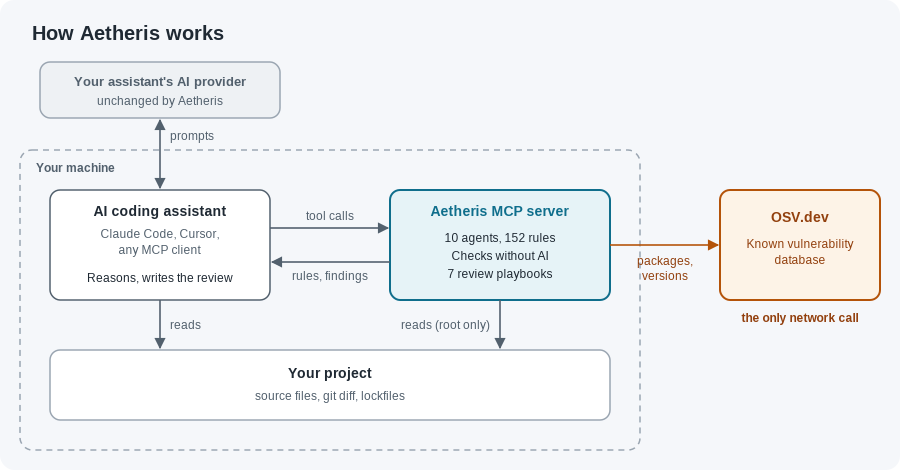
Ask Claude Code, Cursor or any MCP client to review a change, and it can call Aetheris for two kinds of help:
- Review rules from 10 agents: security, architecture, code quality, metrics, dependencies, type safety, performance, API contracts, data privacy, and QA synthesis, which merges the findings of the others into one report. Each rule says what to look for and how severe it is.
- Checks that need no AI: secret scanning, known vulnerabilities in your dependencies (from the OSV database), file metrics, duplicated code and circular imports. They also find API routes that nothing calls, calls to routes that do not exist, and code patterns for security, typing, performance and personal data. They return the same result every time.
Your assistant chooses which tools to call, reads your code and writes the review. Aetheris never calls a language model.
Install
Aetheris runs locally through uvx. There is no account to create.
The quickest way adds it to every client it finds (Claude Code, Cursor, Claude Desktop):
uvx --from adryserage-aetheris aetheris install
Add --client cursor to pick one client, or --project to write the current project's configuration. aetheris uninstall removes it. To set it up by hand instead:
Claude Code
claude mcp add aetheris -- uvx adryserage-aetheris
Cursor
Add this to .cursor/mcp.json in your project, or to ~/.cursor/mcp.json:
{
  "mcpServers": {
    "aetheris": {
      "command": "uvx",
      "args": ["adryserage-aetheris"]
    }
  }
}
Other MCP clients
Run uvx adryserage-aetheris as a stdio server.
Then ask your assistant something like "review my staged changes with Aetheris" or "run an Aetheris security audit on this repository".
Tools
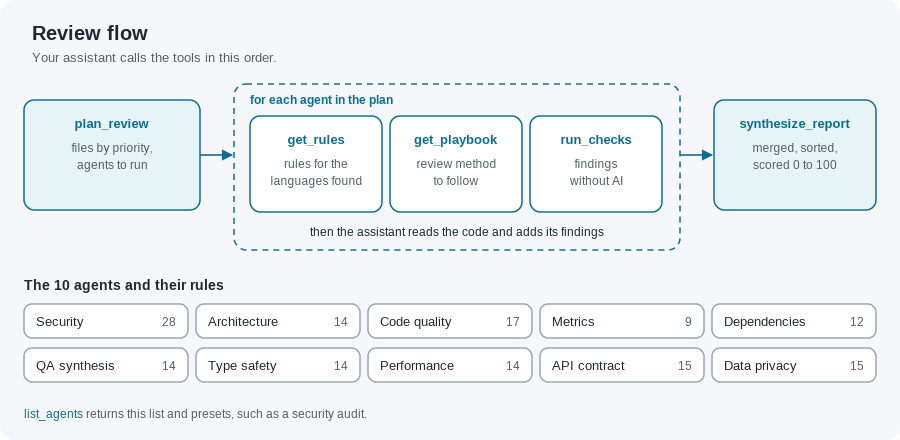
Aetheris exposes six tools. Together they form the review flow your assistant follows.
| Tool | What it returns |
|---|---|
list_agents |
The 10 agents (security, architecture, code quality, metrics, dependency, QA synthesis, type safety, performance, API contract, data privacy) and the preset agent sets, such as a security audit |
plan_review |
The files to review in priority order (your git diff, given paths, or the whole repository), the languages found, and the agents to run, each with its reason |
get_rules |
One agent's review rules, optionally for one language, and the schema of a finding |
run_checks |
Findings from one agent's checks: secrets, known vulnerabilities (OSV), metrics, circular imports, and security, typing, performance, API or personal data patterns |
get_playbook |
A review method to follow, such as a differential review of a diff or a false-positive check, adapted from Trail of Bits Skills. plan_review and get_rules say which ones apply |
synthesize_report |
One report from all findings: duplicates merged, sorted by severity, counted, and scored from 0 to 100 |
The 10 agents hold 152 rules, stored as YAML files in aetheris/rules/.
What leaves your machine
In local mode, Aetheris reads files under your project directory and sends nothing to any AI provider. The only network call is the dependency agent's osv_lookup check (run_checks with agent="dependency"), which sends package names and versions to the OSV API. Your assistant's own provider still sees whatever your assistant reads, as it does without Aetheris.
Contributing
Bug reports and ideas go to GitHub Issues. Pull requests target the main branch. Improvements to the review rules are as welcome as code.
Versions
A small change raises the last number of the version (4.0.1), a security fix the middle one (4.1.0) and a major change the first one (5.0.0), resetting the numbers after it. A release only ships important changes, so update to the latest version, not only to the last number. Every change is listed in CHANGELOG.md, and every version has a tag and a GitHub release.
Releases are rare: the maintainer cuts one when a change matters to many users. Until then, merged changes wait under [Unreleased]. To run the current main branch instead of the last release:
uvx --from git+https://github.com/adryserage/Aetheris adryserage-aetheris
Coming from 3.x
Version 4.0 removes the analysis commands, the AI provider integrations and the Railway worker. The aetheris command remains, to install the MCP server. Old commands such as aetheris analysis now print what changed and exit with code 2, so a CI job fails with a clear message. To keep using the 3.x CLI, pin the last 3.x release:
pip install "adryserage-aetheris==3.0.0"
License
Apache License 2.0. See LICENSE and NOTICE.
The playbooks in aetheris/playbooks/trailofbits/ are adapted from Trail of Bits Skills and stay under CC BY-SA 4.0. Each file names its author, its source and what was changed.
Downloads
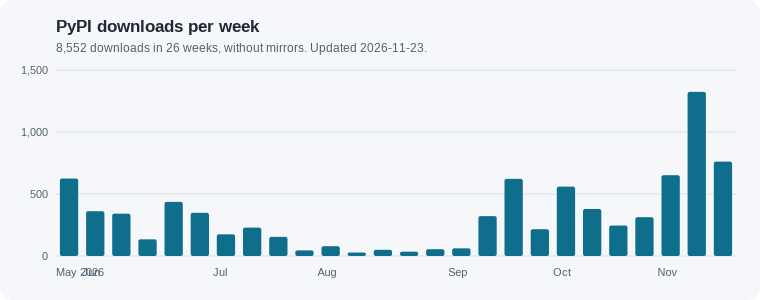
The chart is redrawn every day from pypistats.org, which keeps about six months of history. pepy.tech has the totals since the first release.
1 maintainer

Metadata
1 maintainer
Release files for adryserage-aetheris 5.0.0
For a detailed explanation of source distributions (sdists) and built distributions (wheels), please see the package formats documentation.
Source distribution (sdist)
| File | Size | Uploaded | Provenance | Actions |
|---|---|---|---|---|
| adryserage_aetheris-5.0.0.tar.gz | 136.4 kB | With provenance | Details for adryserage_aetheris-5.0.0.tar.gz |
Built distribution (wheel)
| File | Interpreter | ABI | Platform | Actions Reset |
|---|---|---|---|---|
| adryserage_aetheris-5.0.0-py3-none-any.whl | Python 3 | none | any | Details for adryserage_aetheris-5.0.0-py3-none-any.whl |
Total release size: 249.4 kB
Release files / adryserage_aetheris-5.0.0.tar.gz
| Download URL | adryserage_aetheris-5.0.0.tar.gz |
|---|---|
| Size | 136.4 kB |
| Tags | Source |
|
SHA-256 checksum How to use checksums |
ff2cb2f4e3517b5dfa3e1d31a7e1a8b0fd4671d375e4b6623a7633d43abe6197
|
|
BLAKE2b-256 checksum How to use checksums |
47b9a13b73f5e090e087c48d66602934edd4d5990249ae69bede0510b17b8cd4
|
| Upload date | |
|
Uploaded using Trusted Publishing? What is trusted publishing? |
Yes |
| Uploaded via |
twine/7.0.0 CPython/3.13.16
|
Provenance
Provenance describes where a file came from. On PyPI, provenance is shared via attestations, which provide a verifiable record of the build or publishing details. View details, limitations and caveats.


PyPI Publish Attestation
PyPI verified that this artifact, at this checksum, originated from the publisher listed below.
Signed by GitHub Actions, verified by PyPI on Nov 12, 2026.
Transparency logRelease files / adryserage_aetheris-5.0.0-py3-none-any.whl
| Download URL | adryserage_aetheris-5.0.0-py3-none-any.whl |
|---|---|
| Size | 113.0 kB |
| Tags | Python 3 |
|
SHA-256 checksum How to use checksums |
1ae8377f287ed1a0be508c3e110a6c8b93eccedd1676e797c4c6411bfc69b330
|
|
BLAKE2b-256 checksum How to use checksums |
7f89c794e2adbd5e53f5c6de3f0ce6a12f6f97d3f8cad419002ee37cf2815924
|
| Upload date | |
|
Uploaded using Trusted Publishing? What is trusted publishing? |
Yes |
| Uploaded via |
twine/7.0.0 CPython/3.13.16
|
Provenance
Provenance describes where a file came from. On PyPI, provenance is shared via attestations, which provide a verifiable record of the build or publishing details. View details, limitations and caveats.
PyPI Publish Attestation
PyPI verified that this artifact, at this checksum, originated from the publisher listed below.
Signed by GitHub Actions, verified by PyPI on Nov 12, 2026.
Transparency logSecurity for adryserage-aetheris 5.0.0
Provenance
Provenance describes where a file came from. On PyPI, provenance is shared via attestations, which provide a verifiable record of the build or publishing details. View details, limitations and caveats.
Full provenance
Both files in this release have been uploaded with provenance metadata.
Attestation for adryserage_aetheris-5.0.0.tar.gz
PyPI Publish Attestation
PyPI verified that this artifact, at this checksum, originated from the publisher listed below.
Signed by GitHub Actions, verified by PyPI on Nov 12, 2026.
Transparency logA note on package security
PyPI is a repository for distributing packages, not a service for auditing them. While third-party security researchers and our staff do their best to detect and remove malicious packages, PyPI cannot guarantee the quality, security or suitability of any given package.
To learn more about protecting yourself from malicious actors, visit our package security documentation.














