
Design Space Graph (ADSG Core)

Project description
The Design Space Graph (ADSG Core)



GitHub Repository | Documentation
The Design Space Graph (DSG) allows you to model design spaces using a directed graph that contains three types of architectural choices:
- Selection choices (see example below): selecting among mutually-exclusive options, used for selecting which nodes are part of an architecture instance
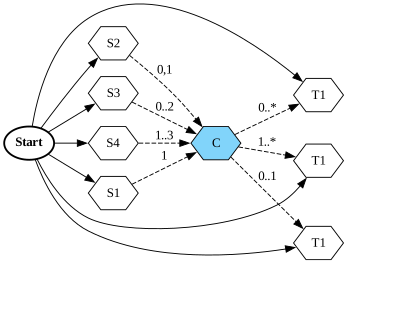
- Connection choices: connecting one or more source nodes to one or more target nodes, subject to connection constraints and optional node existence (due to selection choices)
- Additional design variables: continuous or discrete, subject to optional existence (due to selection choices)
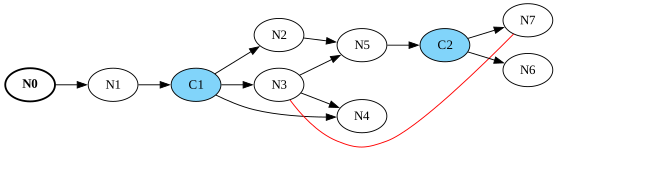
Modeling a design space like this allows you to:
- Model hierarchical relationships between choices, for example only activating a choice when another choice has some option selected, or restricting the available options for choices based on higher-up choices
- Formulate the design space as an optimization problem that can be solved using numerical optimization algorithms
- Generate architecture instances for a given design vector, automatically correct incorrect design variables, and get information about which design variables were active
- Implement an evaluation function (architecture instance --> metrics) and run the optimization problem
Note: due to historical reasons the package and code refer to the ADSG (Architecture DSG), because originally it had been developed to model system architecture design spaces. In the context of this library, the ADSG and DSG can be considered to be equivalent.
Installation
First, create a conda environment (skip if you already have one):
conda create --name dsg python=3.10
conda activate dsg
Then install the package:
conda install numpy scipy~=1.9
pip install adsg-core
Optionally also install optimization algorithms (SBArchOpt):
pip install adsg-core[opt]
If you want to interact with the DSG from a Jupyter notebook:
pip install adsg-core[nb]
jupyter notebook
Documentation
Refer to the documentation for more background on the DSG and how to implement architecture optimization problems.
Examples
An example DSG with two selection choices:
An example DSG with a connection choice:
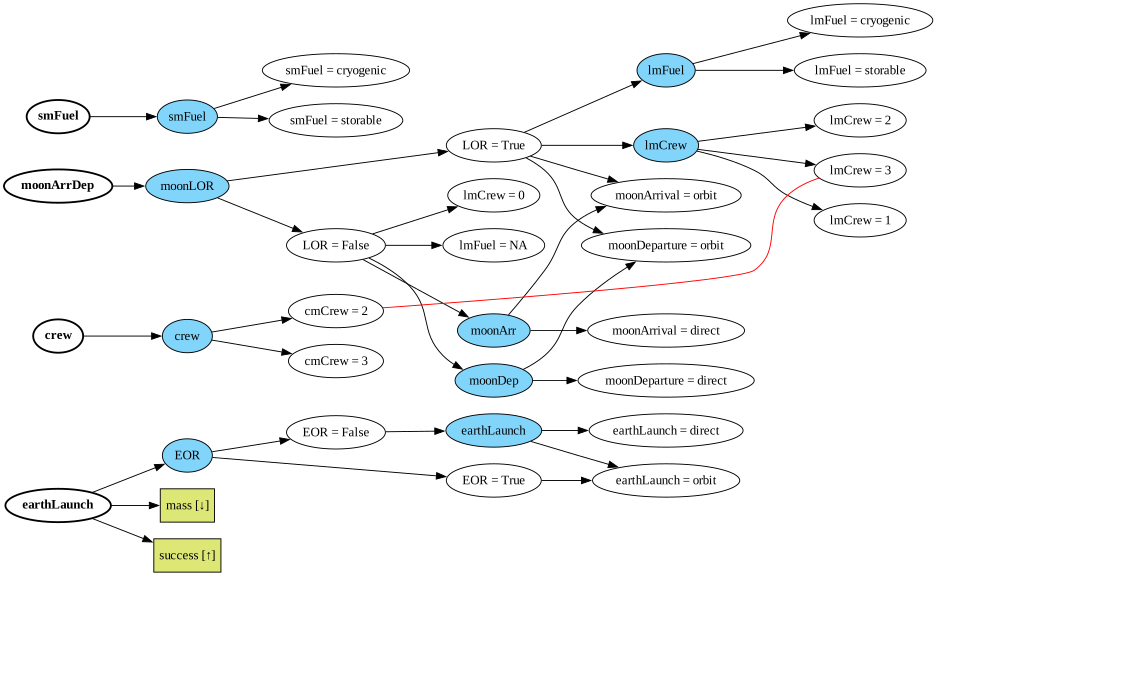
The DSG of the Apollo problem:
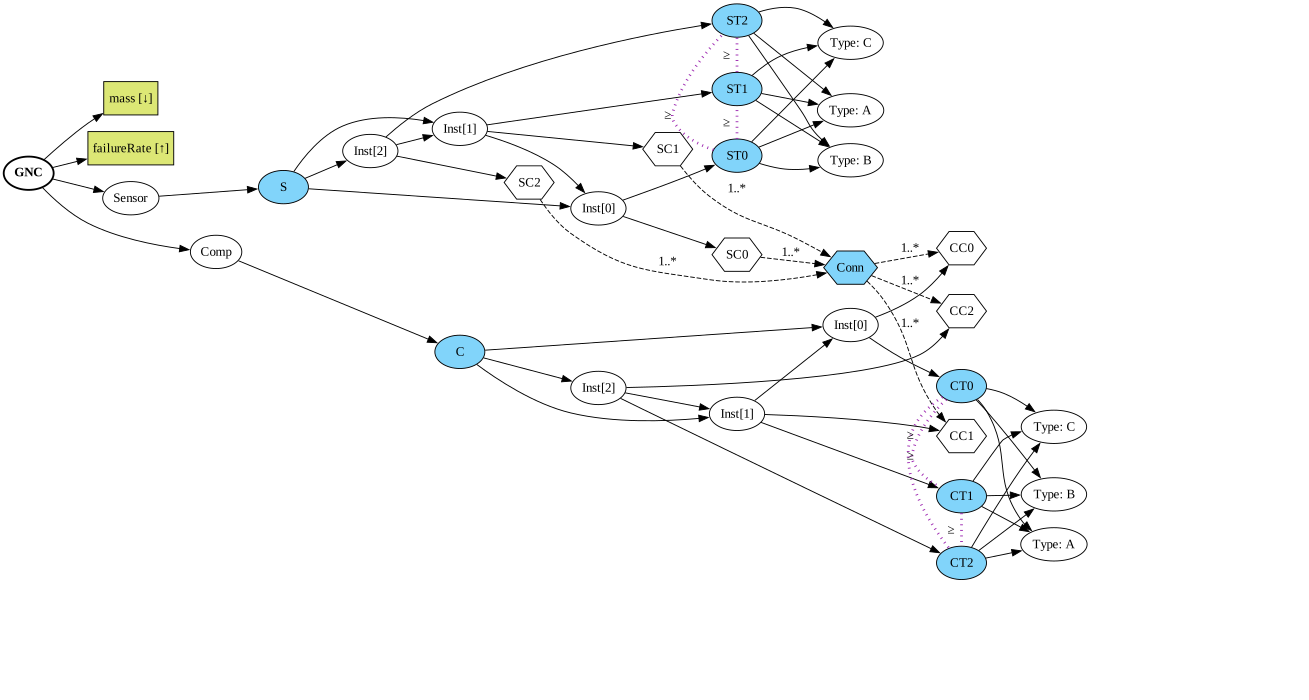
The DSG of the GNC problem:
Citing
If you use the DSG in your work, please cite it:
J.H. Bussemaker, L. Boggero, and B. Nagel. "System Architecture Design Space Exploration: Integration with Computational Environments and Efficient Optimization". In: AIAA AVIATION 2024 FORUM. Las Vegas, NV, USA, July 2024. DOI: 10.2514/6.2024-4647
Contributing
The project is coordinated by: Jasper Bussemaker (jasper.bussemaker at dlr.de)
If you find a bug or have a feature request, please file an issue using the Github issue tracker. If you require support for using the DSG or want to collaborate, feel free to contact me.
Contributions are appreciated too:
- Fork the repository
- Add your contributions to the fork
- Update/add documentation
- Add tests and make sure they pass (tests are run using
pytest)
- Read and sign the Contributor License Agreement (CLA) , and send it to the project coordinator
- Issue a pull request into the
devbranch
NOTE: Do NOT directly contribute to the adsg_core.optimization.assign_enc and .sel_choice_enc modules!
Their development happens in separate repositories:
Use update_enc_repos.py to update the code in this repository.
Adding Documentation
pip install -r requirements-docs.txt
mkdocs serve
Refer to mkdocs and mkdocstrings documentation for more information.
Release history Release notifications | RSS feed


Download files
Download the file for your platform. If you're not sure which to choose, learn more about installing packages.
Source Distribution
Built Distribution
Filter files by name, interpreter, ABI, and platform.
If you're not sure about the file name format, learn more about wheel file names.
Copy a direct link to the current filters
File details
Details for the file adsg_core-1.2.1.tar.gz.
File metadata
- Download URL: adsg_core-1.2.1.tar.gz
- Upload date:
- Size: 145.7 kB
- Tags: Source
- Uploaded using Trusted Publishing? No
- Uploaded via: twine/6.1.0 CPython/3.13.7
File hashes
| Algorithm | Hash digest | |
|---|---|---|
| SHA256 |
330d9c49150e3d7fc1e524271649bb3e24982ab52f7fd7a1754a0f634296a070
|
|
| MD5 |
24e8f5d26f74b4bdd1dc0214b2bb473a
|
|
| BLAKE2b-256 |
ce0b3b45ca6efd762b736f3f2e042e5b39164cba40abb4af56f62c007984e3fb
|
File details
Details for the file adsg_core-1.2.1-py3-none-any.whl.
File metadata
- Download URL: adsg_core-1.2.1-py3-none-any.whl
- Upload date:
- Size: 190.0 kB
- Tags: Python 3
- Uploaded using Trusted Publishing? No
- Uploaded via: twine/6.1.0 CPython/3.13.7
File hashes
| Algorithm | Hash digest | |
|---|---|---|
| SHA256 |
6acea0772a4f716112f7941fa6df3dc0d75fa4a4e6f2a474c58446284b6f91b5
|
|
| MD5 |
254553414850ba2308fb1ae08ae2dc03
|
|
| BLAKE2b-256 |
cbf677da65f51b80f38154506b9f91cd4937cafa9471f9895fec227abba1631b
|






