
⚡ Unlimited Context
Virtual memory for an LLM's attention. Keep a billion-token pool on your own disk; the model reaches it in slices, one small window at a time. Local-first, offline, free.
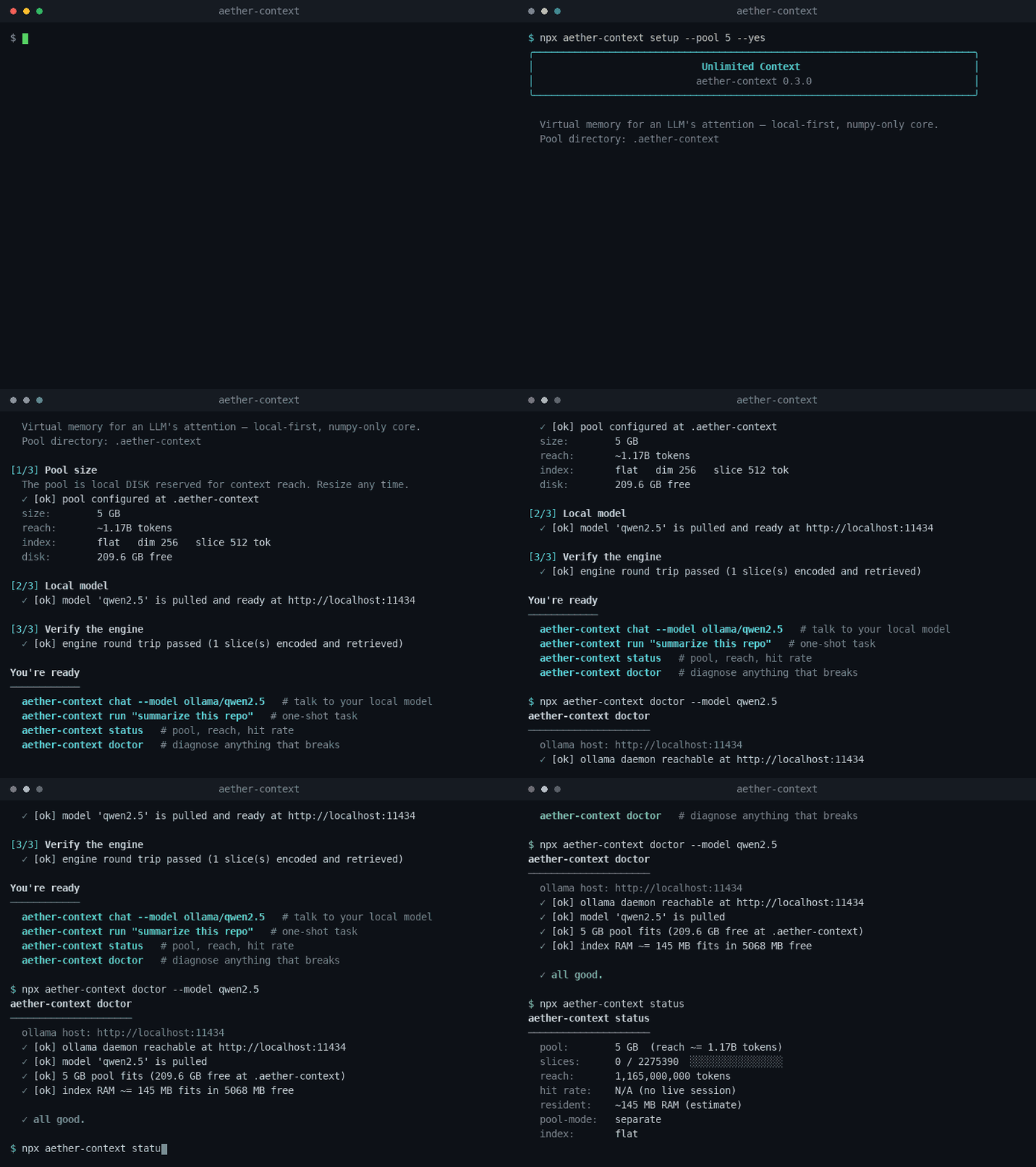






Your context window didn't get bigger. Its reach did. The model keeps its small window. The engine keeps a vast store on your disk and pulls the right slice back in while the model reasons. A small local model stays coherent across runs that would blow past any context window.
Install
pip install aether-context
aether-context setup
setup sizes the pool, checks for a local model, and verifies the engine end to end. It works
with no daemon, no network and no model pulled — the check runs against the built-in mock model.
Two run commands can use the same pool directory. The first task is stored as user-authored
memory; the second retrieves it before generation, even with the default separate pool mode:
aether-context run "remember: the deploy key rotates on Fridays" --dir ./pool
aether-context run "when does the deploy key rotate?" --dir ./pool
With the default mock model, the status lines from a fresh pool are:
[pool 5 GB | slices 2/2275390 | reach 1.17B tok | hit 0% | recalled 0 | mode separate | index flat]
[pool 5 GB | slices 4/2275390 | reach 1.17B tok | hit 0% | recalled 1 | mode separate | index flat]
The mock prints synthetic text, so use a real local model for an answer to the question.
recalled counts slices supplied before generation; hit remains the pager's warm-cache rate.
Only user and tool memory is supplied by default. run --include-model-memory also supplies
model-authored spill. Retrieved context is capped at 20% of the model window, with room reserved
for the task and output; a slice too large to fit is skipped.
from aether_context import Session

s = Session(model="ollama/qwen2.5", pool_gb=5)
s.run("Build me a full-stack weightlifting tracker app.")
# runs long. stays coherent. walk away.
Prefer npm? Same software, same release. The npm package is a launcher that installs the Python engine into a private virtualenv for you (it needs Python 3.10+ on your PATH):
npx aether-context setup
Other install routes
# Straight from source, always the latest main:
pip install git+https://github.com/AetherAI3/Unlimited-Context-LLM.git

# Isolated, if you only want the CLI:
pipx install aether-context
The distribution name is aether-context — pip install unlimited-context is not this
package.
That's the whole thing. One small model, one command, a billion tokens of reach behind it.
The problem
Long agentic runs all die the same way. The model fills its window, starts compressing its own history, silently drops the one detail that mattered three steps ago — and drifts. You've seen it: the runaway PR, the agent that rewrites a function it already wrote, the build that falls apart at hour two. Bigger windows just delay it, and a crammed 1M-token window rots in the middle anyway.
The fix isn't a bigger window. It's to stop throwing the overflow away. Instead of summarizing what spills over, Unlimited Context encodes it to a local pool on your disk and recovers the right slice exactly when it's needed. Nothing load-bearing is silently lost.
Compress & forget ✗ → Encode & recover ✓
How it works
It's virtual memory, for attention. Map it to an OS and it clicks:
| OS | Unlimited Context |
|---|---|
| RAM | the resident window the model sees now (small, fast) |
| Disk | the context pool — your encoded memory (~5 GB ≈ ~1B tokens) |
| Pager | the slice loader — prefetches the next slice from what the model is reasoning about right now |
| Page-replacement | the retention policy — useful slices stay, stale ones fade, anything relevant again comes back |
The pager runs concurrently with generation, so most of the fetch hides behind the model's own
thinking. Full explainer: docs/how-it-works.md.
What you get
- 🧠 Unbounded reach — ~1B tokens of encoded context in ~5 GB on disk; the model reaches it in slices.
- 🧩 MPO context chain — recall pulls the whole connected thread, not isolated nearest-neighbors.
- 🪟 Curated beats crammed — a small, relevant resident window outperforms a stuffed one (no lost-in-the-middle) — and costs less.
- 🔒 Local-first — your context never leaves your machine. Free storage, full privacy, works offline.
- 🤖 Any model — Llama, Qwen, Mistral, Phi — via Ollama, llama.cpp, or Hugging Face, or your own API-backed model.
- 📉 Coherence you can measure — the head-to-head is committed: same model, engine on vs off.
The proof
Not a synthetic micro-benchmark — a real, paid, end-to-end run. A reasoning model
(deepseek-v4-pro, via OpenRouter) driven through a 40-turn agent session that overflows its
window (2,000-token window, 60 real microsoft/vscode issues), measured engine off vs on —
one live run, $0.19, 2026-06-14.
- The model stops forgetting. Recall of early facts after they fall out of the window: 0.15 → 1.00. The baseline drifts and forgets; the engine holds every early fact — zero drift.
- Failure turns into success on the real work. Tasks completed correctly: 3 / 20 → 20 / 20.
- Cheaper, not just better. −24% total cost, −54% in the back half — the engine sends a compact recalled slice instead of dragging the whole transcript into every call.
| Metric | Off (baseline) | On (engine) | Change |
|---|---|---|---|
| Recall coherence (early facts still correct) | 0.15 | 1.00 | 6.7× |
| Work outcome (tasks done right) | 3 / 20 | 20 / 20 | 3 → 20 |
| Cost — full session | $0.0711 | $0.0542 | −24% |
| Cost — back half (recall phase) | $0.00117/turn | $0.00053/turn | −54% |
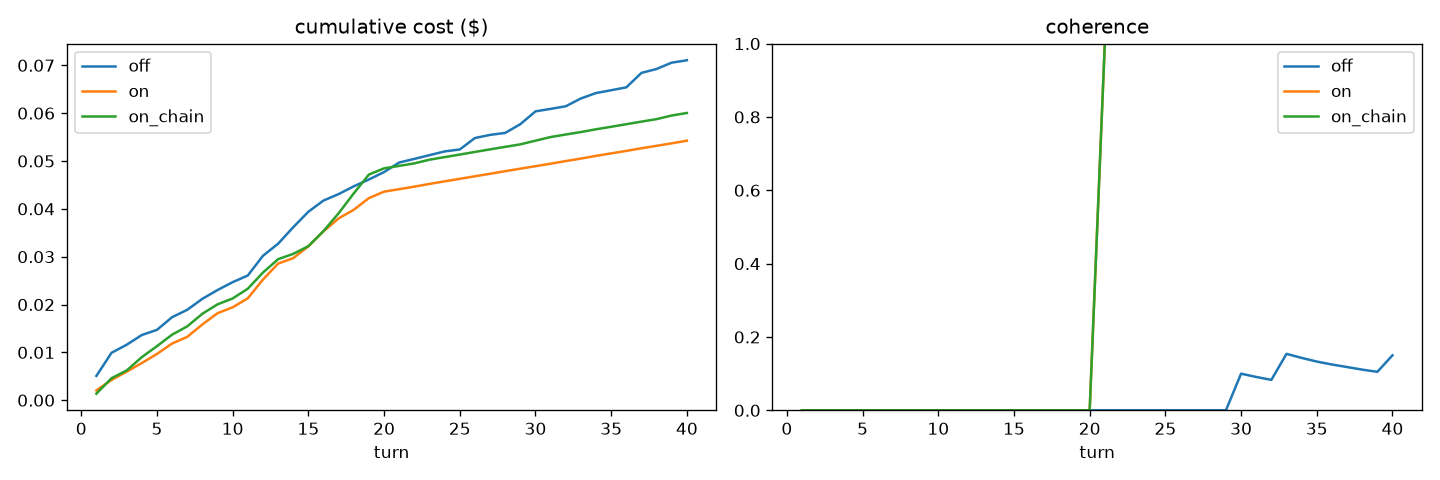
Committed data: full write-up ·
raw artifacts
(api_eval_results.json, api_eval_series.csv, api_eval_plot.png, RESULTS.md) · reproduce with
python -m bench.api_eval --model deepseek/deepseek-v4-pro --repo microsoft/vscode --arms off,on,on_chain --plot
Scope, honestly: this run used a hosted reasoning model, not a local one — the mechanism is
backend-agnostic, but the headline number is not a local number. It measures the engine
(retrieve-on-overflow memory), not the MPO chain: on this single-fact recall task the chain
ties plain recall (both 1.00), and its multi-slice edge is synthetic-only so far
(bench/chain_recall.py: connected-context recall 0.15 → 0.78), with the live thread run
pending, not yet claimed. The 2,000-token window is deliberately tiny to force overflow, so a
realistic window shows a smaller (still real) gain. N = 20 recall turns, single run.
Sizing: disk, reach and RAM
First run drops you into a slider — pick how much your model gets to remember:
$ aether-context init
──────────────────────────────────────────────────────────────────
  ⚡ choose your context pool          encoded reach · not a window
──────────────────────────────────────────────────────────────────
  ▸  5 GB   ████░░░░░░░░░░░░   ~1.16B tokens   a big project   (floor)
     10 GB  ████████░░░░░░░░   ~2.33B tokens   a large monorepo + docs
     15 GB  ████████████░░░░   ~3.49B tokens   multiple repos / long runs
     20 GB  ████████████████   ~4.65B tokens   massive corpus / power user
──────────────────────────────────────────────────────────────────
  reach ≈ pool_GB × 233M tokens     custom: --pool 12  (any size ≥ 5 GB)
  ↑/↓ slide      ↵ confirm

  pool [5]: 10
  ✓ 10 GB  →  your model can now reach ~2.33 billion tokens
One table for the whole trade-off — disk in, reach out, RAM cost, and how many isolated sessions fit on a small machine:
| Pool | Slices | Encoded reach | Index RAM | Sessions on 8 GB (separate pools) |
|---|---|---|---|---|
| 5 GB (floor) | 2.27M | ~1.16B tokens | ~146 MB | ~13 |
| 10 GB | 4.55M | ~2.33B tokens | ~291 MB | ~7 |
| 15 GB | 6.82M | ~3.49B tokens | ~436 MB | ~4 |
| 20 GB | 9.09M | ~4.65B tokens | ~582 MB | ~3 |
Roughly double the session counts on a 16 GB machine. Where the numbers come from: ~2.2 KB per
slice (a 256-dim vector + compressed text + metadata) ÷ 512 tokens per slice → ~455K slices/GB →
~233M tokens of reach per GB. So reach ≈ pool_GB × 233M. At the 5 GB floor that's about
9,000× a 128K window. Bump the pool anytime with aether-context --pool 20.
RAM is a formula, not a mystery. Vectors live on disk (mmap'd) — only the small index graph and a hot working set are ever resident:
RAM  ≈  ~180 MB   base (engine + shared static encoder)
      +  ~29 MB   per GB of pool   (resident index)
      +  ~30 MB   per active session
Sharing the pool is the biggest RAM lever. --pool-mode separate (default) gives every
session its own pool and index — fully isolated and private, but you pay one index per session, so
RAM scales with N × pool (that's the last column above). --pool-mode shared pays for the index
once; each extra session adds only ~30 MB, so 50–70+ sessions fit and CPU becomes the limit
instead of memory. The trade-off is that sessions can see each other's context. Use shared for
related work on one project, separate for unrelated tasks. A run invocation is a special case:
it recalls prior user/tool facts from the same pool directory on reopen, even in separate mode.
Use different directories when those tasks must not share memory.
How much building is that? A ~128K window fills after well under an hour of active agent work, then starts compacting and forgetting. Assuming a busy coding agent encodes ~300K–1M keep-worthy tokens an hour, a 5 GB pool covers on the order of 1,200–3,900 hours before it even fills — weeks of nonstop building. Because the retention policy fades stale slices, the pool never hard-stops anyway; it just keeps what's relevant.
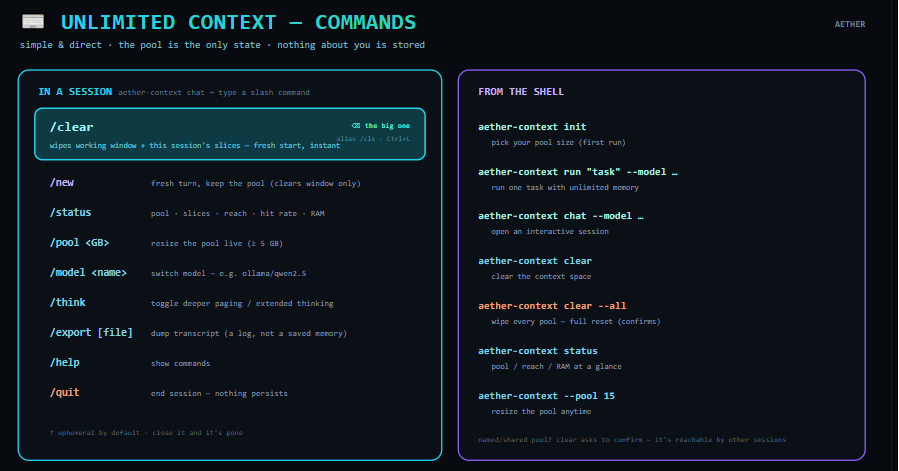
Honest: that's encoded reach, retrieved in slices — not a bigger attention window, and it rides on retrieval hit rate. A bigger pool buys more reachable codebase or corpus per session, never more concurrent sessions (those are RAM-bound).
--index tieredis reserved for a future paged-graph index and currently runs the flat index — it does not yet reduce resident RAM.
Commands
| Command | What it's for |
|---|---|
aether-context setup |
Start here. Guided first run: size the pool, check your model, verify the engine. |
aether-context init |
Pick your pool size — the on-disk storage slider — on first run. |
aether-context run "<task>" |
One-shot a task with full reach, then print the result. |
aether-context run "<task>" --no-mpo-chain |
Same, with the MPO context chain disabled (plain cosine). |
aether-context chat |
Open an interactive session; type /status anytime, /clear to reset. |
aether-context status |
See pool size, slices used, reach, and hit rate at a glance. |
aether-context doctor |
Check Ollama, your model, disk, and RAM before a long run. |
aether-context --pool 20 |
Resize the pool anytime (non-destructive re-index). |
Tip: run
aether-context doctorfirst — it catches the three things that ever go wrong (Ollama down, model not pulled, not enough disk) and prints the exact fix.
MPO: the context chain
Plain semantic search returns isolated nearest-neighbors — the single closest slices, ripped out of the thread they belonged to. Recall a fact and you often miss the three slices around it that made it make sense.
The MPO context chain links the session's slices into one connected structure, so when cosine pulls an entry slice, the chain pulls in the slices most coupled to it — widening the working set with the connected thread, not stray hits. Cosine is still the retrieval mechanism; the chain assists it.
The chain is Aether-tuned, deterministic and fully local — no training, no network. It is purely additive: it only ever adds connected context, never blocks or replaces a hit, and on any hiccup it falls back cleanly to plain cosine. In a planted-thread benchmark it lifts connected-context recall from 0.15 (cosine alone) to 0.78 — over 5× more of the right thread in the window. That result is synthetic so far; see the caveat under The proof.
On by default:
Session(model="ollama/qwen2.5", pool_gb=10)                  # chain on by default
Session(model="ollama/qwen2.5", pool_gb=10, mpo_chain=False) # plain cosine
aether-context run "..." --no-mpo-chain # disable for one run
The aether coding terminal
aether is an open-source agentic coding terminal that runs on this engine. Turns run on your
local Ollama by default — no account, no network; sign in and they switch to
the Aether cloud API. It ships as its own package:
pip install aether-agent # or: npm install -g aether-agents
aether opens the REPL, aether "<prompt>" is a one-shot turn, and aether code "<task>" is an
autonomous coding run on the Unlimited Context brain (test-gated, git-checkpointed). Full command
list, slash commands and backend settings live at
AetherAI3/aether-agent.
The aether_agent/ directory in this repo is the Python-native twin — same commands, same
backend, same tools — kept here for development and deliberately not published from this
package: PyPI's aether-agent already owns that import path and the aether command, so shipping
a second copy would silently overwrite it wherever both are installed. From a clone with Ollama up,
python -m aether_agent.smoke runs the SSRF guard, a real local turn, a web search and fetch, and
the cloud path when signed in.
Safety and use policy
Giving a model durable memory is powerful, and the failure modes are real: runaway agents, grounding drift, an agent's own notes hardening into its rules. What those are and what we do about them is written up in Ethical & Safety Measures. Use of the project is governed by the Acceptable Use Policy — by using the project you agree to and are bound by its terms.
Honest about the word "unlimited"
"Unlimited" means reach, not attention. Your model keeps its native window; the engine makes it reach a billion-token pool in slices, via fast retrieval. The whole thing rides on retrieval hit rate — when that's high, and the loader is built to keep it high, the pool feels like one seamless context. When it isn't, you get a miss, and a miss looks like forgetting. The measured evidence for all of this is in The proof, caveats included.
Contributing
PRs and issues are welcome — start with CONTRIBUTING.md. There are open issues tagged good first issue and help wanted right now, including an LM Studio backend, a Windows quickstart, and a recall-quality benchmark at 100K / 1M / 10M tokens.
Runnable examples live in
examples/ — start with
quickstart.py,
then coding_agent.py.
If the engine earns its place in your setup, a star helps other people find it.
Citation
If Unlimited Context helps your work, please cite it. Built and maintained by Aether AI.
@software{unlimited_context_2026,
  title        = {Unlimited Context (aether-context): virtual memory for LLM attention},
  author       = {Barrante, Brandon},
  organization = {Aether AI},
  year         = {2026},
  url          = {https://github.com/AetherAI3/Unlimited-Context-LLM},
  license      = {Apache-2.0}
}
GitHub's "Cite this repository" button reads
CITATION.cff directly.
License
Apache-2.0. Use it, fork it, ship it in your product.
1 maintainer

Metadata
1 maintainer
Release files for aether-context 0.5.0
For a detailed explanation of source distributions (sdists) and built distributions (wheels), please see the package formats documentation.
Source distribution (sdist)
| File | Size | Uploaded | Provenance | |
|---|---|---|---|---|
| aether_context-0.5.0.tar.gz | 236.4 kB | With provenance | Details |
Built distribution (wheel)
| File | Interpreter | ABI | Platform | Reset |
|---|---|---|---|---|
| aether_context-0.5.0-py3-none-any.whl | Python 3 | none | any | Details |
Total release size: 375.6 kB
Release files / aether_context-0.5.0.tar.gz
| Download URL | aether_context-0.5.0.tar.gz |
|---|---|
| Size | 236.4 kB |
| Tags | Source |
|
SHA-256 checksum How to use checksums |
a0fb783648e3eeca93513503d5e496f12b16762e68d626a79cce233aa177c93e
|
|
BLAKE2b-256 checksum How to use checksums |
5b3e3bf1abce89cabd87573483ffb8ca37d227c5a1f3054bf15b05765c700703
|
| Upload date | |
|
Uploaded using Trusted Publishing? What is trusted publishing? |
Yes |
| Uploaded via |
twine/7.0.0 CPython/3.13.14
|
Provenance
Provenance describes where a file came from. On PyPI, provenance is shared via attestations, which provide a verifiable record of the build or publishing details. View details, limitations and caveats.


PyPI Publish Attestation
PyPI verified that this artifact, at this checksum, originated from the publisher listed below.
Signed by GitHub Actions, verified by PyPI on Sep 27, 2026.
Transparency logRelease files / aether_context-0.5.0-py3-none-any.whl
| Download URL | aether_context-0.5.0-py3-none-any.whl |
|---|---|
| Size | 139.2 kB |
| Tags | Python 3 |
|
SHA-256 checksum How to use checksums |
b70ee3fdb78d143e247d63e3861c585c46827abad69eafae8b0092420e9cebff
|
|
BLAKE2b-256 checksum How to use checksums |
e2e2d63d8052e71ae8f79201e1e1c8fe5e0bc312b55c2733500b43a0aedf442e
|
| Upload date | |
|
Uploaded using Trusted Publishing? What is trusted publishing? |
Yes |
| Uploaded via |
twine/7.0.0 CPython/3.13.14
|
Provenance
Provenance describes where a file came from. On PyPI, provenance is shared via attestations, which provide a verifiable record of the build or publishing details. View details, limitations and caveats.
PyPI Publish Attestation
PyPI verified that this artifact, at this checksum, originated from the publisher listed below.
Signed by GitHub Actions, verified by PyPI on Sep 27, 2026.
Transparency logSecurity for aether-context 0.5.0
Provenance
Provenance describes where a file came from. On PyPI, provenance is shared via attestations, which provide a verifiable record of the build or publishing details. View details, limitations and caveats.
Full provenance
All 2 files in this release have been uploaded with provenance metadata.
Attestation for aether_context-0.5.0.tar.gz
PyPI Publish Attestation
PyPI verified that this artifact, at this checksum, originated from the publisher listed below.
Signed by GitHub Actions, verified by PyPI on Sep 27, 2026.
Transparency logA note on package security
PyPI is a repository for distributing packages, not a service for auditing them. While third-party security researchers and our staff do their best to detect and remove malicious packages, PyPI cannot guarantee the quality, security or suitability of any given package.














