
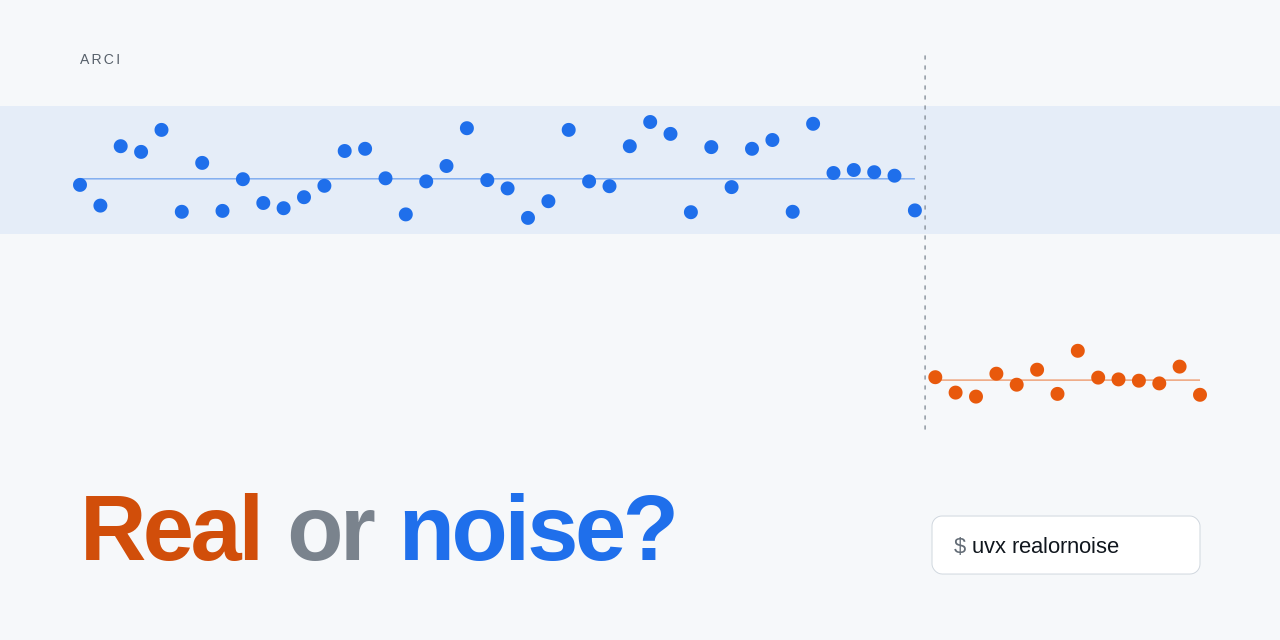
Did your agent get worse? Real, noise, or cannot tell.

ARCI (agent-reliability-ci) offers three comparisons with increasing effort and evidence. Each prints the assumptions it cannot check.
1. Logs you already have. If you use Claude Code or Codex, the session logs on your disk record how the model behaved each day. One command compares recent days with earlier ones:
uvx --python 3.14 realornoise
Python 3.14 reads compressed Codex logs; uvx downloads it if missing.
On the packaged example data (uvx --python 3.14 realornoise --example):
RESULT: REAL DROP
reasoning tokens per response 986 (42)      529 (14)     -46%    real drop
The tool sends nothing; installing it downloads the package. The output holds counts, rates, dates and bounded model, effort
and client-version names. It shows what your logs recorded, not why: your tasks, prompts and client
may have changed too. With a short history the usual answer is CANNOT TELL.
How to read it ·
the method and its limits
2. Results you already have. arci verdict decides a baseline against a candidate from
pass/fail results another tool produced (Inspect AI, pytest, CSV).
Recipe
3. Controlled trials. arci run runs the old agent and the new one on the same predeclared
tasks, injects tool timeouts, errors and empty results, and returns PASS, BLOCK,
INCONCLUSIVE or ERROR. A PASS or BLOCK is wrong at most 2.5% of the time each, at the
defaults and under assumptions ARCI states and does not check.
Start here · no install: uvx --from agent-reliability-ci arci demo
New in 2.4: compare the setting you use now
arci logs compares the model and effort used most after the split, instead of the most used over the whole window.
--keep saves daily counts beyond vendor retention. Claude Code deletes session files after 30 days by default (cleanupPeriodDays; settings reference, read 15 Nov 2026).
With a short history the usual answer is CANNOT TELL. When days are too few, the output names the earliest possible test date, conditional on daily usable counts and retained earlier days.
Packaged example data (arci logs --example), Claude Code:
RESULT: REAL DROP
reasoning tokens per response 986 (42)      529 (14)     -46%    real drop
The output states the largest wrong-REAL-DROP rate of the rule as built, over all histories, in the self-check's correlation, weekly-cycle and regime cells: 18.1%, at 14/16 after/before days in regimes (362/2000 = 0.181000 [0.164743, 0.198480], Wilson 95% interval, seed 18112185).
For AR(1) correlation 0.5 and log SD 0.45, the rule as built measured wrong REAL DROP at 0.092500, 0.036000 and 0.005000 for 5/10, 7/21 and 14/42 days (2000 histories each).
Work in phases can break the bound; other patterns can give more. These logs cannot establish cause, answer quality or a model change.
Claude Code: /plugin marketplace add ajaysurya1221/agent-reliability-ci, /plugin install realornoise@agent-reliability-ci, then /realornoise:realornoise.
Codex: copy integrations/codex/skills/realornoise into ~/.agents/skills/. Both skills put the printed numbers into the conversation.
Recipe · Statistics and limits · Design record.
New in 2.2: a verdict from results another tool produced
Imported outcomes. arci verdict decides a baseline against a candidate from pass/fail
results another tool already produced (Inspect AI, pytest, or CSV/JSONL), using ARCI's existing
decision rule; arci verdict-rule writes a rule file from those results' task ids. ARCI runs
nothing on this path: no fault injection, no fault accounting, no replay.
uvx --from agent-reliability-ci arci verdict --example
Descriptive verdict: the rule file declares it was written after outcomes existed. The error bound is not claimed.
VERDICT: BLOCK (exit 1)

BLOCK threshold crossed
Once installed: arci verdict --example (drop the uvx --from agent-reliability-ci prefix).
A rule written from files that already exist is always labelled a descriptive verdict and
never claims the error bound; claiming the bound needs a rule written and declared
fixed_before_runs: true before either arm ran. See the
verdict recipe.
Controlled trials: arci run
PASS means only this: for this predeclared experiment, the evidence supports that any reliability drop from baseline to candidate is smaller than the allowed drop. It is not a claim of absolute reliability.
A small first run will often be INCONCLUSIVE. That is a valid result; use arci plan before
choosing a larger confirmatory run.
ARCI observes calls that cross its tool boundary. It is not a sandbox, it does not replay model inference, and trace divergence shows where runs differ, not why.
A LangChain create_agent example, offline, no API key:
pip install 'agent-reliability-ci[langchain]'
mkdir try-arci && cd try-arci && arci init --langchain && arci run arci.yaml
VERDICT: BLOCK (exit 1)
pairs: 96 (192 trials)
baseline 96/96 passed, candidate 48/96 passed
The candidate is the baseline with one retry removed. Next:
swap the model ·
your own agent ·
plain Python functions ·
no install: uvx --from agent-reliability-ci arci demo
baseline + candidate → same predeclared tasks/faults → repeated trials → verdict
For single-task experiments a failing trial can then be minimised and replayed; for suites those commands are not built yet.
New in 2.0: many tasks, and LangChain agents
Suites. v1 gates one task under a few fault conditions. A suite registers many tasks by fault conditions and gates the suite average, in rounds, stopping as soon as the evidence decides. A PASS covers the average and can hide a regression in one task, so the per-task table sits beside every verdict. Verdicts are given only at the end of complete rounds; when every pair is a tie, a PASS needs 79 pairs at the default margin. The statistics and their assumptions are in docs/STATISTICS_SUITE.md.
LangChain. If your agent is built with create_agent, ARCI can run it behind its tool
boundary: you supply your tools, two settings functions and a check.
pip install 'agent-reliability-ci[langchain]>=2.0.0'
mkdir try-arci && cd try-arci && arci init --langchain && arci run arci.yaml
That runs a 24-task example offline with a scripted model and ends in BLOCK, by
construction. To compare real models, see
examples/langchain_quickstart and the
recipe.
Two recorded comparisons. Both pre-registered, with the prediction written first, on two local models (12B baseline, 4B candidate, temperature 0.7) and the 24-task example.
| Run 1: a wrong tool call ends the trial | Run 2: the tool's error is returned to the model | |
|---|---|---|
| Prediction | PASS (wrong) |
INCONCLUSIVE (right) |
| Verdict | BLOCK after 1 round |
INCONCLUSIVE after 5 rounds |
| Baseline passed | 96 of 96 | 480 of 480 |
| Candidate passed | 70 of 96 | 428 of 480 |
Run 1's write-up first called the gap a capability gap. A reader pointed out that the tool raised an exception the model never saw, so one wrong call was fatal. The correction and run 2 came from that comment. In run 2 the small model made the same wrong first call as often and went on to pass in most of those trials; 77 of its passes came after a tool error that would have ended the trial under run 1's set-up. Most of its remaining failures (41 of 52) had both an injected fault and a tool error of this kind in one trial. These are two runs on one suite and say nothing about the models elsewhere. Write-up: docs/results/order-desk-study.md. Reports: run 1, run 2.
Since 2.1. Suite reports show, per arm, which tools were never called and how many trials had a recorded tool failure without an injection marker, and how many of those passed. The record does not show why a call failed. The quickstart compares two different models with everything else equal (model swap).
Related tools
As each project describes itself; read in November 2026, not tested here. Corrections are welcome as issues.
- Tools about "did the model get worse", as they describe themselves, read 16 Nov 2026, not tested here: is-it-nerfed, "A Claude Code plugin that checks your own logs for proof". It asks Sonnet subagents whether you had to correct the model, for a sample of your prompts, and compares the last two weeks with an earlier window. livenerf, "A long-running, deterministic-as-possible benchmark for detecting whether a frontier model gets quietly worse after launch".
- Fault injection for agent tool calls: agentchaos-sdk, probe-ai, flakestorm, chaos-agents, agentfuzz, agentic-chaos, and the chaos testing in Strands Evals.
- Sequential tests with a bounded false-alarm rate for agent verifiers: E-valuator.
- Three-valued verdicts (PASS, FAIL, INCONCLUSIVE) for agent regression testing: AgentAssay.
- Statistical comparison of two evaluation runs from their result files: evalsig (paired tests, sequential testing and a release gate), and the evaluation comparison in inspect-mlflow (McNemar's test on two Inspect AI logs).
- Repeated trials with confidence intervals: agentrial. Repeated runs against a pass-rate threshold in pytest: pytest-agent-eval.
- A reliability platform for tool-using agents with fault injection and statistical scoring: agent-reliability.
- Evaluation platforms and frameworks (LangSmith, promptfoo, DeepEval, Inspect AI, Braintrust, Phoenix) score and compare runs; use them for that.
Tools that read the same local logs include ccusage
(npx ccusage, usage and cost from local logs). The following descriptions are quoted from
those projects: kiyoakii/is-gpt-nerfed,
"Shrinkflation detector for Codex"; NerfTrack/NerfTrack,
"Think Codex limits got nerfed by can't prove it? Prove it with NerfTrack!";
One-Lyf/claude-nerf-watcher,
"Claude Code skill: is your plan quietly giving you less? Tracks work per 1% of the 5-hour limit vs your own baseline.";
lucemia/claude-session-analyzer,
"Quantitative analysis tool for Claude Code session logs — thinking depth, Read:Edit ratio, behavioral signals, sentiment, cost. Replicates methodology from anthropics/claude-code#42796";
jspaterson000/nerfd,
"The public record of how AI coding models actually perform on real work. Local-first, privacy-first scorecard captured from Claude Code, Codex, OpenCode and other terminals.";
tendaigomo/NerfWatch,
"The Taravangian Test for AI: catch silent model degradation before your users do. SPC-based reasoning-quality monitoring for Claude, GPT, Gemini, and Grok."
haowang02/codex-candy-eval is a script that
re-runs one question against Codex; its own description is in Chinese.
ARCI did not test any of these tools and does not claim to be the only tool of this kind.
ARCI joins injected tool faults, a baseline-against-candidate verdict from a rule fixed before the run, a stated bound on each kind of wrong statistical verdict, and a count of whether each fault fired. The local-log comparison is a separate observational method.
Try the offline demo
Python 3.11+, POSIX and uv. Installation needs network; the fixture makes no model calls.
uvx --from agent-reliability-ci arci demo
arci demo runs a packaged copy of the seeded inventory fixture (arci.demo): the same world, agents,
seeds and sample size as the recorded run below, so it computes 192/200 baseline successes and
132/200 retry-removed successes fresh on your machine and says whether they matched the recorded
run. It is a reproduction, not the recorded evidence. The six steps go through the real CLI and the
Python API, each trial in a fresh process with a separate grader process. Runtime depends on the
machine and current load (measured: 38 s on a 15-core Apple Silicon Mac with 8 workers; 72 s through
uvx from a local wheel including environment creation; CI runners are slower). just demo runs the checkout script
examples/retry_agent/hero_demo.py, the same six steps. Lines from the recorded run:
=== 2. The frozen experiment, N=200 per arm, fault: tool_timeout on reserve
  VERDICT: BLOCK (exit 1)   [A vs agent_b]
  VERDICT: PASS (exit 0)   [A vs agent_a]

=== 3. Where do a passing and a failing run part ways?
  left: tool_start tool="reserve" arguments={"order_id":"order-7","quantity":2,"sku":"widget"}
  right: tool_start tool="confirm" arguments={"order_id":"order-7","sku":"widget"}
  after_injection: tool_timeout

=== 4. Shrink the failing condition (3 injected faults)
  kept: tool_timeout
  removed: empty_result, tool_error_once
  minimality: 1-minimal

=== 5. Replay the reduced bundle offline
  REPRODUCED: failure reproduced
Copied from the unedited, committed log
hero-demo-2026-10-05.txt, without
the ok lines. Step 1 passes both agents on one clean run; step 6 passes the repaired agent C on
the exact reproducer and on its own frozen experiment; the run ends All six steps held, exit 0.
The experiment is also a frozen acceptance test (test_hero.py).
Agent B is not rigged with dice. It is agent A with the retry around reserve removed, a plausible
refactoring slip: when reserve times out it carries on to confirm and still reports success. Its
failure rate comes from the environment. Reservations already exist with configured probability
65% (135 of the default 200 seeds, plus 8 scenarios with a naturally flaky confirm; shares set in
world.py, counts asserted in
test_retry_example.py), and in those the missing retry
never matters. That is exactly why one run hides it.
Recorded result and evidence
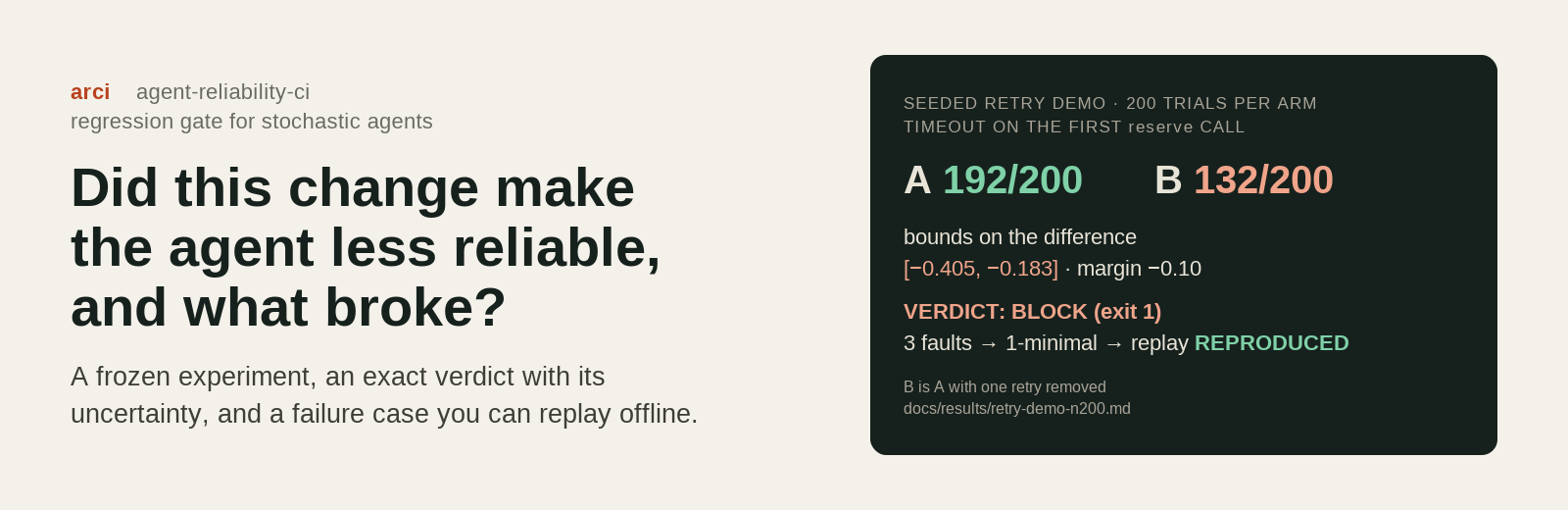
Recorded fixture: 200 trials per arm; timeout on reserve.
Baseline: 192/200. Retry removed: 132/200. Verdict: BLOCK (exit 1).
Recorded results · Trace, reduction and replay
Evidence: 18 archived decisions re-derived · Frozen contracts · Design records · CI and macOS statistics checks
Re-derived means each archived decision.json regenerates byte for byte from its committed
inputs, whatever its verdict: reproducing a BLOCK, INCONCLUSIVE or ERROR counts, and no archived
run is turned green (reproduction recipe,
CITATION.cff).
Review a retry-policy change before merging
In the recorded inventory-reservation fixture, the candidate loses its retry after a timeout. ARCI reports BLOCK, locates the trace divergence, reduces three injected faults to one, and reproduces the failure offline. The repaired candidate passes the reproducer and its own separately frozen experiment.
Scaffold your own experiment with
arci init(below), or start from the example’s manifest builder. Define the oracle, fault conditions, margin and sample size before running. A small experiment may remain INCONCLUSIVE.
Manifest builder of the recorded run: examples/retry_agent/experiment.py.
Verdicts and exit codes
Every gating command ends in a verdict and an exit code. Nothing else decides.
| Verdict | Exit | Meaning |
|---|---|---|
PASS |
0 | The candidate is non-inferior to the baseline within delta. Nothing about absolute reliability. |
BLOCK |
1 | The candidate is worse by more than delta, or it broke a hard invariant. |
INCONCLUSIVE |
2 | Not enough evidence either way. CI stays non-green. No regression is claimed. |
ERROR |
3 | The experiment is invalid: a harness or grader fault, a missing, duplicated or foreign trial, a broken seal. It can never pass. |
An agent crash, timeout, blown budget or uncaught tool fault is a FAIL. A broken environment,
injector, grader or event sink is an ERROR, and it invalidates the experiment instead of quietly
leaving the denominator. arci replay uses its own codes: 0 reproduced, 1 not reproduced, 3 invalid.
Diagnose failures and compare recorded runs
arci triage RUN_DIR finds up to three representative candidate failure groups,
selects their scheduled baseline partners and names the containing tool events at
the first recorded difference. It reads existing stores without executing agents
or writing evidence. Start with the packaged offline fixture:
arci demo --workers 4 --keep arci-triage-demo
arci triage arci-triage-demo/runs/arci-demo-agent_b-reserve-timeout-200
The second command returns the whole-run BLOCK (exit 1). Use --format json
for coding agents or CI, or --trial ID to inspect a particular candidate trial.
Triage preserves the statistical exit; a diagnostic validation failure exits 3.
A selected trace can MATCH while its whole run is BLOCK or INCONCLUSIVE. The
triage recipe
explains selection, context and how to save a report without masking that exit.
arci trace-check BASE_RUN BASE_TRIAL CAND_RUN CAND_TRIAL compares selected recorded
tool behavior across compatible native stores and reports MATCH (0), DRIFT (1),
or INVALID (3). It reads sealed records without executing agents; --format json
includes source hashes, the re-derived statistical verdicts, and the first difference.
This is a diagnostic result: a match does not establish reliability or successful replay,
and drift does not prove a regression. The offline recipe
shows the missing-retry example and preserves both statistical and comparison exits in CI.
New in v1.0.0: triage and trace-check are absent from v0.8.0.
Independent agent QA is not human adoption or retention; both remain unmeasured.
Use this workflow to explain an ARCI experiment's decision from its recorded evidence. Snapshot testing and general trace viewers already exist; ARCI keeps diagnosis attached to its declared statistical design and scheduled trial pairs. The v1 compatibility contract covers documented commands, exit meanings and versioned evidence formats.
How it works
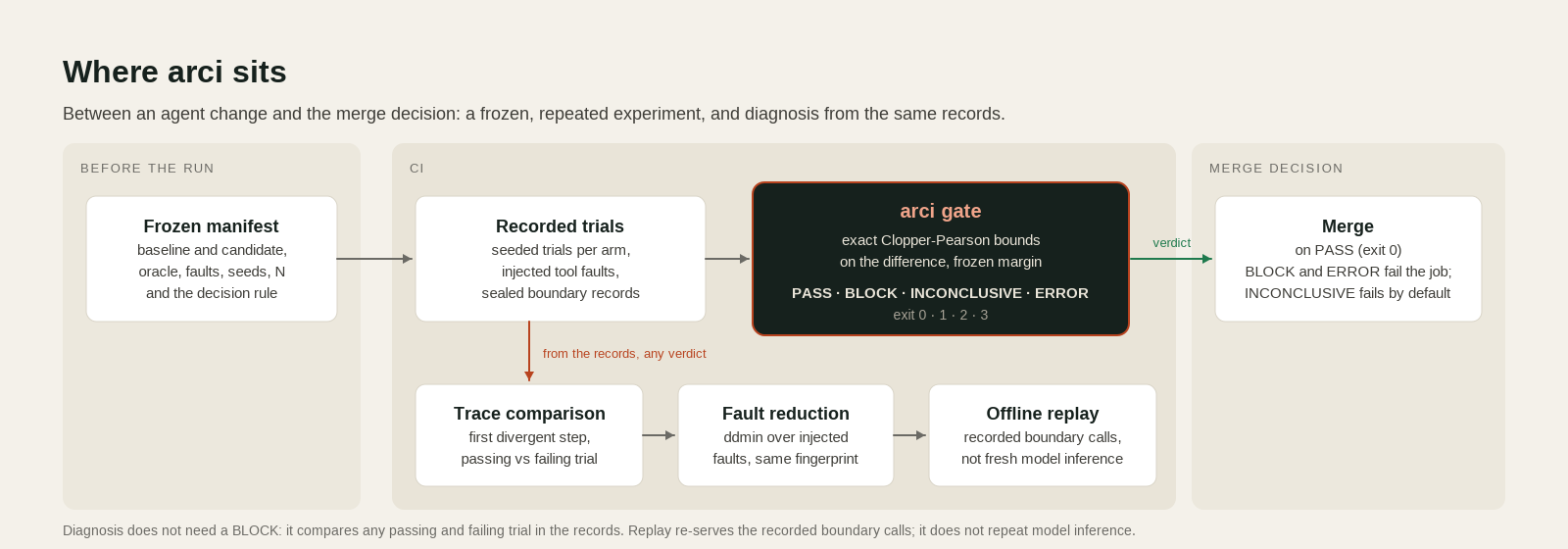
In words: the manifest (task, toolset, oracle, contract, both arms, fault conditions, alpha,
delta, n_per_arm, seeds) is sealed before the run. Each trial runs as a Python worker or a
command agent behind an MCP boundary, with a separate grader process; the tool boundary applies
budgets and seeded faults and records every call into sealed trials.jsonl. The gate is a pure
function of manifest and trials. Diagnosis reads the same records, whatever the verdict: diff
(first divergence), minimize (ddmin over injected faults, same failure fingerprint), bundle
and replay (re-serves recorded boundary calls: REPRODUCED, NOT_REPRODUCED or INVALID).
A Python agent is a plain function, agent(task, tools, rng) -> dict. It calls tools.call("name", ...)
and may annotate its reasoning with tools.note_model_step(...). Success is decided by an oracle
over the environment's final state, never by what the agent says about itself.
A gate that can say "I do not know". The rule is fixed-sample and deliberately boring
(docs/STATISTICS.md): per arm, an exact Clopper-Pearson interval at tail
alpha / (4K); bounds on the difference by Bonferroni; PASS iff the lower bound is above
-delta, BLOCK iff the upper bound is below it. No peeking, no extending a run, no rerunning
until green. The decision rule is bound into every trial's identity, so a manifest resealed after
the run with a different rule no longer matches its trials and the gate returns ERROR: choosing
the rule after the data is detected, not merely forbidden. Earlier runs on the same candidate are
listed in prior_runs and printed in the decision and the Markdown report; arci does not
discover them or enforce a cross-run error budget for you. Wilson intervals are shown for
readability and never decide.
Command agents. An agent does not have to be a Python function: it can be any program
that speaks MCP over stdio. arci owns the one MCP server behind it, so every tool call is
recorded, budgeted, fault-injected and replayable from outside the agent's process.
your agent (any argv) --> arci.mcp_shim --> arci.mcp_boundary --> MCP server (the environment)
                          byte relay        recorder, faults,     yours, or any python toolset via
                                            budgets, latches      python -m arci.mcp_toolset_server
docs/REAL_AGENTS.md has the recipe and the local-model worked example.
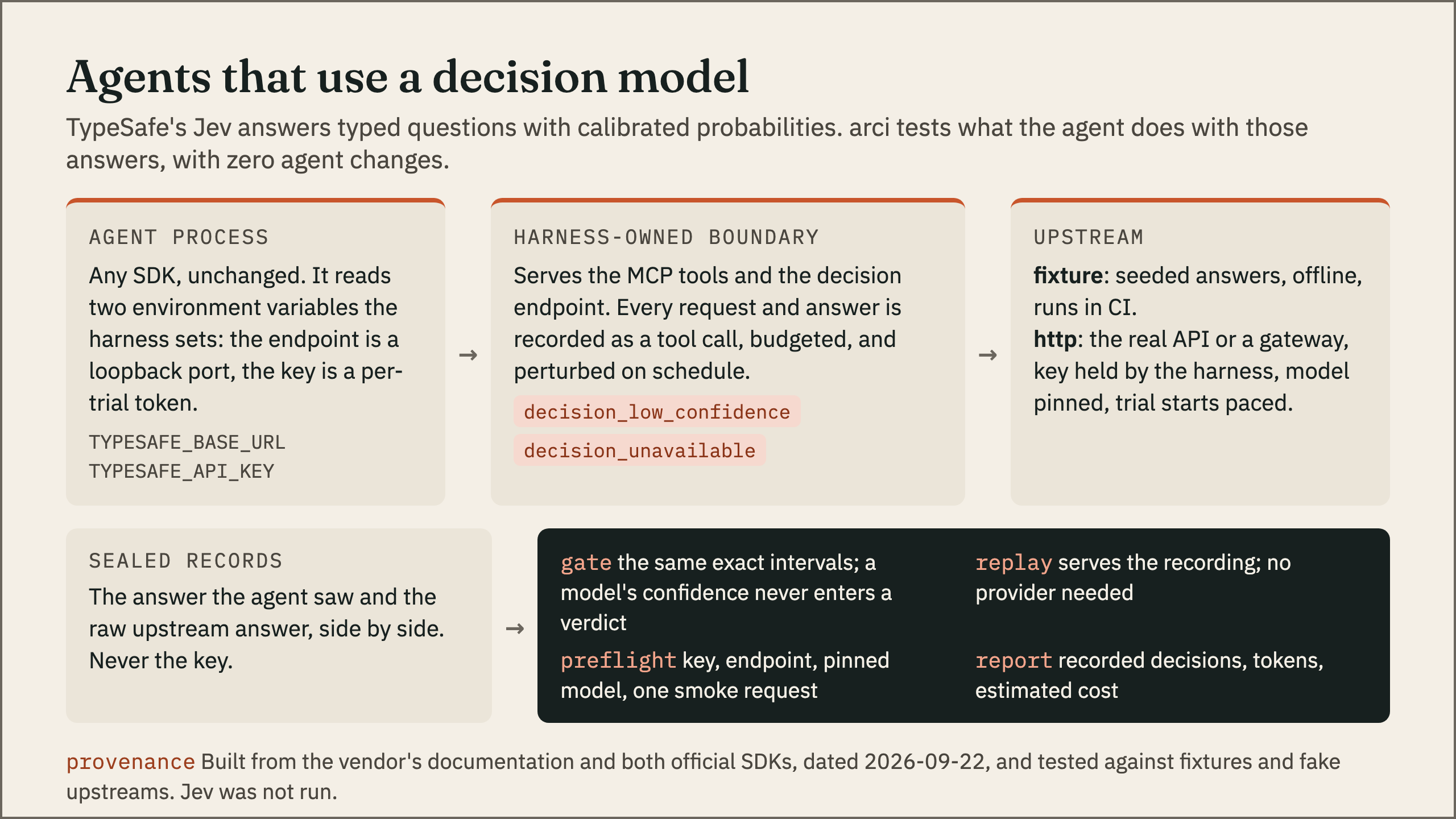
Decision calls. A command agent may call a System One decision endpoint (TypeSafe's Jev
API). The same boundary serves POST /v1/systemone on loopback, records each admitted request as
a tool call named decision:systemone, and applies budgets, perturbations, diff, minimisation,
bundles and exact replay to it. The agent is redirected with TYPESAFE_BASE_URL and a per-trial token
while any real key stays in the harness; the official Python and JavaScript SDKs are exercised
unchanged by the acceptance tests. arci preflight checks key, endpoint, pinned model and one
smoke decision before a live run.
Run against Jev on 2026-10-03. Built from documentation dated 2026-09-22, the boundary ran the
pre-registered day one live. Four things did not survive contact
and are fixed: alias-only model lists (arci preflight --allow-unlisted-model), smoke questions
needing instructions, CONNECT-only egress (ARCI_HTTPS_PROXY), and the console script needing
the repository root on PYTHONPATH. Prices and provider limits are still as documented, not
measured, and the gateway route is still untested. See docs/DECISIONS.md.
Where it has been run
All runs are the maintainer's own; no external users yet. Failed and invalid attempts stay in the linked records.
- Seeded retry demo (2026-09-23): the result above; A against itself and the repaired C both PASS (retry-demo-n200.md).
- Support-triage agent, live Jev endpoint (2026-10-03,
jev-1.13.0pinned, Python and Node SDKs unchanged; planted regression, the harness caps confidence and B stops escalating): A vs B at N=200, 200/200 vs 0/200, bounds [-1.000, -0.957], BLOCK; one minimised failure replays REPRODUCED; 902 recorded decisions (docs/results/jev). Offline against a seeded fixture:.venv/bin/python examples/jev_triage_agent/hero_demo.py --n 50. - The tool-call guard of the maintainer's other project, frontier-scout (2026-10-05,
hook_runtime.pyverbatim at58b0b17, run through the harness boundary, not inside a coding-agent session; outages injected): fail-closed against fail-open underdecision_unavailableat N=200, 200/200 vs 130/200, bounds [-0.4304, -0.2537], BLOCK; diffed, minimised (reduced) and replayed REPRODUCED (docs/results/guardrail). - A local model, one sentence of prompt (
qwen3.5:4b-mlxthrough Ollama, one machine, exploratory): N=400, 376/400 vs 308/400, bounds [-0.2445, -0.0921], INCONCLUSIVE; BLOCK needed the upper bound below -0.10 and missed by 0.008. Not re-run until it blocks (docs/results).
What went wrong and was kept.
- Ollama run 1: a harness bug (tools advertised with no parameters), found from the failure
clusters (ollama-run1-n30-bridge-bug.md). Run 3:
the model server died and one ERROR trial invalidated the run
(ollama-run3-n400-invalid.md); hence
infra_exit_codes(75 by default), which turns an agent's own infrastructure failure into ERROR. - Jev attempt 1: every trial crashed on an import error, so equally broken arms "passed"; the invalid stores are kept in attempt-1-invalid.
- Guardrail at N=50: 50/50 vs 38/50, bounds [-0.4016, -0.0348], INCONCLUSIVE against the pre-registered BLOCK, reported as is (docs/results/guardrail).
Is the model's confidence something you can gate on? A separate, pre-registered audit of
jev-1.13.0 on CLINC150 and Banking77 answers that for intent routing, not permission
calibration: zero-shot accuracy 0.921 with ECE 0.024 on CLINC150, and 0.801 with ECE 0.084 on
Banking77, where confidence is over-stated in the middle of the range. Write-up, full table and
limits: docs/results/jev-calibration; protocol and code:
bench/jev_calibration.
The gate, measured against itself
just selfcheck (or .venv/bin/python bench/selfcheck.py) computes the gate's own operating
characteristics by exact enumeration (alpha 0.05, delta 0.10, one condition). Probabilities of
PASS / BLOCK / INCONCLUSIVE:
| baseline -> candidate | N=20 | N=100 | N=200 | N=400 |
|---|---|---|---|---|
| 0.95 -> 0.95 | .000 / .000 / 1.000 | .443 / .000 / .557 | .889 / .000 / .111 | .999 / .000 / .001 |
| 0.95 -> 0.85 (the margin) | .000 / .000 / 1.000 | .001 / .000 / .999 | .001 / .000 / .999 | .001 / .001 / .999 |
| 0.95 -> 0.75 | .000 / .000 / 1.000 | .000 / .093 / .907 | .000 / .365 / .635 | .000 / .828 / .172 |
| 0.95 -> 0.65 | .000 / .008 / .992 | .000 / .685 / .315 | .000 / .985 / .015 | .000 / 1.000 / .000 |
| 0.80 -> 0.80 | .003 / .000 / .997 | .059 / .000 / .941 | .218 / .000 / .782 | .615 / .000 / .385 |
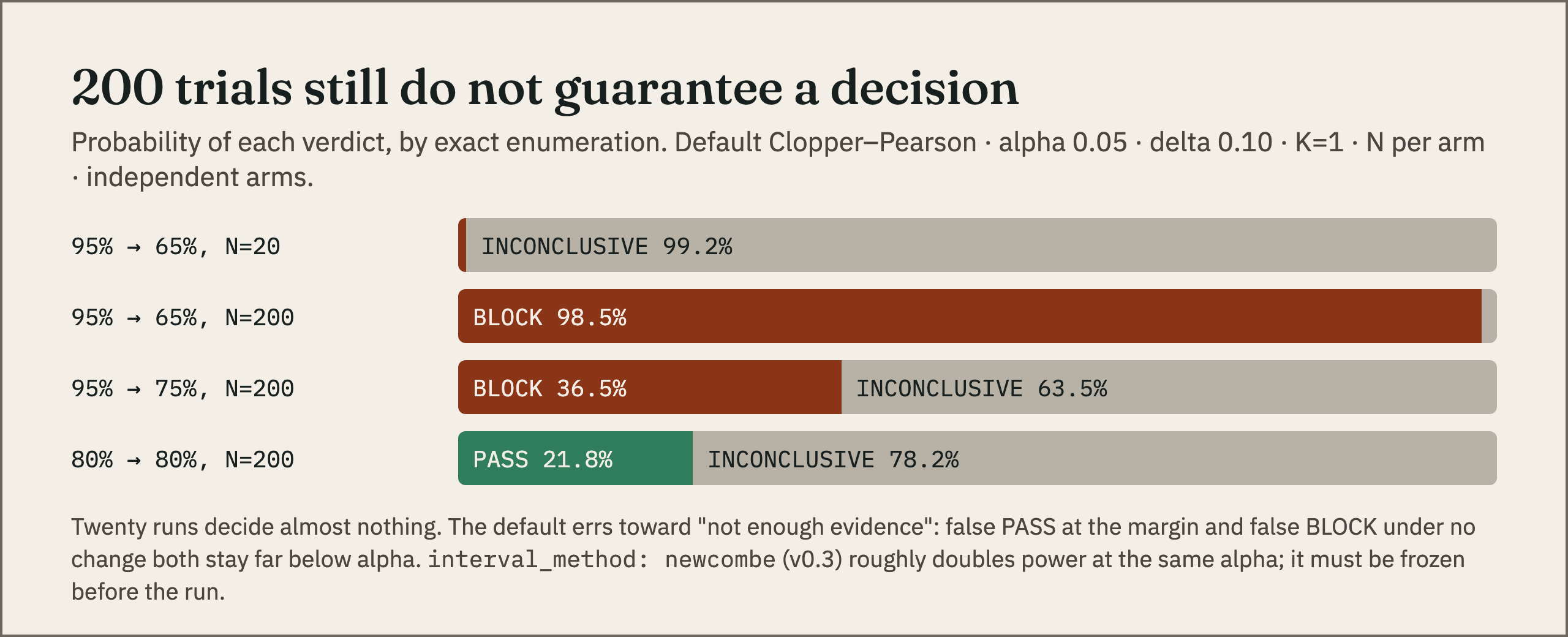
- False PASS at the margin and false BLOCK under no change are both far below
alpha(worst 0.004 and 0.001 over the boundary sweep). The price is conservatism: two equal agents at 80% reach PASS only 21.8% of the time at N=200. - Twenty runs decide almost nothing. At N=20 a 95% -> 65% collapse is still INCONCLUSIVE 99.2% of the time, and showing a failure rate below 0.5% needs at least 598 clean trials. A twenty-point drop from 0.95 to 0.75 BLOCKs only 36.5% of the time at N=200.
interval_method: newcombe(about twice the power, calibrated by exact enumeration rather than proved) and pre-registeredlooksmust be frozen before the run;arci planshows a design's verdict probabilities before you spend trials. Details: docs/STATISTICS.md, report section 3.
Gate your own agent
Scaffold one experiment from four references, then run it:
uv tool install agent-reliability-ci
arci init checkout-retry --baseline app.v1:run --candidate app.v2:run --toolset tests.world:make_world --oracle tests.world:passed --task '{"order_id": "order-7"}'
arci run arci.yaml
arci init imports the four references once (in a child process, as a trial would), checks that every
fault names a tool the toolset provides, and writes arci.yaml: a thin, schema-checked descriptor that
arci run seals into the same JSON manifest the Python builder produces. The scaffold is a smoke
design (8 trials per arm): under the default rule two perfect arms cannot PASS below N=42 and a
total collapse cannot BLOCK below N=8, so expect INCONCLUSIVE, then plan a confirmatory N with
arci plan before spending trials. Without --fault the scaffold writes one clean condition (no
injected fault); --fault tool_timeout:reserve adds a timeout on the first reserve call, and --task '{...}'
sets the task. arci init calls your toolset factory once with that task, so a factory that reads
task data needs --task: the sample project's make_world
(examples/recipes/python_agent)
reads order_id, which is why the command above passes --task '{"order_id": "order-7"}'; without
it arci init fails and the error message names the flag. A hand-written descriptor with one fault
looks like this:
experiment_id: checkout-retry
task: {order_id: "order-7"}
toolset: tests.world:make_world
oracle: tests.world:passed
baseline: app.v1:run
candidate: app.v2:run
conditions:
  - id: reserve-timeout
    fault: {name: tool_timeout, tool: reserve, occurrence: 0}
alpha: 0.05
delta: 0.10
n_per_arm: 8
The descriptor expands documented shorthands (id, fault, occurrence, oracle) into a sealed
manifest; the key reference lists its defaults. arci schema prints the JSON Schema, and docs/DESCRIPTOR.md
has the key reference, command-agent experiments and the YAML quoting rule. The toolset is (task, seed) -> object with .tools and .snapshot(), the
oracle (task, final_state) -> bool, and each agent a plain function agent(task, tools, rng) -> dict.
Advanced: the Python manifest builder
A manifest is a sealed JSON document built in Python. The retry example's builder, examples/retry_agent/experiment.py, is the template; its shape:
Manifest.create(
    experiment_id="retry-agent-agent_b-reserve-timeout-200",
    task_id="confirm-inventory-order",
    task={"order_id": "order-7", "sku": "widget", "quantity": 2, "stock": 10},
    toolset="examples.retry_agent.world:make_world",  # (task, seed) -> tools + snapshot
    contract=ContractSpec(
        oracle="examples.retry_agent.world:oracle"
    ),  # (task, final_state) -> bool
    baseline=ArmSpec(label="agent_a", agent="examples.retry_agent.agents:agent_a"),
    candidate=ArmSpec(label="agent_b", agent="examples.retry_agent.agents:agent_b"),
    conditions=(
        Condition(
            condition_id="reserve-timeout",
            faults=(
                FaultSpec(
                    name="tool_timeout", bucket=Bucket.FALSIFY, tool="reserve", at_occurrence=0
                ),
            ),
        ),
    ),
    n_per_arm=200,
    base_seed=12_000,
    budgets=Budgets(max_tool_calls=10, max_model_steps=10, max_seconds=15.0),
)
A behaviour contract names the oracle plus the invariants the tool boundary can observe
(max_tool_calls, forbidden_tools, required_tools, max_calls_per_tool). A contract that asks
for something the boundary cannot see is rejected, not silently skipped. Fault conditions are tagged
falsify (a robust agent should survive), benign (must not change the outcome) or ceiling
(known-unrecoverable: reported, never gated on rates). Built in: tool_timeout, tool_error_once
and empty_result at the tool boundary, plus decision_low_confidence and decision_unavailable
at the decision boundary; a "module:function" reference plugs in your own. For a command agent,
replace toolset with mcp_server and the arms' agent with command, as
docs/REAL_AGENTS.md shows.
arci init NAME --baseline M:F --candidate M:F --toolset M:F --oracle M:F   # write arci.yaml (smoke N=8)
arci schema                                        # the descriptor's JSON Schema, generated from code
arci demo                                          # the packaged six-step retry story, no clone
arci plan --help                                   # verdict probabilities of a design, before any trial
arci preflight manifest.json                       # live decision upstreams: key, model, smoke call
arci run arci.yaml --workers 8                     # run + gate; exit code is the verdict (--out defaults to runs)
arci gate runs/<experiment> --junit junit.xml --markdown report.md
arci report runs/<experiment>                      # gate, failure clusters, tokens, estimated cost
arci triage runs/<experiment>                      # representative failures + paired tool context; gate exit
arci diff runs/<experiment> <passing_trial> <failing_trial>    # --all-steps to include annotations
arci minimize runs/<experiment> <failing_trial> --out min.json
arci bundle runs/<experiment> <failing_trial> --out bundle.json --root . --include my_agent.py
arci replay bundle.json                            # 0 reproduced, 1 not reproduced, 3 invalid
A run store is one directory per experiment with the sealed manifest, events.jsonl and
trials.jsonl. Keep it with the evidence it supports; it can hold the agent's full task state and,
for decision calls, the full request state, so treat stores and bundles as sensitive data. Records
sealed by an earlier schema version are not readable after an upgrade (v0.2 and v0.5 changed the
schema); re-run the experiment rather than trust an unreadable store.
GitHub Actions
This example pins v2.4.0, the current release (the Action installs that tag's source; the
same code is on PyPI as agent-reliability-ci==2.4.0). See
CHANGELOG.md.
- uses: actions/setup-python@v7
  with: { python-version: "3.12" }
- run: pip install -e .            # your agent, importable
- uses: ajaysurya1221/agent-reliability-ci@v2.4.0
  id: gate
  with:
    manifest: reliability/manifest.json
    workers: "4"                   # out: arci-runs by default
- run: echo "verdict=${{ steps.gate.outputs.verdict }}"
This assumes your agent's repository is checked out and installed, and that you pin action versions
you have verified. The report lands in the job summary (a start-up failure shows only in the step's
stderr). BLOCK and ERROR always fail the job; INCONCLUSIVE fails it unless you set
allow-inconclusive: "true". The verdict output (PASS, BLOCK, INCONCLUSIVE or ERROR) is
there for steps that run after the gate. This repository's own CI runs the test suite,
re-derives the archived decisions, builds both distributions, smoke-tests their wheels on
Linux and macOS, and runs the Action on a committed fixture that must BLOCK.
Since v2.0.0 the Action has an opt-in pr-comment: "true": it uploads the offline HTML
report and creates or updates a PR summary. Grant pull-requests: write and serialize runs for
each PR:
permissions:
  contents: read
  pull-requests: write
concurrency:
  group: ${{ github.workflow }}-${{ github.event.pull_request.number || github.ref }}
  cancel-in-progress: false
Add pr-comment: "true" under the Action's with. The default comment identity includes the
workflow, job id and manifest path. Set comment-id to a stable experiment name to survive
workflow or manifest renames; it remains scoped to the job id. For matrix jobs, set comment-id
to include the matrix values (for example, comment-id: reliability-${{ matrix.python }}).
Renaming a job or changing an identity creates a new comment; old comments retain their recorded
head SHA and run id. Forks without write access skip comments softly. Upload or comment failures
never change the gate result. Racing duplicate comments are refreshed on the next run, not deleted.
What it does not do
- Logs cannot establish cause or answer quality.
arci logsreads recorded measures, not a controlled model comparison. Short histories and streaks often give CANNOT TELL; passing the streak check does not establish interchangeable days. The measured error rates under correlation can exceed the claimed bound's nominal level, as the statistics show. There is no scan over dates, comparison of two models, range for the change, cost or usage-limit measure, or reader for other agents. Days are kept only with--keep, and only when captured while their files still existed. Windows is untested for this command. - It is not a sandbox and not a security boundary. Python agents share a process with their tool boundary. Command agents use a separate harness-owned MCP boundary, which is isolation from accident, not containment. Both assume buggy, non-hostile agent code; a hostile agent could still forge or bypass its record. See docs/TRUST_MODEL.md.
- Controlled trials only see the tool boundary. Files, network and subprocesses the agent touches directly are invisible, as is any decision call that does not go through the injected base URL.
- It replays the boundary, not the model. Deterministic replay is guaranteed for seeded, fixture-backed agents. A live model will not repeat itself token for token, so replaying its bundle is usually INVALID; what survives is the recorded trace and the reduced fault condition.
- INCONCLUSIVE is common at small N. That is the honest answer, not a failure of the run: at N=20 even a 95% -> 65% collapse is INCONCLUSIVE 99.2% of the time, and one real 400-trial run missed BLOCK by 0.008 and stayed INCONCLUSIVE.
- A bundle embeds code, and replaying it runs that code. Hashes are integrity checks, not
signatures. Replay bundles only from sources you trust. A bundle embeds only the files you
--include(the minimiser's output embeds none), so portable replay needs the referenced code and a compatible environment. - A divergence is evidence, not proof of cause. It shows where two runs part ways.
- The decision boundary has been run against one vendor model, on one day, on three seeded
tickets. The live model answered every clean decision with confidence 1.0, so the runs in
docs/results/jevshow the harness, the pacing, both SDKs and the gate working end to end and the planted regression caught; they say nothing about the model's calibration or about ambiguous tickets. Live answers are sampled, so live minimisation is reported asreduced, never1-minimal, and a decision model's confidence never enters a verdict except through the agent's actions. - Reference validation executes user code.
arci initvalidates Python references by importing them, and calls the toolset factory once, in a child process; import-time code runs. - Declaring a fault does not guarantee injection. A fault names a tool; if the agent never calls that tool at that occurrence, the condition runs clean. Since 2.0.0 the fault accounting section of a report counts, per arm, the trials each declared fault fired in, and marks a fault that never fired.
- Command agents get one stdio MCP server (revision 2026-07-28), serial tool calls, no HTTP transport, no concurrent decisions.
- Since 2.2.0,
arci verdictreads pass/fail outcomes another tool already produced (Inspect AI JSON logs, JUnit XML, CSV, JSONL) and gives a verdict only; there are still no replay-capable trace importers (OTLP, Claude Code, Codex), and imported outcomes cannot be replayed, minimised or fault-accounted. POSIX only: on Windows the package installs andarci --helpruns, but experiments are unsupported.
Related work: Documentation comparison, checked 2026-10-05; not a matched benchmark.
Independence. ARCI's job is preregistered stochastic regression testing. The manifest is a
prospective contract supplied by its author: it fixes the task, fault conditions, sample size and
decision rule before the trials run, and a rule changed after the fact is detected, not merely
forbidden. It does not independently authenticate when the manifest was written or that every earlier
run was disclosed; that discipline stays with the author. A PASS reports relative non-inferiority
against the baseline within the registered margin under those conditions, never absolute reliability
or a general quality score; BLOCK, INCONCLUSIVE and ERROR are defined above. ARCI is one of the
maintainer's independent projects alongside the earlier
evalopt-graph experiment, whose standalone feature
development has ended. ARCI declares no package or runtime dependency on evalopt and imports nothing
from it, and it shares no runtime layer with the maintainer's sibling projects Actseal, Dorian and
Frontier Scout. NOTICE records two adaptations from evalopt under MIT with attribution: the
canonical JSON hashing helpers in src/arci/hashing.py and the self-sealing decision pattern in
src/arci/schema.py, both attributed source adaptation inside the frozen manifest, not a dependency.
It also names the four files of the examples/guardrail_agent example that were taken from
Frontier Scout under MIT; that example is in the repository and not in the PyPI package.
ARCI is not a successor to, conformance target for or drop-in replacement for evalopt, and nothing
here claims adoption, performance or superiority.
Roadmap
Nothing is scheduled. From v2.1.0 on, an item is taken up only when someone who would use it
asks for it, or when a recorded run shows the need. What is not in 2.4.0
(a scan over split dates, reading an Inspect .eval log directly, promptfoo, the Action's verdict mode, interrupts, async agents, a suite
example with several faults in one condition, a second framework adapter, the v1 commands that
do not yet accept suites) and the earlier candidate list (last revised for v0.8.0) are in
docs/ROADMAP.md.
Development
How it was built. One maintainer, September to November 2026, with Claude Code and Codex as pair-programmers (recorded in the commit messages). Through v1.0.0 the experiment design, the decision rule and its calibration, the trust model and the acceptance tests are the maintainer's own. For 2.0.0 and 2.1.0 the design records were drafted by Claude as orchestrator and approved by the maintainer; for 2.2.0 the maintainer approved the plan, and design record 0015 was drafted by Claude and reviewed twice by Codex. For 2.3.0, record 0016 and the log statistics had three read-only reviews before product code (13, 10 and 6 findings, all handled, with the recorded differences in the maintainer's choices). An agent wrote acceptance tests from the records alone without seeing the code. Implementation was by Codex from written briefs (design records 0011 to 0016). The retry demo, the calibration table and the test suite reproduce from a clean clone. Issues and PRs welcome. Where the code came from and who holds it: docs/PROVENANCE.md. Commercial and partnership questions: see the maintainer's GitHub profile.
uv sync
just check        # ruff format --check, ruff, basedpyright strict, pytest
just frozen       # the frozen contract files are unchanged
just selfcheck    # the calibration table above
just demo
npm ci --prefix examples/jev_triage_agent   # only for the Node agent and its test (Node 20+)
python docs/assets/src/make_figures.py --check   # the README figures match their generator
The acceptance suite is hash-pinned in FROZEN.sha256. CI checks formatting, lint, strict typing
and tests on Python 3.11 and 3.14, with separate macOS statistics checks. See
the workflow for coverage and
the evidence report for measured results. Design
records live in docs/design, the changelog in CHANGELOG.md.
Availability and project status
Availability: v2.4.0 is the current release. Install agent-reliability-ci==2.4.0 from PyPI
(agent-reliability-ci[langchain]==2.4.0 for the LangChain adapter), use uvx realornoise,
or use Action tag v2.4.0. The realornoise distribution pins the same main-package version.
The release page
links the wheel, sdist, checksums and verification receipt. The release workflow
builds both distributions, tests their wheels on Ubuntu/macOS, and publishes the main
package before realornoise through trusted publishing with attestations. The timing
workflow is manually triggered and can time either packaged log example or arci demo.
The single-task gate, triage, trace-check, the packaged demo, descriptors, initialization, planner and opt-in pass^k reporting from earlier releases remain
available.
Boundary: PASS means relative non-inferiority, not absolute reliability. This is not a sandbox.





Apache-2.0. See NOTICE for adapted code.
1 maintainer

Metadata
1 maintainer
Release files for agent-reliability-ci 2.4.0
For a detailed explanation of source distributions (sdists) and built distributions (wheels), please see the package formats documentation.
Source distribution (sdist)
| File | Size | Uploaded | Provenance | Actions |
|---|---|---|---|---|
| agent_reliability_ci-2.4.0.tar.gz | 299.7 kB | With provenance | Details for agent_reliability_ci-2.4.0.tar.gz |
Built distribution (wheel)
| File | Interpreter | ABI | Platform | Actions Reset |
|---|---|---|---|---|
| agent_reliability_ci-2.4.0-py3-none-any.whl | Python 3 | none | any | Details for agent_reliability_ci-2.4.0-py3-none-any.whl |
Total release size: 599.6 kB
Release files / agent_reliability_ci-2.4.0.tar.gz
| Download URL | agent_reliability_ci-2.4.0.tar.gz |
|---|---|
| Size | 299.7 kB |
| Tags | Source |
|
SHA-256 checksum How to use checksums |
b15f23a27e599f26c570e3c286c2afff6419a3a234b0eedae28f703b9c27744d
|
|
BLAKE2b-256 checksum How to use checksums |
141e3024e54181fec09ae6757e1d073d00a7395343aee7bccc39f012e4f6d0b5
|
| Upload date | |
|
Uploaded using Trusted Publishing? What is trusted publishing? |
Yes |
| Uploaded via |
twine/7.0.0 CPython/3.13.14
|
Provenance
Provenance describes where a file came from. On PyPI, provenance is shared via attestations, which provide a verifiable record of the build or publishing details. View details, limitations and caveats.


PyPI Publish Attestation
PyPI verified that this artifact, at this checksum, originated from the publisher listed below.
Signed by GitHub Actions, verified by PyPI on Nov 16, 2026.
Transparency logRelease files / agent_reliability_ci-2.4.0-py3-none-any.whl
| Download URL | agent_reliability_ci-2.4.0-py3-none-any.whl |
|---|---|
| Size | 299.9 kB |
| Tags | Python 3 |
|
SHA-256 checksum How to use checksums |
dabfd522edf9597465f62fbe3e816c0adaf7a7d7efaab705787118ae26626e0d
|
|
BLAKE2b-256 checksum How to use checksums |
c7300780997ee004367333dd96ba56eceeefd00172148a773fea703efe3ccdee
|
| Upload date | |
|
Uploaded using Trusted Publishing? What is trusted publishing? |
Yes |
| Uploaded via |
twine/7.0.0 CPython/3.13.14
|
Provenance
Provenance describes where a file came from. On PyPI, provenance is shared via attestations, which provide a verifiable record of the build or publishing details. View details, limitations and caveats.
PyPI Publish Attestation
PyPI verified that this artifact, at this checksum, originated from the publisher listed below.
Signed by GitHub Actions, verified by PyPI on Nov 16, 2026.
Transparency logSecurity for agent-reliability-ci 2.4.0
Provenance
Provenance describes where a file came from. On PyPI, provenance is shared via attestations, which provide a verifiable record of the build or publishing details. View details, limitations and caveats.
Full provenance
Both files in this release have been uploaded with provenance metadata.
Attestation for agent_reliability_ci-2.4.0.tar.gz
PyPI Publish Attestation
PyPI verified that this artifact, at this checksum, originated from the publisher listed below.
Signed by GitHub Actions, verified by PyPI on Nov 16, 2026.
Transparency logA note on package security
PyPI is a repository for distributing packages, not a service for auditing them. While third-party security researchers and our staff do their best to detect and remove malicious packages, PyPI cannot guarantee the quality, security or suitability of any given package.
To learn more about protecting yourself from malicious actors, visit our package security documentation.














